


AI Search Statistics 2026: 60+ Data Points on Visibility, Citations, and Traffic
AI search is reshaping how people discover information, evaluate brands, and make purchasing decisions. Instead of clicking through search results, users now get instant, conversational answers from systems like ChatGPT, Perplexity, Gemini, and Google AI Mode.
This article brings together 60+ AI search statistics from 2025 and 2026, covering adoption, referrals, citations and brand discovery. Sources include Adobe, Pew Research Center, Conductor, Ahrefs, Semrush, SE Ranking and other published research. Each finding includes the date and context marketers need for planning, presentations and customer discussions.
TL;DR
- AI referrals remain a small but measurable channel: 1.08% of traffic in Conductor's U.S. enterprise-site sample across 10 industries, measured May–September 2025. (Conductor)
- AI Overviews appeared in 82.91% of Ahrefs' tracked U.S. desktop branded-search results on September 29, 2026. Include searches for your own brand in visibility monitoring. (Ahrefs)
- About 57% of brands that disappeared from an AI answer returned in a later run in AirOps' 2025 study of 800 questions. Check repeated answers before treating one absence as a lasting drop. (AirOps)
- Strong existing search visibility matters: domain traffic was the strongest predictor of AI Mode citations in SE Ranking's study of 2.3 million pages. (SE Ranking)
- AI referrals are becoming commercially valuable in retail: Adobe found a 90% higher purchase conversion rate than non-AI visits to U.S. retail sites in September 2026. (Adobe)
How Big Is AI Search in 2026?
AI search has moved from experiment to mainstream channel. Here are the numbers that define its scale.
- OpenAI reported 1.2 billion weekly active ChatGPT users on September 29, 2026, up from more than 1 billion in August. This is a weekly audience figure, not a daily user count.
- AI Overviews now reaches over 2.5 billion monthly users, a milestone that underscores how deeply artificial intelligence has been integrated into Google search. Source: Google earnings report, as reported by Yahoo Finance.
- Google AI Mode is serving more than 1 billion monthly active users. Source: Google earnings report, as reported by Yahoo Finance.
- 49% of U.S. adults said they had used AI chatbots in Pew's February 2026 survey, up from 33% in 2024. (Pew Research Center)
- Gartner's February 2024 forecast predicted a 25% decline in traditional search engine volume by 2026. Treat it as a forecast, separately from observed search usage. (Gartner)
- 54% of U.S. marketers planned to fully implement a GEO strategy within three to six months in September 2025 research from Scribewise, reported by eMarketer in January 2026. (eMarketer)
- Dimension Market Research estimates the global GEO market at USD 1,089.3 million in 2026 and projects further growth through 2034. (Dimension Market Research)
How are visits distributed across chatbot websites?
In September 2026, ChatGPT accounted for 56.4% of chatbot website visits in Similarweb’s comparison, followed by Gemini at 25.0% and Claude at 9.6%.
These estimates cover visits to chatbot websites, excluding app and API usage. They describe where chatbot web activity takes place, rather than the share of AI searches or the referral traffic sent to other websites.
- AI is projected to contribute $15.7 trillion to the global economy by 2030 (National University).
To dive deeper into how to create content that AI systems understand and recommend, explore our guide on best practices for optimizing content for generative AI.
How Are Users Searching and Trusting AI in 2026?
Consumer trust, verification habits, and generational patterns are evolving as AI assistants become a daily search habit.
- 68.01% of U.S. Google searches ended without a click in January–April 2026, according to SparkToro's analysis of Similarweb's mobile and desktop data. (SparkToro)
- 92–94% of Google AI Mode sessions ended without a visit to another website in Semrush's early U.S. desktop study, covering May 1–July 5, 2025. This makes visibility inside the answer important even when a click does not follow. (Semrush)
- 42% of U.S. adults used chatbots to search for information in Pew's February 2026 survey, making information search the most common use it measured. (Pew Research Center)
- 75% of respondents in Yext's 2025 survey said they used AI search more than a year earlier, and 43% used it daily or more. The survey covered more than 2,200 recent online purchasers who used voice or conversational AI across the U.S., U.K., France and Germany. (Yext)
- 37% of respondents in the same Yext survey cited a lack of trustworthy sources as a frustration with AI. Clear sourcing and accurate brand information address a real reader concern. (Yext)
- Traditional search still led for product and service details in Yext's survey: 70% favored it for that task, compared with 45% for conversational AI. (Yext)
- For local search, 19% of Yext's respondents trusted AI search tools, versus 45% who trusted traditional search results. Keep business details consistent across your site and listings. (Yext)
- 24% of U.S. adults used chatbots daily in Pew's February 2026 survey. Regular use is growing, but marketers still need to identify which tasks their own buyers bring to AI. (Pew Research Center)
- 52% of U.S. adults used AI platforms weekly in Edison Research at SSRS's February 2026 surveys. (Edison Research at SSRS)
- ChatGPT reached 36% of U.S. adults in the past week in the same February 2026 research, followed by Gemini at 26% and Copilot at 14%. (Edison Research at SSRS)
- 38% of employed U.S. adults used chatbots for work tasks in Pew's February 2026 survey, making professional questions a relevant part of audience research. (Pew Research Center)
- Users are more likely to completely finish their browsing session and leave the search engine without visiting any other site when an AI summary is shown (26% vs. 16% without AI). (Pew Research Center)
- Perceived helpfulness declined. In Fractl's U.S. consumer surveys, the share who found AI search more helpful than traditional search fell from 82% in 2025 to 54% in 2026. The share who found it less helpful rose from 3% to 17%. (Fractl, Q2 2026)
- Use of AI search still increased. In the Q2 2026 survey of 1,008 U.S. consumers, 70% said they were using AI tools for search more than a year earlier, while 3% said they used them less. (Fractl, Q2 2026)
What Does OpenAI's ChatGPT Usage Data Reveal About AI Search?
The October 26, 2026 OpenAI Signals v3.0 release analyzes 1 million sampled individual ChatGPT messages a month from July 2024 to September 2026. It covers Free, Go, Plus and Pro accounts and excludes Enterprise usage and Codex. Its topic categories can help explain information-seeking behavior, but they do not directly measure web searches, citations or purchases.
Information-seeking, guidance, and writing
In September 2026, 20.2% of sampled individual ChatGPT messages were classified as Seeking information, up from 16.7% in July 2024. The category includes requests for facts, information about purchasable products and services, and recipes.
Practical guidance represented 28.1% of messages in September 2026, while Writing accounted for 21.4%. Together these three topic groups comprised 69.7% of messages, but none of the categories is equivalent to a live web search or a commercial buying journey.
OpenAI classified 32.2% of sampled individual messages as work-related in September 2026. That share does not represent all workplace ChatGPT use because Enterprise and Codex usage fall outside the dataset.
OpenAI also published a work-activity dataset spanning 165 categories across nearly 100 countries. It helps describe activities such as producing marketing content and analyzing business information, not the frequency of vendor recommendations.
These are shares of messages, not shares of users. The older Asking/Doing/Expressing framework describes intent, while Signals v3.0's Seeking information, Writing and Practical guidance categories describe topics. Comparing those figures as if they measured the same behavior would be misleading.
What This Means for AI Search Strategy
For marketers, the data suggests three useful distinctions:
Information seeking is not the same as web search. Some ChatGPT messages concern facts or products, but Signals cannot show which messages triggered retrieval, which sources were cited or whether the brand appeared. Monitor representative buyer questions and the full answers directly.
Work-related messages are not proof of B2B purchases. The 32.2% share reflects work-classified messages on individual plans, not enterprise procurement, referrals or sales. Use it to identify a reason to investigate professional questions, then measure actual outcomes separately.
Market-level patterns differ. A global message distribution is not a country-level demand forecast. Compare relevant customer markets and languages before choosing which AI Search questions to monitor.
Usage trends can guide a test, not guarantee visibility. Prioritize topics where a buyer might reasonably evaluate a brand, inspect AI responses and cited sources, and decide whether an improvement would help the reader.
Sources: OpenAI Signals v3.0 data and methodology (October 26, 2026), and OpenAI's 2026 work-activity research. Message-topic shares are not directly comparable to earlier Asking/Doing/Expressing intent figures. For the full usage and demographics breakdown, see ChatGPT Statistics 2026.
India: why country-level usage matters
OpenAI's February 2026 India report describes India as its second-largest ChatGPT market, with more than 100 million weekly users reported separately that month. Its usage mix offers an example of geographic variation; it should not be treated as a forecast for other markets.
In OpenAI's February 2026 India report, 35% of sampled messages were work-related versus roughly 30% globally in the report's comparison period. The difference illustrates the importance of checking markets separately; it is not proof of faster B2B purchasing or AI Search adoption.
Younger-user concentration: The India study reported particularly high usage among younger adults. Age-based message shares should not be read as shares of all users or as evidence of product discovery or purchases.
Technical topics: The India study reported coding-related usage around three times the global median. That may justify testing developer and technical questions for relevant brands, but it is not a direct measure of high-intent leads.
International adoption: Earlier OpenAI Signals analysis found substantially faster growth in ChatGPT use in lower-income countries than in high-income countries. Usage growth is not the same as AI Search demand; international marketers should test their own markets, languages and buyer questions rather than assume one global pattern.
The practical implication is to research the questions that matter in each market, including technical and product-related questions, then compare observed AI answers and brand representation. Neither a large audience nor an information-seeking message share proves that citations produce discovery or sales.
Source: How India Uses ChatGPT, OpenAI Signals (February 2026); TechCrunch, February 20, 2026. Data licensed under CC BY 4.0. Citation: Chatterji et al., NBER Working Paper 34255 (2025).
What Do the AI Search Traffic Numbers Look Like?
AI referrals are still a small part of total traffic, but recent retail research shows their commercial value rising. Read traffic share, purchase conversion and revenue per visit together.
- AI referrals represented 1.08% of traffic and grew roughly 1% month over month in Conductor's U.S. enterprise-site study across 10 industries, measured May–September 2025. (Conductor)
- ChatGPT supplied 95.1% of AI referrals in BrightEdge's August 2026 data. Its referral traffic grew 101% from January to August. (BrightEdge)
- Gemini supplied 2.4% of AI referrals in the same BrightEdge data, followed by Perplexity at 1.1% and Claude at 0.8%. These referral shares measure clicks sent to websites; Similarweb's chatbot website-visit figures above measure a different activity. (BrightEdge)
- IT had the highest AI referral share among Conductor's 10 analyzed industries, at 2.8% of visits. (Conductor)
- Blog content was the most frequently cited page type in Conductor's AI Overview analysis, followed by video, article, news and product pages. (Conductor)
- AI-referred visits converted to purchases 90% more often than non-AI visits to U.S. retail sites in September 2026, Adobe reported on October 29. The comparison includes channels such as email, paid search and social. (Adobe)
- Ahrefs reported a 23× higher signup conversion rate for AI referrals than traditional organic visitors on its own site. In the 30 days covered by its June 16, 2025 report, AI referrals supplied 0.5% of visits and 12.1% of signups. (Ahrefs)
- AI-referred U.S. retail visits spent 73% longer on site, viewed 25% more pages and added products to carts at a 53% higher rate than non-AI visits in September 2026. (Adobe)
- AI-referred traffic to U.S. retail sites grew 71% year over year in September 2026, according to Adobe's latest report. (Adobe)
- Results differ by industry: in May 2026, Adobe found AI referrals converted 54% better than non-AI traffic in U.S. retail, but 28% worse in travel. Travel visitors nevertheless spent 70% longer on site. (Adobe)
- AI referral traffic to U.S. retail sites rose 693.4% year over year during November–December 2025, providing a historical holiday benchmark alongside the newer September 2026 figures. (Adobe)
- Adobe's October 29 forecast projected AI retail traffic growth of 159% on Thanksgiving, 95% on Black Friday and 88% on Cyber Monday 2026. These are holiday forecasts, not results. (Adobe)
- eMarketer's January 2026 forecast put U.S. AI search ad spending at $2.08 billion in 2026 and $25.93 billion by 2029, or 13.6% of total U.S. search ad spending in 2029. (eMarketer)
For a deeper breakdown of how AI search engines surface and rank content, see our guide on How to Optimize for AI Search Results in 2026.
How Do AI Overviews and AI Mode Affect Search Results?
Google's AI features are rapidly expanding and changing how search results work.
- AI Overviews were associated with a 58% lower clickthrough rate for the top-ranking page in Ahrefs' analysis of 300,000 desktop keywords, comparing December 2023 and December 2025. (Ahrefs)
- In a newer French study, the domains most exposed to AI Overviews saw median clickthrough rate fall 23.1% in the nine days after the July 22, 2026 rollout. Ahrefs studied 963 domains and compared the period with the preceding 28 days. (Ahrefs)
- AI Overview prevalence varies by search topic. Conductor found them in 25.11% of 21.9 million U.S. searches analyzed from September 15 to October 12, 2025, ranging from 48.75% in Health Care to 4.48% in Real Estate. (Conductor)
- Google AI Mode has been rolled out globally in over 200 countries and territories.
- Google AI Mode supports more than 35 languages.
What Predicts Whether AI Will Cite Your Content?
SE Ranking's study of 2.3 million pages across 295,485 domains found that established search visibility, useful content and clear presentation were associated with more AI Mode citations. (SE Ranking)
- Domain traffic was the strongest predictor of AI Mode citations in SE Ranking's analysis. Keep investing in your broader search presence rather than treating GEO as an isolated content tactic. (SE Ranking)
- Sites with more than 1.16 million monthly visitors had stronger citation performance than sites with fewer than 2,700. The practical lesson is to build authority and helpful coverage over time. (SE Ranking)
- Referring domains were more prominent in SE Ranking's ChatGPT citation analysis than in its AI Mode analysis. Credible third-party coverage and relevant backlinks belong alongside work on your own site. (SE Ranking)
- SE Ranking found stronger citation performance for in-depth articles around 1,500 words and clearly separated sections of roughly 100–150 words. Cover the question fully without padding the answer. (SE Ranking)
- Recently updated pages performed better in SE Ranking's AI Mode study than pages untouched for more than two years. Refresh changed facts, examples and product details when readers need them. (SE Ranking)
- Pages with useful FAQ sections performed better in SE Ranking's AI Mode analysis than pages without them. Answer the follow-up questions your buyers actually ask. (SE Ranking)
- FAQ markup itself showed no meaningful citation benefit in SE Ranking's AI Mode study. Prioritize the quality of the answers on the page. (SE Ranking)
- Brands with more Reddit and Quora mentions also had stronger citation performance in SE Ranking's study. Focus on useful participation where your audience already discusses the topic. (SE Ranking)
- Clearer, more accessible writing was associated with stronger citation performance in SE Ranking's study. Explain complex products in language a buyer can use. (SE Ranking)
- Adding relevant sources, quotations and statistics improved source visibility by 30–40% on one of the GEO paper's benchmark measures. Use evidence where it helps explain or support the answer. (GEO research)
- Google requires no special schema for AI Overviews or AI Mode. Use relevant structured data that accurately reflects the page, alongside helpful content and sound SEO. (Google Search Central)
- More than 70% of ChatGPT-cited pages in AirOps' August 2025 study had been updated within 12 months. Review high-value pages for outdated pricing, examples and product information. (AirOps)
- Adding schema alone did not produce a meaningful citation lift in Ahrefs' May 2026 study of 1,885 pages, compared with 4,000 similar pages. Keep schema accurate, and invest in the substance and usability of the page. (Ahrefs)
How Volatile Are AI Search Citations?
AI answers are far more fluid than classic SERPs. Understanding this volatility is critical for any brand tracking AI visibility.
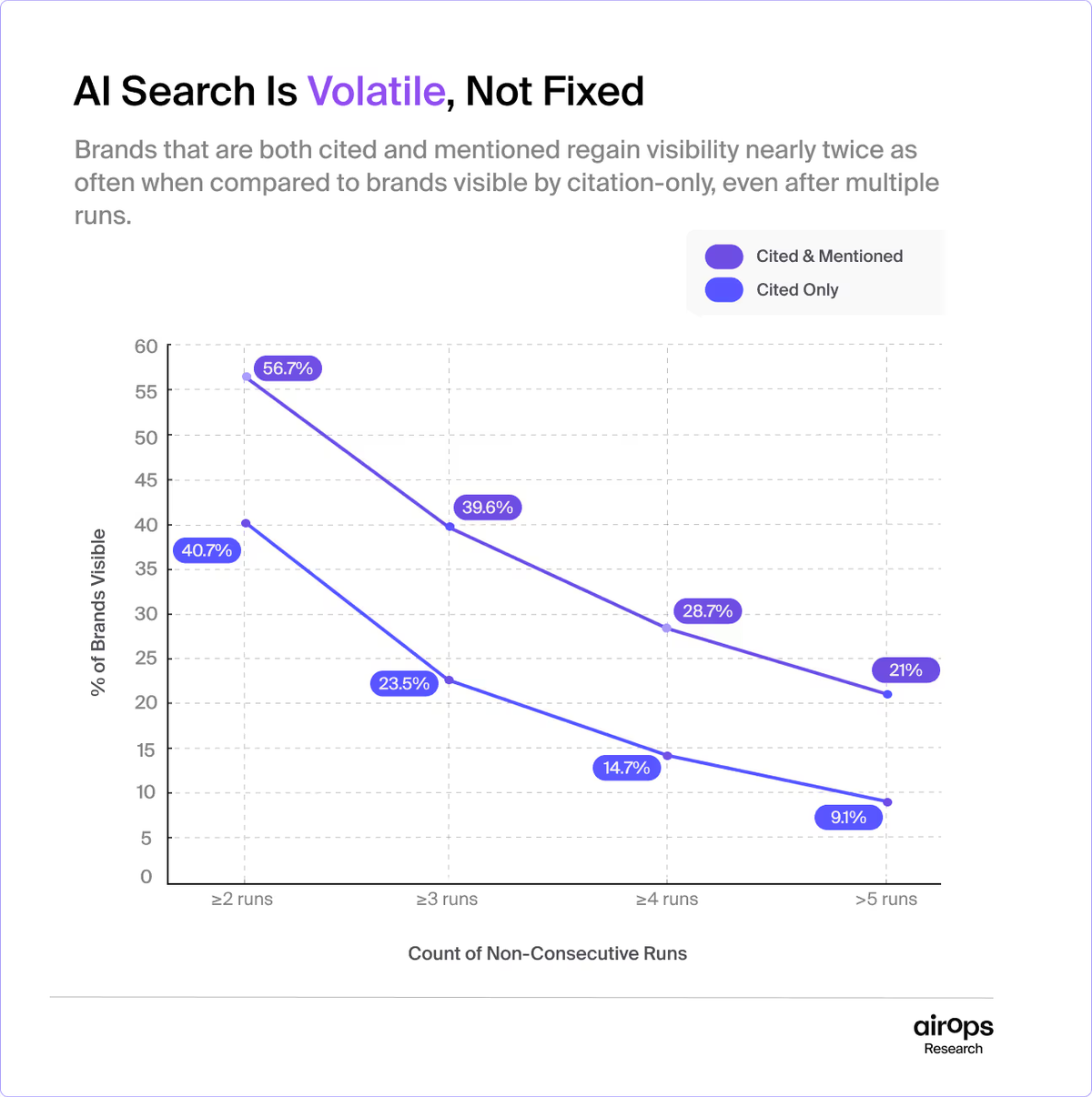
- About 57% of brands that disappeared from an answer resurfaced in a later run in AirOps' September 2025 study of 800 queries. Check repeated answers before treating one absence as a lasting loss. (AirOps)
- Only about 30% of brands remained visible in consecutive answers in the same AirOps study. A single screenshot is a weak basis for judging your ongoing visibility. (AirOps)
- Only about 12% of AI-cited URLs also ranked in Google's top 10 for the original question in Ahrefs' August 2025 study of ChatGPT, Gemini, Copilot and Perplexity. The study used 15,000 long-tail questions. (Ahrefs)
- Sequential headings appeared on 68.7% of ChatGPT-cited pages versus 23.9% of uncited page-one Google results in AirOps' July 2025 research. Use descriptive headings that help readers find and understand each answer. (AirOps)
- Rich schema appeared on 61% of ChatGPT-cited pages versus 25% of uncited page-one Google results in the same AirOps study. That difference describes the pages; the newer Ahrefs study above tests what happened after schema was added. (AirOps)
- Brands in the top quarter for web mentions averaged 169 AI Overview mentions, compared with 14 in the next quarter, in Ahrefs' study of 75,000 brands. A strong off-site presence was associated with more AI mentions. (Ahrefs)
How Do AI Crawlers and Bots Read Your Site?
Crawler access affects whether platforms can retrieve your content. Training bots, search crawlers and agents acting for users serve different purposes.
- Cloudflare reports AI crawler activity separately from total automated traffic, which includes search-engine bots and other scripts. Use its AI Insights report to understand AI crawling rather than treating all bot traffic as AI activity. (Cloudflare Radar)
- Ahrefs counted 21 major AI bots in December 2024, up from 10 in August 2023, illustrating how quickly crawler coverage expanded. (Ahrefs)
- GPTBot was blocked by 5.89% of the roughly 140 million websites in Ahrefs' study, including general robots.txt blocks. Search access and model-training permissions should be reviewed separately. (Ahrefs)
- AI bots accounted for nearly 25% of bot requests in May 2025 in Ahrefs' analysis of Cloudflare Radar, behind search-engine bots. That is a share of automated requests, rather than all web traffic. (Ahrefs)
- In Jes Scholz's October 2025 study of more than 100 ChatGPT Agent actions, 92% of tests used the Bing Search API. Later RESONEO research in July–August 2026 found different retrieval paths across ChatGPT modes and plans. (Jes Scholz) (RESONEO)
- 63% of first clicks ended in an immediate exit in Scholz's ChatGPT Agent tests. Common obstacles included pages that failed to load, unexpected redirects, slow responses and bot challenges. Test whether an agent can reach your key product and conversion pages. (Jes Scholz)
- 86% of citations came from websites and listings classified as brand-managed in Yext's July–August 2025 study. It covered 6.8 million citations from location-based questions in retail, financial services, healthcare and food service on ChatGPT, Gemini and Perplexity. (Yext)
What Does the Agentic Commerce Shift Mean for AI Search?
A new wave of AI-powered commerce is emerging that will reshape how brands think about AI search optimization.
- Google announced the Universal Commerce Protocol (UCP) on January 11, 2026, working with partners including Shopify, Etsy and Wayfair. The announcement described upcoming checkout for eligible U.S. listings in AI Mode and Gemini, with retailers remaining the seller of record. (Google)
- McKinsey estimates that agentic commerce could orchestrate $3–5 trillion in global consumer-goods revenue by 2030. The forecast excludes services and B2B commerce. (McKinsey)
- Gartner forecast that 40% of enterprise applications would include task-specific AI agents by the end of 2026, up from less than 5% in 2025. (Gartner)
- Google announced its Direct Offers advertising pilot in AI Mode on January 11, 2026, allowing participating advertisers to offer relevant discounts. (Google)
- OpenAI announced ChatGPT Ads expansion to Indonesia, Malaysia, the Philippines, Singapore, Thailand, Vietnam and Taiwan on September 23, 2026, bringing availability to more than 60 countries. (OpenAI)
- ChatGPT Ads reached a $1 billion annualized revenue run rate in under 200 days following its pilot launch. (OpenAI, Reuters)
Other 2026 AI Search Benchmarks
- AI-referred U.S. retail visits generated 83% more revenue per visit than non-AI visits in September 2026. Revenue per visit measures sales value; conversion rate measures how often a visit becomes a purchase. Use both when assessing the channel. (Adobe)
- Only 6–8% of Google AI Mode sessions led to another website in Semrush's May–July 2025 U.S. desktop study. Make your brand's role clear in the answer as well as on the landing page. (Semrush)
- Yext's separate Q4 2025 report found 46.89% of citations came from websites and 43.71% from listings across Claude, Gemini, Perplexity and SearchGPT. The 17.2-million-citation dataset reinforces the value of accurate website and location information. (Yext)
AI Search Statistics Summarized
These statistics show a growing channel with different patterns of visibility, traffic and commercial value. Buyers may encounter a brand in an AI answer before visiting its site, while traditional search remains important. A useful GEO strategy measures both the answer experience and what happens after the click.
Use these benchmarks to choose what to measure: brand visibility, citations and sentiment inside answers, followed by referral traffic and business outcomes on your site. Prioritize improvements that give buyers clearer, more accurate information.
Superlines tracks brand visibility, citations, sentiment, and competitive share of voice across 10 AI platforms, helping marketing teams turn AI search data into actionable optimization workflows.