


AI Search Statistics 2026: 60+ Data Points on Visibility, Citations, and Traffic
AI search is reshaping how people discover information, evaluate brands, and make purchasing decisions. Instead of clicking through search results, users now get instant, conversational answers from systems like ChatGPT, Perplexity, Gemini, and Google AI Mode.
This article compiles 60+ verified statistics from 2025 and 2026 across Conductor, SE Ranking, Gartner, BrightEdge, Ahrefs, Semrush, Adobe, and original Superlines research. It covers AI search adoption, traffic patterns, citation behavior, platform differences, and what all of it means for marketers navigating the shift from traditional SEO to Generative Engine Optimization (GEO). We keep updating this article continuously with fresh data points.
TL;DR
- AI referral traffic now accounts for 1.08% of all website traffic and is growing roughly 1% month over month.
- Google AI Overviews now appear on 48% of all Google search queries, up 58% year over year.
- The same brand can see citation volumes differ by 615x between Grok and Claude (Superlines data, March 2026), proving that multi-platform tracking is not optional.
- SE Ranking's study of 2.3 million pages found that domain traffic is the #1 predictor of AI citations, with high-traffic sites earning 3x more citations than low-traffic ones.
- The global Generative Engine Optimization market is valued at USD 1,089.3 million in 2026 and is forecast to grow at a compound annual growth rate (CAGR) of 40.6% through 2034.
How Big Is AI Search in 2026?
AI search has moved from experiment to mainstream channel. Here are the numbers that define its scale.
- ChatGPT has ~900 million weekly active users globally, up from 800 million in autum 2025 and 1.1 billion monthly active users as of August 2026.
- AI Overviews now reaches over 2.5 billion monthly users, a milestone that underscores how deeply artificial intelligence has been integrated into Google search. Source: Google earnings report, as reported by Yahoo Finance.
- Google AI Mode is serving more than 1 billion monthly active users. Source: Google earnings report, as reported by Yahoo Finance.
- 36% of U.S. adults will use generative AI for online search by 2028.
- Gartner predicts that by 2028, 50% of all online searches will involve an AI assistant.
- Gartner also projects that website traffic via traditional engines will drop 50% by 2028.
- 54% of US marketers plan to implement GEO within 3-6 months (eMarketer, January 2026).
- The global Generative Engine Optimization market is valued at USD 1,089.3 million in 2026 and is forecast to grow at a compound annual growth rate (CAGR) of 40.6% through 2034.
- AI is projected to contribute $15.7 trillion to the global economy by 2030 (National University).
To dive deeper into how to create content that AI systems understand and recommend, explore our guide on best practices for optimizing content for generative AI.
How Are Users Searching and Trusting AI in 2026?
Consumer trust, verification habits, and generational patterns are evolving as AI assistants become a daily search habit.
- 68.01% of U.S. Google searches end without an external click, according to a 2026 study by SparkToro using Similarweb data.
- Around 93% of AI Search sessions end without a visit to a website (Semrush, September 2025).
- Between 42% and 60% of US adults use artificial intelligence to search for information, making it the single most common reason Americans interact with generative AI tools. (Pew Research Center 2026)
- 75% of people say they're using AI search tools more than they did a year ago, and 43% use them daily or more (Yext, 2025).
- 62% of consumers trust AI recommendations more when brand citations include source links (Yext).
- Only 10% trust the first AI result, while 48% verify answers across multiple platforms (Yext).
- 82% of Gen Z users prefer AI tools that provide direct answers over traditional web search (Yext).
- 28% of Gen Z launch searches via AI chatbot (Adobe, cited by Inside Higher Ed, February 2026).
- Over half (52%) of U.S. adults use AI chat platforms like ChatGPT on a weekly basis, with everyday tasks like seeking information and practical guidance driving the majority of usage.(Edison Research at SSRS data.)
- 39% of U.S. adults use ChatGPT weekly for decision-making tasks such as comparing products or services (Pew Research).
- About four-in-ten U.S. adults say they use chatbots for information searching. (Pew Research Center 2026)
- Users are more likely to completely finish their browsing session and leave the search engine without visiting any other site when an AI summary is shown (26% vs. 16% without AI). (Pew Research Center)
What Do the AI Search Traffic Numbers Look Like?
AI referral traffic is still a small share of total traffic, but it is growing faster than any other channel and behaves differently from organic search.
- AI referral traffic now accounts for 1.08% of all website traffic and is growing roughly 1% month over month (Conductor 2026 AEO/GEO Benchmarks).
- ChatGPT Referral Traffic More Than Doubles in 2026, Reaching Record 95.1% Share of AI Traffic. (Brightedge, September 2026)
- In August 2026, Gemini accounted for 2.4% of AI referral traffic, followed by Perplexity at 1.1% and Claude at 0.8%. Together, the three platforms accounted for just 4.3%, meaning ChatGPT generated roughly 22 times their combined share of AI referral traffic. (Brightedge, September 2026)
- The IT industry sees the highest AI referral traffic at 2.8% of all visits (Conductor 2026).
- Blog content is the #1 page type most likely to be cited in AI Overviews, followed by video, article, news, and product pages. (Superlines, 2026)
- AI-driven visitors convert on average 4.4x higher than standard organic visits (Semrush).
- Ahrefs reported that AI traffic converts at 23x the rate of traditional organic in some cases (cited in r/Entrepreneur).
- Visitors referred by artificial intelligence tools spend significantly more time on websites, often 36% to 70% longer, compared to traditional organic search traffic. (Adobe Business)
- 68.94% of websites now receive some AI traffic (SE Ranking).
- 84% of marketers report measurable traffic changes tied to AI search adoption (BrightEdge).
- Adobe reported a 693% surge in AI referral traffic during the 2025 holiday season (cited by Retail Brew, February 2026).
- AI Ad Spending Will Reach $32 Billion In 2026. (Forbes)
- Search ad spending will cross $200 billion by 2029, according to eMarketer's June 2026 forecast, but the growth is increasingly concentrated outside traditional search engines.
For a deeper breakdown of how AI search engines surface and rank content, see our guide on How to Optimize for AI Search Results in 2026.
How Do AI Overviews and AI Mode Affect Search Results?
Google's AI features are rapidly expanding and changing how search results work.
- The presence of an AI Overview correlates with a 58% lower average clickthrough rate for the top-ranking page (Ahrefs, February 2026).
- Google AI Overviews are reducing website visits by 30-70% depending on the query type (cited by Marketech APAC, February 2026).
- AI Overviews now appear in roughly 50% of all search results according to Google's own data (Marketech APAC, February 2026).
- Google AI Mode has been rolled out globally in over 200 countries and territories.
- Google AI Mode supports more than 35 languages.
What Predicts Whether AI Will Cite Your Content?
SE Ranking published one of the most comprehensive studies on AI citation factors, analyzing 2.3 million pages across 295,485 domains. Here are the key findings.
- Domain traffic is the #1 predictor of AI Mode citations with a SHAP value of 0.63 (SE Ranking, December 2025).
- Sites with over 1.16 million monthly visitors earn an average of 6.4 citations per query, compared to just 2.4 for sites with fewer than 2,700 visitors, a 3x difference (SE Ranking).
- Referring domains have a SHAP value of 0.56 for AI Mode vs. 1.21 for ChatGPT, meaning ChatGPT values backlinks roughly 2x more than Google AI Mode (SE Ranking).
- Content of 1,500+ words earns more citations, with a sweet spot of 100-150 words per section (SE Ranking).
- Pages updated within 2 months earn 5.0 citations on average, compared to 3.9 for pages older than 2 years (SE Ranking).
- FAQ sections in content correlate with 4.9 citations vs. 4.4 without (SE Ranking).
- FAQ schema markup has no measurable impact on AI Mode citations (SE Ranking).
- Pages mentioned on Reddit (35K+ mentions) earn 5.5 citations on average; Quora mentions (3.8K+) correlate with 5.3 citations (SE Ranking).
- Readable text (Flesch-Kincaid Grade 6-8) earns 4.6 citations vs. 4.0 for Grade 11+ content (SE Ranking).
- Content with citations, statistics, and quotations achieves 30-40% higher visibility in AI responses (Princeton GEO research).
- Schema markup adoption rose 35% from 2023 to 2026 across the web (industry analysis, cited by Snezzi).
- Websites with author schema are 3x more likely to appear in AI answers (BrightEdge).
- Pages updated within 60 days are 1.9x more likely to appear in AI answers (BrightEdge).
- Sites implementing structured data and FAQ blocks saw a 44% increase in AI search citations (BrightEdge).
How Volatile Are AI Search Citations?
AI answers are far more fluid than classic SERPs. Understanding this volatility is critical for any brand tracking AI visibility.
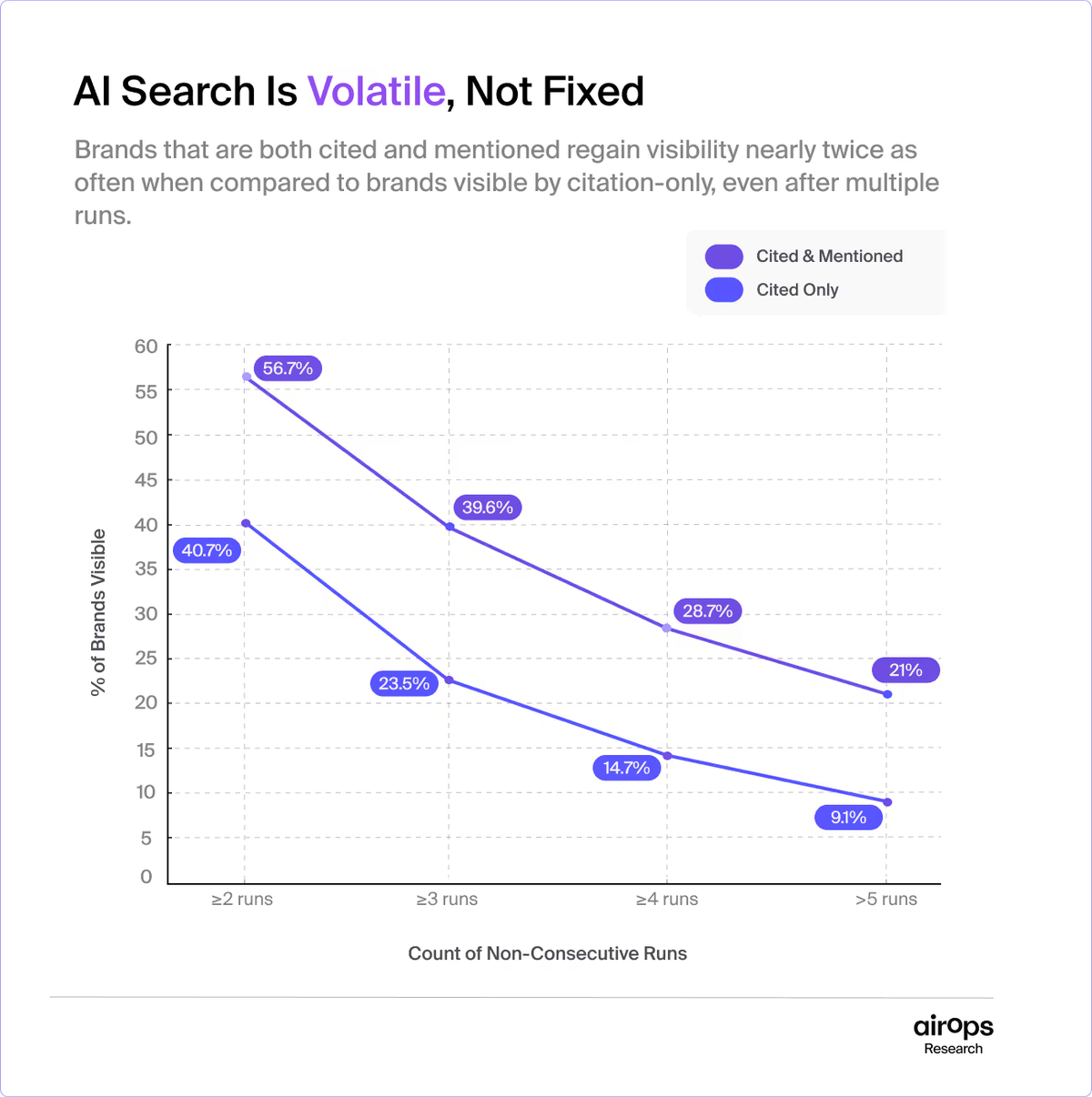
- AI Overview content changes roughly 70% of the time for the same query, and when the answer updates, almost half of the citations are replaced with new sources (AirOps).
- Only about 30% of brands remain visible in back-to-back AI responses for the same query (AirOps).
- Across ChatGPT, Perplexity, Copilot, and AI Mode, around 80% of cited URLs do not rank in Google's top 100 results for the original query (Ahrefs, August 2025).
- Pages with well-organized headings are 2.8x more likely to earn citations in AI search results (AirOps).
- 90% of AI citations driving brand visibility originate from earned and owned media, not paid placements (Edelman).
- Brands in the top 25% for web mentions get 10x more AI visibility than others; the top 50 brands receive about 28.9% of all mentions in AI Overviews (Ahrefs).
How Do AI Platforms Differ in Citation Behavior? (Superlines Original Data)
Most statistics treat "AI search" as a single channel. Our data shows it is anything but. Superlines analyzed 34,234 AI responses across 10 platforms over 30 days (January 14 to February 13, 2026) and found dramatic differences in how each platform cites and mentions brands.
The 615x Platform Gap
The same brand, the same content, the same 30-day period, yet citation volumes differ by a factor of 615 across platforms (Superlines data, March 2026):
- Grok: 27.01% citation rate, 8.47% brand visibility
- Perplexity: 13.05% citation rate, 0.64% brand visibility
- Google AI Mode: 9.09% citation rate, 2.14% brand visibility
- Gemini: 6.38% citation rate, 0% brand visibility
- Google AI Overview: 2.11% citation rate, 2.28% brand visibility
- Copilot: 1.27% citation rate, 1.10% brand visibility
- ChatGPT: 0.59% citation rate, 0.14% brand visibility
- Claude, Mistral, DeepSeek: 0% citation rate, 0% brand visibility
The citation volume gap between the highest-citing platform (Grok) and the lowest (Claude) is 615x. A brand can be thriving on one platform and invisible on another, and without multi-platform tracking, you would never know.
Ghost Citations: When AI Links to You But Won't Say Your Name
We identified a phenomenon we call "ghost citations," where AI platforms link to your website but never mention your brand name:
- Gemini cited superlines.io 182 times in 30 days but mentioned the brand name "Superlines" zero times. 100% ghost citations.
- Perplexity generated 20x more website links than brand name mentions.
- Across all platforms combined, 73% of our AI presence consisted of citations without brand mentions.
This has direct implications for measurement: if you only track brand mentions, you miss the citations. If you only track citations, you miss the brand awareness gap. Both metrics are needed.
Video is an already-meaningful, under-discussed citation channel
YouTube alone accounts for 5.15% of third-party citations, with reach broader than most individual news outlets in the source list. Most GEO commentary fixates on text sources; this is comparatively unclaimed territory and a natural seed for a follow-up piece. (Original Superlines research data from the State of AI Search — H1 2026 Benchmark by Superlines research team)
Each AI Platform Has a Distinct Sentiment Profile
Sentiment analysis across 6,447 brand mentions revealed that each AI platform has what amounts to an editorial personality:
- Perplexity: 76.9% positive sentiment (fewest mentions, highest praise)
- Grok: 58.2% positive (many mentions, mostly positive)
- Google AI Mode: 35.6% positive (balanced)
- Copilot: 90.9% positive (overwhelmingly favorable)
- ChatGPT: 6.8% positive (neutral, rarely praises)
- Claude: 0% positive (factual, zero emotional language)
The sentiment gap between Perplexity (0.769 score) and ChatGPT (0.052 score) is 14.8x. Same brand, radically different editorial treatment depending on the platform.
AI Visibility Is Volatile: A 36% Decline in 5 Weeks
Tracking weekly trends from January 11 to February 8, 2026, we observed:
- Brand visibility declined from 1.92% to 1.23% (-35.9%)
- Citation rate declined from 7.35% to 4.82% (-34.4%)
- Share of voice declined from 0.66% to 0.43% (-34.8%)
All three core metrics declined in lockstep over 5 weeks. This proves that AI visibility is not a "set it and forget it" metric. A brand can lose a third of its AI presence in just over a month. Quarterly audits are insufficient; weekly monitoring is the minimum.
AI Visibility Varies 2.8x by Geography
Our data shows that AI search is not as "global" as most brands assume:
- United States: 2.49% brand visibility, 10.31% citation rate
- Non-US markets: ~1.15-1.90% brand visibility, ~3.73-6.58% citation rate
- The US citation rate is 2.8x higher than non-US markets
This suggests AI models have geographic biases in brand recommendations, likely driven by training data composition, search index locality, and content language signals.
How Do AI Crawlers and Bots Read Your Site?
AI crawlers now act as the invisible backbone of search visibility, indexing and interpreting web content in new ways.
- AI-driven automated scripts and bots generate 63.3% of global web traffic, officially surpassing human web usage at 36.7%. (Cloudflare Radar September 2026)
- The number of AI bots has doubled since August 2023, with 21 major AI bots now active on the web (Ahrefs).
- GPTBot (OpenAI) is the most blocked AI bot, with 5.89% of all websites blocking it (Ahrefs).
- AI bots now contribute to 25% of all web requests, ranking second behind search engine bots (Ahrefs).
- 92% of ChatGPT agent queries relied on the Bing Search API back in 2025 (Search Engine Land, October 2025), but now OpenAI has built it’s own Search Index.
- 63% of ChatGPT agent visits bounced immediately after landing, mostly due to HTTP errors, redirects, slow loading, CAPTCHAs, or bot blocking rules (Search Engine Land).
- 86% of AI citations came from brand-controlled content (websites and listings) rather than forums (Yext).
What Does the Agentic Commerce Shift Mean for AI Search?
A new wave of AI-powered commerce is emerging that will reshape how brands think about AI search optimization.
- Google launched its Universal Checkout Protocol (UCP) with Etsy and Wayfair in February 2026, allowing users to purchase items without leaving AI Mode or Gemini.
- McKinsey projects that AI agents could mediate $3-5 trillion of global consumer commerce by 2030.
- Gartner predicts that 40% of enterprise apps will include conversational AI agents by end of 2026.
- Google is testing sponsored ads within AI Mode (February 2026), signaling that paid AI visibility is imminent.
- ChatGPT Ads has officially launched worldwide as of Septmeber 2026, with latest expansion into Southeast Asia and Taiwan (OpenAI).
- ChatGPT Ads reached a $1 billion annualized revenue run rate in under 200 days following its pilot launch. (OpenAI, Reuters)
Conclusion
These 60+ statistics paint a clear picture: AI search is no longer experimental. It is a measurable, growing channel that is reshaping how brands are discovered, evaluated, and chosen. The shift from rankings to citations, from clicks to mentions, and from single-platform SEO to multi-platform GEO is happening now.
The brands that measure and optimize for AI visibility today will have a durable advantage as this channel scales. The data shows that freshness, structure, authority, and multi-platform presence are the key levers.
Superlines tracks brand visibility, citations, sentiment, and competitive share of voice across 10 AI platforms, helping marketing teams turn AI search data into actionable optimization workflows.
OpenAI's Own Data: What ChatGPT Usage Reveals About AI Search Behavior
In February 2026, OpenAI published OpenAI Signals, the first official dataset on how people actually use ChatGPT. Based on 1.8 million conversations analyzed in a NBER Working Paper by OpenAI's Economic Research team and Harvard economist David Deming, the data offers the most authoritative view yet of ChatGPT as a search and discovery channel.
ChatGPT as a Search Channel: The Numbers
- 49% of all ChatGPT messages are "Asking" (seeking information, clarification, or advice), 40% are "Doing" (requesting outputs like drafting, coding, or planning), and 11% are "Expressing" (personal reflection or play).
- 75% of all conversations focus on practical guidance, seeking information, and writing.
- Approximately 30% of consumer usage is work-related and 70% is non-work. This likely understates business use since the dataset excludes ChatGPT Enterprise and Team plans.
- Writing is the most common work task on ChatGPT, while coding and self-expression remain niche.
- User cohorts deepen their usage over time through improved models and new use-case discovery, indicating growing stickiness.
What This Means for AI Search Strategy
The OpenAI Signals data confirms several patterns that matter for GEO and AI Search strategy:
- ChatGPT is a search channel, not just a chatbot. Nearly half of all messages are information-seeking queries. For brands, this validates treating ChatGPT visibility as a core marketing metric alongside Google rankings and Google’s own AI Search surfaces.
- Work-related usage means B2B exposure. With 30% of consumer messages being work-related (and enterprise plans excluded from this count), ChatGPT is already a significant channel for professional research, vendor evaluation, and purchasing decisions.
- Global reach is broadening fast. The 4x growth rate in low-income countries means AI search is not a US-only phenomenon. Brands with international audiences need multi-language, multi-market AI visibility tracking.
- Usage deepens over time. OpenAI reports that user cohorts increase their activity over time, meaning the channel will only grow in importance as existing users find more use cases.
Source: OpenAI Signals (February 2026), How People Are Using ChatGPT (September 2025). Data from NBER Working Paper 34255, licensed under CC BY 4.0.
March 2026 Data Update
- AI search traffic converts at 14.2% compared to Google's 2.8%, making AI referral traffic approximately 5x more valuable per session. (Source: Exposure Ninja)
- Reddit is the #1 most-cited domain in AI search overall with approximately 5,588 citations across 37 tracked prompts (Superlines data, March 2026).
- 8 of the 10 most-cited URLs across AI platforms are "Best X" listicles, confirming that comparison and recommendation content formats dominate AI citations (Superlines data, March 2026).
- 93% of Google AI Mode sessions end without a click to an external website, compared to 34% for traditional Google Search without AI Overviews. (Source: Semrush)
- 86% of AI citations come from brand-managed sources such as websites and listings. (Source: Yext)
Emerging Markets: OpenAI Signals India Spotlight
The OpenAI Signals India report (February 2026) provides a concrete data point for how AI search behavior differs by market maturity. India is OpenAI's second-largest market with 100M+ weekly users, and its usage patterns reveal where AI search is heading globally.
- 35% work-related messages in India vs. 30% globally: India's higher professional usage share signals that emerging markets are adopting AI as a work tool faster than established markets, making AI search a B2B channel in developing economies from the outset.
- Youth-dominated usage (80% under 30): The 18–24 age cohort sends ~50% of all ChatGPT messages from India. For brands targeting this demographic—in edtech, fintech, and consumer tech—AI search visibility in India is already a primary discovery channel.
- Coding and technical queries dominate: Indian users ask 3× more coding questions than the global median. For brands in developer tools, APIs, or SaaS, India represents a high-intent AI search audience that actively queries technical content.
- 4× faster adoption growth in lower-income countries: OpenAI Signals shows adoption growth in the lowest-income countries outpaces high-income countries by more than 4×. This means AI search is not a saturating Western trend—it is accelerating in the highest-growth markets. Multi-language, multi-market AI visibility tracking is no longer optional for global brands.
The GEO implication: The combination of 49% information-seeking ("Asking") behavior globally, plus concentrated professional use in high-growth markets, means brands that rank well in AI citations capture both consumer discovery and B2B research simultaneously. The OpenAI Signals data makes a compelling case for treating ChatGPT visibility as a global top-of-funnel metric.
Source: How India Uses ChatGPT, OpenAI Signals (February 2026); TechCrunch, February 20, 2026. Data licensed under CC BY 4.0. Citation: Chatterji et al., NBER Working Paper 34255 (2025).