


The best AI search visibility tools in 2026 are Superlines, Profound, SE Visible, Peec AI, and Ahrefs Brand Radar, each with different strengths depending on your team size, budget, and how many AI platforms you need to cover. The right choice depends on whether you need a monitoring dashboard, an execution-focused workflow, or an add-on to your existing SEO stack.
This comparison breaks down 15 tools across the features that actually matter: how they collect data (API vs. real interface scraping), which AI platforms they track, what metrics they report, and what they cost. Instead of ranking tools from best to worst, this guide groups them by use case so you can find the right fit faster.
Why do brands need AI search visibility tools in 2026?
AI platforms now influence a significant share of how people discover brands and products. Bain & Company found that roughly 80% of search users rely on AI-generated summaries at least 40% of the time, and about 60% of those searches end without the user clicking through to a website. That means if your brand is not visible inside the AI response itself, you are missing a growing share of your audience.
Traditional SEO tools were not built for this. They track rankings on Google's blue links, not whether ChatGPT mentions your product or Perplexity cites your blog post. AI visibility tools fill that gap by monitoring how your brand shows up across multiple AI platforms, tracking citations back to your website, measuring sentiment, and benchmarking you against competitors.
The practical question is not whether you need this data, but which tool gives you the most useful version of it for your budget and workflow.
What features should you compare when choosing an AI visibility tool?
Before diving into individual tools, it helps to know which features separate a basic tracker from a platform that can actually drive results. Here are the seven dimensions that matter most:
Data collection method: API vs. real interface scraping
This is the single most important technical difference between tools. Some platforms query AI models through their APIs, which is fast and scalable but can return different results than what a real user sees in the ChatGPT or Perplexity interface. Others scrape the actual AI interfaces, capturing the formatted answers, citations, and source links that users interact with.
Tools using real interface data include Superlines, Profound, and ZipTie. Tools relying primarily on APIs include Semrush, Ahrefs, Peec AI, and Otterly AI. A study referenced by Matt Diggity from Surfer found that API-based data can differ meaningfully from real interface answers, which means API-only tools may not reflect what your customers actually see.
AI platform coverage
Not all tools track the same platforms. At minimum, you want coverage of ChatGPT, Google AI Overviews, and Perplexity. Broader coverage should include Google AI Mode, Gemini, Copilot, Claude, Grok, DeepSeek, and Mistral.
Here is how the major tools compare on platform coverage:
- 10+ platforms: Superlines, Profound (enterprise tier)
- 5-7 platforms: Ahrefs Brand Radar, SE Visible, Semrush AI Visibility
- 3-4 platforms: Otterly AI, Peec AI (baseline), ZipTie, Clearscope
Core metrics tracked
The essential metrics for AI visibility are:
- Brand Visibility: How often your brand is mentioned in AI responses for tracked queries
- Citation Rate: How often your website URLs appear as sources in AI responses
- Share of Voice: Your brand's mention share compared to competitors
- Sentiment: Whether AI platforms describe your brand positively, neutrally, or negatively
Most tools track the first three. Sentiment analysis is less common and varies in quality.
Actionable insights vs. passive dashboards
Some tools show you data and leave interpretation to you. Others analyze the data and suggest specific actions: which content to create, which pages to optimize, which competitors are gaining ground. This is the difference between a monitoring tool and a growth platform.
Pricing and prompt limits
Most AI visibility tools charge based on the number of "prompts" (search queries) you track. A prompt is a specific question like "best project management software" that the tool monitors across AI platforms. Entry-level plans typically include 15 to 50 prompts, while mid-tier plans offer 75 to 300.
Technical analysis capabilities
Some tools audit your website for AI-readiness: checking schema markup, HTML structure, robots.txt configuration, and whether AI crawlers can access your pages. This is valuable for teams that want to fix technical barriers to citation.
Integration and workflow support
As marketing teams adopt AI assistants for their own workflows, tools with MCP (Model Context Protocol) servers or robust APIs let you pull visibility data directly into your existing tools rather than switching between dashboards.
How do the top 15 AI visibility tools compare on pricing and features?
Here is a side-by-side breakdown of the 15 most relevant tools in the market as of February 2026, organized by category.
Dedicated GEO platforms
These tools were built specifically for AI search visibility. They tend to offer the deepest feature sets for tracking and improving how your brand appears in AI responses.
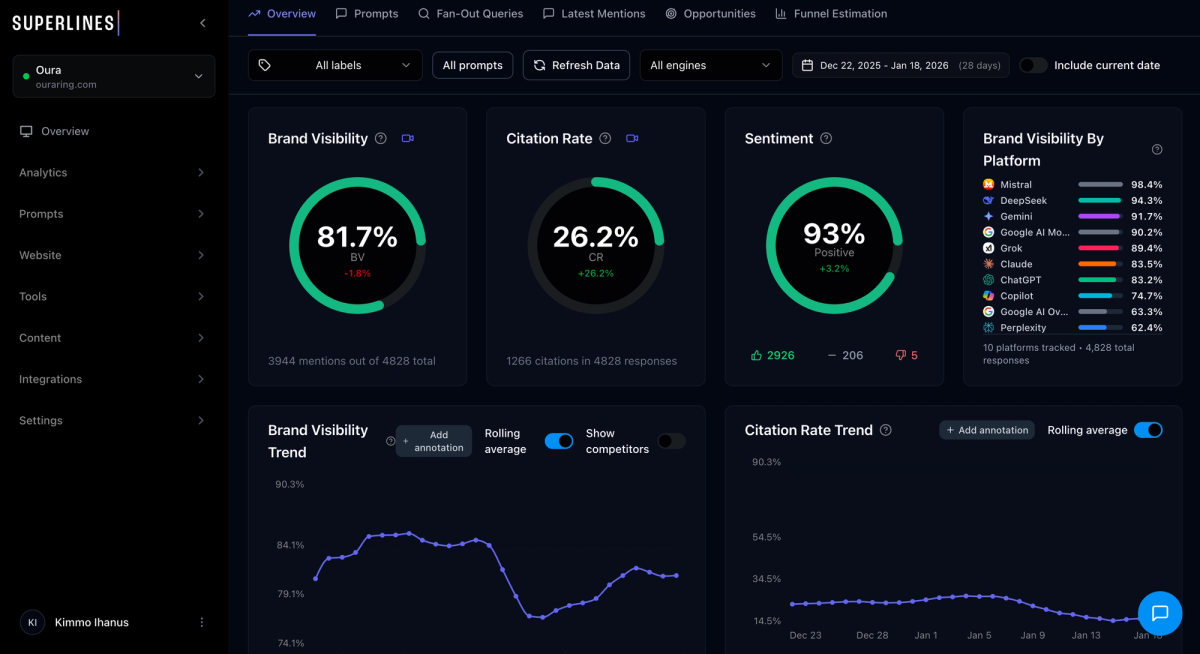
Superlines (superlines.io): Starts at €79/month (€69/month with annual billing). Tracks 10+ AI platforms using real interface scraping plus APIs. Includes query fan-out analytics, AI bot traffic tracking, in-app agent for data analysis, and MCP server for agentic workflows. Best for multi-brand marketing teams and agencies that need to move from monitoring to action. Free trial available.
Profound (tryprofound.com): Starts at $99/month (Starter plan). Growth plan at $399/month. Enterprise plans with custom pricing available. Tracks 10+ platforms on enterprise plans. Offers content generation, conversation explorer with large prompt database, and ChatGPT Shopping tracking. Best for teams that want an all-in-one platform with content creation built in.
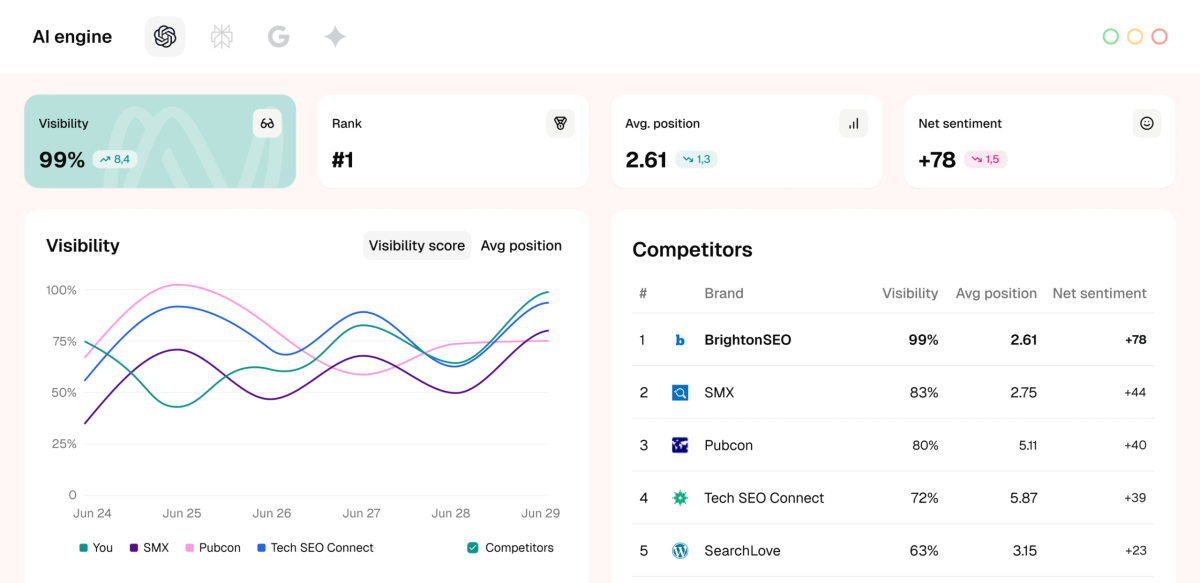
SE Visible (visible.seranking.com): Starts at $99/month (Basic plan with 150 prompts and 3 brands). Built by SE Ranking as a standalone GEO platform. Tracks Google AI Overviews, AI Mode, ChatGPT, Perplexity, Gemini, and Copilot. Includes content optimization suggestions and competitive benchmarking. Best for teams already using SE Ranking for SEO.
Peec AI (peec.ai): Starts at €89/month for 25 prompts. Tracks ChatGPT, Perplexity, and Google AI Overviews in baseline plans, with Gemini, AI Mode, Claude, DeepSeek, Llama, and Grok available as add-ons. Offers Pitch Workspaces for sharing reports with clients. Best for agencies that need lightweight tracking with client-facing reports.
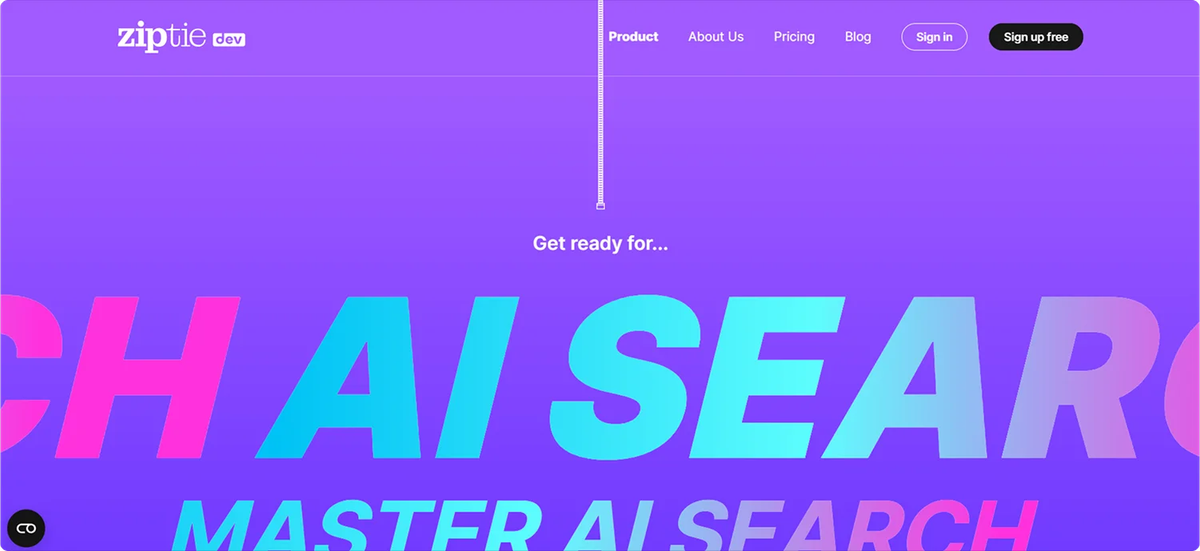
ZipTie (ziptie.dev): Starts at $58.65/month (annual billing) for 500 AI search checks. Tracks Google AI Overviews, ChatGPT, and Perplexity. Offers granular URL-level filtering, AI Success Score, and content optimization suggestions. Best for teams that want deep analytical capabilities at a lower price point.
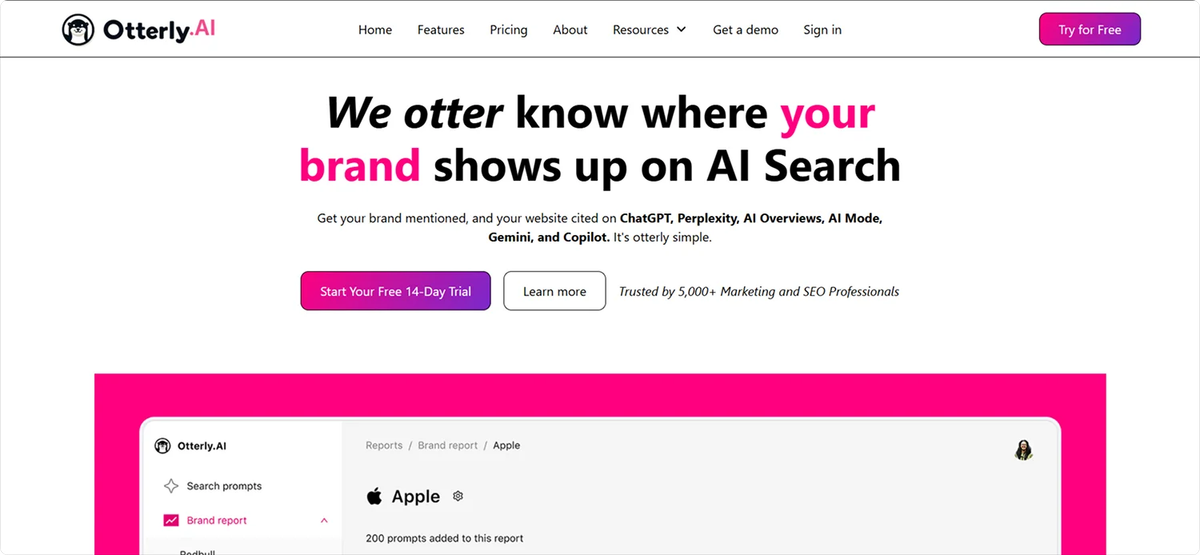
Otterly AI (otterly.ai): Starts at $25/month (annual billing) for 15 prompts. Tracks Google AI Overviews, ChatGPT, Perplexity, and Copilot, with AI Mode and Gemini as add-ons. Converts existing SEO keywords into LLM prompts automatically. Best for freelancers and small teams on tight budgets.
SEO platforms with AI visibility add-ons
These are established SEO tools that have added AI visibility features. They are convenient if you already use the platform but typically offer less depth than dedicated GEO tools.
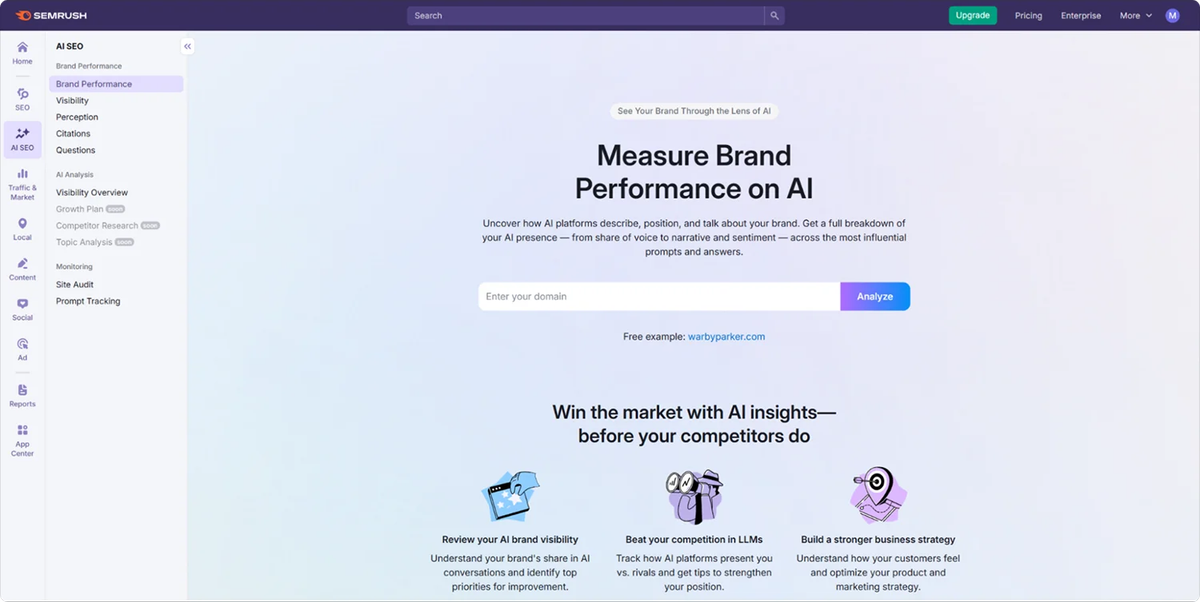
Semrush AI Visibility (semrush.com): Starts at $99/month per domain. Tracks ChatGPT, Google AI, Gemini, and Perplexity. Includes AI readiness site audit, 180M+ prompt database, and strategic recommendations. Best for existing Semrush users who want GEO data alongside their SEO workflow.
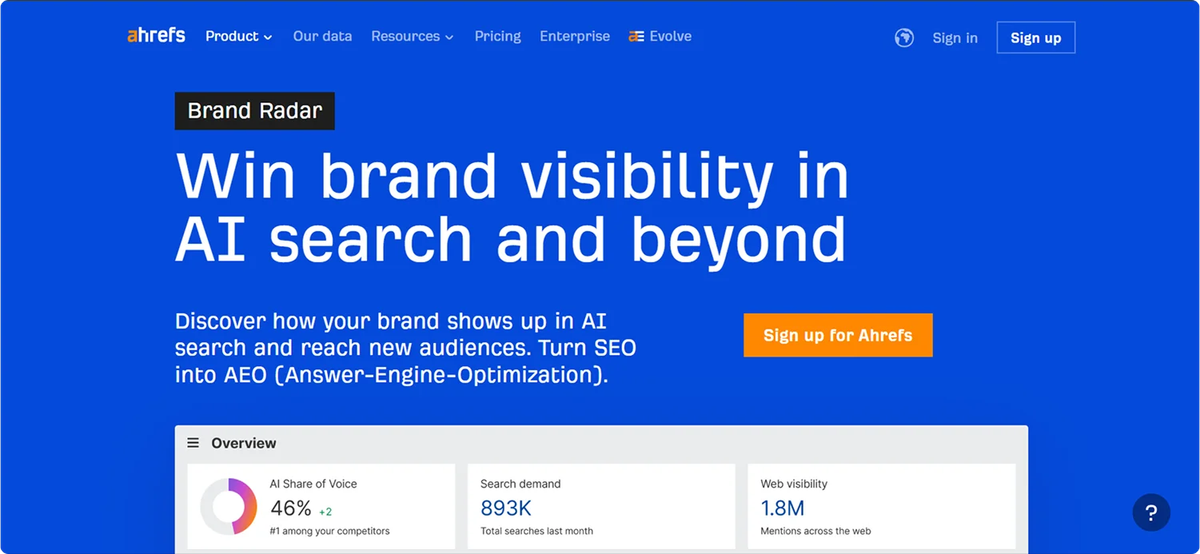
Ahrefs Brand Radar (ahrefs.com/brand-radar): $199/month per individual AI platform index, or $699/month for all platforms. Available as a standalone tool to all Ahrefs users. Tracks Google AI Overviews, AI Mode, ChatGPT, Perplexity, Gemini, and Copilot. Offers competitive benchmarking and share of voice tracking. Best for Ahrefs users who want brand-level AI visibility data.
Similarweb (similarweb.com): Contact sales for pricing. Tracks AI referral traffic as GA4-style reports, identifies topic themes driving AI traffic, and shows traffic distribution across AI channels. Best for teams that want to connect AI visibility to actual website traffic data.
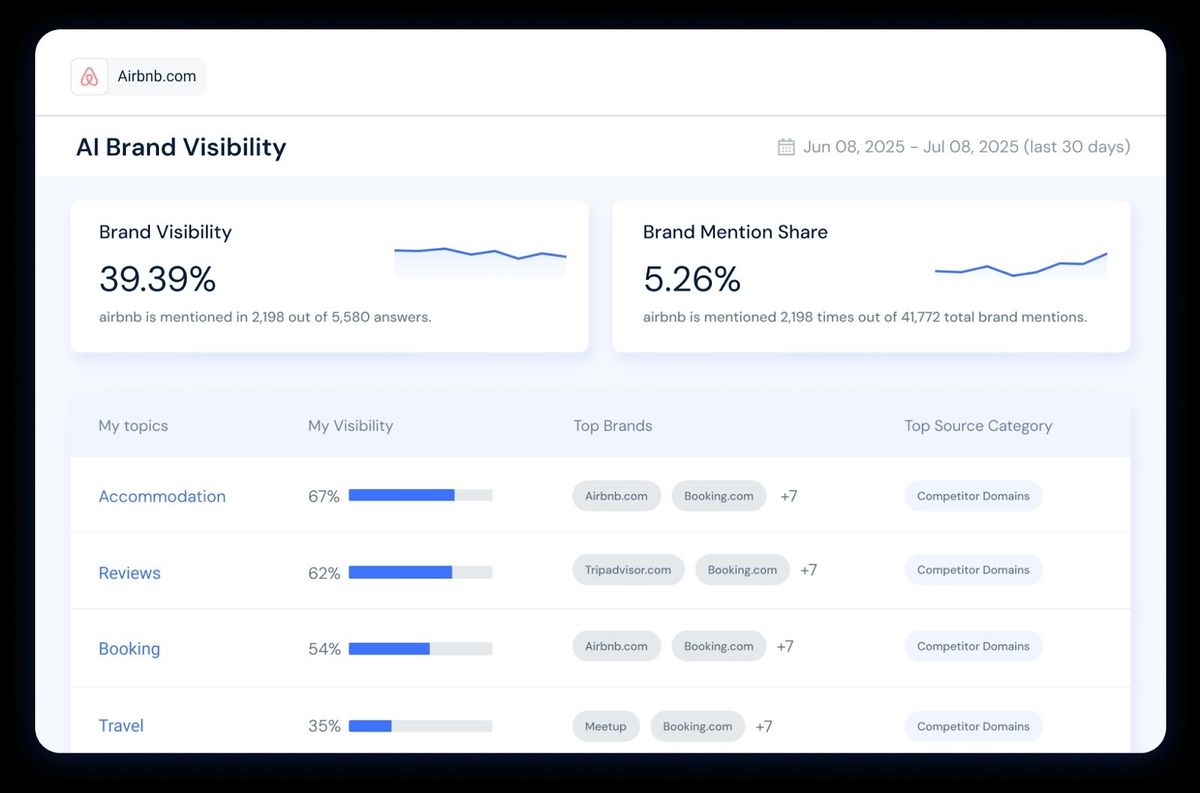
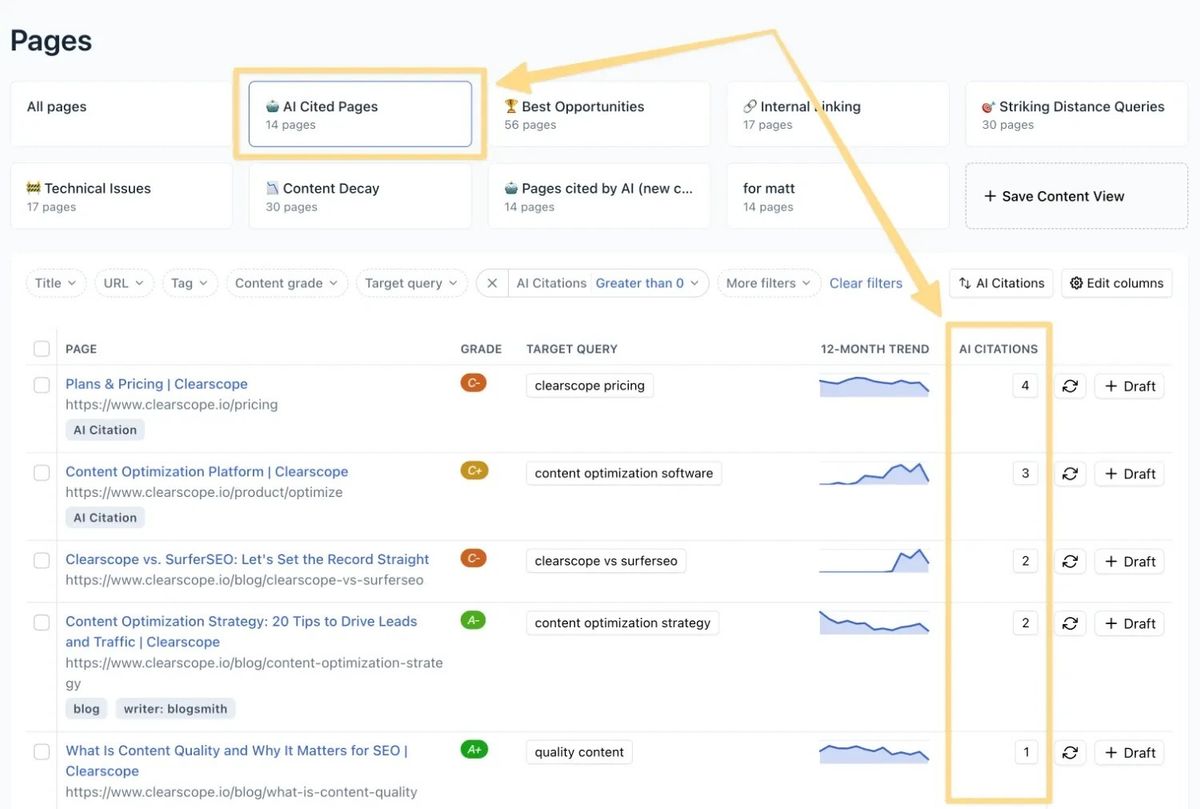
Clearscope (clearscope.io): Starts at $129/month. Tracks ChatGPT, Gemini, and Perplexity. Focuses on content optimization with AI Draft feature and topic exploration. Best for content teams that want to create AI-optimized content rather than just monitor visibility.
Emerging and specialized tools
These are newer entrants or tools with unique approaches worth watching.
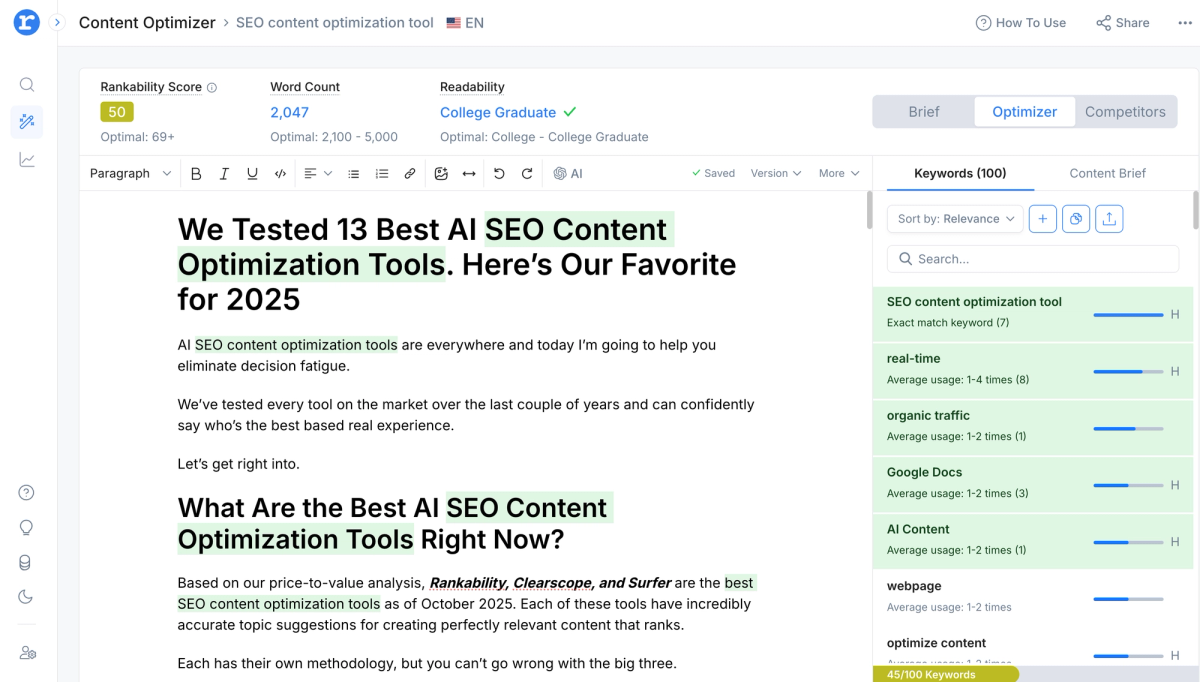
Rankability (rankability.com): Pricing varies. Positions itself as a GEO platform with competitive benchmarking and content recommendations. Has published extensive tool comparison content that performs well in AI citations.
AIclicks (aiclicks.io): Pricing varies. Focuses on ChatGPT and Copilot rank tracking with founder-led content strategy. Publishes detailed tool comparisons with embedded case studies and webinars.
Rankscale (rankscale.ai): Pricing varies. Offers sentiment analysis and AI readiness scoring. Focuses on helping brands understand how AI platforms perceive their content.
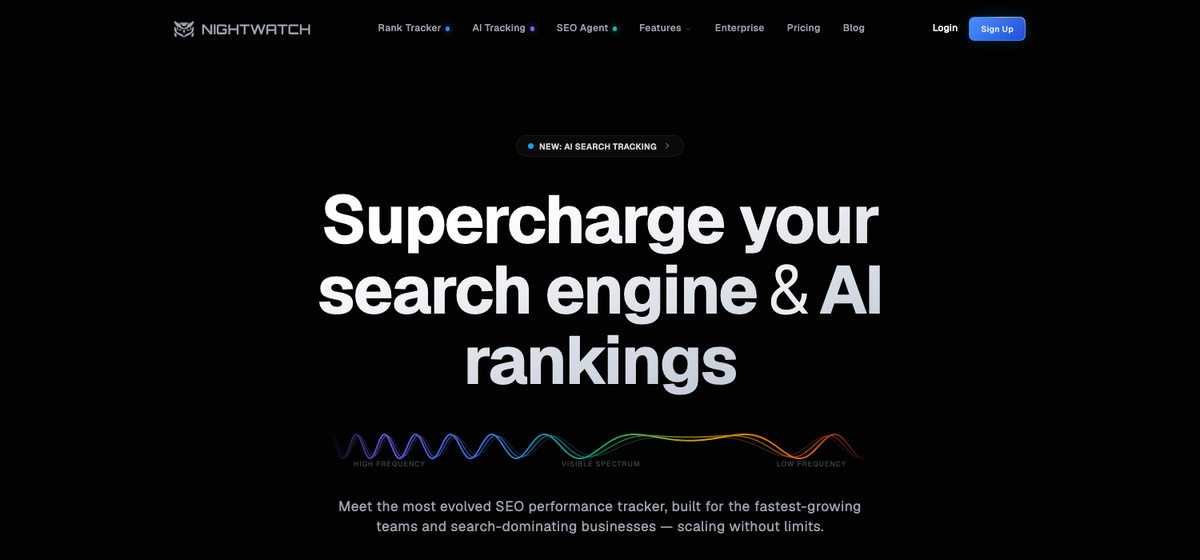
Nightwatch (nightwatch.io): Rank tracker starts at $32/month (annual). AI Tracking is a separate add-on at $99/month for 100 prompts. Hybrid SEO and AI tracking tool. Covers Google AI Overviews and some AI platforms alongside traditional rank tracking. Best for teams that want a single tool for both SEO and basic AI monitoring.
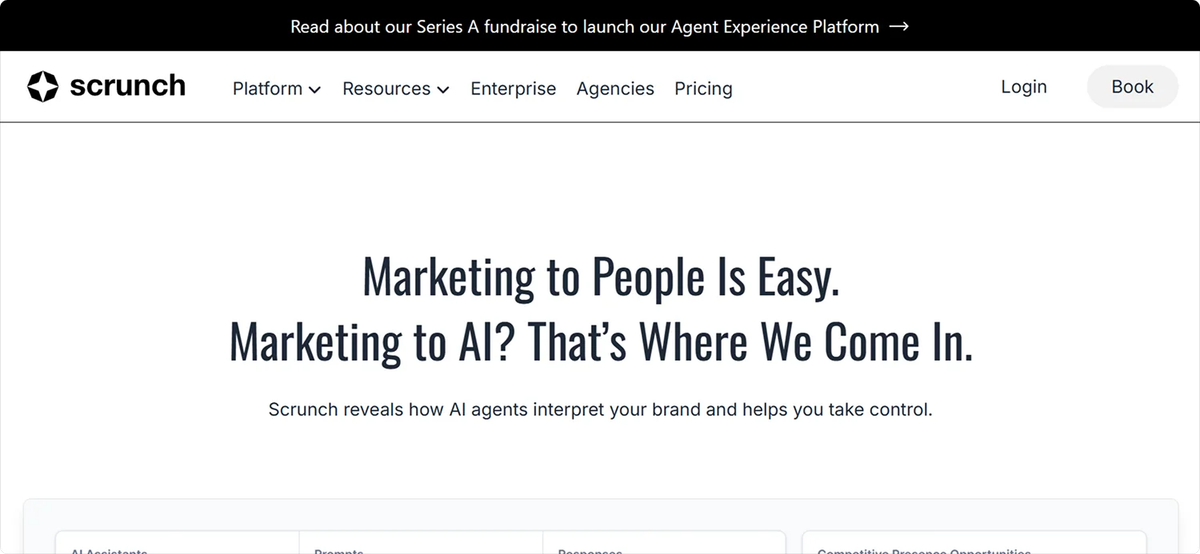
Scrunch AI (scrunch.ai): Pricing varies. Offers a unique AXP (AI Experience) optimization layer that generates bot-optimized content while leaving the public-facing site unchanged. Worth watching for its novel technical approach.
Which data collection method produces more accurate results?
This question matters more than most buyers realize. Forbes reports that 60% of organic traffic now comes from AI-generated results, which means the accuracy of your visibility data directly affects your strategic decisions.
API-based tools send queries to AI models through their programming interfaces. The responses come back as raw text, often without the formatting, source links, and contextual elements that users see in the actual interface. This is faster and cheaper to operate, but the data can diverge from reality.
Interface-scraping tools simulate real user sessions in ChatGPT, Perplexity, and other platforms. They capture the full response including citations, source cards, and follow-up suggestions. This is slower and more expensive to operate, but the data reflects what your customers actually see.
For most teams, the practical recommendation is: if you are making strategic decisions based on this data (content investments, competitive positioning, executive reporting), prioritize tools that use real interface data. If you just need a directional signal, API-based tools are fine and more affordable.
How much should you budget for AI visibility tracking?
Budget depends on your scale and goals. Here is a rough framework:
Solo practitioners and freelancers ($25 to $100/month): Otterly AI or ZipTie give you basic tracking across 3 to 4 platforms with enough prompts to monitor your core queries. Good for getting started and proving the value of AI visibility data.
Small to mid-size marketing teams ($100 to $250/month): Superlines (from €79/month), Peec AI, or Semrush AI Visibility provide broader platform coverage, competitive benchmarking, and enough prompts (50 to 300) to cover your key topics. Superlines stands out with 3 AI engines, unlimited users and brands, daily tracking, and MCP server access — all at the Starter tier. This is where most teams land.
Agencies and multi-brand teams ($200 to $500/month): Superlines (from €79/month) or Profound (from $99/month) offer multi-brand management, client reporting, and the depth needed to run GEO as a service. Agencies typically need unlimited domains and higher prompt volumes.
Enterprise ($700+/month): Profound enterprise, Similarweb, or custom plans from Superlines provide full platform coverage, dedicated support, and integration with existing marketing stacks.
McKinsey projects that billions in commerce will flow through AI searches by 2027 to 2028, calling AI search the "new front door to the internet." Given that trajectory, the question is less about whether to invest and more about how quickly you can start building visibility data.
What are the biggest mistakes teams make when choosing an AI visibility tool?
Tracking only one AI platform
Many teams start by monitoring just ChatGPT because it has the largest user base. But our data shows that different platforms behave very differently. Some platforms cite brands at dramatically higher rates than others, while some mention your website without ever naming your brand. Tracking a single platform gives you a distorted picture.
Confusing brand mentions with citations
A brand mention means the AI response includes your brand name. A citation means it links to your website as a source. These are different metrics that tell different stories. Some platforms mention brands frequently but rarely cite sources. Others cite URLs without naming the brand. You need both metrics to understand your full AI presence.
Choosing based on the number of tools tracked rather than data quality
A tool that tracks 10 AI platforms using APIs may give you less useful data than one that tracks 6 platforms using real interface scraping. The quality of the data matters more than the breadth of coverage, especially when you are making content and budget decisions based on the results.
Ignoring the action gap
The most common complaint from GEO practitioners, echoed across Reddit communities like r/SaaS, is that most tools stop at monitoring. Users want to know "what do I publish this week?" not just "here is your visibility score." Look for tools that bridge the gap between data and action.
Not connecting AI visibility to business outcomes
AI visibility data is only valuable if you can connect it to traffic, leads, or revenue. Tools that track AI referral traffic (like Similarweb) or that integrate with your analytics stack help you prove ROI. Without that connection, AI visibility becomes a vanity metric.
How should you evaluate AI visibility tools for your specific needs?
Start with three questions:
What is your primary goal? If you want to monitor brand reputation in AI, a lighter tool like Otterly AI or Peec AI works. If you want to actively grow your AI visibility, you need a platform with actionable insights and content recommendations.
What is your existing tech stack? If you already use Semrush or Ahrefs, their AI add-ons are the fastest path to getting started. If you are building a dedicated GEO practice, a purpose-built platform will serve you better long-term.
How many brands and markets do you cover? Solo brand teams can use almost any tool. Agencies and multi-brand enterprises need platforms designed for scale, with workspace management, client reporting, and flexible prompt allocation.
A practical evaluation checklist
Before committing to any tool, run this quick test:
- Set up tracking for 10 core queries across at least 3 AI platforms
- Compare the results to what you see when you manually ask those questions in ChatGPT and Perplexity
- Check if the tool explains why your visibility is high or low on specific queries
- Look for competitive data showing who is winning the queries you care about
- Ask about data freshness: how often does the tool re-check your queries?
What does the future of AI visibility tracking look like?
The market is consolidating around a few patterns. First, the line between SEO tools and GEO tools is blurring. Every major SEO platform now has some form of AI visibility tracking, and dedicated GEO tools are adding traditional SEO signals.
Second, the shift toward agentic workflows is accelerating. Tools with MCP servers and robust APIs will have an advantage as marketing teams increasingly use AI assistants to analyze data and execute strategies.
Third, SE Visible reports that brands appear in 90% of AI Mode results, suggesting that AI visibility is becoming table stakes rather than a competitive advantage. The differentiation will shift from "are you visible?" to "are you the recommended choice?"
For teams evaluating tools today, the practical advice is: start with a tool that covers your core platforms and gives you actionable data, then expand as the market matures. The worst decision is waiting, because competitors who build visibility data now will have a compounding advantage.
Conclusion
The AI visibility tools market in 2026 offers options for every budget and use case, from $25/month basic trackers to enterprise platforms with full workflow integration. The key differentiators are data collection method (API vs. real interface), platform coverage, and whether the tool helps you act on the data or just displays it.
For teams that want to move beyond monitoring into active AI visibility growth, platforms like Superlines combine real interface data, multi-platform coverage, and agentic workflows (including MCP server support) to turn visibility tracking into a repeatable growth process. You can explore how it works with a free trial.
Whatever tool you choose, the important thing is to start tracking now. AI search is growing fast, and the brands building visibility data today will have a significant head start over those who wait.