


The 12 Best AI Search Visibility Dashboards & Tools in 2026
AI search is no longer a niche experiment. ChatGPT, Perplexity, Gemini, Claude, and Microsoft Copilot now handle hundreds of millions of queries daily, and the brands that appear in those AI-generated answers capture a growing share of attention and traffic. But unlike traditional SEO, where Google Search Console shows you rankings and clicks, tracking AI search visibility requires a new category of tools: AI visibility dashboards.
These platforms monitor how your brand, products, and content appear across AI-powered search engines. They track brand mentions, URL citations, sentiment, share of voice, and competitive positioning in AI-generated responses. For marketing teams, SEO professionals, and growth leaders, they answer a critical question: are AI models recommending you or your competitors?
This guide compares the 12 best AI search visibility dashboards and tools available in 2026. Each tool is evaluated on LLM coverage, pricing, unique capabilities, and practical value for teams that need to know where their brand stands in AI search.
Key Takeaways
What are AI search visibility dashboards?
AI search visibility dashboards are platforms that monitor how your brand, content, and URLs appear across AI-powered search engines, including ChatGPT, Perplexity, Gemini, Claude, Copilot, and Google AI Overviews. They track metrics like brand mentions, URL citations, sentiment, share of voice, and competitive positioning in AI-generated responses. Unlike traditional SEO tools that focus on rankings and clicks, these dashboards measure whether AI models actually reference your brand when users ask questions in your category.
How much do AI search visibility tools cost?
Pricing ranges widely across this category. Budget-friendly options like Rankscale start at $20/month, mid-range tools like Otterly.AI and Semrush range from $29 to $139/month, and enterprise platforms like BrightEdge and xFunnel offer custom pricing. Most tools provide free trials or demo access so you can evaluate before committing. The right price depends on how many prompts, keywords, and LLMs you need to track.
Which LLMs do they cover?
Most AI visibility dashboards in 2026 cover the five major platforms: ChatGPT, Perplexity, Gemini, Claude, and Microsoft Copilot. Leading tools like Superlines, Profound, and xFunnel also track Google AI Overviews, Grok, and many other AI engines. Coverage depth matters —some tools only monitor direct brand mentions, while others track URL citations, sentiment, source attribution, and fan-out queries across each platform.
Quick Comparison: 12 AI Search Visibility Tools at a Glance
| Tool | Best For | LLMs Covered | Starting Price | Unique Feature |
|---|---|---|---|---|
| Superlines | Tracking + GEO workflow | ChatGPT, Perplexity, Gemini, Claude, Copilot, Grok, AI Overviews, Meta AI | Custom pricing | Visibility tracking with actionable content optimization and citation source analysis |
| Semrush AI Toolkit | Enterprise SEO teams | ChatGPT, Perplexity, Gemini, Google AI Mode | $139/mo | Full-stack SEO suite with integrated AI visibility layer |
| Profound | Answer engine analytics | ChatGPT, Perplexity, Gemini, Claude, Copilot | $120/mo | Visibility scoring with sentiment analysis across answer engines |
| Otterly.AI | Budget-friendly monitoring | ChatGPT, Perplexity, Gemini, Copilot, AI Overviews | $29/mo | Simple setup with competitor tracking at accessible price |
| Rankscale | Small companies | ChatGPT, Perplexity, Gemini, Claude, Copilot, AI Overviews | $20/mo | Lowest entry price with share of voice and citation analysis |
| Peec AI | Brand perception analysis | ChatGPT, Perplexity, Gemini, Copilot, AI Overviews | $39/mo | AI sentiment and perception scoring with recommendation engine |
| AIclicks | Prompt-level optimization | ChatGPT, Perplexity, Gemini, Claude | $49/mo | Granular prompt-by-prompt visibility tracking with optimization tips |
| Ahrefs Brand Radar | Brand monitoring integration | ChatGPT, Perplexity, Gemini, Copilot, AI Overviews | $188/mo | Traditional brand monitoring combined with AI visibility |
| xFunnel | Citation deep-dives | ChatGPT, Perplexity, Gemini, Claude, Copilot, AI Mode | Custom pricing | Deep citation analytics with dedicated analyst support |
| Surfer SEO AI Tracker | Content-first teams | ChatGPT, Perplexity, Claude, AI Overviews | $95/mo add-on | Content optimization scoring combined with AI visibility data |
| BrightEdge | Enterprise operations | ChatGPT, Perplexity, Copilot, AI Overviews | Custom pricing | 10+ years of historical SEO data with AI visibility layer |
| Moz Pro | Traditional SEO expansion | Google AI Overviews | $49/mo | AI Overview tracking within familiar SEO interface |
1. Superlines — Best for AI Visibility Tracking With Actionable GEO Workflow
- Best for: Marketing teams, SEO professionals, and growth leaders who need both AI visibility data and a clear path to improve it
- LLMs covered: ChatGPT, Perplexity, Gemini, Claude, Microsoft Copilot, Grok, Google AI Overviews, Google AI Mode, Deepseek and Mistral
- Starting price: Starter €79/mo with 3 AI engines (choose 3 from the 10+ available) and 50 prompts, Pro €199/mo with 150 prompts and data exports for mid-market teams, Growth €379/mo with 300 prompts and API access, and an Enterprise package with custom pricing. (7 day free trial available)
- Standout feature: Doesn’t just show data, but also tells you which actions to take based on it. In-app agent, API and MCP access available in all packages.
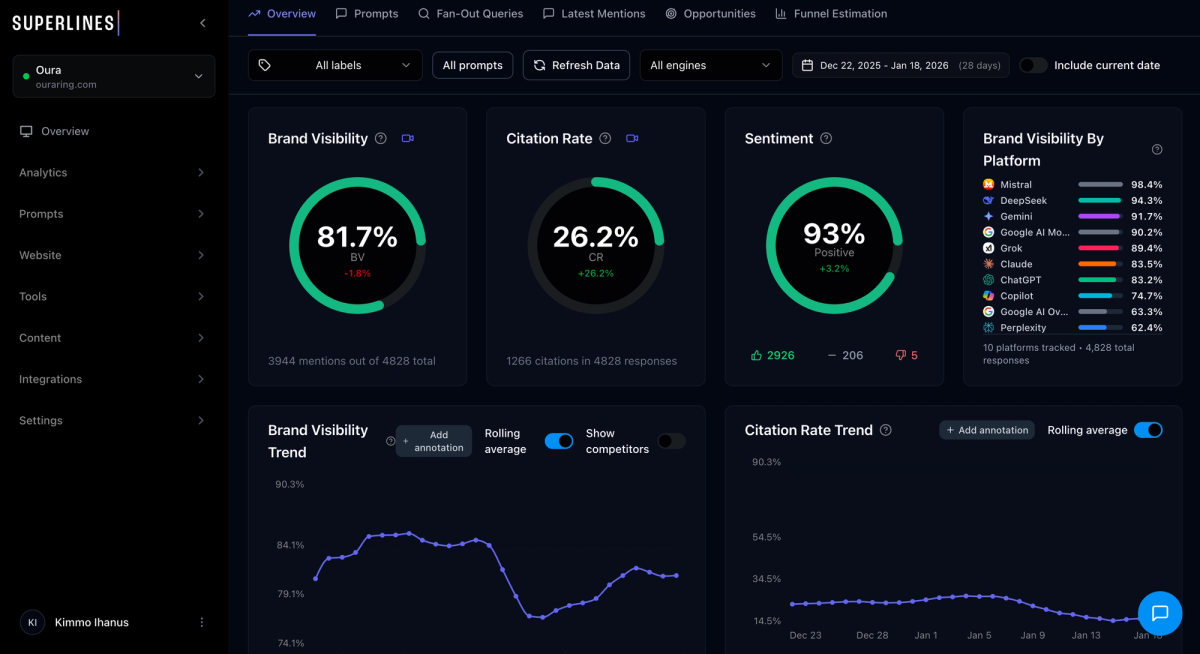
Superlines is an AI Search Intelligence Platform that goes beyond passive monitoring. While most dashboards tell you where you stand, Superlines connects visibility data to a concrete workflow for improving it — what the industry calls Generative Engine Optimization (GEO).
The platform tracks brand mentions, URL citations, share of voice, and competitive positioning across eight major AI platforms, making it one of the broadest coverage tools available in 2026. What sets it apart is the integrated content optimization layer: Superlines identifies which prompts your brand is missing from, analyzes which competitor content gets cited instead, and maps the third-party sources that amplify or diminish your AI presence.
Key capabilities:
- Cross-platform visibility tracking across 10 LLMs with daily monitoring cadence
- Citation source analysis showing which URLs and domains drive AI mentions for your brand and competitors
- Share of voice benchmarking with competitor comparison across every tracked prompt
- Fan-out query mapping to discover what secondary questions AI models explore when processing your target queries
- Actionable GEO recommendations that translate visibility gaps into specific content actions
- Third-party source intelligence revealing which review sites, publications, and forums influence how AI models talk about your category
Where Superlines stands out is in bridging the gap between data and action. Other tools show you a dashboard of metrics; Superlines shows you the metrics and tells you what to do about them. For teams that want an analytics-to-action pipeline rather than another monitoring screen, this is the strongest option in 2026.
2. Semrush AI Toolkit — Best for All-in-One Enterprise SEO + AI Visibility
- Best for: Digital marketing teams and SEO professionals already using Semrush
- LLMs covered: ChatGPT, Perplexity, Gemini, Google AI Mode
- Starting price: $99/month AI visibility add-on for your existing Semrush subscription
- Standout feature: AI visibility integrated into a full-stack SEO platform
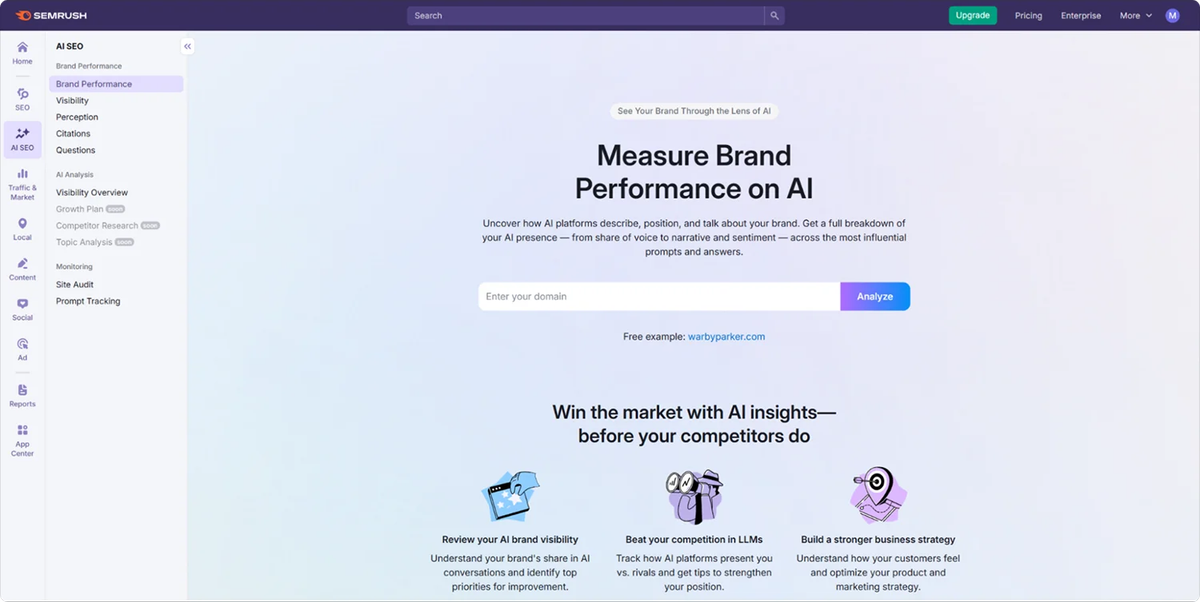
Semrush is the dominant player in traditional SEO tools, and its AI Toolkit extends that reach into generative search. The AI visibility features are built directly into Semrush's existing interface, so teams already paying for Semrush get AI tracking without adding another vendor.
The toolkit tracks how AI search engines present your brand, monitors competitor visibility across LLMs, and automates keyword and SERP tracking. Semrush's strength is its massive keyword database and competitive intelligence — you can see both your traditional search rankings and AI visibility in one place.
Key capabilities:
- AI-prioritized site audits identifying content gaps specific to AI search
- Competitive monitoring comparing your AI visibility against competitors
- Forecasting and trend analysis for AI search performance
- Integrated workflow with keyword research, site audit, and backlink tools
The main limitation is LLM coverage: Semrush currently tracks four platforms compared to 10 for tools like Superlines and Profound. It also lacks supportive features and doesn’t analyze the data on your behalf. If you are an existing Semrush user and are happy with a lightweight solution for AI visibility tracking, this isn’t an issue.
3. Profound — Best for Answer Engine Analytics and Visibility Scoring
- Best for: Fortune 500 companies looking for full GEO platforms with agentic capabilities and custom support
- LLMs covered: ChatGPT, Perplexity, Gemini, Claude, Microsoft Copilot
- Starting price: $99/month Starter tier and Growth tier from $399/month and Enterprise plan with custom pricing. According to third-party sources, the smallest Enterprise package is around $2000/month.
- Standout feature: Visibility scoring and sentiment analysis at the answer engine level
Profound helps businesses understand how answer engines are talking about them. The tool provides visibility scoring — a numeric measure of how prominent your brand is in AI-generated responses for target queries.
Where Profound excels is in the qualitative side of AI visibility: sentiment analysis reveals whether AI models discuss your brand positively, negatively, or neutrally. Citation authority insights show which third-party websites influence how AI engines answer questions about your category.
Key capabilities:
- Visibility scoring across major AI platforms
- Sentiment and keyword insights revealing brand perception in AI answers
- Citation authority analysis showing which sources influence AI responses
- Competitive benchmarking with side-by-side comparisons
- Trend tracking over time for topics, languages, and regions
Profound is an excellent choice for brands that care about how they are described in AI answers, not just whether they appear. The visibility score makes it easy to track progress month over month.
4. Otterly.AI — Best for Budget-Friendly AI Search Monitoring
- Best for: SEO professionals, content teams, and agencies managing multiple clients
- LLMs covered: ChatGPT, Perplexity, Gemini, Microsoft Copilot, Google AI Overviews
- Starting price: $29/month
- Standout feature: Affordable competitive tracking with citation monitoring
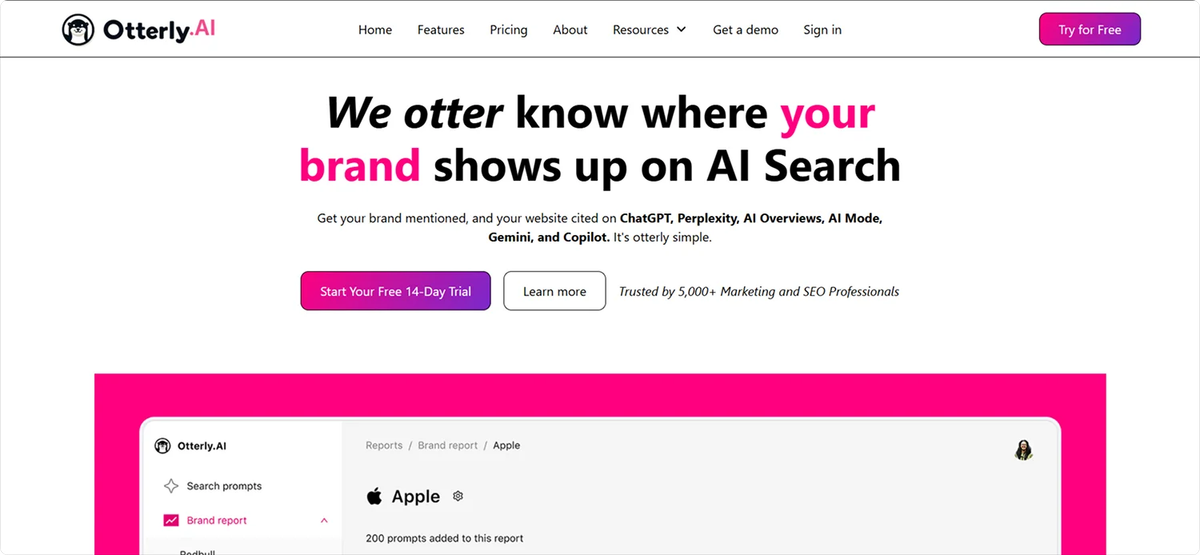
Otterly.AI was purpose-built for generative engine optimization. It monitors how your brand and content appear across five major AI search platforms and provides competitive tracking at a price point that works for smaller teams and agencies.
The tool automatically tracks link citations, brand mentions, and competitive positioning. Its straightforward interface makes it easy to set up and start monitoring without a steep learning curve.
Key capabilities:
- Automated citation and mention tracking across AI search engines
- Competitive visibility tracking with side-by-side comparisons
- LLM direct output tracking to see exactly how AI models present your brand
- Multi-client support for agencies managing multiple brands
Otterly has earned a reputation for reliability and ease of use. It is not the most feature-rich option on this list, but for teams that want solid AI visibility data without a significant monthly investment, it delivers strong value.
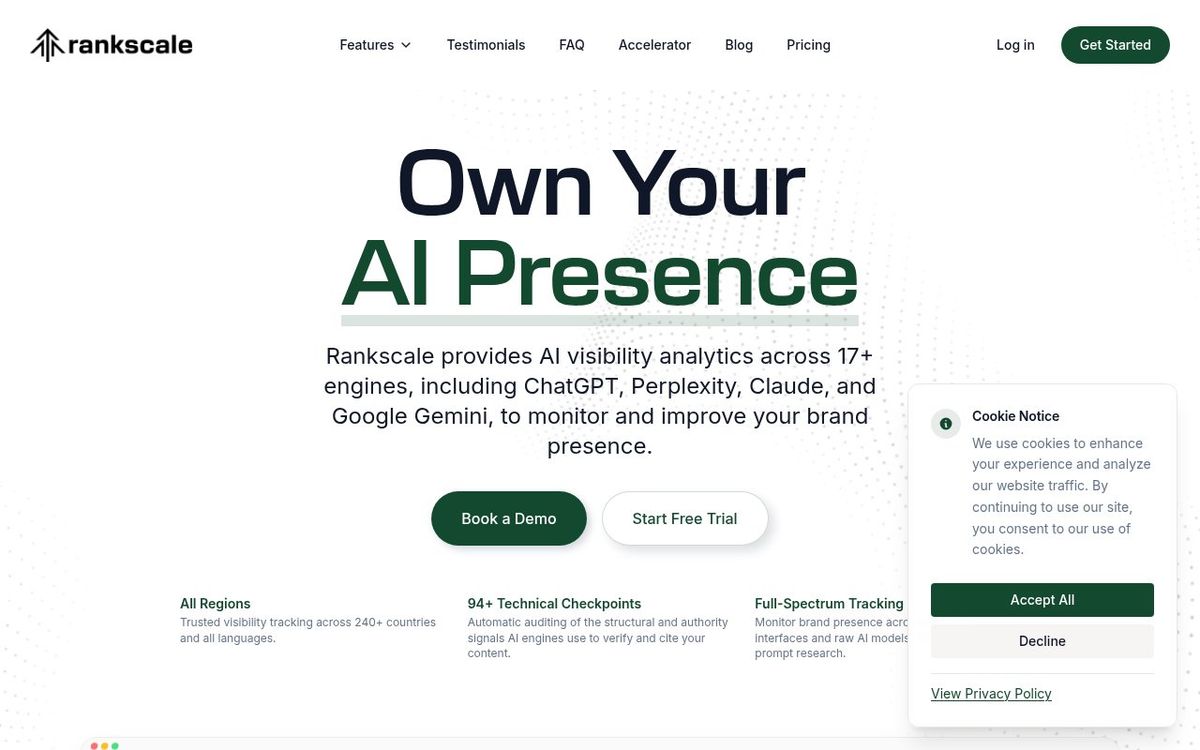
5. Rankscale — Best Value AI Visibility Tracker for Small companies
- Best for: Smaller businesses with lean budgets
- LLMs covered: ChatGPT, Perplexity, Gemini, Claude, Microsoft Copilot, Google AI Overviews
- Starting price: $20/month with credit-based pricing which can be confusing at start
- Standout feature: Lightweight tracking at the lowest price point in this category
Rankscale offers AI visibility tracking at a starting price that undercuts other competitors on this list, but once you start tracking several engines on a daily basis, the price starts going up.
Key capabilities:
- AI overview visibility tracking with interactive graphs and trend indicators
- Share of voice quantification across multiple LLMs
- Citation and sentiment analysis with source filtering
- Competitor benchmarking to identify strategic advantages
- Centralized brand dashboard with visibility metrics, citation sources, and sentiment scores
Rankscale is a great starting point for smaller companies looking to get into AI visibility tracking. It relies on API-based analysis, so the data you see can differ greatly what the users actually see in the AI engines user interfaces.
6. Peec AI — Best for Brand Perception Monitoring Across LLMs
- Best for: Brand managers, PR teams, and marketers focused on brand reputation in AI
- LLMs covered: ChatGPT, Perplexity, Gemini, Microsoft Copilot, Google AI Overviews
- Starting price: €85/month (Starter for Brands). Peec AI now offers separate pricing for brands and agencies. Brand plans: Starter €85/mo (50 prompts, 3 models), Pro €205/mo (150 prompts), Advanced (350 prompts, multi-country), Enterprise custom. Agency bundles also available. 15% annual discount.
- Standout feature: AI perception scoring with recommendation engine
Peec AI takes a brand-perception-first approach to AI visibility. Rather than focusing exclusively on citations and rankings, Peec monitors how AI engines perceive and describe your brand, products, and services — and provides actionable recommendations to improve that perception.
Key capabilities:
- Brand perception scoring that quantifies how AI models discuss your brand
- Sentiment tracking across multiple AI platforms
- Competitor perception comparison with benchmarking
- AI-powered recommendations for improving brand positioning in LLM responses
- Trend analysis showing how perception changes over time
Peec AI is particularly valuable for brands where how they are described matters as much as whether they are mentioned. If your competitive advantage depends on positioning and messaging, Peec provides the perception data most visibility tools overlook. Relies entirely on API-based analysis, which can lead to significant differences from what users actually see in the interfaces.
7. AIclicks — Best for Prompt-Level Visibility Optimization
- Best for: SEO specialists and content strategists focused on specific query optimization
- LLMs covered: ChatGPT, Perplexity, Gemini, Claude
- Starting price: $59/month
- Standout feature: Granular prompt-by-prompt visibility tracking
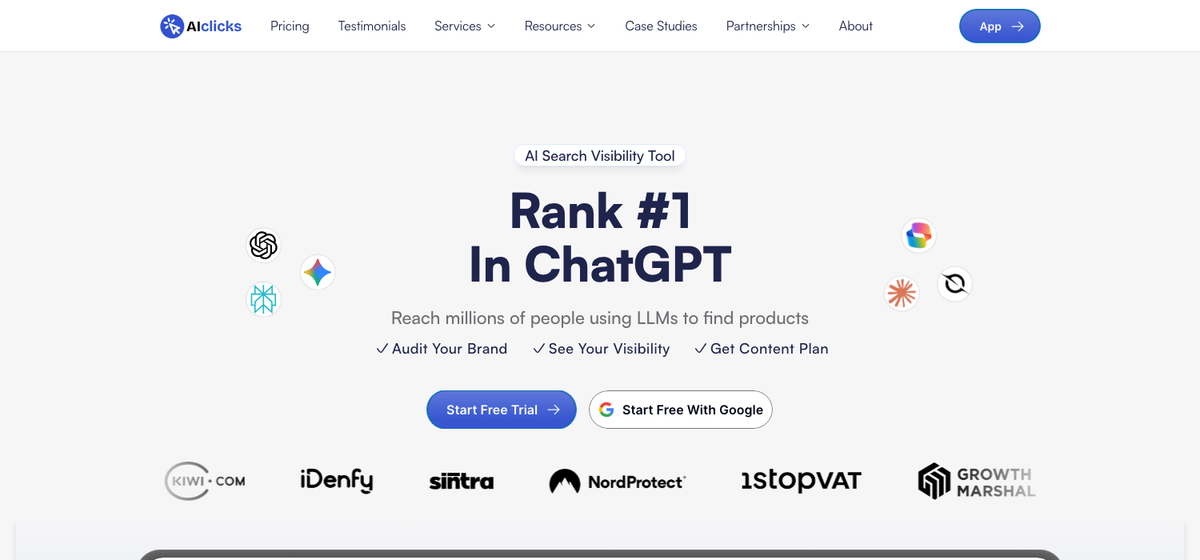
AIclicks focuses on the prompt level: it tracks how your brand appears for specific prompts and queries across AI platforms, then provides optimization guidance for each one. This granular approach is useful for teams that want to improve visibility one query at a time.
Key capabilities:
- Prompt-by-prompt tracking showing exactly how each AI model responds to target queries
- Visibility optimization suggestions per prompt
- Competitor analysis at the query level
- Citation tracking with source attribution
- Historical trend data showing visibility changes for each tracked prompt
AIclicks is less of a broad dashboard and more of a tactical optimization tool. It works best for teams that have a defined list of priority queries and want to systematically improve their AI visibility for each one. Relies entirely on API-based analysis, which can lead to significant differences from what users actually see in the interfaces. Relies entirely on API-based analysis, which can lead to significant differences from what users actually see in the interfaces.
8. Ahrefs Brand Radar — Best for Integrated Brand Monitoring
- Best for: Brands focused on digital PR and SEO who already use Ahrefs
- LLMs covered: ChatGPT, Perplexity, Gemini, Microsoft Copilot, Google AI Overviews
- Starting price: €179/month (Brand Radar)
- Standout feature: AI visibility combined with traditional SEO monitoring
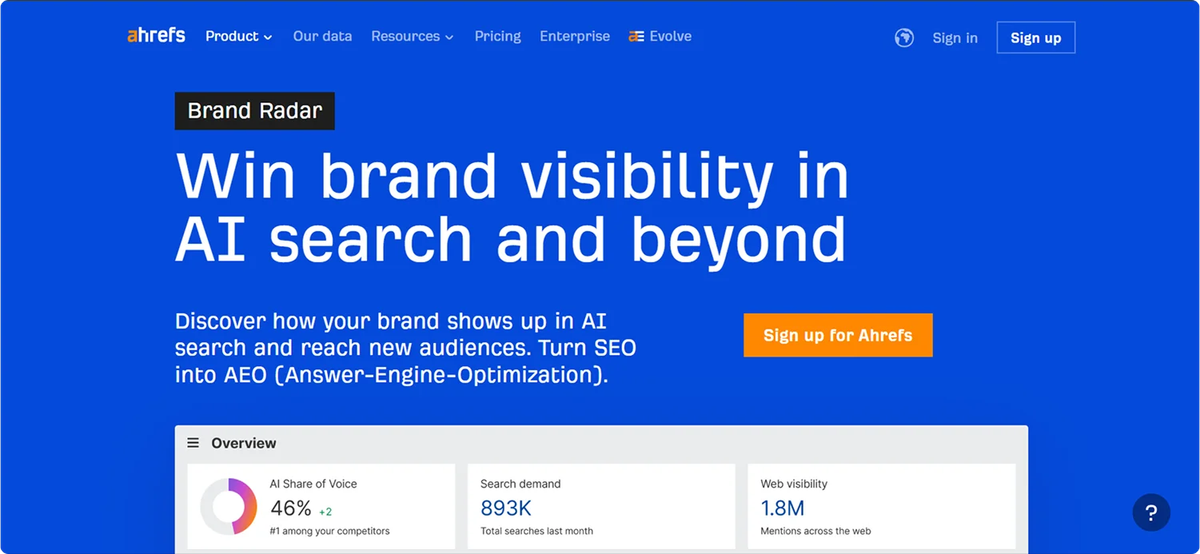
Ahrefs Brand Radar extends Ahrefs' established brand monitoring capabilities into AI search. It tracks brand mentions across major LLMs and provides visibility insights alongside Ahrefs' industry-leading backlink and keyword data.
Key capabilities:
- Real-time brand mention tracking across AI chatbots
- Competitor brand tracking with side-by-side comparison
- AI-powered filtering to surface the most relevant mentions
- Integration with Ahrefs' backlink, keyword, and site audit tools
The main drawback is price: at €179/month for the Brand Radar, it is one of the most expensive options on this list. But for teams already invested in the Ahrefs ecosystem, the integrated experience is valuable — you avoid switching between tools for AI visibility versus traditional SEO data.
9. xFunnel — Best for Citation Analytics and Deep-Dive Research
- Best for: Marketing teams, agencies, and enterprises focused on understanding why they appear (or don't) in AI answers
- LLMs covered: ChatGPT, Perplexity, Gemini, Claude, Microsoft Copilot, Google AI Mode
- Starting price: Custom pricing (free plan available)
- Standout feature: Deep citation analytics with dedicated analyst support
xFunnel measures visibility across leading AI search engines and goes deep on citation analytics — understanding not just where you appear, but why you appear and which sources drive those citations.
Key capabilities:
- Citation analytics breaking down sources, frequency, and patterns
- AI search visibility tracking with share of voice metrics
- Response and intent analysis understanding why AI models select certain sources
- Dedicated analyst support for interpreting data and building strategies
- Experimentation platform for testing visibility improvement tactics
xFunnel is one of the few tools that pairs software with human analyst support. If your team needs help interpreting AI visibility data and translating it into strategy, this combination is compelling. Pricing information is not available on their site, but they do offer a free trial to evaluate the platform before committing to their custom plans.
10. Surfer SEO AI Tracker — Best for Content-First SEO Teams
- Best for: Content marketers, SEO agencies, bloggers, and freelancers
- LLMs covered: ChatGPT, Perplexity, Claude, Google AI Overviews
- Starting price: $119/month AI visibility tracking from Standard plan onwards
- Standout feature: Content optimization scoring combined with weekly AI visibility tracking
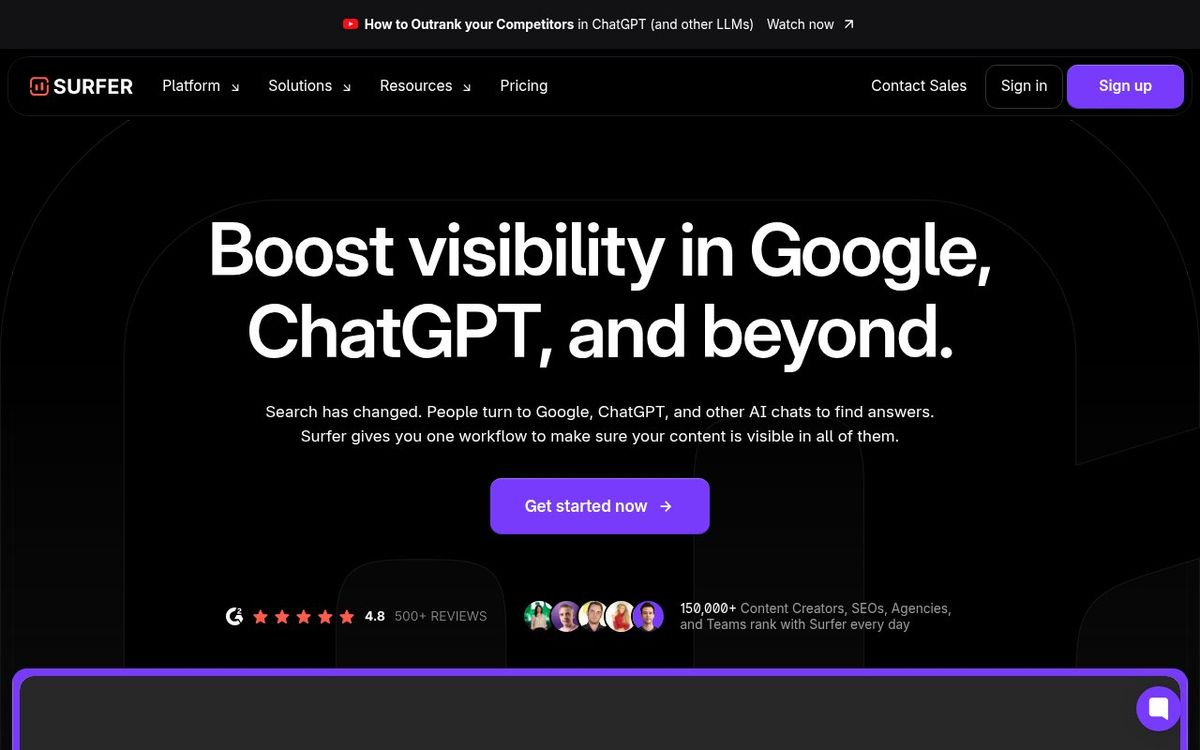
Surfer SEO AI Tracker adds AI visibility monitoring to Surfer's content optimization platform. If you already use Surfer for on-page SEO and content scoring, the AI Tracker extends that workflow to generative search.
Key capabilities:
- AI-generated content score measuring how AI-optimized your content is
- Brand, product, and topic mention tracking across AI platforms
- Automated prompt generation based on your brand and topics
- Clean charts and visualizations showing visibility changes over time
- Content optimization suggestions specific to AI search
Teams already committed to Surfer, this is a natural extension to include AI visibility tracking to their subscription. If you are already subscribed to their Standard plan, you can start tracking 25 prompts on a weekly basis in ChatGPT.
This platform is mainly focused on content creation only.
11. BrightEdge — Best for Enterprise-Scale SEO and AI Visibility
- Best for: Enterprise businesses and large agencies with significant SEO operations
- LLMs covered: ChatGPT, Perplexity, Microsoft Copilot, Google AI Overviews
- Starting price: Custom pricing (enterprise)
- Standout feature: 10+ years of historical SEO data combined with AI visibility monitoring
BrightEdge brings enterprise-grade infrastructure to AI visibility monitoring. Built on over a decade of SEO data and 4 billion data points, BrightEdge connects AI visibility with business impact, persona mapping, and traditional search performance.
Key capabilities:
- AI-driven SEO recommendations with zero-click analysis
- URL-level tracking showing exactly which pages appear in AI summaries
- Keyword opportunity identification for AI Overview triggers
- Real-time data on content appearances in AI-generated responses
- BrightEdge Copilot providing prompt-based optimization recommendations
BrightEdge is built for organizations with complex SEO operations that need AI visibility integrated into existing enterprise workflows. The custom pricing reflects this positioning — it is not designed for small teams or individual practitioners.
BrightEdge pricing is customized based on enterprise needs, typically requiring a 12-month contract, with third-party estimated costs for mid-market to enterprise teams ranging from $50,000 to over $100,000 annually.
12. Moz Pro — Best for Traditional SEO Teams Expanding to AI
- Best for: Small to medium-sized businesses looking for an all-in-one SEO tool with AI tracking
- LLMs covered: Google AI Overviews
- Starting price: $49/month
- Standout feature: AI Overview tracking within a familiar, established SEO toolkit
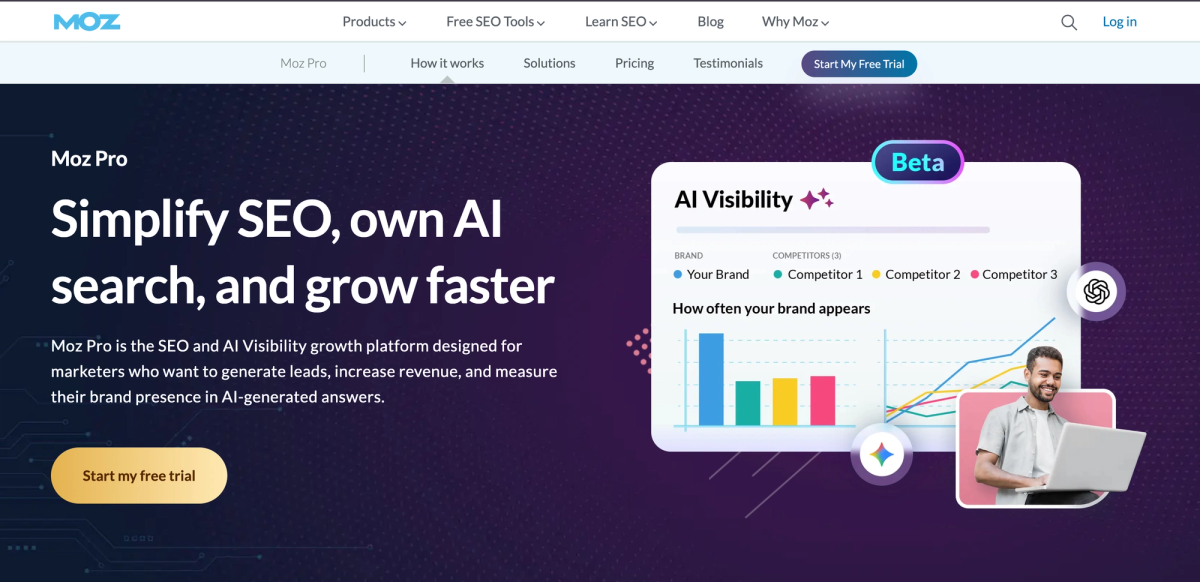
Moz Pro is a well-established SEO platform that has added AI Overview tracking to its feature set. While its AI coverage is limited compared to dedicated AI visibility tools, it provides an entry point for teams that want to start monitoring AI search without adding a new vendor.
Key capabilities:
- AI Overview tracking based on keyword research data
- Rank tracking across millions of keywords
- Domain authority and brand authority metrics
- Site crawling with technical SEO recommendations
- Competitor research with keyword gap analysis
Moz Pro's AI visibility features are the most limited on this list — it only tracks Google AI Overviews, missing ChatGPT, Perplexity, Claude, and other major platforms entirely. For teams that primarily care about Google's AI features, this may be sufficient. For anyone needing cross-platform AI visibility, Moz Pro should be supplemented with a dedicated tool.
How to Choose the Right AI Visibility Dashboard for Your Goals
AI search visibility tools are still a young category, and choosing the right one depends on your specific situation. Here are the factors that matter most when evaluating the best dashboards for AI search visibility.
1. LLM Coverage
The number of AI platforms a tool monitors directly affects how complete your visibility picture is. If you only track ChatGPT, you miss visibility (or gaps) on Perplexity, Gemini, Claude, and Copilot — platforms that collectively handle hundreds of millions of queries. Prioritize tools that cover at least ChatGPT, Perplexity, Gemini, and Google AI Overviews as a baseline, with Claude and Copilot as strong additions.
2. Actionability
Data without direction is just noise. The best AI search visibility dashboards do not just show you metrics — they tell you what to do about them. Look for tools that provide specific content recommendations, identify which competitor pages are earning citations you are not, and map the optimization path from visibility gap to improved presence. This is where platforms like Superlines differentiate from pure-monitoring tools.
3. Budget
Pricing in this category ranges from $20/month to enterprise custom pricing. Consider what you actually need: a startup running 50 queries might get full value from Rankscale at $20/month, while an enterprise tracking thousands of prompts across a dozen competitors needs the scale of BrightEdge or Superlines. Start with the number of prompts and competitors you want to track, then match that to a pricing tier.
4. Integration With Existing Tools
If your team already uses Semrush, Ahrefs, or Surfer, their AI visibility add-ons minimize the learning curve and keep data consolidated. If you are starting fresh or want best-in-class AI visibility as a primary capability, a dedicated platform like Superlines or Profound will likely deliver more depth and faster time-to-insight.
5. Competitor Benchmarking Depth
Knowing your own visibility metrics only tells half the story. The tools that show competitor visibility, share of voice breakdowns, and citation source analysis give you the full competitive picture. This is especially important in categories where multiple brands compete for the same AI answer slots.
6. Citation and Source Analysis
Understanding which URLs and domains AI models cite is one of the most valuable features in this category. Tools that show you not just that a competitor is visible, but exactly which pages and third-party sources earn those citations, give you a concrete content strategy to follow. Citation analysis turns abstract metrics into specific content actions.
Frequently Asked Questions
What are AI search visibility dashboards?
AI search visibility dashboards are software platforms that track and analyze how brands, products, and content appear in AI-powered search engines like ChatGPT, Perplexity, Gemini, Claude, and Microsoft Copilot. They monitor brand mentions, URL citations, sentiment, share of voice, and competitive positioning in AI-generated responses — giving businesses a data-driven view of their presence in the growing AI search ecosystem.
How much do AI search visibility tools cost in 2026?
Pricing ranges from $20/month for entry-level tools like Rankscale to custom enterprise pricing for platforms like BrightEdge and xFunnel. Most mid-range tools cost between $29 and $139/month. Many offer free trials or limited free plans, making it possible to evaluate before committing. The right price depends on the number of queries you need to track, how many LLMs you want to monitor, and whether you need features like citation analysis or competitor benchmarking.
Which LLMs do AI visibility dashboards typically cover?
In 2026, most AI visibility tools monitor ChatGPT, Perplexity, Gemini, and Google AI Overviews as a baseline. More comprehensive platforms also cover Claude, Google AI Mode, Microsoft Copilot, Grok, Deepseek, Mistral and Meta AI. Coverage breadth matters because users split their queries across multiple AI platforms, and your brand's visibility may vary significantly between them.
Do I need an AI visibility tool if I already use Google Search Console?
Yes. Google Search Console only tracks traditional search performance — impressions, clicks, and rankings in Google's standard results. It does not track how your brand appears in ChatGPT, Perplexity, Claude, or even Google's own AI Overviews. AI visibility dashboards fill this gap by monitoring the growing share of search that happens through AI-generated answers rather than traditional blue links.
How is AI search visibility different from traditional SEO?
Traditional SEO focuses on ranking web pages in search engine results pages based on keywords, backlinks, and technical factors. AI search visibility measures whether your brand and content get cited in AI-generated answers. The ranking factors are different: AI models prioritize well-structured, authoritative, and factually accurate content that directly answers user questions. Tools built for traditional SEO do not capture these AI-specific visibility metrics.
Can I track competitor visibility in AI search?
Yes. Most AI visibility dashboards include competitor benchmarking features that let you compare your brand's visibility against competitors across the same set of queries. This includes share of voice comparisons, citation analysis showing which competitor pages get cited, and gap analysis identifying queries where competitors appear in AI answers but you do not.
To summarize
The AI search visibility tools market in 2026 has matured significantly. Teams no longer need to manually query ChatGPT and Perplexity to check if their brand appears — dedicated dashboards automate this tracking across multiple LLMs simultaneously.
The right choice depends on your goals. If you need the broadest LLM coverage with an integrated workflow for actually improving your visibility, Superlines stands out as the platform that combines tracking with actionable GEO recommendations. For enterprise teams already invested in traditional SEO suites, Semrush and Ahrefs offer the path of least resistance. And for teams just getting started, Rankscale and Otterly.AI provide excellent value at accessible price points.
Whatever tool you choose, the important thing is to start tracking now. AI search is not a future trend — it is where your customers are already searching today.