


ChatGPT tracking tools show whether your brand is mentioned, recommended or cited when people ask questions relevant to your business. The useful evidence is the recorded answer: which brands appear, what ChatGPT says about them, which pages it visibly cites and recommendations on what to do next to improve your brands visibility.
This guide compares dedicated AI Search analytics platforms and ChatGPT tracking capabilities within existing SEO tools. It is written for enterprise marketing teams, agencies and in-house SEO teams choosing what to monitor, how to report it and which subscription to buy.
Disclosure: Superlines publishes this guide and is included in the comparison. Product descriptions and purchasing terms are based on first-party documentation checked on 14 October 2026. The fit recommendations are editorial judgments, not results of firsthand accuracy or usability testing. Display order is not a performance ranking.
TL;DR: choosing a ChatGPT tracking tool
ChatGPT tracking tools: quick comparison
The table highlights the substantial profiles below. Other relevant options follow in a shorter alternatives section. Check the cost of ongoing monitoring, including any required SEO subscription or AI tracking add-on. A price advertised per month may require annual billing, while a free trial does not show what continued tracking will cost.
What useful ChatGPT monitoring should show
Traditional rank tracking asks, “Where does my website rank for payment management software?” ChatGPT tracking asks, “Does ChatGPT recommend my brand when someone asks which payment management tool suits a small ecommerce business?” A Google position does not answer the second question.
Choose a tool that lets you open the recorded ChatGPT answers when visibility changes. Look at the question, when the answer was collected, the market, competing brands and cited URLs to understand what changed.
Mentions, citations and placement are different signals
Brand Visibility shows how often your brand appears in a tracked answer sample. Citation Rate shows how often the relevant website is visibly cited, using the tool's stated denominator. Sentiment describes the tone of answers mentioning the brand. These are the core views to inspect, with competitor comparisons, positioning and source analysis providing context.
A brand can be mentioned without its website being cited. A page can be cited without its product being recommended. And being first in a generated list is placement within that answer, not a stable Google-style ranking.
Ask how each vendor calculates Share of Voice and visibility scores before comparing percentages between systems. For definitions and examples, see our guide to generative search metrics.
Your own prompts versus a discovery dataset
Repeated custom tracking is useful for questions such as “best CRM for a European sales team,” “Is Acme suitable for a regulated business?” and “Acme versus Beta CRM.” Keep branded evaluation questions separate from unbranded category and comparison questions so you can see discovery gaps.
A broad discovery dataset helps you investigate which topics, brands and sources appear across a vendor's existing collection. It may offer immediate historical research, but it does not automatically include your niche questions or markets. Keyword-led tools can generate prompt variants; check whether you can inspect and control those variants when exact question coverage matters.
Search query fan-outs are background searches generated while an AI system finds information. They can suggest adjacent topics to investigate, but they are not the original user's prompt or a direct measure of market demand.
Tracking frequency, markets and recorded answers
Daily tracking can help you follow a campaign; weekly tracking may be enough for less frequent reviews. Check how often the tool collects new ChatGPT answers, as reports may be updated or delivered on a different schedule. Compare the same questions, ChatGPT experience, market and language over time. When visibility changes, read several recorded answers before deciding how to respond.
Tools may collect answers through ChatGPT’s browser interface, through an API, or both. Check which experience the tool monitors and whether you can inspect the recorded answers. Our API-versus-UI collection guide explains how these methods work and why the answers they collect can differ.
Dedicated ChatGPT analytics platforms
Superlines: analytics across brands and markets
Superlines provides AI Search analytics for enterprise marketing teams and agencies. Use it to inspect Brand Visibility, Citation Rate and Sentiment, compare competitors and investigate source domains, exact URLs and answers across ChatGPT and other engines. Its platform overview shows how these views support identifying gaps and prioritizing recommendations through the Action Center.
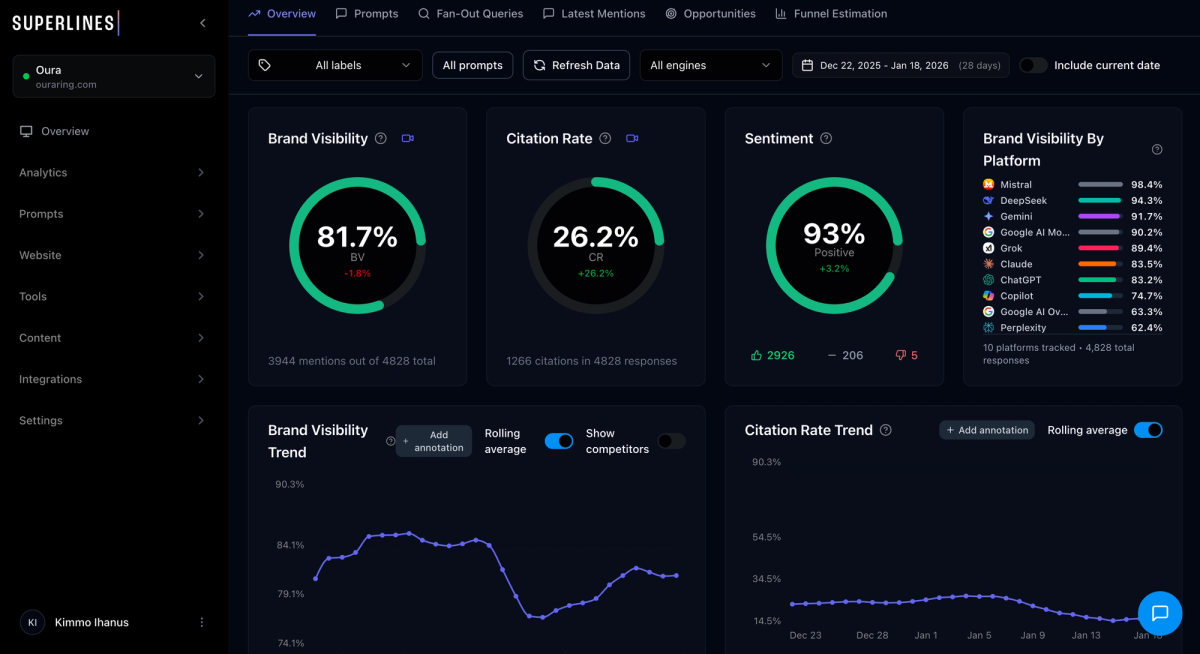
Subscription and reporting: Brand Starter is €79/month for 50 prompts, one brand, three selected engines and one month of history. Pro is €199/month with 150 prompts, three brands, exports and two months of history. Growth is €379/month with 300 prompts, seven brands, API access and six months of history. MCP access is listed across plans. The separate agency plans allow 5, 10 and 20 client brands respectively; Enterprise offers unlimited brands and tailored coverage. See current pricing.
Buying trade-off: Starter is a monitoring entry point, but external reporting through exports requires Pro and API workflows require Growth. Three selected engines are not the entire available engine catalog. MCP lets external AI assistants work with Superlines data; it does not itself publish content or turn recommendations into completed edits.
Profound: tailored enterprise tracking and shopping analysis
Profound's Answer Engine Insights supports examining brands and competitors in AI responses, including citations, sentiment and positioning. It is worth evaluating when a team needs tailored regional coverage or ChatGPT Shopping alongside ongoing monitoring.
Subscription and reporting: The current brand offer is a free Trial and custom Enterprise, replacing the older Starter/Standard prices. The trial runs 50 recommended prompts daily for seven days across ChatGPT, Gemini and Google AI Overviews, in one region and language. Enterprise supports customized prompts, ongoing daily tracking, shopping, CSV/JSON exports and API access. Profound pricing
Buying trade-off: You cannot customize the trial's prompts, and it has no exports or API. It is useful for inspecting the product, but not for validating every question in your own monitoring program. Specify prompt coverage, markets, history and data access in the enterprise package. Agency Growth costs $99/month plus $399/month per ongoing client workspace, or $498/month with one client workspace. Each client workspace tracks 100 prompts daily across ChatGPT, Perplexity and Google AI Overviews, with CSV/JSON exports but no API access. Included pitch workspaces run for seven days with an option to extend; they are time-limited evaluations rather than ongoing client monitoring.
Peec AI: daily prompt, competitor and source analysis
Peec AI supports investigating brand visibility and positioning through prompt results and source analysis. Its chat documentation shows answers, mentioned brands, locations and a source sidebar. This is relevant for marketing teams that want to move from a trend to the evidence behind it.
Subscription and reporting: The rendered monthly brand cards list Starter at €85 for 50 prompts and one project, Pro at €205 for 150 prompts and two projects, and Advanced at €425 for 350 prompts and five projects. Each selects three models and lists daily tracking and unlimited users. Additional models are paid add-ons. Advanced lists multi-country tracking and Looker Studio; Enterprise lists API access and custom coverage. Peec pricing
Buying trade-off: Project and model allowances matter for an agency or international team. Country and data-access descriptions differ between some public pages, so confirm your required markets, CSV/MCP access and connector entitlement for the selected package. Separate agency bundles are available; do not assume the brand Starter project allowance covers a client portfolio.
OtterlyAI: recurring prompt monitoring with a low entry price
OtterlyAI combines brand monitoring, link citation analysis and GEO audits. Its product overview is useful for buyers who want a focused way to review prompts and cited pages rather than another full SEO suite.
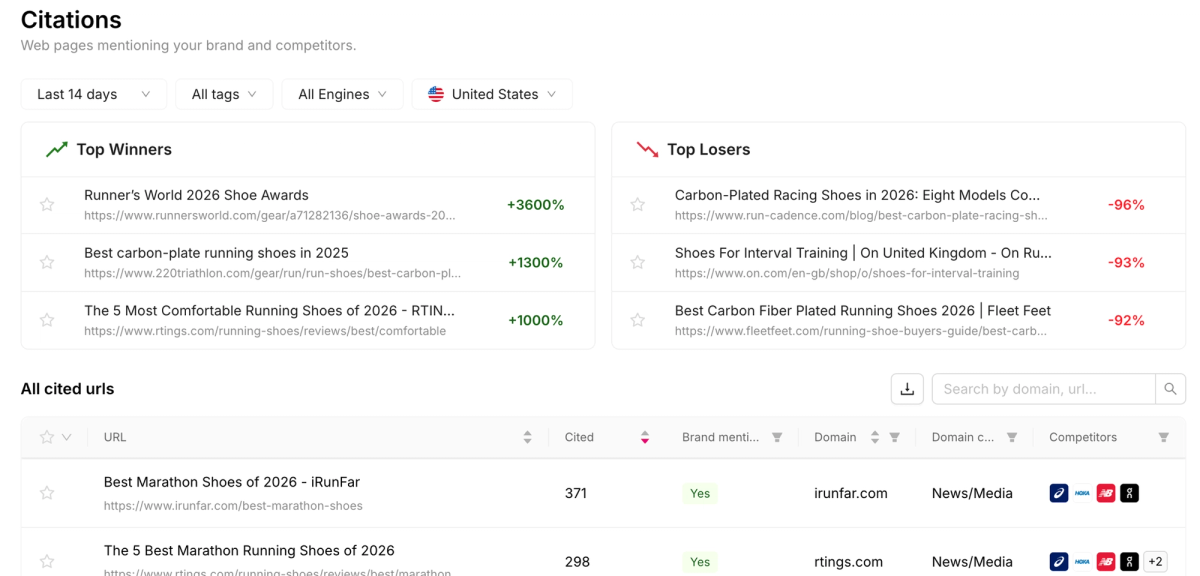
Open the full-size OtterlyAI screenshot to inspect the cited-page fields.
Subscription and reporting: Lite is $29/month for 15 prompts, Standard $189 for 100 and Premium $489 for 400. Daily tracking includes ChatGPT, Perplexity, Google AI Overviews and Copilot; Claude, AI Mode and Gemini cost extra. Lite includes reports/exports and one workspace. Standard adds unlimited workspaces, a Data Studio connector, API/MCP access and Agent Analytics, with usage limits. OtterlyAI pricing
Buying trade-off: A small ChatGPT pilot can fit Lite, but external integrations require Standard. Include extra engines and prompt expansion in the bill; the low entry price is not the price of every workflow.
AthenaHQ: response-level analysis and credit-based monitoring
AthenaHQ combines prompt/response analysis, source and competitor insights, recommendations and action workflows. It suits buyers who want to allocate monitoring across a broader model mix and evaluate recommendations alongside the evidence.
Subscription and reporting: Starter is $295/month with 3,600 credits; the plan table defines one credit as one AI response. It lists coverage across 11 models, CSV exports and integrations. API access and additional credits are paid add-ons with quoted prices. Enterprise adds multi-region/multi-language support, tailored allocation and BI-oriented reporting. A free Essential offer has 300 credits; it is a separate starting allowance. AthenaHQ plans
Buying trade-off: A response allowance is not a count of unique prompts tracked every day. For example, 40 prompts run on three engines daily for 30 days require 3,600 responses, before other runs. Confirm how schedules and any additional operations affect credits, and request the total including API access if your reporting needs it.
Scrunch: custom and industry prompts with site diagnostics
Scrunch combines custom prompt monitoring, industry-prompt coverage, citations, page audits and agent traffic monitoring. It is relevant when a marketing team wants to inspect brand representation and website information alongside visibility trends.
Subscription and reporting: Starter is $300 month-to-month or $250/month billed annually, with 350 custom prompts, 1,000 industry prompts, three users and five page audits. Growth is $500 monthly or $417/month annually, with higher allowances. The overview names ChatGPT, Claude, Gemini, Perplexity, AI Mode, AI Overviews and Meta. Enterprise includes the Enterprise Data API and expanded support/security. Scrunch pricing
Buying trade-off: Separate the prompts you define from the supplied industry collection. Check export formats and regional configuration in a demo; the plan overview does not establish every reporting entitlement. AXP is a separate capability to evaluate for serving AI traffic, not evidence that monitoring or a website variant will improve visibility.
Promptwatch: daily tracking with API and MCP at entry level
Promptwatch offers prompt monitoring, competitive analysis and citation investigation alongside optional agent, crawler and content workflows. Its product overview is useful for teams deciding whether they need analytics alone or a wider execution suite.
Subscription and reporting: Essential is $95/month with one project, 50 prompts, four models, country-level tracking and API/MCP access. Professional is $245/month with two projects, 150 prompts and Agent Analytics. Business is $579/month with five projects, 350 prompts and state/city-level tracking. The plan table lists daily collection. Promptwatch pricing
Buying trade-off: Four included models are not the full supported catalog. Specify ChatGPT in your selection and check the report/export format and geographic detail you need. Crawler or conversion analysis may require extra implementation; that is a different requirement from running tracked prompts. The higher plan is relevant when those traffic views or finer locations are part of the job.
SE Visible: daily tracking across multiple projects
SE Visible, from SE Ranking, supports buyer-defined ChatGPT prompts, competitor comparisons, individual results and cited-source analysis. It merits consideration for teams managing several projects with shared access, rather than only for existing SE Ranking users.
Subscription and reporting: Basic is $99/month with 200 prompts and three projects; Core $189 with 450 prompts and five projects; Plus $355 with 1,000 prompts and ten projects. The current product page says added prompts run daily across all five included engines: ChatGPT, Gemini, Perplexity, AI Mode and AI Overviews. It documents CSV exports; beta API documentation covers metrics, prompt results and cited sources.
Buying trade-off: The included daily engine mix is different from a plan where you choose only three models. Confirm API access/limits and country coverage for your package. More customized reports and sharing features remain on the public roadmap, so inspect the report you can actually deliver today rather than treating planned features as included.
ChatGPT monitoring within an existing SEO stack
Semrush AI Visibility Toolkit: research plus custom tracking
Semrush separates broad AI research, Brand Performance and tracking of your own prompts. This is useful if your team wants ChatGPT evidence alongside its existing SEO work, or needs discovery research as well as a recurring prompt set.
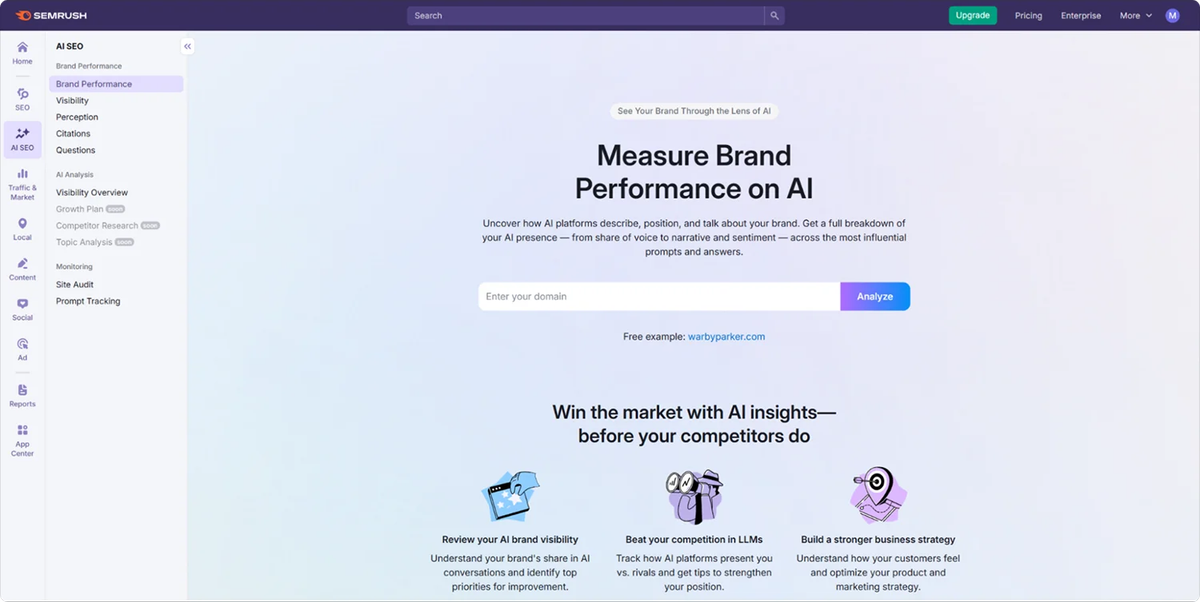
Open the full-size Semrush screenshot to inspect the navigation.
Subscription and reporting: The standalone Base offer is advertised at $99/month per domain, billed annually, with 25 custom prompts and one Brand Performance domain. Documentation lists ten daily CSV exports per user. Extra 50-prompt packages cost $60/month; extra Brand Performance domains or locations cost $99 each. Separate user licenses can also add cost. Semrush One bundles SEO and AI with different allowances. Official toolkit documentation
Buying trade-off: Custom tracking updates daily, while Brand Performance updates weekly. Existing SEO access does not mean every AI feature or additional user is included. The pricing page and documentation differ on month-to-month purchasing; confirm those terms at checkout rather than assuming the advertised annual price is available without a commitment. AI pricing
Ahrefs Brand Radar: discovery index or custom prompts
Ahrefs now offers two distinct routes. Brand Radar's AI Visibility Index supports broad topic, brand and competitor research; Custom Prompts monitors questions you configure. The latter matters when a discovery dataset does not cover your niche. Brand Radar overview
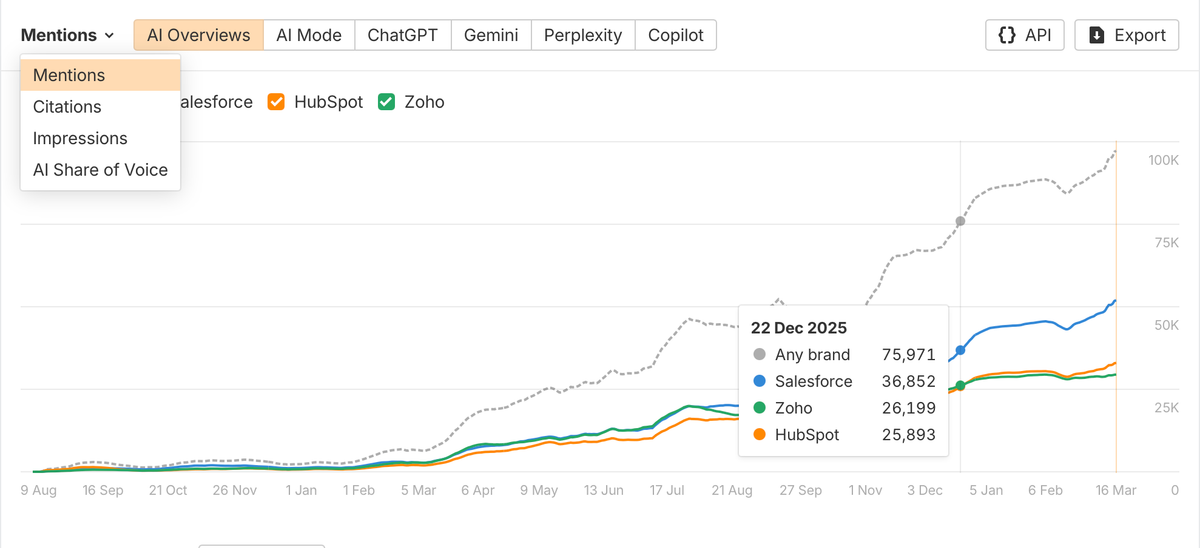
Open the full-size Ahrefs screenshot to inspect the metric and platform controls.
Subscription and reporting: Custom Prompts can be purchased without an existing Ahrefs SEO subscription. The current euro offer lists 2,500 checks at €46.70/month, with overages. Eligible Lite, Standard and Advanced SEO plans include 150, 300 and 600 custom checks/month; additional packages can extend those allowances. Checks are consumed by platform, location and update; daily, weekly and monthly schedules are available. Broad discovery-index access is separately priced, with rendered pricing starting at €179/month. Custom Prompts pricing and allowances
Buying trade-off: Five daily prompts on one platform can use Lite's 150 monthly checks; adding markets or engines increases consumption. Choose the index for broader discovery and custom checks for controlled monitoring. API data access is documented, but confirm the entitlement for your specific custom/index package.
SEOmonitor: keyword-led ChatGPT evidence beside Google rankings
SEOmonitor uses tracked keywords as the basis for AI Search monitoring across ChatGPT, Claude, Gemini and Perplexity. This suits teams wanting a shared keyword strategy across Google and AI, rather than maintaining an entirely separate prompt program. Its AI Search product page distinguishes mentions and citations and explains the keyword-led approach.
Subscription and reporting: Current base plans start at €99/month for Starter and €299/month for Pro. AI Search volume is a separate pricing input; the product page advertises €19 per 1,000 AI Search keywords. Pro lists API, MCP beta and native Looker Studio access. SEOmonitor pricing
Buying trade-off: ChatGPT/AI Search tracking is weekly, distinct from daily Google and AI Overview tracking. Confirm the total for your campaigns and AI keyword allocation. Ask to see the generated question and answer evidence, and check whether the keyword-led coverage matches the buyer questions you need. It serves brands as well as agencies.
Other relevant ChatGPT tracking options
These tools remain useful alternatives for particular workflows. Their shorter profiles reflect the narrower decision they help readers make, not a finding that their data is inferior.
Writesonic: tracking alongside content and SEO workflows
Writesonic is relevant if you want monitoring and content tools in one subscription. Starter includes ChatGPT, Gemini and AI Overviews, 50 prompts and one project at $79/month billed annually. Basic is $199/month annually; Growth $399/month annually; Enterprise is custom. Sentiment is included on Growth, while full Action Center and wider engine coverage are Enterprise features. Starter's listed 50 daily answers differ from its 50 prompts and three named engines: confirm how answers are allocated before assuming every prompt runs on every engine daily. Writesonic pricing
ZipTie: configurable prompts, engines and schedules
ZipTie now operates at ziptie.ai. It prices prompt slots by selected engines and daily, weekly or monthly cadence; seats, projects and exports are included. API/MCP is a $10/month add-on. Agency readers should note the stated absence of white-label reports and cross-client rollups. Use its calculator for your configuration instead of relying on the former $179 starting price. A seven-day trial uses a fixed 25-prompt daily setup. ZipTie pricing
Morningscore: ChatGPT tracking within a simpler SEO suite
Morningscore combines SEO tasks and reporting with ChatGPT tracking. Current monthly plans are $69, $99, $159 and $299, including 100, 1,000, 5,000 and 20,000 AI credits respectively. Its plan comparison makes reporting and export gates relevant: the full report tool starts on Business, and ongoing reports on Pro. API access is advertised across plans. Confirm ChatGPT check consumption and scheduling before translating AI credits into a recurring prompt allowance. For replacement-specific guidance, see Morningscore alternatives. Official pricing
LLMrefs: keyword-led tracking and weekly reports
LLMrefs generates prompts around keywords and aggregates brands and sources, offering a different workflow from manually managing every question. Its All in One offer is $79/month, marked limited-time, with 500 prompts, weekly refreshed AI visibility reports, unlimited projects/users and CSV/API access. Check how much control you have over generated variants and whether the collection schedule meets your needs. Do not treat the keyword or generated-prompt allowance as an identical unit to another vendor's custom daily prompt slot. LLMrefs product and pricing
Xofu: client-facing reports at different frequencies
Xofu's current offer emphasizes brand recommendations and client reporting. It lists a free allowance of 50 prompts per model, Consultant at $99/month, Agency Weekly at $499 and Agency Daily at $999. The plan cards and detailed table differ on engine inclusion and report-edit access, so confirm those entitlements and the actual collection cadence for your chosen plan. Reporting frequency alone does not establish run frequency. The current vendor is xofu.com, not the old linked xofu.ai domain. Xofu pricing
Atomic AGI: analytics purchased per project
Atomic AGI is relevant for teams combining SEO analysis, ChatGPT mentions/citations and report workflows. Starter is $40/month per project with 75 prompts refreshed every 72 hours, up to three models, sentiment and MCP; Team is $100/month per project with 240 prompts refreshed every 48 hours, broader coverage and custom-domain reports. A free offer has seven days of history. For several brands, calculate the project total and confirm any external data-access requirements beyond the listed MCP and reporting features. Atomic AGI pricing
OmniSEO: channel and seat allowances that change by plan
OmniSEO's current Essentials is $89/month with 50 saved prompts, four channels including ChatGPT, five competitors and five seats; it does not list exports. Professional is $349/month with 100 saved prompts, ten channels and ten seats, plus CSV/PDF exports limited to 5,000 rows per month. Enterprise starts at $899+ with custom scale, unlimited seats and CSV/PDF/JSON exports. Confirm that the selected channel package covers the ChatGPT surface you need and how often saved prompts run. A saved-prompt allowance is not automatically a number of daily responses. OmniSEO pricing
XFunnel and HubSpot AEO: check the current purchasing route
XFunnel remains relevant to buyers investigating funnel-based AI visibility and analyst support, but it should no longer be presented without its HubSpot context. HubSpot's acquisition announcement describes expanding AEO capabilities; its AEO product page provides the current HubSpot route.
HubSpot AEO costs $50/month, or $45/month billed annually, for 25 prompts across ChatGPT, Gemini and Perplexity, with no additional HubSpot subscription required. AEO is also included in Marketing Hub Pro and Enterprise, with expanded prompt allowances and CRM-powered recommendations; do not assume the standalone allowance applies to those subscriptions. The existing XFunnel pricing page still lists a free one-time audit and custom Enterprise platform/services. Confirm whether those legacy XFunnel offers remain separately purchasable and how ongoing tracking, exports and services relate to HubSpot AEO. Do not assume legacy XFunnel access is included in an existing HubSpot subscription or that a free audit is recurring monitoring.
How to choose the right ChatGPT tracking subscription
An agency monitoring client brands
Start with the number of clients, questions and reporting recipients. Five clients with 20 prompts each require 100 prompt slots if those slots are pooled. That will not fit a 50-prompt plan even when five client brands are allowed. For example, Superlines Agency Starter's five-brand allowance and 50 prompts solve different constraints; Agency Pro lists 150 prompts, ten client brands and exports.
Also check client permissions, separate workspaces, scheduled reports and portfolio summaries. Unlimited projects do not guarantee cross-client rollups or white-label reports. Request a client-ready sample before choosing between a dedicated platform and the reporting tools you already use.
An enterprise comparing markets
Write down the country/language combinations you want to compare and whether each consumes separate prompts or checks. Do not accept “global coverage” as confirmation that your selected plan includes every required market.
Ask for the same category question in two priority markets, the retained answers and a competitor/source comparison. Check how long history is retained. A one-month history can support a pilot, but quarterly reporting needs retained evidence, an export process or a different package. Export access, API access and BI connectors are separate entitlements.
An SEO team keeping or upgrading its stack
Semrush users can examine custom Prompt Tracking and the AI Visibility Toolkit or a Semrush One bundle. Ahrefs users can inspect their included checks and decide whether they need more custom capacity or the broader discovery index. SEOmonitor users can price the AI keyword allocation and accept or reject its weekly cadence based on the job.
Keep the existing tool when its evidence, coverage and reporting meet the need. If the tool provides the reports you need but cannot track enough questions, compare the cost of upgrading or adding its AI tracking features. Add dedicated analytics when you need different markets, deeper source investigation or workflows your current setup cannot support. A new dashboard is useful only if it resolves a specific gap.
Price the actual monitoring workload
These examples estimate tracking capacity using a 30-day month. To estimate your cost, check how each provider counts prompts, responses or checks, adjust for your billing period, and include any extra tracking charges.
For external reporting, start with exports if your team can use them. API access supports automated retrieval into reporting systems; MCP gives compatible AI assistants a way to query the data. Either route still needs the appropriate permissions, workflow setup and review. Our AI Search analytics API comparison covers those access decisions in more detail.
Validate the evidence before committing
During a trial or demo, use a small set of questions that represents your actual buying journey. Include a category question, a branded evaluation and a competitor comparison. Ask the vendor to show:
- The stored ChatGPT answer, with its prompt, date, market and collection surface.
- Detected brand aliases, competitor mentions and visibly cited URLs, with a way to inspect errors.
- A trend for the same configured questions and markets, with changes to the tracked scope identified.
- The export or client report available on the quoted subscription, including its fields and history.
Inspect the answer context rather than treating every mention as a recommendation. Keep AI visibility separate from crawler activity, identifiable referral sessions and CRM outcomes. These reports provide different pieces of evidence that helps you get an idea of the full picture and business outcomes.
Choose a tool your team can use every week
The right ChatGPT tracking tool gives you useful evidence at a sustainable level of coverage and cost. Begin with your questions and reporting needs, then choose the plan that supports them. Once you have a baseline, use our guide to tracking brand mentions and generative AI optimization guide to investigate gaps and decide what to improve.
If you are evaluating Superlines, start a trial or book a demo with your required brands, markets and reporting workflow. Use the demo to inspect ChatGPT answers, competitor/source analysis and the relevant subscription.