


Most brands have zero visibility into what Claude says about them. The best Claude rank tracking tools let you monitor brand mentions, citations, and competitor positioning across Anthropic's Claude, so you can close the gap before competitors own the conversation.
Claude is growing fast in enterprise and developer workflows, yet most AI visibility tools either skip it entirely or treat it as an afterthought. This guide compares 6 tools that actually track Claude, explains what to look for in a Claude tracker, and helps you pick the right one for your team.
Why Track Your Brand's Visibility in Claude?
Anthropic's Claude has quietly become one of the most influential AI platforms for enterprise decision-making. While ChatGPT dominates consumer search with over 900 million weekly active users, Claude has carved out a strong position in professional, research, and developer workflows where purchase decisions happen.
Here's the problem: most brands track ChatGPT and maybe Perplexity, but completely ignore Claude. That creates a blind spot. If a procurement team asks Claude "what are the best project management tools for enterprise?" and your brand isn't mentioned, you've lost a potential deal without ever knowing it.
Claude also behaves differently from other LLMs. It tends to give longer, more nuanced responses with explicit reasoning. It cites sources differently than ChatGPT or Gemini. And its training data and retrieval patterns mean your brand might perform well on ChatGPT but be completely absent from Claude, or vice versa.
AI referral traffic now accounts for 1.08% of all web traffic and is growing roughly 1% month-over-month. That traffic is spread across multiple AI platforms, and brands that only track one or two engines are missing the full picture.
The bottom line: if you're serious about generative engine optimization, you need visibility data across every major LLM, including Claude.
Our Selection Methodology
We evaluated Claude rank tracking tools across five criteria:
- Claude Data Depth — Does the tool actually scrape Claude's UI responses, or does it rely on API calls? UI scraping captures the real user experience, including formatting, citation placement, and recommendation order. API-based tools often return different results than what users actually see.
- Multi-Platform Coverage — Claude tracking alone isn't enough. The best tools also cover ChatGPT, Gemini, Perplexity, Copilot, and Google AI Overviews so you can compare performance across engines from a single dashboard.
- Competitive Benchmarking — Can you see how competitors perform on Claude compared to your brand? Share of voice, citation frequency, and head-to-head comparisons matter for strategic planning.
- Actionable Insights — Raw data is table stakes. The best tools tell you why you're not showing up on Claude and what to do about it, whether that's content gaps, missing citations, or structural issues.
- Pricing and Scalability — Can you start small and scale up? Enterprise teams need multi-brand support, while smaller teams need affordable entry points without sacrificing Claude coverage.
Important to notice that many of the established players in the market doesn’t offer Claude straight out of the box or at all. These platorms that we are showcasing in this article, we were able to confirm that they offer Claude tracking in some of their packages and we were able to try the platforms as well.
How Does Claude Differ from Other AI Platforms for Brand Visibility?
Before diving into the tools, it helps to understand why Claude tracking requires specific attention.
Claude's response style is distinct. Claude tends to produce longer, more structured responses with explicit reasoning chains. Where ChatGPT might give a quick list of recommendations, Claude often explains why it recommends each option, including trade-offs and caveats. This means your brand might get mentioned but in a less favorable context if Claude perceives weaknesses in your offering.
Citation behavior varies. Claude's web search capabilities (via its tool-use features) work differently from ChatGPT's browsing or Perplexity's real-time search. The sources Claude pulls from and how it attributes them don't mirror other platforms. A Semrush study on AI visibility found significant variation in which brands get cited across different AI engines for the same queries.
Enterprise adoption is the key differentiator. Currently, Claude’s strongest foothold is in enterprise and developer contexts, but it’s gaining traction among the general public as a go-to choice due to its advanced agentic capabilities.
Anthropic's focus on safety and reliability has made Claude the preferred choice for many B2B workflows. If your audience includes enterprise buyers, developers, or technical decision-makers, Claude visibility matters disproportionately.
This is why tracking Claude separately (not just as one engine in a bundle) gives you strategic insight into a high-value audience segment. For a broader look at how AI platforms compare, see our breakdown of AI Mode vs AI Overviews vs ChatGPT Search.
6 Best Claude Rank Tracking Tools Compared
1. Superlines
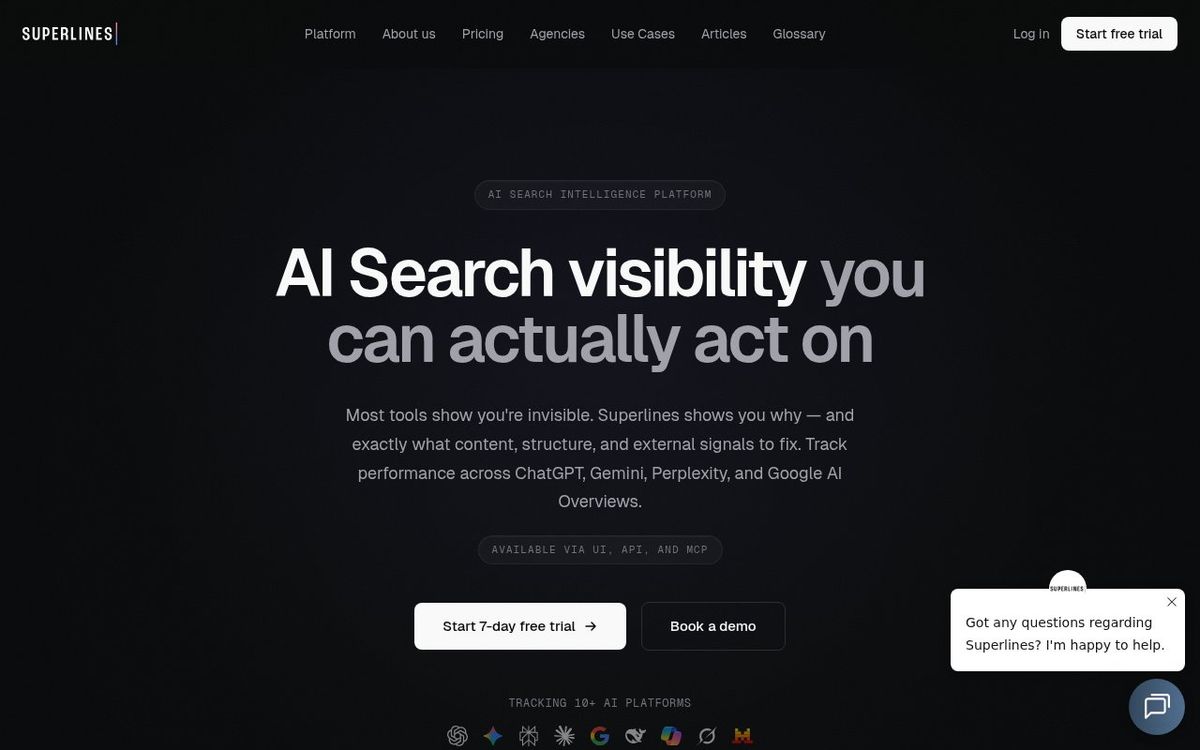
Superlines is an AI Search intelligence platform for marketing teams that tracks brand visibility across 10 AI engines, including Claude, ChatGPT, Gemini, Perplexity, Copilot, Grok, Google AI Overviews, Google AI Mode, DeepSeek, and Mistral. It uses real UI scraping (not API approximations) to capture exactly what users see when they query each platform.
What sets Superlines apart for Claude tracking is the combination of accurate data collection and actionable next steps. The platform doesn't just show you that Claude mentions your brand 3 out of 10 times. It surfaces why you're being mentioned (or not), identifies content gaps, and provides optimization recommendations.
Superlines also offers an MCP server that lets AI agents query your visibility data, run content audits, and generate optimized content programmatically. For teams building agentic content workflows, this means your AI tools can automatically check Claude performance and adjust content strategy without manual intervention.
Pricing: Starter plan at €79/mo includes 3 AI engines and 50 tracked prompts. Higher tiers unlock all 10 engines and more prompts. Claude available for tracking in all plans.
Best for: Teams that want a complete GEO platform that doesn’t just show you data, but also tells you what to do based on it. Covering Claude alongside every other major AI engine, with built-in optimization tools and agentic workflow support.
2. Profound
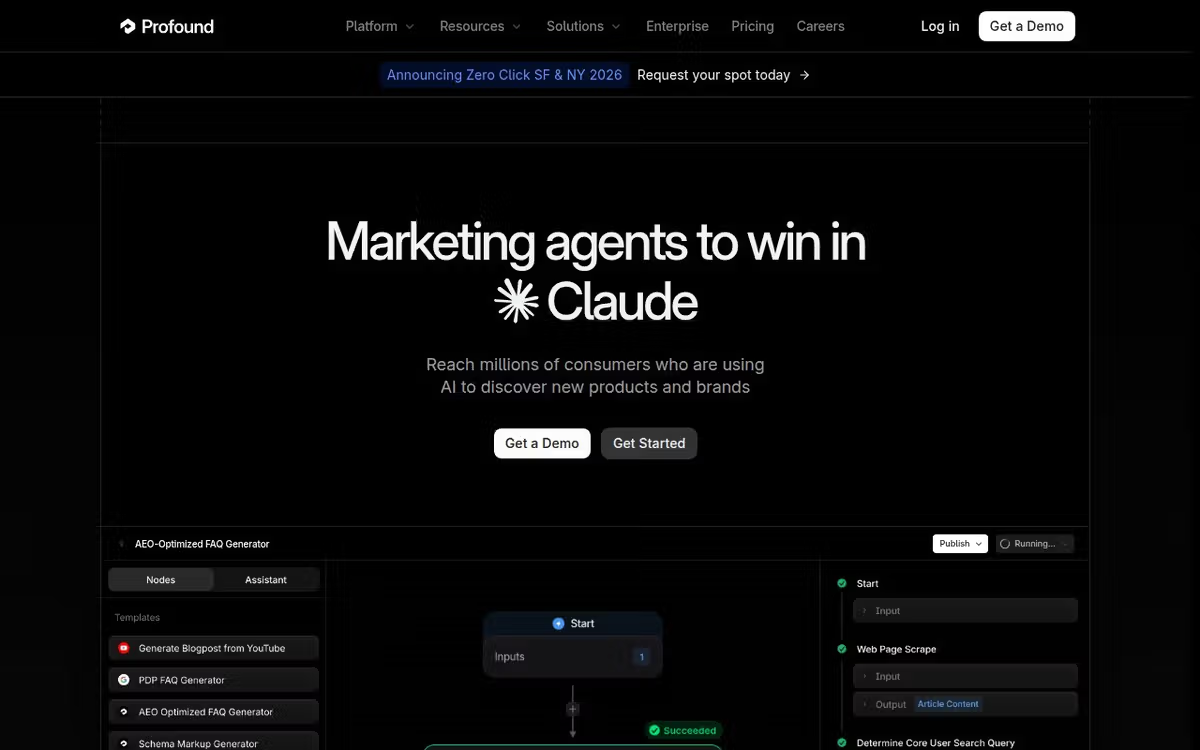
Profound takes a conversation intelligence approach to Claude tracking. Beyond simple mention counting, it analyzes how Claude frames your brand within the full context of its responses. The platform's Conversation Explorer draws from a dataset of 400M+ anonymized prompts, letting you see which types of queries trigger Claude to mention your brand and how the sentiment shifts across different prompt categories.
For Claude specifically, Profound tracks visibility across multiple AI engines and provides detailed breakdowns of how each engine treats your brand differently. This is valuable because Claude’s citation behavior differs significantly from ChatGPT's or Perplexity's, and understanding those differences is key to optimizing for each platform.
3. Peec AI
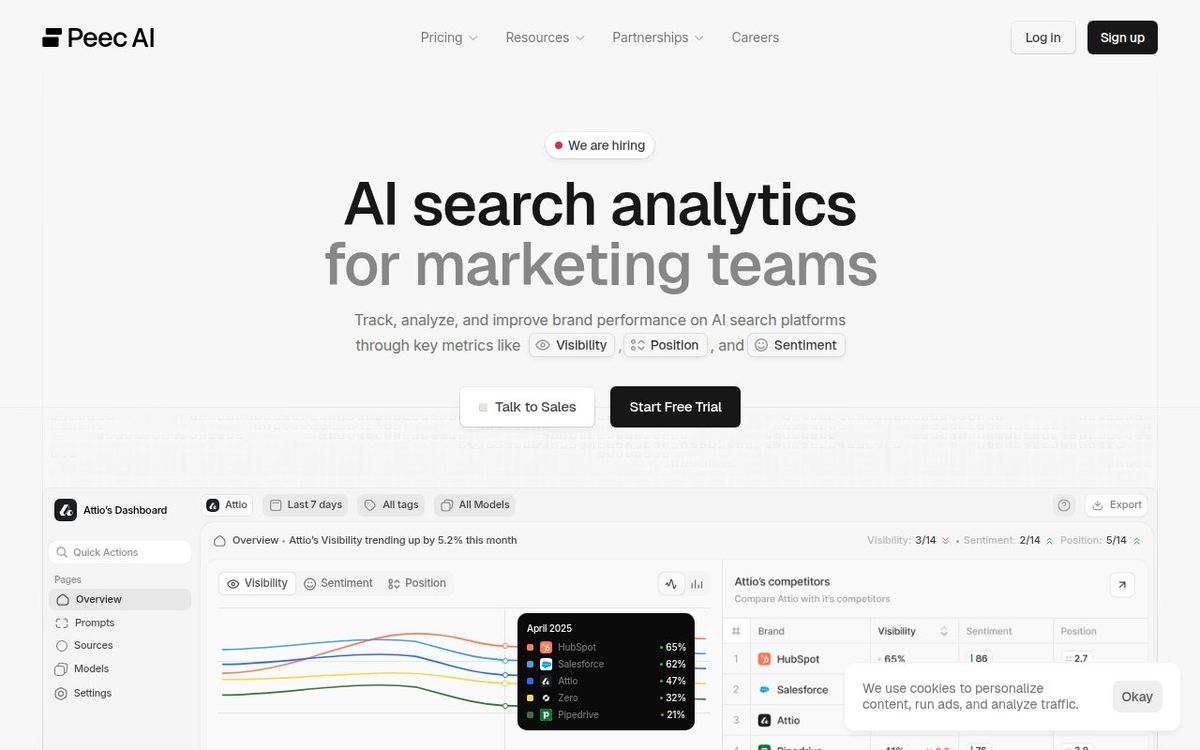
Peec AI is an AI visibility monitoring platform with strong competitive benchmarking capabilities. It tracks brand mentions and citations across multiple LLMs including Claude, ChatGPT, Gemini, and Perplexity.
Peec AI's strength for Claude tracking lies in its competitor analysis features. You can see exactly how your share of voice on Claude compares to specific competitors, track changes over time, and identify which prompts trigger competitor mentions instead of yours. The visual dashboards make it easy to spot trends and report to stakeholders.
The platform offers prompt-level insights, showing you the exact queries where Claude mentions (or doesn't mention) your brand. This granularity is valuable for understanding Claude's specific recommendation patterns.
Pricing: Paid plans start at €85/mo, but important to notice that Claude is only available in the Enterprise tier with custom pricing.
Best for: Teams focused on competitive intelligence across LLMs, especially those who need to benchmark against specific competitors on Claude.
4. AIclicks
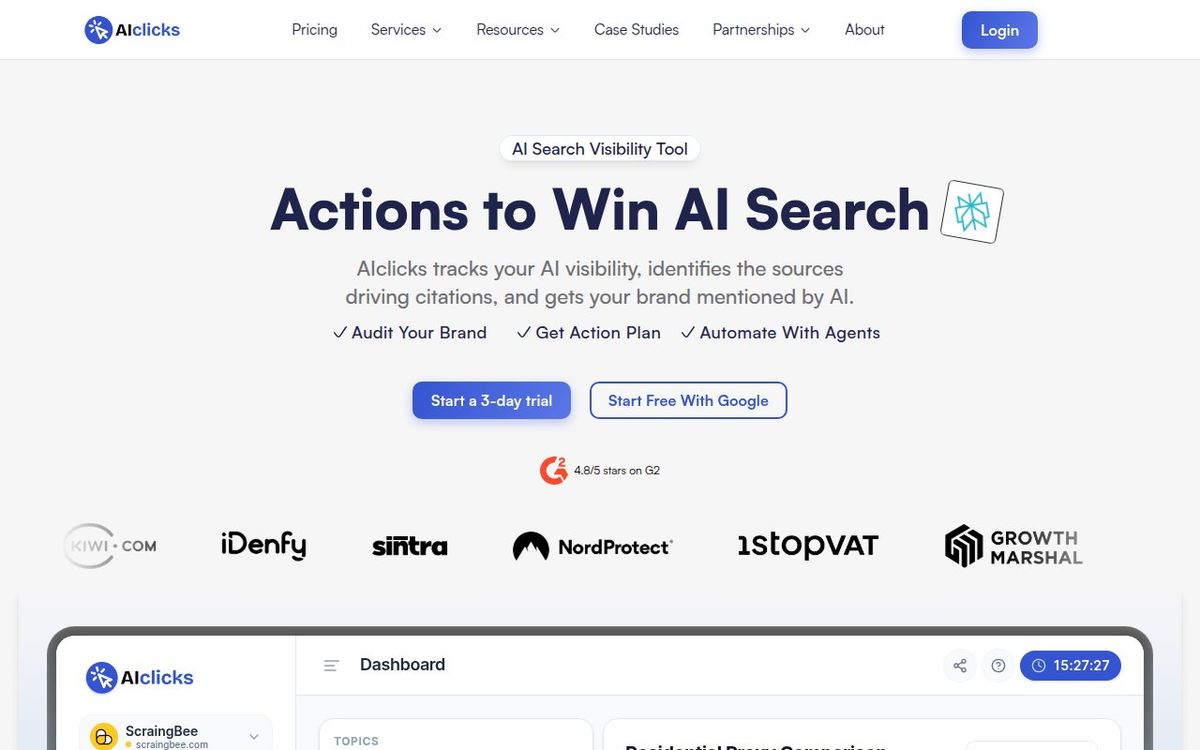
AIclicks is a focused AI search monitoring tool that tracks brand visibility across multiple LLMs including Claude. It's built specifically for AI search tracking (not bolted onto an existing SEO platform), which means the interface is streamlined for monitoring AI responses.
AIclicks uses API-based analysis to gather visibility data and combines that information with ‘powerful SEO-tools’ to provide actionable insights.
The platform has built a strong content hub around platform-specific tracking guides, and their Claude coverage is solid for basic monitoring needs. Where AIclicks falls short compared to more comprehensive platforms is in optimization features: it tells you what's happening but offers less guidance on what to do about it.
Pricing: Starter plan at $59/mo with Claude marked as ‘available’ AI engine without explanation whether it costs extra to unlock it or whether one of the default AI engines can be swapped to it in the Starter plan.
Best for: Teams that want straightforward Claude monitoring and actions to go with it.
5. Semrush
Semrush is the dominant SEO platform that has expanded into AI Search tracking. Its AI visibility features now cover multiple LLMs including Claude, integrated into the broader Semrush SEO toolkit.
For teams already using Semrush, adding Claude tracking is a natural extension, but its only available for Enterprise tier users. You get AI visibility data alongside your existing keyword rankings, backlink profiles, and content audits. Semrush's massive keyword database means you can track a large number of prompts across Claude and other engines.
The trade-off is that Semrush's AI tracking is API-based rather than UI-scraped, which means the Claude responses you see in Semrush may not perfectly match what real users experience. For many teams, this approximation is good enough, especially when combined with Semrush's other capabilities.
Pricing: Starts at $179/mo for the base SEO plan. AI visibility features may require additional add-ons and to unlock Claude tracking you need the Enterprise plan.
Best for: Teams already invested in Semrush Enterprise plan who want to add Claude tracking without switching platforms.
6. Writesonic
Writesonic combines AI content creation with AI search visibility tracking, covering Claude among its monitored platforms. The dual focus on creation and tracking makes it unique in this list.
For Claude tracking, Writesonic monitors brand mentions and citations across multiple LLMs. But the real differentiator is the workflow: once you identify a gap in your Claude visibility, you can use Writesonic's AI content tools to create optimized content designed to improve your performance, all within the same platform.
The four-tier pricing structure (Starter through Enterprise) means there's an entry point for most budgets, but it’s important to notice that Claude is only available in the Enterprise tier with custom pricing.
Pricing: Starter plan from $99/mo, but Claude available only in Enterprise plan.
Best for: Bigger content teams that want to track Claude visibility and create optimized content in the same tool.
Claude Rank Tracking Tools: Pricing Comparison
What Should You Look for in a Claude Rank Tracker?
Choosing the right Claude tracking tool depends on your team's needs, but there are a few non-negotiable features to prioritize.
Does the tool use real UI scraping or API calls?
This is the single most important technical distinction. Tools that scrape Claude's actual user interface capture the real response, including formatting, citation placement, recommendation order, and any visual elements. API-based tools query Claude's API directly, which often returns different results than what a human user sees.
For a deeper dive into why this matters, read our analysis of API vs UI data in AI visibility tools.
Can you track competitors on Claude specifically?
Knowing your own Claude visibility is useful. Knowing how you compare to competitors on Claude is actionable. Look for tools that let you add competitor brands and see per-platform share of voice, not just aggregate numbers across all engines.
Does it cover more than just Claude?
Claude tracking in isolation has limited value. You need to understand how your brand performs across the full AI search landscape. A McKinsey report on AI search found that consumers increasingly use multiple AI platforms for different types of queries. Your Claude strategy should be part of a broader GEO approach.
How to Set Up Claude Rank Tracking (Step by Step)
Getting started with Claude tracking doesn't require a massive investment. Here's a practical approach:
Step 1: Identify your 30-50 most important prompts. Think about what your target audience would ask Claude. For a project management tool, that might be "best project management software for remote teams" or "compare Asana vs Monday vs ClickUp." Focus on prompts where a Claude recommendation could influence a purchase decision.
Step 2: Pick a tool that covers Claude + at least 2-3 other engines. Don't track Claude in isolation. At minimum, pair it with ChatGPT and one other platform (Gemini or Perplexity) to get a comparative baseline.
Step 3: Add your top 3-5 competitors. Claude tracking is most valuable when you can see relative performance. If Claude recommends a competitor but not you, that's a specific content gap you can address.
Step 4: Run your first baseline scan. Most tools will generate initial results within 24-48 hours. Don't panic if your Claude visibility is 0%. That's common and gives you a clear starting point.
Step 5: Review weekly and look for patterns. Claude's responses change as its training data and retrieval systems update. Weekly monitoring helps you catch shifts early. For a structured approach to this process, our GEO audit framework walks through the full methodology.
Start Tracking Your Brand on Claude Today
Claude is one of the fastest-growing AI platforms in enterprise contexts, and most brands have zero data on how it represents them. The tools in this guide range from $29/mo basic monitoring to full GEO platforms with built-in optimization, so there's an option for every budget and team size.
The key differentiator between tools is depth: do you just want to know if Claude mentions you, or do you want to understand why and what to do about it? Superlines takes the extra step, instead of just showing you data, it shows you exactly what to do with it. With real UI scraping across 10 AI engines (including Claude), agentic MCP workflows, and built-in content optimization, it's built for teams that want to move from tracking to action.
Start a free Superlines trial to see exactly where your brand stands on Claude and other AI platforms important for your brand!