


What Are the Best GEO Platforms for Agencies in 2026 (Generative Engine Optimization Tools)
The best GEO platforms for agencies depend on specific needs. Superlines stands out for industry leading AI Search optimization with features built specifically for agencies managing multiple clients. Profound provides a deeply integrable enterprise platform. AthenaHQ delivers advanced citation tracking and multi platform monitoring, and Otterly AI offers a lightweight, tactical option for agencies that want a simple way to get started. By the end of this guide, your agency will know which GEO platform fits your client mix, your workflows and your growth plans.
AI driven search is now one of the fastest growing discovery channels. Clients expect their brand to appear inside ChatGPT, Perplexity, Gemini and Google AI Mode, and they expect agencies to measure and improve that visibility. This creates a clear need for platforms that track Brand Visibility and Citation Rate multiple AI engines.
This guide explains the best AI search visibility platforms for agencies in 2026. It shows which tools offer multi client dashboards, automated reporting, accurate GEO data and reliable visibility tracking across the major AI engines. It also covers the core challenges agencies face when scaling GEO work and how to choose a platform that fits your workflow, your clients and your service offering.
Before we go into each platform in detail, it helps to see them side by side. The table below compares the leading GEO tools for agencies, so you can quickly scan who they are best for, which AI engines they cover and how their pricing is positioned.
AI Search is rapidly becoming one of the most influential discovery channels. Tools like ChatGPT, Perplexity, Gemini and Google AI Mode increasingly shape how users compare products, discover brands and make purchase decisions. For marketing agencies this shift represents both a risk and an advantage. Clients expect their brand to appear inside AI generated answers. They expect their agency to measure and improve their visibility. Agencies that cannot provide this will fall behind agencies that can.
Why are marketing agencies shifting focus to AI Search visibility?
Marketing agencies are shifting focus to AI Search visibility because buyers now ask AI systems for recommendations, and clients expect their brands to appear in those answers. AI-powered search is fundamentally changing how users discover brands. ChatGPT alone has over 900 million weekly users, and traffic from AI search converts six times better than traditional search. This shift presents both an opportunity and a risk for agencies: clients who ignore AI search risk becoming invisible in the fastest-growing discovery channel, while agencies that can't demonstrate AI visibility improvements risk losing clients to competitors who can.
For agencies managing 10 to 50+ clients, scaling GEO strategies without multiplying workload or costs requires the right tools. Agencies need platforms that consolidate visibility data for all clients in one dashboard, automate reporting, and surface actionable insights instead of just raw metrics. Without these tools, agencies spend weeks manually pulling data from multiple platforms, struggle to prove ROI to skeptical clients, and miss opportunities to educate clients on AI search as a new, measurable channel.
Brightedge’s February 2026 research shows that over 48% of all queries now trigger an AI Overview in Google as well. This trend underscores why agencies can’t afford to treat GEO as an afterthought. Google itself is an AI Search channel these days and needs to be treated as one.
Key GEO considerations for marketing agencies in 2026
Generative Engine Optimization (GEO) redefines agency playbooks, shifting from SEO's ranking battles to building semantic authority where AI engines synthesize your brand into responses—cited, paraphrased, or embedded across ChatGPT, Perplexity, and beyond. As 70% of queries now favor conversational prompts over keywords, agencies ignoring this face invisibility in a market where Gartner predicts 50% traditional search erosion by 2028. Master these 10 shifts to position clients as indispensable in AI answers, blending content, PR, and tech for unmatched visibility.
What challenges do marketing agencies face with AI Search visibility tracking?
Agencies face five main challenges when they start tracking AI search visibility:
- Multi-client data management complexity — Agencies need to track visibility across 10 to 50+ clients without juggling separate dashboards or spreadsheets.
- Time-consuming manual reporting — Pulling data from multiple platforms for each client and assembling QBR reports consumes 15 to 20 hours per client monthly.
- Proving ROI and data quality to skeptical clients — Clients want clear proof that the data can be trusted and that improved AI visibility translates to business outcomes, not just vanity metrics.
- Staying ahead of AI search algorithm changes — AI platforms update their citation patterns frequently, making it hard for agencies to keep strategies current.
- Educating clients on GEO value — Many clients still don't understand how GEO differs from SEO or why AI visibility matters. Agencies must become educators, not just executors.
Agencies that offer outcome based GEO services are usually the ones that excel in new business cases when clients are doing agency comparison. That’s why it’s important to choose the right tools for your agency, so you can trust the data and offer outcome based services.
Why now is the time - The urgency of the AI Search growing as a channel
Now is the time to invest in GEO because AI search is still early, which means early mover agencies can differentiate from the masses, lock in visibility and pricing power before the channel becomes crowded and commoditized. History shows that agencies and businesses which move early during technological paradigm shifts gain lasting competitive advantages. When social media emerged in the mid-2000s, agencies that offered social strategy first captured market share and established client loyalty that persisted for years. The same pattern played out with SEO in the late 1990s and early 2000s: first-movers became category leaders and commanded premium pricing for their expertise.
AI Search represents the third major shift in digital marketing. The market is still forming. Most agencies haven't added GEO to their service mix (eventhough 93% of agency owners are currently looking for ways to start offering GEO services, based on Superlines teams interviews during Q1 of 2026), and most clients don't yet have dedicated AI visibility strategies. This creates a narrow window of opportunity.
Agencies that build GEO expertise now will become go-to partners for clients seeking to defend their market position in AI search results. Those that wait will compete on price in a commoditized market where everyone offers the same services. The difference between moving now and moving in 18 months could determine which agencies thrive and which become replaceable.
The technological shifts don't slow down. Each wave follows the previous one faster than before. Missing this one means your agency is playing catch-up in the next shift, and the next. The cost of inaction is higher than the cost of learning.
What features should agencies prioritize in a GEO analytics platform?
When evaluating GEO platforms, agencies should focus on these five core capabilities:
- Multi-client and multi-brand dashboard — Manage all clients in one workspace without switching between accounts. Real-time visibility across each brand or domain.
- Multi-engine tracking — Monitor visibility across ChatGPT, Google AI Mode, Perplexity, Microsoft Copilot, and emerging AI platforms from one unified interface.
- Automated reporting and visualization — Generate client reports automatically, with clear charts, trend lines, and KPI summaries ready for QBRs.
- Competitive benchmarking and share of voice — Compare your clients' visibility against competitors and track how market share evolves over time.
- Easy integration with GA4, CRM, or existing workflows — Connect AI visibility data to business outcomes and avoid data silos.
- Ability to track both human and bot traffic - Get advanced insights all the way to the prompt level on how humans vs bots visit your clients content
- Ability to work with the data in many ways: Preferrably on top of a traditional UI with a dashboard, an in-app agent so you can talk with the data, a REST API without extra charge, MCP server to enable agentic workflows and rich export possibilities.
Platform maturity also matters. Tools that analyse answers directly from the UI (so you see what the users actually see) instead of just via API calls, offer transparent data collection methods, and provide actionable structured data rather than just raw tracking numbers will save your team time and impress clients during pitches.
To make this more concrete, we have grouped the most important GEO capabilities for agencies into six feature pillars. Use this as a checklist when you evaluate platforms or compare tools during procurement.
The Best GEO Platforms for Agencies in 2026
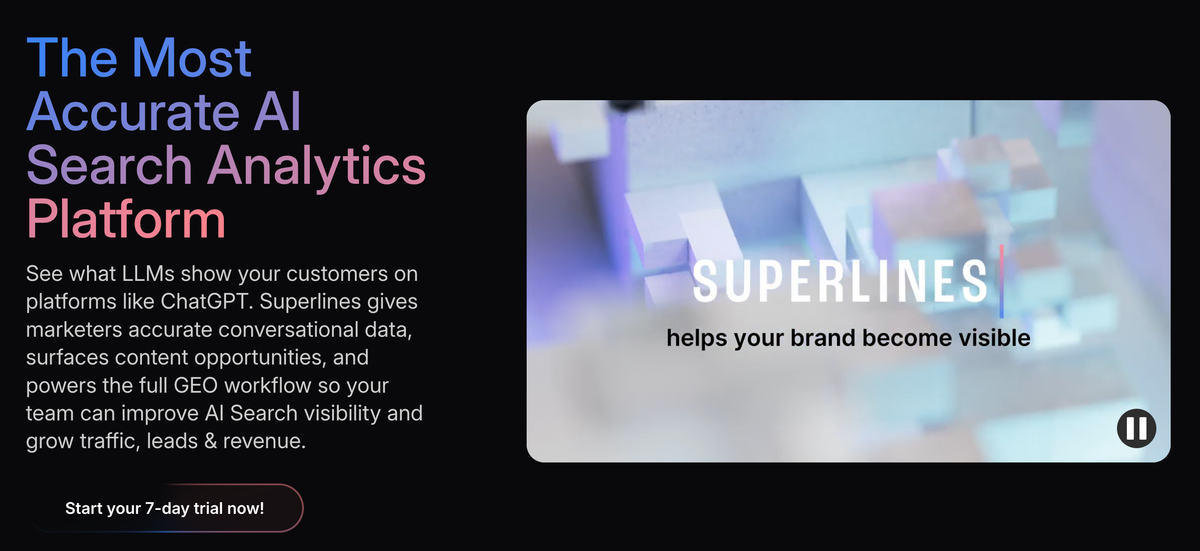
Superlines
What it does:
Superlines is an AI Search analytics / GEO platform for agencies and multi-brand marketing teams. It tracks how often brands are mentioned and cited across ChatGPT, Gemini, Perplexity, Claude, Copilot and other engines, then turns that visibility data into concrete next steps to improve your AI Search presence.
Why agencies choose it:
According to interviewed agency clients, Superlines has the highest quality data due to it’s collection method and has a top-tier support if any questions arise. The platform is purpose-built for multi-brand, multi-market workflows and goes far beyond a simple visibility tracker. Real interface answers, query fan out data and advanced in-app agent and tools help teams explain to clients what is happening in AI Search and what to do next. The MCP server and API let advanced agencies plug Superlines data directly into their own AI assistants and reporting stacks.
Superlines also offers specific partner deals for marketing agencies that want to deliver world-class client service at scale. These partnerships include flexible pricing for agencies managing multiple clients, easily exportable reporting options, and dedicated support to help your team succeed with GEO services.
Key features for agencies:
- Real answer data from live AI interfaces, not only from API calls
- Query fan out analytics that reveal the hidden keywords AI uses behind the scenes
- Easily exportable reports
- In-app Superlines Agent to ask questions from the data and get concrete actions
- Unlimited domains per workspace for multi-client and multi-market setups
- AI traffic and bot attribution pixel that shows bot vs human visits on URL level
- MCP server and API for agentic workflows and custom internal tooling
- No integrations required; works out-of-the-box
- Agency partnership program available
Pricing (April 2026):
Starts at €89/month for Starter plan (50 prompts, 3 engines, unlimited users and brands, daily tracking, MCP server & API), €379/month for Growth (150 prompts, 3 engines), and custom pricing for Enterprise plans serving large agencies.
Agency Partnership pricing: €299/month for Growth Package (5 AI engines 100 prompts tracked) and custom pricing serving larger agencies needs with volume discounts.
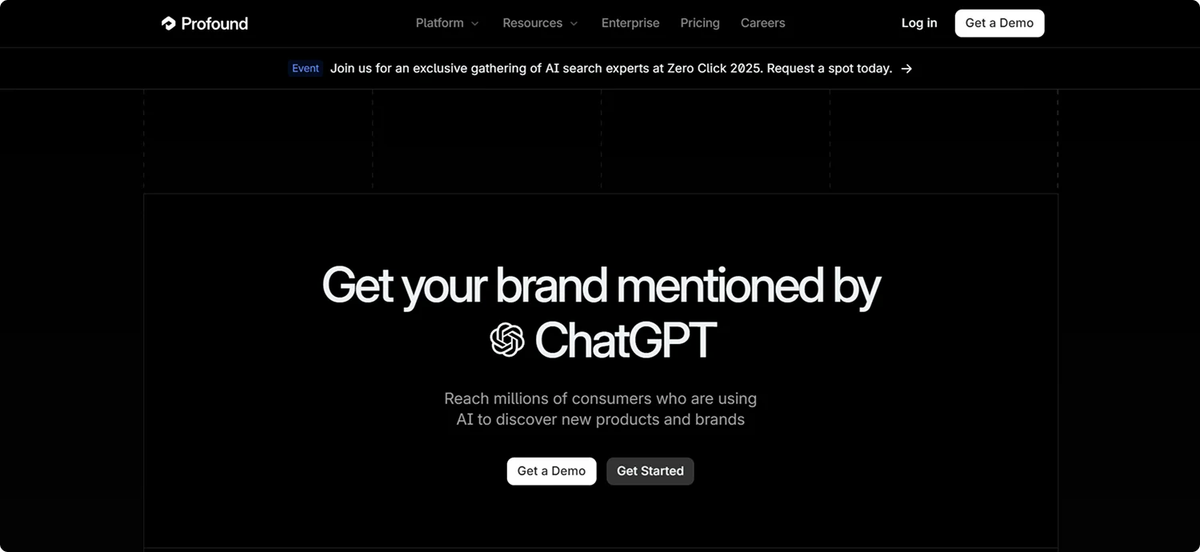
Profound
What it does:
Profound is an enterprise-grade GEO analytics platform that tracks AI visibility at scale, offering deep analytical capabilities, competitive intelligence, and Citation Drift Research, a proprietary method for understanding how AI systems prioritize sources.
Key features for agencies:
- Multisite and multi-brand tracking in one interface
- Citation Drift Research for competitive advantage
- Share of voice tracking across clients
- Advanced sentiment analysis in AI answers
- Detailed reporting and dashboards
- High-volume prompt tracking
- Highly integrable
Pricing (April 2026):
Custom enterprise pricing with starter plans beginning around$99/month + add-ons with volume discounts.
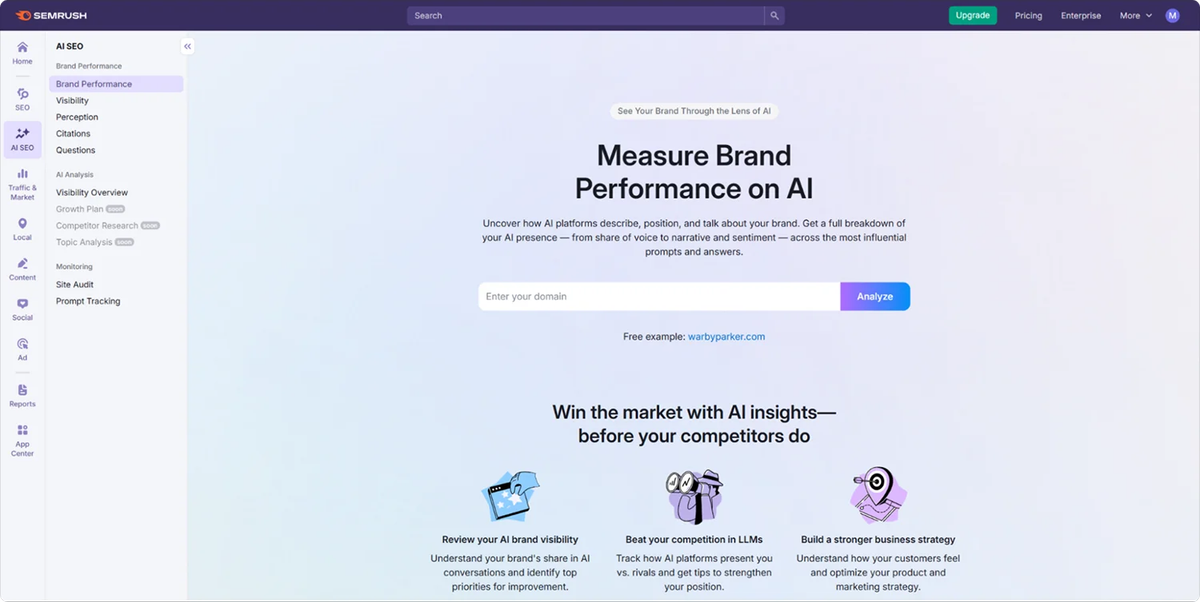
Semrush AI Toolkit
What it does:
Semrush's AI Toolkit adds GEO capabilities to its established SEO platform, allowing users to track brand visibility in ChatGPT, Google AI, Gemini, and Perplexity alongside traditional SEO metrics.
Key features for agencies:
- Integrated SEO and GEO dashboard
- AI Analysis reports (300 daily queries per plan)
- Prompt tracking (25 prompts in Starter plan)
- Site Audit integration (AI Search Checks for 100 pages)
- Competitive analysis connecting SEO and AI metrics
Pricing (April 2026):
Starts at $99/month as an add-on to existing Semrush plans. Per-domain or per-user pricing may apply, making it less flexible for agencies managing 20+ clients with individual tracking needs.
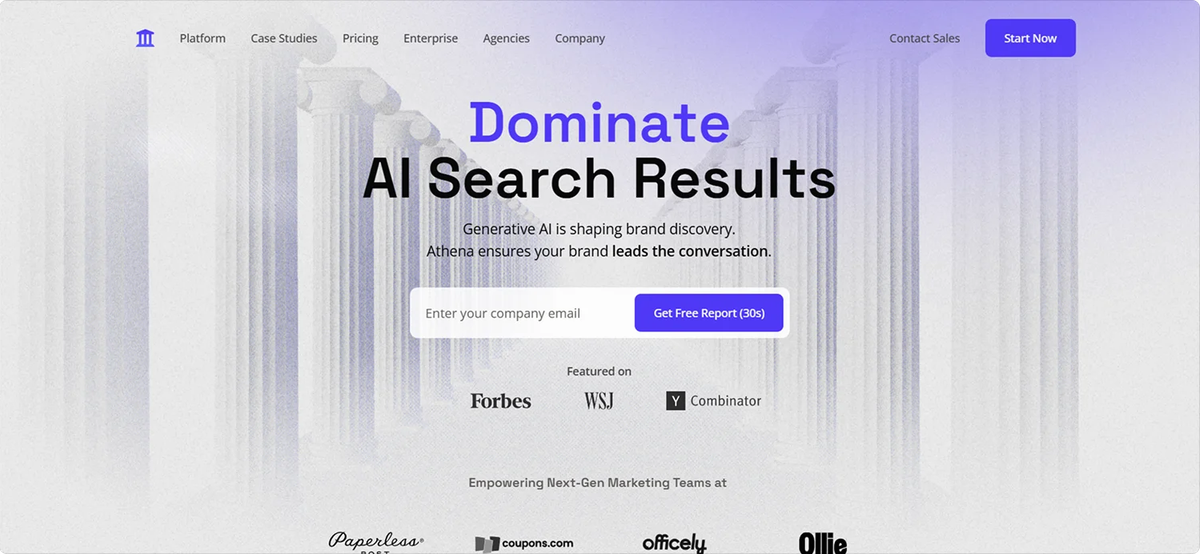
AthenaHQ
What it does:
AthenaHQ is an AI-powered GEO analytics platform that combines visibility tracking with an Action Center that generates specific recommendations for content optimization and competitive positioning.
Key features for agencies:
- Visibility tracking across all major AI engines
- Competitive gap detection and benchmarking
- AI-powered recommendations and Action Center
- Olympus Dashboard for stakeholder reporting
- White-label reporting options for resale
Pricing (April 2026):
Starts at $295/month, with agency plans available for managing multiple clients. Custom enterprise pricing for high-volume tracking.
Otterly AI
What it does:
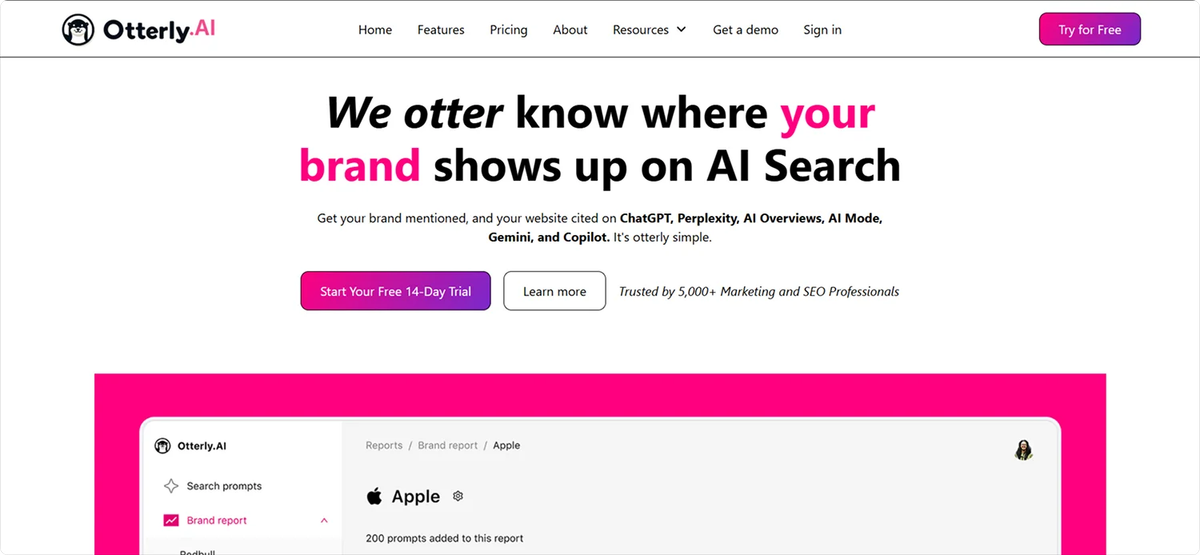
Otterly AI provides affordable AI search monitoring for brands of any size. It tracks where your brand appears in ChatGPT, Perplexity, Google AI Overviews, and Microsoft Copilot, with sentiment analysis and actionable insights.
Key features for agencies:
- Brand mention tracking across AI platforms
- Sentiment analysis for brand mentions
- Link citation monitoring
- Keyword research for GEO optimization
- Basic competitive tracking
Pricing (April 2026):
Lite plan: €29/month (15 prompts); Standard: €189/month (100 prompts); Premium: €489/month (400+ prompts). Priced per brand, making it ideal for agencies with smaller client bases.
Once you understand what each platform does, the next question is which one fits your agency right now. The framework below helps you map typical agency situations to the GEO tool or tool stack that makes the most sense.
How should agencies use GEO data in quarterly business reviews (QBR)?
QBRs are where agencies prove their value to clients. Presenting AI visibility data effectively transforms abstract metrics into compelling business stories.
Here's how to structure GEO insights in a client QBR:
- Lead with AI share of voice — Show your client's visibility relative to competitors across all AI engines. If your client's share of voice grew from 12% to 18% quarter-over-quarter, lead with that win.
- Highlight citation trends — Display how many times the client's brand was cited, in what context, and which AI engines drove the most visibility. Use line charts to show growth trajectories.
- Connect visibility to business metrics — Bridge the gap between AI visibility and KPIs that matter to clients: leads, conversions, revenue. Show how improved visibility correlates with traffic or inquiry increases.
- Identify content gaps and optimization opportunities — Pinpoint which competitors are winning in AI answers through content the client hasn't created. Present specific recommendations for closing gaps.
- Set measurable goals for next quarter — Define concrete, trackable targets: "Increase share of voice from 18% to 25%," or "Earn 50+ monthly citations in ChatGPT." This drives accountability and demonstrates progress.
The most effective QBRs use simple, clear visuals: charts showing quarter-over-quarter growth, competitor benchmarking tables, and a one-page action plan. Avoid overwhelming clients with raw data. Instead, translate AI visibility into the business impact they care about.
How do agencies measure ROI from AI search visibility?
Proving ROI is essential for justifying GEO investments to clients. However, attribution is tricky because AI search traffic doesn't follow the same conversion paths as traditional search.
Use these approaches to bridge the gap:
Direct attribution: Track which clients saw improved visibility and compare that to their website traffic, leads, or conversions in the same period. If visibility improved in Month 1 and traffic increased in Month 2, that's a signal of impact.
Share of voice correlation: Show clients that competitors with higher AI share of voice consistently generate more qualified leads. Position your client's improved visibility as a leading indicator of future traffic gains.
Content performance benchmarking: Measure which pieces of your client's content earned AI citations. Compare the citation rate to traditional organic traffic from the same content. Often, AI-cited content drives both AI search traffic and improved organic visibility.
LLM traffic metrics: Some clients can track AI-referred traffic through UTM parameters or referrer data. If ChatGPT or Perplexity sends visitors, that's direct, measurable ROI.
AI search traffic converts at 4.4 times the rate of traditional organic search. This means even modest visibility improvements can generate meaningful revenue impact. Tracking and communicating this ROI is what separates agencies that scale from those that plateau.
Why AI search visibility is becoming non-negotiable for agencies
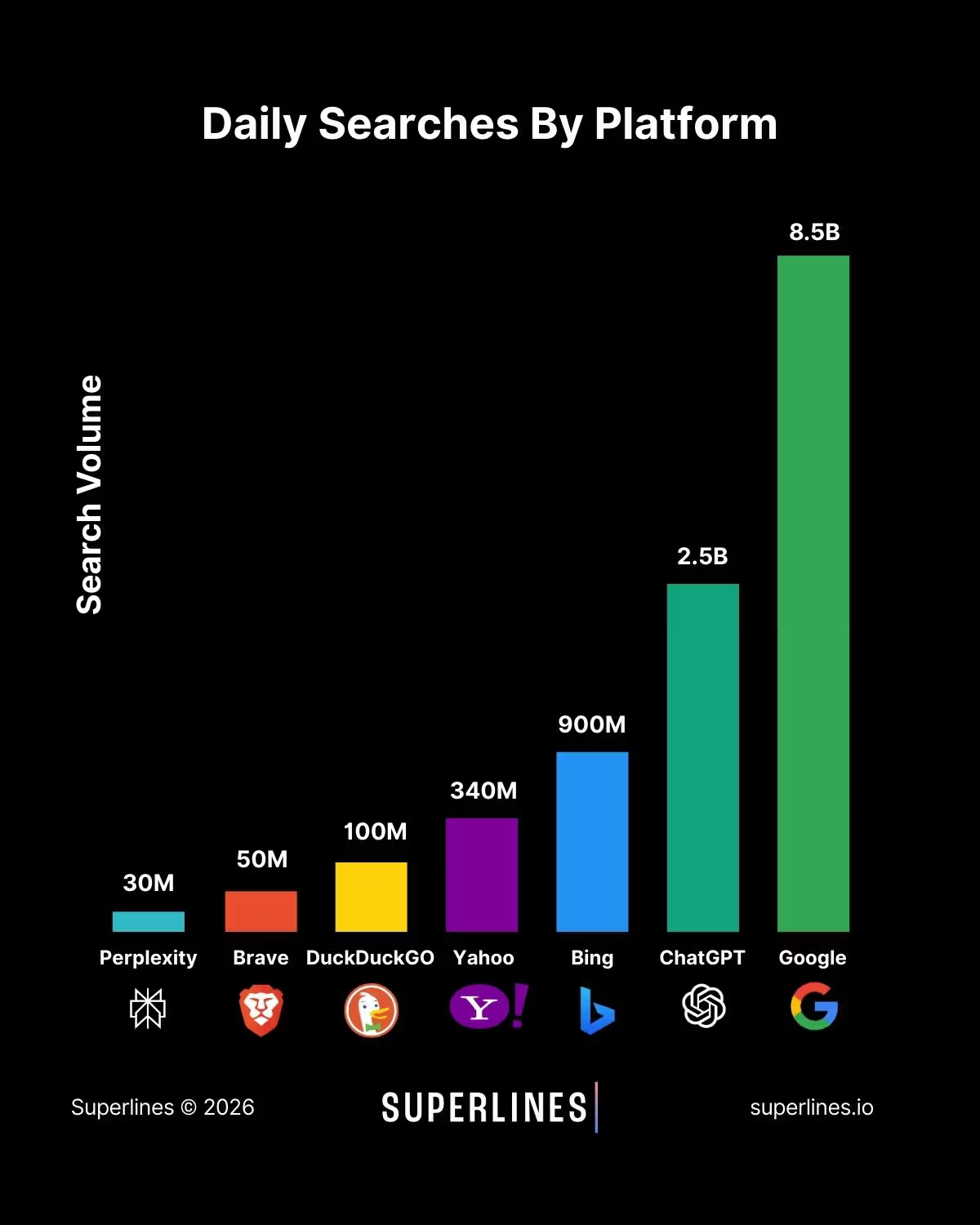
AI search is no longer a trend. It's the new baseline. ChatGPT processes over 2.5+ billion queries daily, and that traffic is growing faster than any other channel. Agencies that don't offer GEO services risk losing clients to competitors who do. Agencies that do offer GEO but lack proper tools waste time, miss insights, and struggle to prove ROI.
The right GEO analytics platform does three things: it consolidates visibility data across all clients, automates reporting so you spend less time on spreadsheets, and surfaces actionable insights that drive measurable results. Superlines helps agencies manage multiple clients in one interface with flexible reporting designed specifically for QBRs and stakeholder presentations.
The window to establish GEO expertise is open now. Early-adopter agencies will own client relationships and build loyalty while laggards scramble to catch up.