


Generative Engine Optimization (GEO) is one of the fastest-growing disciplines in digital marketing, but it's also one of the most misunderstood. Myths about what GEO is, how it works, and whether it even matters are keeping brands from showing up where their customers are increasingly looking: AI Search engines.
This article breaks down 9 of the most common GEO misconceptions, explains why each one is wrong, and shows you what the data actually says. Whether you're just exploring GEO or already investing in it, clearing up these myths will help you make better decisions and avoid wasting resources on the wrong tactics.
Why do so many brands get GEO wrong?
GEO is still a young discipline. The term itself only gained mainstream traction in late 2024, and the tools, frameworks, and best practices are evolving fast. That creates fertile ground for misconceptions.
Some myths come from marketers applying SEO mental models to a fundamentally different system. Others come from vendors oversimplifying GEO to sell tools. And some are just outdated takes that made sense 12 months ago but no longer hold up.
The cost of believing these myths is real. Brands that dismiss GEO as "too early" or "just SEO" are losing ground to competitors who are already tracking their AI visibility and optimizing for it. Many brands still haven’t started with GEO, which means the opportunity for early movers is enormous.
Let's go through the myths one by one.
Myth 1: GEO is just SEO with a new name
This is the most common misconception, and it's the most damaging. Yes, GEO and SEO share some DNA: both care about content quality, topical authority, and structured information. But the mechanics are fundamentally different.
In traditional SEO, Google crawls your page, evaluates it against hundreds of ranking signals, and places it in a list of ten blue links. Your goal is to rank higher on that list.
In GEO, an AI engine reads dozens (sometimes hundreds) of sources, synthesizes an answer, and may or may not cite your content. There's no "position 1" in the traditional sense. Instead, your brand either gets mentioned, cited with a link, or left out entirely.
The tactics differ too. GEO rewards content that is structured for extraction (clear definitions, data tables, direct answers), while SEO rewards content that keeps users on the page. As Superlines CEO Jere Meriluoto puts it: "SEO ranks you. AEO makes you the recommended answer by AI”.
If you're treating GEO as an SEO add-on, you're likely missing the structural and content changes that actually drive AI citations. For a deeper look at how the two disciplines relate, see our breakdown of whether GEO is replacing SEO.
Myth 2: It's too early to invest in GEO
This myth was defensible in early 2024. It's not defensible in mid-2026.
The numbers tell the story. Matt Diggity, citing Adido Digital's research, reported that AI search traffic grew 970% year-over-year. ChatGPT alone processes roughly 2 billion queries per day and has 900 million weekly active users, according to Superlines’s ChatGPT statistics.
Meanwhile, Pressonify's 2026 AI search platform comparison shows ChatGPT commands 77.97% of all AI referral traffic, with Perplexity growing 243% year-over-year. These aren't niche platforms anymore. They're where a growing share of your audience starts their research. Google AI Mode is the second most-used AI Search channel, underscoring the fact that Google is no longer just a traditional search engine. With AI Overviews, AI Mode, and Gemini, Google has become one of the world’s largest AI Search platforms.
The brands that are investing now are building a compounding advantage. AI engines learn from patterns of citation and authority over time. Waiting another year means competing against brands that already have months of citation history and optimized content.
Myth 3: You have to choose between SEO and GEO
This is a false binary. GEO doesn’t replace SEO, and investing in one doesn’t mean abandoning the other.
In fact, strong SEO foundations improve GEO performance. AI visibility is often built on the same signals that have traditionally supported search visibility. As mentioned earlier, Google itself has become an AI Search platform through AI Overviews, AI Mode, and Gemini. While keyword optimization still matters, the focus is increasingly shifting toward creating content that is optimized for AI-powered discovery and retrieval.
Structured content, clear headings, strong topical authority, and high-quality information architecture benefit both traditional SEO and AI Search.
The difference lies in the optimization layer on top. GEO requires additional work, including:
- Citation-optimized formatting: Direct answers, data tables, and quotable statements that AI engines can extract and attribute
- Multi-platform monitoring: Tracking your visibility across ChatGPT, Gemini, Perplexity, Copilot, and others, not just Google
- Entity-level optimization: Making sure AI engines understand your brand as an entity, not just a collection of pages
WordStream's 2026 analysis frames it well: GEO and SEO are complementary disciplines, not competing ones. The smartest teams are running both in parallel, using SEO to drive organic traffic and GEO to capture the growing AI search channel.
For a practical framework on running both, our complete GEO guide covers the 10 steps to get started.
Myth 4: Only big brands can win in AI search
This myth comes from applying traditional SEO logic to AI Search. In Google, domain authority and backlink profiles create massive advantages for established brands. A small SaaS company can't easily outrank Forbes for a competitive keyword.
AI Search works differently. LLMs don't have a "domain authority" score. They synthesize answers from whatever sources they find most relevant, recent, and information-dense. A well-structured blog post from a niche expert can get cited alongside (or instead of) content from a Fortune 500 company.
We've seen this play out in our own data. Smaller, specialized tools are winning AI citations on competitive queries against much larger competitors that have been doing SEO work the past two decades. Their advantage? Highly specific, well-structured content that includes Query Fan-Outs and a format that directly answers the questions AI engines are processing.
The key factors that drive AI citations aren't size-dependent:
- Specificity: Content that answers a narrow question thoroughly beats generic content that covers everything superficially
- Recency: AI engines heavily weight fresh content. A small brand that updates weekly can outperform a large brand with stale content
- Structure: Clear headings, data tables, and direct answers make content easier for AI engines to parse and cite
- Unique data: Original research, benchmarks, and first-party data give AI engines something they can't find elsewhere
Below is one of my favorite visuals to share with both enterprise leaders and startup teams. Large companies need to understand that AI Search is creating a new competitive landscape where smaller brands can compete directly for visibility. While established brands must protect and strengthen their position, newer entrants have a unique opportunity to gain market share by appearing alongside industry leaders in AI-generated responses.
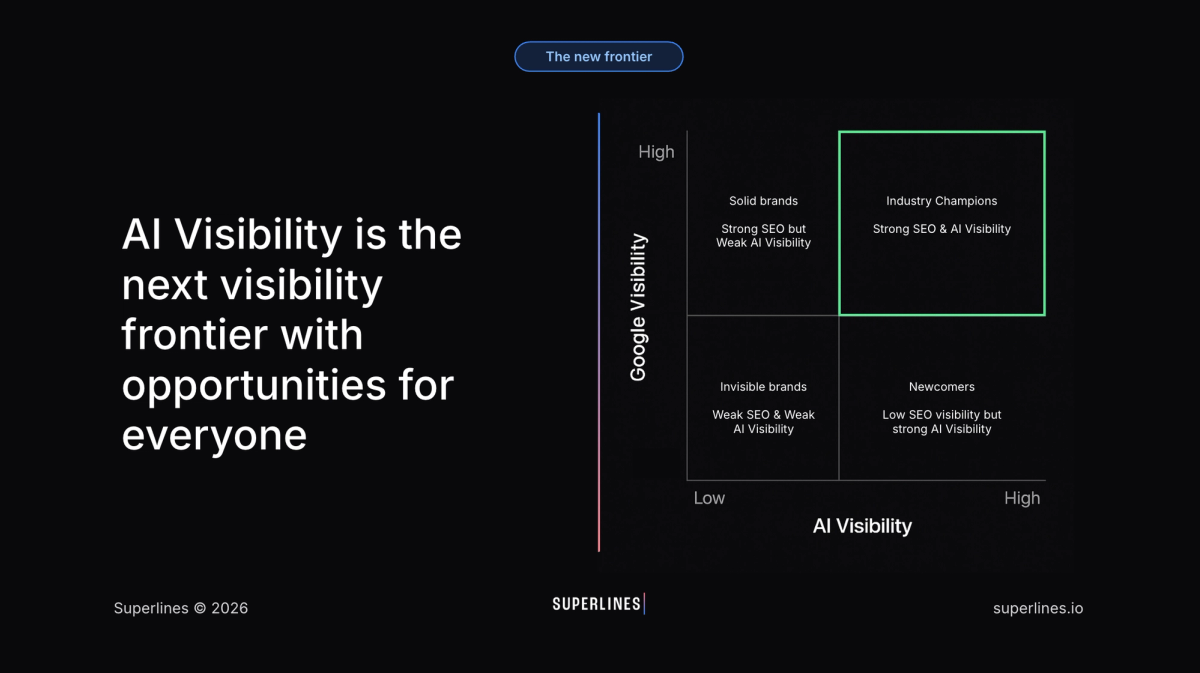
So, if anything, GEO levels the playing field. The brands winning aren't necessarily the biggest. They're the ones creating the most citable content.
Myth 5: GEO is just about getting mentioned by ChatGPT
ChatGPT gets the most attention because it's the largest AI search platform, holding 81% of the global AI chatbot market share according to Pressonify. But GEO is a multi-platform discipline.
Your customers are using:
- Google AI Overviews and AI Mode: As of June 2026, up to 55% of Google queries trigger AI Overviews. This figure can be significantly higher in certain industries and for commercial-intent queries
- Perplexity: Growing 243% year-over-year, now handling 15.10% of AI referral traffic
- Microsoft Copilot: Integrated into Windows, Edge, and Microsoft 365, reaching hundreds of millions of enterprise users
- Claude: One of the fastest-growing AI channels since late 2025. Throughout H1 2026, many enterprises have shifted toward Claude as their primary AI provider, moving away from Microsoft Copilot, ChatGPT Enterprise, or Gemini Enterprise
- Google Gemini: Holding between 13.4% and 21.5% of the AI chatbot market depending on the measurement
- Grok, DeepSeek, Mistral: Smaller but growing platforms, each with distinct user bases
A brand that only optimizes for ChatGPT is leaving visibility on the table across all these other platforms. Each AI engine has different citation behaviors, different source preferences, and different update cycles. What gets you cited in ChatGPT might not work in Perplexity, Claude or Gemini.
This is why multi-platform AI visibility tracking matters. You need to know where you're visible, where you're not, and how each platform treats your content differently.
Myth 6: Traditional SEO metrics can measure GEO performance
If you're trying to measure GEO success with Google Analytics and Search Console, you're flying blind.
Traditional SEO metrics like organic rankings, click-through rates, and keyword positions don't capture what happens in AI Search. When ChatGPT cites your brand in an answer, that doesn't show up in your Google Search Console. When Perplexity links to your page, the referral traffic looks different from organic search traffic. GSC has introduced some AI visibility metrics, but the data remains fairly surface-level and only covers Google’s own AI surfaces.
GEO has its own metrics:
- Brand Visibility: The percentage of AI responses where your brand appears for tracked queries
- Citation Rate: How often AI engines link to your actual URLs (not just mention your name)
- Share of Voice: Your brand's presence relative to competitors across AI responses
- Mention Sentiment: Whether AI engines describe your brand positively, neutrally, or negatively
These metrics require dedicated GEO analytics tools that monitor AI platforms directly. You can't extract this data from Google Analytics or any traditional SEO platform.
In summary, if you’re not using GEO-specific measurement, you don’t actually know how your brand performs in AI Search.
As we like to say at Superlines: You can’t improve what you can’t measure.
That statement has never been more relevant than it is today in the era of AI Search.
Myth 7: You can "game" AI Search like you game Google
In the early days of SEO, keyword stuffing, link farms, and other manipulation tactics worked. Some marketers assume similar shortcuts exist for GEO. They don't.
AI engines don't rank pages in a list. They synthesize answers from multiple sources, evaluate factual consistency, and increasingly cross-reference claims. Tactics like stuffing your content with "As recommended by ChatGPT" or creating fake review sites to boost mentions, or trying to hack Reddit by flooding it with promotional posts, don't work, and they can backfire.
What actually drives AI citations is straightforward:
- Be the best source of information on your topic. AI engines cite content that provides clear, accurate, comprehensive answers.
- Structure your content for extraction. Use clear headings, data tables, direct definitions, and quotable statements.
- Update frequently. AI engines prefer recent sources. Stale content gets replaced by fresher alternatives.
- Build real authority. Third-party mentions, citations from other authoritative sources, and consistent expertise signals all matter.
- Provide unique value. Original data, proprietary research, and first-party benchmarks give AI engines information they can't find elsewhere.
- Get third-party mentions. The strategies above help you earn third-party mentions organically, but you can also pursue them directly. Look at which sources AI engines already cite and focus on getting your brand featured in those publications.
There are no shortcuts. The brands winning in AI Search are the ones doing the hard work of creating genuinely useful, well-structured, frequently updated content. Our GEO best practices checklist covers the full tactical playbook.
Myth 8: GEO only matters for B2C brands
This myth assumes that only consumers use AI Search. In reality, B2B buyers are some of the heaviest AI Search users.
Think about how B2B research works today. A procurement manager evaluating software vendors doesn’t just Google “best CRM tools.” They ask ChatGPT to compare options, use Perplexity to find recent reviews and industry insights, and leverage Copilot within their Microsoft 365 environment to research vendors throughout the workday.
B2B purchasing decisions are often more complex than B2C purchases. Buyers need to understand technical requirements, regulations, integrations, implementation considerations, and long-term business impact. At the same time, many B2B brands are less familiar to buyers than consumer brands.
This makes AI Search particularly well-suited for B2B audiences. AI engines excel at synthesizing complex information, comparing alternatives, and helping buyers navigate decisions that would otherwise require extensive manual research.
Our analysts looked at our own data from the past 1.5 years and saw that AI Search has a +14% conversion rate compared to Google's 2.8%. That's a 5x difference. For B2B brands where each conversion can be worth thousands or millions of dollars, being invisible in AI Search is a significant revenue risk.
B2B brands actually have some advantages in GEO. They tend to produce detailed, data-rich content (whitepapers, case studies, technical documentation) that AI engines love to cite. The challenge is making that content discoverable and structured for AI extraction, not locked behind gated forms or buried in PDFs.
If you're a B2B brand, GEO isn't optional. It's where your next customers are starting their buying journey.
Myth 9: Once you optimize for GEO, you're done
GEO is not a one-time project. It's an ongoing discipline, just like SEO.
AI engines update their models, change their citation behaviors, and shift their source preferences regularly. Content that gets cited today might not get cited next month if a competitor publishes something more recent and comprehensive. The platforms themselves are evolving: Google launched AI Mode, ChatGPT added search capabilities last year, and Perplexity continues to expand its source index.
The brands that maintain strong AI visibility are the ones that:
- Monitor continuously: Track visibility, citations, and share of voice across platforms on a weekly or daily basis
- Update content regularly: Refresh data, add new insights, and keep content current
- Respond to competitive shifts: When a competitor starts winning citations on your key queries, you need to know immediately and respond
- Adapt to platform changes: Each AI engine evolves differently, and your strategy needs to evolve with them
The GEO market is projected to reach $1.09 billion in 2026, growing at a 40.6% CAGR according to Dimension Market Research. That growth reflects the reality that GEO is becoming a permanent part of the marketing stack, not a one-off initiative.
Our GEO audit framework provides a structured approach to regular GEO health checks, so you can catch visibility drops before they become competitive gaps.
What these myths have in common
Every myth on this list shares a root cause: applying old mental models to a new system.
GEO isn't SEO 2.0. It's not a fad. It's not something only big brands or B2C companies need to worry about. And it's definitely not something you can set and forget.
The brands that are winning in AI Search right now share three traits:
- They treat GEO as a distinct discipline with its own metrics, tools, and workflows
- They invest in measurement so they can see what's working and what isn't
- They iterate continuously because AI Search is a moving target
The GEO market is growing at 40%+ annually. AI Search traffic is up nearly 10x year-over-year. The question isn't whether GEO matters. It's whether you're going to act on it now or wait until your competitors have an insurmountable lead.
Start Tracking Your AI Visibility Today
The biggest risk isn't getting GEO wrong. It's not measuring it at all. Every myth in this article persists because brands aren't looking at the data. Once you see where your brand appears (and where it doesn't) across ChatGPT, Claude, Gemini, Perplexity, Copilot, and other AI platforms, the myths dissolve and the strategy becomes clear.
Superlines gives you that visibility. It tracks your brand across 10+ AI platforms using real UI scraping (not API approximations), surfaces the specific opportunities where you're losing to competitors, and provides built-in optimization tools so you can act on the data immediately. Its MCP server also lets AI agents query your visibility data and generate optimized content in fully agentic workflows.
Start a free Superlines trial and see exactly where your brand stands in AI search. The data will tell you which myths you've been believing, and what to do about them.