


How Marketing Agencies Can Use Superlines for Multi Brand Management in 2026
Superlines is an AI Search visibility platform that helps marketing agencies track how multiple client brands show up in AI engines like ChatGPT, Perplexity and Google AI Mode.
This article is for marketing agencies that manage many client brands and want to turn AI Search visibility into a scalable service without adding headcount. In this article you will learn how to:
•Track AI Search visibility for dozens of client brands in one Superlines workspace
•Set up multi brand, multi market and multi engine tracking without complex integrations
•Use Superlines data in client reporting, QBRs and GEO service pitches
•Package AI Search visibility as a scalable, profitable service line for your agency
What multi-brand AI Search management with Superlines looks like
Superlines enables marketing agencies to track AI Search visibility from a single, unified platform. It provides real-time monitoring across platforms such as ChatGPT, Perplexity, and Google AI Mode, with multi-site, multi-brand, and multi-market tracking that simplifies client reporting and competitive benchmarking. This allows you to capture market-specific nuances and deliver more accurate insights to your clients.
Agencies today face a dual pressure: they need to adopt emerging channels like AI search to stay competitive, while managing the operational complexity of reporting across 10, 20, or even 50+ clients. To support this, Superlines offers multiple ways to work with the data.
You can use the traditional UI with exports, query the data through an in-app AI agent, or access everything via a REST API. For more advanced workflows, Superlines also provides an MCP server, which many agencies use to integrate the data directly into their preferred AI assistants. This enables deeper analysis, combining datasets, and building custom agentic workflows on top of AI visibility data.
Why AI Search Visibility Matters for Marketing Agencies in 2026
The search market has fundamentally shifted. According to Superlines’ teams own interviews (conducted during January-April 2026), over 93% of agency leaders agree that AI-assistants such as ChatGPT, Google AI Mode and Claude has "flipped the SEO script", permanently changing how brands are discovered. It’s no longer just about ranking for traditional search; it’s about being cited as the answer.
This shift is driven by explosive user adoption. Recent data shows that web traffic from AI-driven referrals has increased more than tenfold in the last year alone. For agencies, this represents both a threat and an opportunity. Clients are beginning to ask, "Why aren't we showing up in ChatGPT?" and agencies that lack a clear answer risk losing those accounts to more forward-thinking competitors.
The market potential is massive. The market forces behind GEO are stronger than ever in 2026. The broader AI industry continues to accelerate, the global AI market is on track to reach $826 billion by 2030, while the GEO-specific market has reached an estimated $1.09–1.48 billion in 2026 according to Dimension Market Research and IntelMarket Research.
What Challenges Do Agencies Face Managing Multiple Client Brands?
Managing digital visibility for a single brand is difficult; managing it for dozens is exponentially harder. Agencies often hit a “growth wall,” where adding new clients creates unsustainable operational overhead.
From an AI search perspective, one way to address this is by choosing tools that support agentic workflows and reduce the need for constant manual work. Automated reporting and data-driven suggestions can remove a significant portion of repetitive tasks, allowing teams to focus more on client strategy and value creation.
The Multi-Client Reporting Bottleneck
As client rosters grow, the number of data sources increases rapidly. An agency with 15 clients might be managing 15 analytics accounts, 15 SEO dashboards, and dozens of spreadsheets. Industry estimates suggest that agencies lose 15 to 25 percent of productive time due to reporting inefficiencies.
Without a centralized view, senior strategists often spend more time compiling data than analyzing it. A more effective approach is to build a marketing stack where tools integrate and share data seamlessly (via MCPs for instance). This simplifies orchestration, reduces reporting friction, and opens the door to partial or fully automated workflows.
Client Expectation Management and Retention Pressure
As topics like Generative Engine Optimization (GEO) gain visibility, clients increasingly expect their agency to have a clear strategy in place. If an agency cannot show concrete data on AI visibility, it risks appearing behind the curve.
Professional services firms face an average 27% annual client churn rate. To retain clients, agencies must constantly demonstrate new value. While many agencies have started offering GEO services, they often lack the data layer to support their recommendations. This makes it difficult to measure impact or justify the work being done.
SEO agencies are typically best positioned to adopt GEO quickly. The underlying process is familiar: understanding visibility, identifying gaps, and optimizing content. The difference is that GEO introduces new data points, additional sources, and a new analytics layer.
A practical way to approach clients is to start with a lightweight audit over a few weeks. This allows you to present real data, demonstrate how the brand appears in AI search, and provide clear, data-backed recommendations for improvement.
This approach immediately differentiates your agency from others that rely on assumptions or generic advice. Instead of selling open-ended experiments, you are able to position your work around measurable outcomes and informed decision-making.
Adopting Emerging Channels Without Adding Headcount
The traditional agency model scales linearly: more revenue requires more people. AI Search creates an opportunity to break that pattern. By using tools that automate tracking, analysis, and reporting, agencies can offer high-value GEO services without proportionally increasing headcount.
Many agencies are already seeing this shift, using AI to move a significant share of their time from execution to higher-value strategic work.
As more tools support agentic workflows through MCP integrations, this efficiency can increase further. Agencies can automate larger parts of their data workflows, combine sources, and generate insights with less manual effort.
From Superlines’ perspective, this shift is also changing the ideal team profile. The most effective teams are increasingly made up of adaptable generalists, people who can leverage AI tools, understand multiple domains, and continuously learn. As AI takes over more of the execution layer, the ability to think broadly and connect insights becomes a key advantage.
How Superlines Solves Multi-Brand Management for Agencies
Superlines is designed to address the infrastructure needs of agencies that manage complex client portfolios. It replaces fragmented spreadsheets with a single "mission control" for AI Search.
Many brands operate in multiple markets or have several products and services with different target groups. Superlines adapts to this by letting you configure multiple brands inside one workspace and label prompts by brand, product line or campaign. This makes it easy to filter AI search data and provide clear reporting to clients about their AI Search performance.
Superlines collects data by running conversations inside the chosen market and interface of each AI engine, not only through APIs. This approach produces more accurate AI search visibility data that reflects how real users experience answers in tools such as ChatGPT, Perplexity and Google AI Mode.
Agencies can add as many brands into Superlines and the amount of prompts you have in your subscription is the only limitation to keep an eye on. You can also track as many competitors as you want.
Real-Time Visibility Tracking Across Multiple AI Engines
Superlines monitors brand mentions and citations across 10 major platforms such as ChatGPT, Perplexity, Mistral and Google AI Mode in real time. Instead of manually checking queries for each client, the system automatically tracks how often and in what context client brands appear.
Multi-Site, Multi-Brand, Multi-Market Tracking
Agencies can manage unlimited client brands within one Superlines workspace. Whether you have a retail client in the UK, a SaaS client in the US, or a multi-national brand with domains in five countries, all data flows into a unified interface. This allows account managers to switch between client views instantly without logging in and out.
Automated Prompt Management
Researching hundreds of test queries for every client is impossible manually. Superlines automates this by suggesting relevant prompts based on trending industry topics and search behaviors. This ensures agencies are always tracking the most relevant queries without dedicating hours to research. You can also let the solution to manage your clients prompt library on automation or have full control over everything, it's the most flexible platform out there.
Detailed Reporting and Competitive Benchmarking
The platform provides pre-built dashboards that visualize key metrics like Brand Visibility and Citation Frequency. Crucially, agencies can add competitors to each client's dashboard. Reporting that "Client A appeared in 15% of answers" is good; reporting that "Client A overtook Competitor B this month" is what proves value to stakeholders.
No Integrations Required
Superlines works out-of-the-box. Because it tracks external AI Search behavior rather than internal site data, agencies can onboard a new client and start generating data within 24–48 hours—no IT tickets or code snippets required.
See below how Superlines address a marketing agency's need for delivering GEO solutions to their clients:
Setting Up Multi-Client Tracking in Superlines
Effective setup is key to long-term scalability. Here is the recommended workflow for agencies.
Step 1: Create Your Agency Workspace
Start by establishing a master agency account. This acts as the container for all your client data. Your top brand in the workspace should be your own agency - this way you not only help you clients with AI visibility, also yourself.
Step 2: Configure Brands and Domains
For each client, input their primary domain and any relevant subdomains. If a client operates in multiple regions, set up separate tracking instances (e.g., "Client X - USA" and "Client X - Germany") to capture geo-specific AI nuances.
Step 3: Add Team Members and Organize Access
Add team or client members, organised per full account or single brands. Superlines allows you to invite internal team members (account managers, strategists) and assign them to specific client brands. This ensures data confidentiality—Team Member A only sees the clients they manage, while the Agency Owner sees everything. You can also give clients "view-only" access to their specific dashboard, building trust through transparency.
Step 4: Add Competitor Brands
Always add 3–5 competitors for every client. This baseline data is essential for the "Share of Voice" metrics that form the backbone of agency reporting. Superlines recommends 3-5 competitors, but you can always add more competitors into tracking as well. Even if you don’t choose any competitors, you will still see all the brands appearing in the answers and add interesting brands from there to be tracked as competitors.
Step 5: Set Up Automated Reporting
Configure weekly or monthly exports. Automating this step prevents the end-of-month "reporting scramble" and ensures clients receive consistent updates.
How Agencies Use Superlines Data in Client Reporting
Data is only valuable if it tells a story. Here is how to package Superlines insights for clients.
Monthly Performance Updates
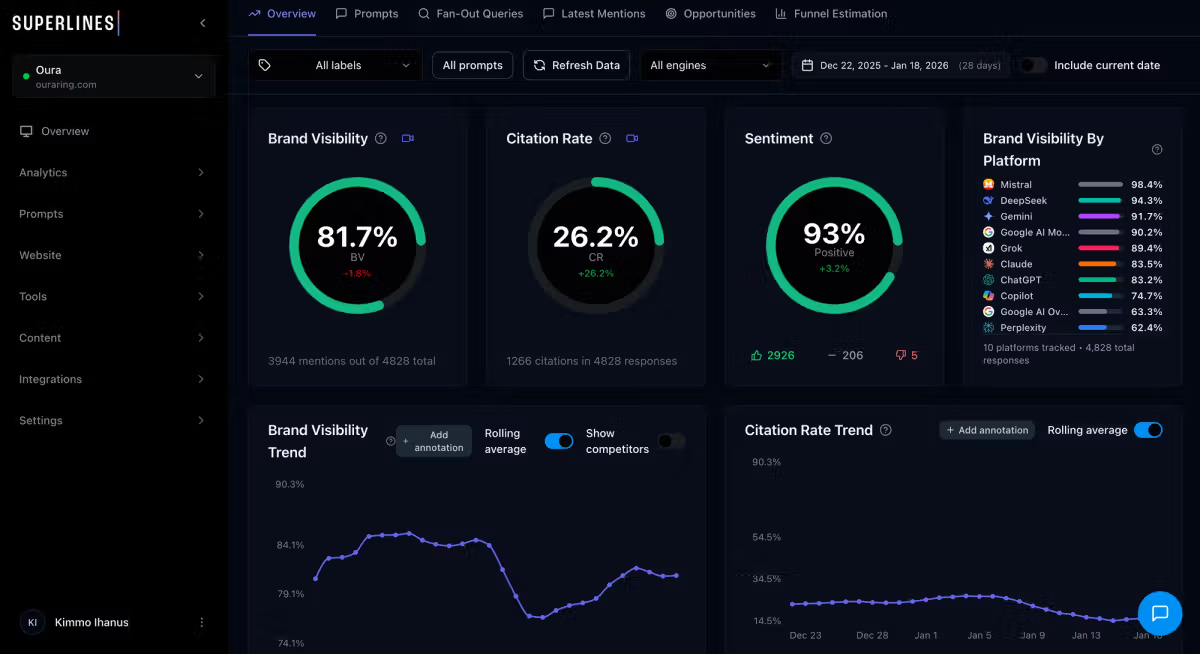
Focus on trends rather than raw numbers. Show the week-over-week and month-over-month growth in Brand Visibility and Citation rate (how often the brand is cited). Visual charts from Superlines can be pasted directly into client slide decks and you can also build custom reports based on the parameters that you want via Superlines’ MCP server.
Demonstrating GEO ROI
Connect visibility to both human and LLM crawler traffic. By integrating Superlines with Google Analytics 4 (GA4) and installing the Superlines Pixel, agencies can attribute specific site visits to AI referrals and see which AI Bots (LLM Crawlers) are visiting the content. This closes the loop, proving that increased visibility in ChatGPT actually drives qualified traffic and conversions.
Identifying Content Gaps
Use the "Competitor Gap Analysis" features to show clients where they are losing. If a competitor is consistently cited for a specific topic (e.g., "best CRM for small business") and the client is not, that is a clear, data-backed mandate for new content creation.
See below an example of services an agency can present to their clients:
Best Practices for Agencies Using Superlines
- Start with a Pilot: Do not roll out to all 50 clients at once. Pick your top 3–5 "innovation-ready" clients to pilot the service. Use their feedback to refine your services packaging.
- Standardize Reports: Create a single "AI Visibility Report" template that works for all clients. Standardization is the only way to scale profitably.
- Educate Your Clients: Most clients do not yet understand "Brand Visibility and Citation rate" in an AI context. Create a simple one-pager explaining these metrics so your points land during meetings.
- Connect to Business Outcomes: Vanity metrics are dangerous. Always try to draw a line between "we increased your AI visibility" and "we drove more qualified leads."
Join Superlines today
The shift to AI Search is not a temporary trend; it is the new reality of digital discovery. Superlines provides the essential infrastructure for this adaptation. By centralizing multi-brand tracking, automating prompt research, and delivering client-ready competitive intelligence, it enables agencies to turn a complex challenge into a scalable, profitable service line.
If you want to read more about How to Offer AI Search Visibility as a Service, you can read this guide.
For marketing agencies ready to lead in the AI Search era, the next step is clear: move beyond manual checking and implement a system that scales with your growth.
Start today!