


How to Find Which Sources and Domains Get Cited in AI Search Results
AI platforms like ChatGPT, Gemini, and Perplexity pull information from specific third-party sources when answering user queries. Knowing which domains get cited, how often, and for which topics gives you a concrete map of where AI search visibility actually comes from.
This guide walks through how to identify citation sources, find the top domains in your space, and use that data to shape your content strategy. Each section covers a specific question you can answer with AI search intelligence data.
TL;DR
- AI search engines cite specific domains and pages, not just brands. Tracking these citations reveals which content actually drives visibility.
- Third-party sources like review sites, directories, and industry publications often carry more citation weight than brand-owned pages.
- Citation patterns vary across platforms: ChatGPT, Gemini, Perplexity, and Claude each prefer different source types.
- Monitoring top cited domains in your category shows where competitors earn AI visibility and where gaps exist.
- Combining citation source data with query-level analytics creates an actionable playbook for improving AI search presence.
What Are Citation Sources in AI Search?
When an AI model answers a question, it often references specific web pages as supporting sources. These are citation sources: the URLs and domains that AI platforms point users to for more information.
Unlike traditional search, where rankings are the primary metric, AI search visibility depends on whether your content gets cited in a generated answer. A page that never appears in Google's top 10 might still get cited by Perplexity or Gemini if it contains the right information in the right format.
Gartner predicted that traditional search engine volume will drop 50% by 2028 as AI-powered answers take over informational queries. This means citation-based visibility is becoming a bigger share of how users find and trust information online.
Citation sources fall into a few categories:
- First-party sources: Your own website pages that get directly cited
- Third-party sources: External domains (review sites, directories, news outlets, forums) that mention your brand and get cited in AI answers
- Competitor sources: Domains in your space that get cited for queries where you want visibility
How to See Which Third-Party Sources Drive Your AI Visibility
One of the most useful data points in AI search intelligence is understanding which external domains mention your brand and get cited by AI models. These third-party sources act as amplifiers: when a review site or industry publication mentions your product and AI models cite that page, your brand gets visibility even without a direct citation.
Here is how to find them:
Check which external URLs get cited alongside your brand
AI search intelligence platforms track every URL that appears in AI-generated answers for your monitored queries. Filter for URLs that are not on your own domain to see third-party sources.
Look for patterns in the data:
- Review and comparison sites (G2, Capterra, TrustRadius) frequently get cited in product-related queries
- Industry publications and blogs that cover your space
- Forums and communities (Reddit, Stack Overflow, Quora) that discuss your product category
- News outlets that have covered your company or competitors
Measure third-party citation frequency
Not all third-party sources contribute equally. Track how often each external domain appears in AI answers for your queries. A domain that gets cited across 50 different queries matters more than one that shows up once.
BrightEdge found that AI-generated search results now appear in over 25% of all queries, with citation patterns heavily favoring authoritative, well-structured content. This means the quality bar for getting cited is higher than simply having content on a topic.
Identify gaps where third parties outperform you
Compare which queries cite third-party pages about your brand versus queries where your own pages get cited directly. If a review site consistently gets cited for "best [your category] tools" queries but your own comparison page does not, that signals a content or authority gap.
Where to Find Top Domains With AI Search Visibility
Beyond your own brand, understanding which domains dominate AI citations in your industry reveals the competitive landscape.
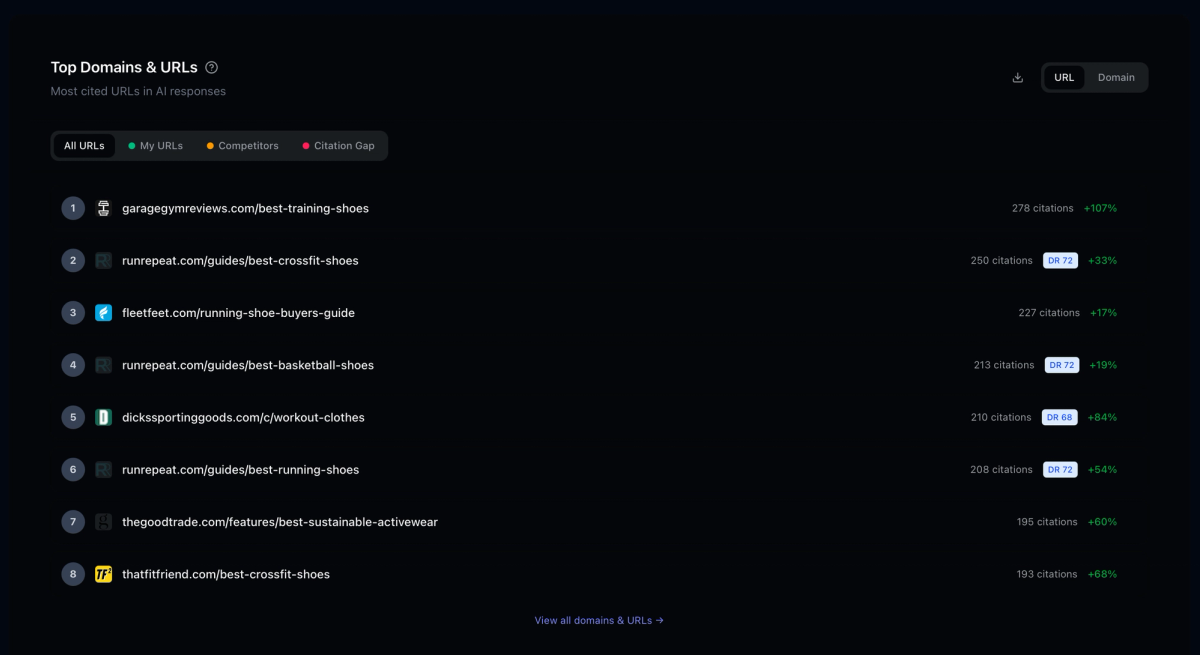
View top cited domains by query category
Group your monitored queries by topic or category and look at which domains appear most frequently in AI answers. For each category, you will typically see a mix of:
- Established media outlets with high domain authority
- Niche industry sites that specialize in the topic
- User-generated content platforms (Reddit, forums) for opinion-based queries
- Tool and product pages for transactional queries
- Research and data sources for statistical queries
Compare domain citation share across competitors
Track how your domain's citation share compares to competitors across the same query set. This "share of voice" metric in AI search tells you who controls the narrative for specific topics.
SparkToro and Datos reported that nearly 60% of Google searches end without a click to any website, driven partly by AI-generated answers satisfying user intent directly. For queries where clicks do happen, the cited sources in AI answers capture a disproportionate share of that traffic.
Track domain performance over time
AI citation patterns shift as models update their training data and retrieval sources. A domain that dominated citations three months ago might lose ground to newer, more comprehensive content. Regular monitoring catches these shifts early.
How Citation Patterns Differ Across AI Platforms
Different AI platforms have different citation behaviors. Understanding these differences helps you prioritize where to focus.
ChatGPT
ChatGPT with web browsing cites sources inline and tends to favor well-known domains. It often pulls from a mix of authoritative sites and recent content. Citation density varies by query type: factual queries get more citations than opinion-based ones.
Perplexity
Perplexity is the most citation-heavy platform. Every answer includes numbered source references, typically 5 to 15 per response. It actively crawls the web and tends to cite a wider range of sources, including smaller niche sites that other platforms might skip.
Gemini
Google's Gemini integrates with Search and tends to favor pages that already rank well in traditional search. Its citation patterns overlap more with Google Search results than other AI platforms.
Claude
Claude with web access cites sources selectively and tends to be conservative with the number of citations. It often favors primary sources (research papers, official documentation) over secondary roundup content.
Grok
Grok pulls heavily from X (Twitter) posts and real-time web content. Its citation patterns skew toward recent, conversational sources rather than traditional long-form articles.
What this means for your strategy
If your content gets cited on Perplexity but not ChatGPT, that tells you something about how each platform evaluates your pages. Cross-platform citation tracking reveals which content attributes drive visibility on each engine.
What Data Points Should You Track for AI Search Visibility
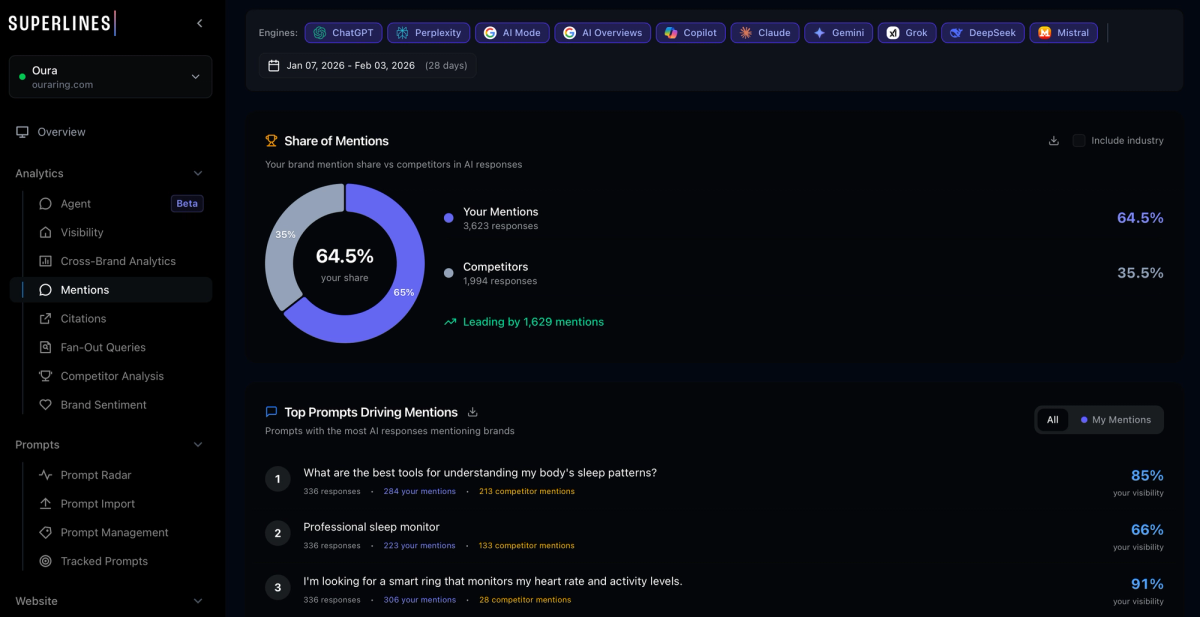
Effective AI search monitoring goes beyond just checking if your brand appears in answers. Here are the key metrics that matter:
Citation rate
The percentage of monitored queries where your domain gets cited. This is your core visibility metric. Track it overall and broken down by query category.
Share of voice
How your citation count compares to competitors for the same query set. If a competitor gets cited in 40 answers where you get cited in 15, their share of voice is roughly 2.7x yours for that category.
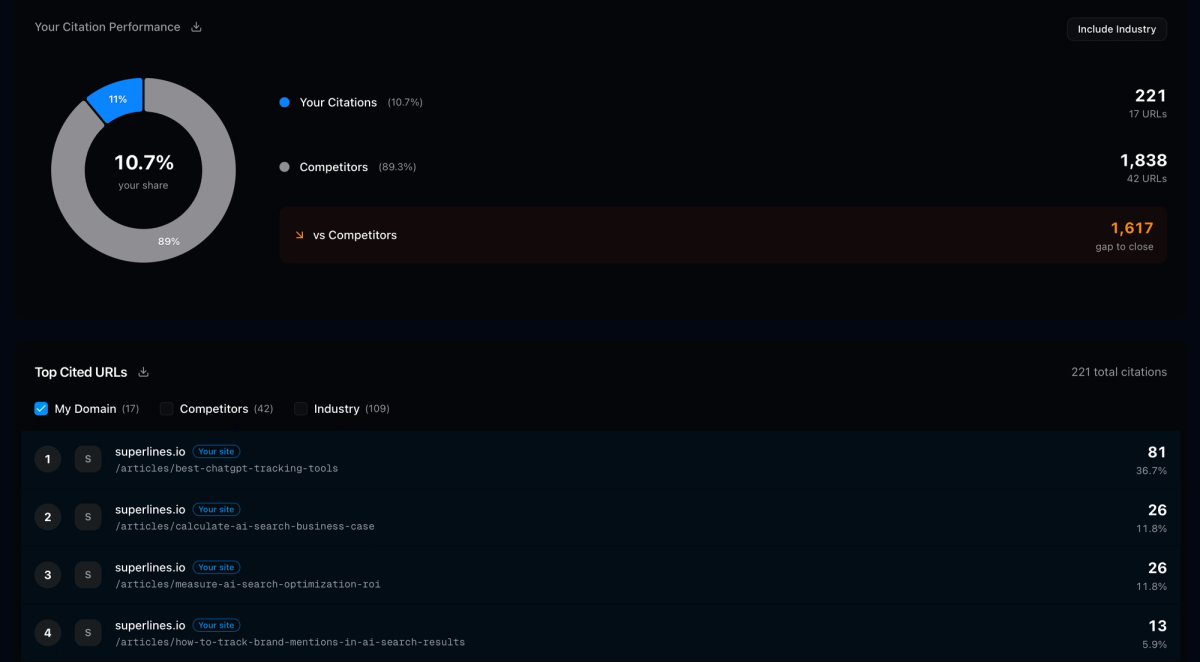
Source diversity
How many unique third-party domains cite your brand or products. A broader source base means your visibility is more resilient because it does not depend on a single review site or publication.
Citation position
Where your source appears in the AI answer. Sources cited in the first paragraph or as the primary recommendation carry more weight than sources listed at the bottom of a reference list.
Fan-out queries
The secondary queries that AI models generate internally when answering a user's question. These reveal what the model considers related or important to the original query, and they surface content opportunities you might not find through traditional keyword research.
Platform coverage
How many AI platforms cite your content across your query set. Appearing in ChatGPT answers but not Perplexity or Gemini means you are missing visibility on platforms that collectively handle millions of queries daily.
How to Turn Citation Source Data Into an Actionable Strategy
Raw data is only useful if it leads to action. Here is how to translate citation insights into concrete next steps.
Prioritize content gaps by citation volume
Identify high-volume queries where competitors get cited but you do not. These are your biggest opportunities. Rank them by query volume and create content specifically designed to earn citations for those topics.
Build relationships with top-cited third-party sources
If a particular review site or publication consistently gets cited in AI answers for your category, getting featured on that site has compounding value. It earns you both the direct traffic from the publication and indirect visibility through AI citations.
Optimize existing content for citation-friendly formatting
AI models prefer content that is structured, specific, and easy to extract information from. Pages that include clear headings, data points, comparison tables, and direct answers to questions tend to get cited more often. Audit your existing pages against these criteria.
Monitor shifts monthly
Citation patterns change as AI models update. Set a monthly review cadence to catch new opportunities and declining sources before they become problems.
To summarize
Understanding which sources and domains drive AI search visibility is no longer optional for teams that depend on organic discovery. The data is available, and the brands that act on it gain a real edge over those still guessing.
Superlines provides the AI search intelligence layer for tracking citation sources, top domains, share of voice, fan-out queries, and cross-platform visibility in one place, giving teams the data they need to make informed decisions about their AI search strategy.