


An AI search visibility dashboard is a centralized interface that tracks how your brand appears across AI-powered search engines like ChatGPT, Google Gemini, Microsoft Copilot, and Perplexity. The best dashboards monitor brand mentions, website citations, share of voice, and sentiment in real time, giving marketing teams a single view of their generative search performance.
If you've been tracking traditional SEO rankings for years but have no visibility into how AI engines talk about your brand, you're flying blind in the fastest-growing search channel. This guide reviews the 11 best AI search visibility dashboards available in 2026, compares their features and pricing, and explains exactly what metrics your dashboard should track.
Why You Need a Dedicated AI Search Visibility Dashboard
Traditional SEO dashboards (Google Search Console, Ahrefs, Semrush) track how your pages rank in conventional search results. They don't tell you whether ChatGPT mentions your brand when someone asks "What's the best project management tool?" or whether Gemini cites your website when answering industry questions.
AI search visibility dashboards fill this gap. They monitor the actual responses that large language models generate, tracking whether your brand gets mentioned, whether your URLs get cited, and how you compare to competitors in the AI answer layer.
This matters because the shift is accelerating fast. Position Digital reported that generative AI traffic is growing 165x faster than traditional organic search. Meanwhile, DemandSage found that over 50% of Google queries in the US now trigger AI Overviews, and the resulting organic CTR has dropped by 61% for affected queries. If your brand isn't visible in these AI-generated answers, you're losing ground every week.
A good AI visibility dashboard gives you three things traditional tools can't:
- Mention monitoring: Does the AI engine name your brand in its response?
- Citation tracking: Does the AI engine link to your website as a source?
- Competitive benchmarking: How does your visibility compare to competitors across the same prompts?
What Metrics Should an AI Search Visibility Dashboard Track?
Before evaluating specific tools, it helps to understand the five core metrics that define AI search visibility. Any dashboard worth using should cover at least four of these:
Brand Mention Rate
The percentage of AI-generated responses that mention your brand by name. This is the most basic visibility metric. If you ask ChatGPT "What are the best CRM tools?" and it names your product, that's a brand mention. A good dashboard tracks this across hundreds or thousands of prompts relevant to your industry.
Citation Rate
The percentage of AI responses that include a link to your website. Citations are more valuable than mentions because they drive actual traffic. Some AI engines (Perplexity, Copilot) cite sources frequently, while others (ChatGPT in conversational mode) cite less often. Your dashboard should break this down by engine.
Share of Voice
Your brand's mention count as a proportion of all brand mentions in your category. If there are 1,000 AI responses about "project management tools" and your brand appears in 50 of them while a competitor appears in 200, your share of voice is 5% vs their 20%. This is the competitive metric that matters most.
Sentiment Analysis
Not all mentions are positive. A dashboard with sentiment tracking tells you whether AI engines describe your brand favorably, neutrally, or negatively. This is especially important for reputation management: if an LLM consistently pairs your brand with phrases like "expensive" or "limited features," you need to know.
Prompt-Level Tracking
The ability to monitor specific prompts (search queries) and see exactly how AI engines respond to each one. This is the most granular metric and the most actionable: it tells you which queries you're winning, which you're losing, and what the AI actually says about you in each response.
Our Selection Methodology
We evaluated 10 AI search visibility dashboards across five criteria:
- AI Engine Coverage: How many AI platforms does the dashboard monitor? The best tools track ChatGPT, Gemini, Copilot, Perplexity, Claude, and emerging engines like Mistral and DeepSeek. Tools covering fewer than 4 engines scored lower.
- Metric Depth: Does the dashboard go beyond basic mention counting? We prioritized tools that track citations, share of voice, sentiment, and prompt-level data over those offering only surface-level mention alerts.
- Competitive Intelligence: Can you benchmark your brand against competitors on the same prompts? Dashboards with built-in competitive tracking scored higher than those requiring manual comparison.
- Update Frequency and Freshness: How often does the dashboard refresh its data? Daily or weekly updates are essential because AI engine responses change rapidly. Tools relying on monthly snapshots scored lower.
- Pricing Scalability: Is the pricing reasonable for the value delivered, and does it scale sensibly as your monitoring needs grow? We looked for transparent pricing with clear tier differentiation.
1. Superlines
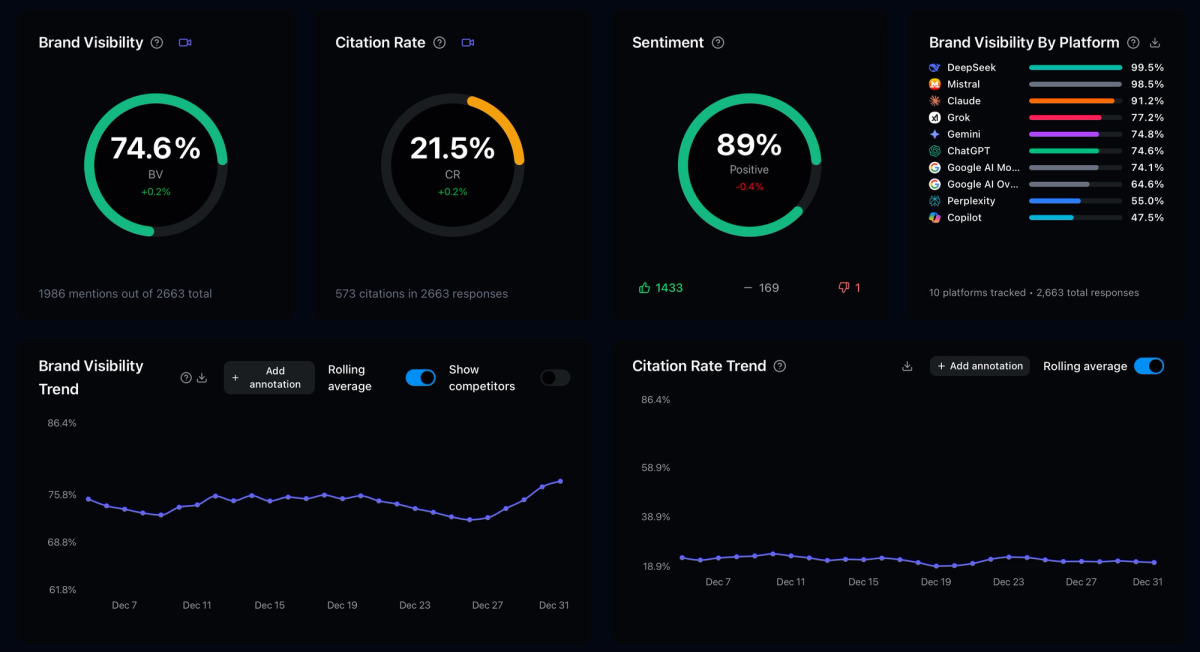
Superlines is the most complete AI search visibility platform available, purpose-built for brands serious about generative engine optimization. It tracks brand mentions, citation rate, share of voice, and sentiment across 10 AI engines — ChatGPT, Perplexity, Gemini, Claude, Copilot, Grok, Google AI Overviews, Google AI Mode, DeepSeek, and Mistral — using real interface data collected directly from each platform.
What separates Superlines from every other tool on this list is that it goes beyond dashboards to deliver actionable GEO workflows. Query fan-out analytics reveal how AI engines expand and interpret queries in your topic space, while citation gap analysis shows exactly which competitor pages are getting cited in answers where you're absent. The platform's MCP server lets you bring your AI visibility data into agentic workflows and AI-powered tools like Claude and Cursor — the only AI visibility platform with native agentic integration.
Key Dashboard Features
- 10-engine visibility dashboard: A unified view of brand mentions, citation rate, share of voice, and sentiment across ChatGPT, Perplexity, Gemini, Claude, Copilot, Grok, Google AI Overviews, Google AI Mode, DeepSeek, and Mistral — with per-engine drill-down.
- Query fan-out analytics: Understand how AI engines expand and interpret queries in your topic space, revealing the full range of prompts where your brand needs visibility.
- Citation gap analysis: Pinpoint which competitor pages are being cited in AI answers where you're absent, enabling targeted content and authority-building priorities.
- AI bot traffic analytics: Monitor AI crawler activity on your website and connect bot crawl data to your brand visibility scores — closing the loop between what AI engines index and what they surface.
- MCP server for agentic workflows: Integrate AI visibility data directly into Claude, Cursor, and custom AI agents via Model Context Protocol — the only AI visibility platform with native agentic workflow support.
Pricing
Superlines offers a free trial with no credit card required. Paid plans scale based on number of tracked topics, AI engines, and team seats. See current pricing at superlines.io.
Best For
Marketing teams and SEO professionals who need a clear, actionable path from AI visibility data to concrete GEO improvements. Superlines is the right choice if you need the broadest multi-engine coverage available paired with the workflow tools to actually act on what you find — not just measure it.
2. Rankability
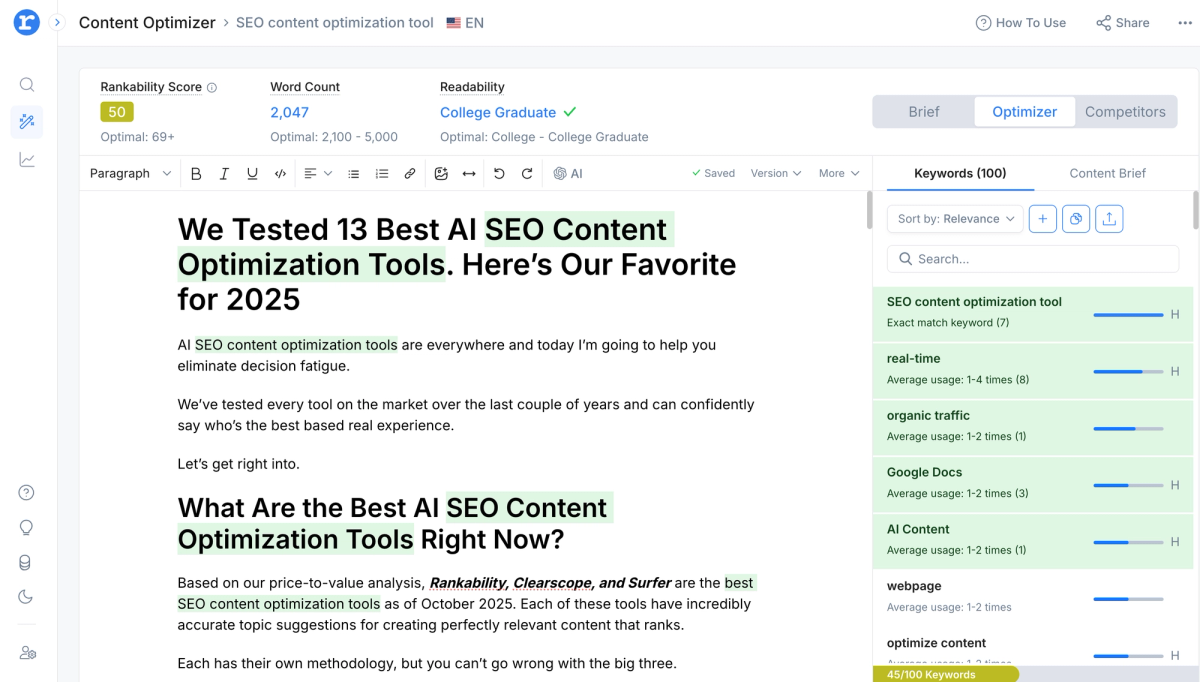
Rankability offers one of the most comprehensive AI search visibility dashboards on the market. It tracks brand mentions, citations, and share of voice across 10+ AI engines, including ChatGPT, Gemini, Copilot, Perplexity, Claude, Mistral, and several emerging platforms. The dashboard provides a unified view of how your brand performs across all these engines, with competitive benchmarking built in.
What sets Rankability apart is its methodology transparency. The platform explains exactly how it collects data, how it scores visibility, and what each metric means. This matters because AI visibility measurement is still a young field, and understanding the methodology behind the numbers helps you make better decisions.
Key Dashboard Features
- Multi-engine overview: A single dashboard view showing brand visibility across all tracked AI engines, with the ability to drill down into individual platforms.
- Competitive benchmarking: Track up to 10 competitors on the same prompts and see side-by-side share of voice comparisons.
- Weekly trend tracking: Historical charts showing how your visibility changes over time, with annotations for content changes or algorithm shifts.
- Prompt-level detail: Click into any prompt to see the exact AI response, which brands were mentioned, and which URLs were cited.
- Exportable reports: PDF and CSV exports for stakeholder reporting.
Pricing
Rankability's pricing starts at approximately $149/mo for the Starter tier (limited prompts and competitors) and scales to $499+/mo for enterprise plans with full engine coverage and API access. Custom enterprise pricing is available for agencies managing multiple brands.
Best For
SEO and marketing teams that need the broadest possible AI engine coverage in a single dashboard. Particularly strong for competitive intelligence use cases where you need to benchmark against multiple rivals across multiple AI platforms simultaneously.
3. Otterly AI
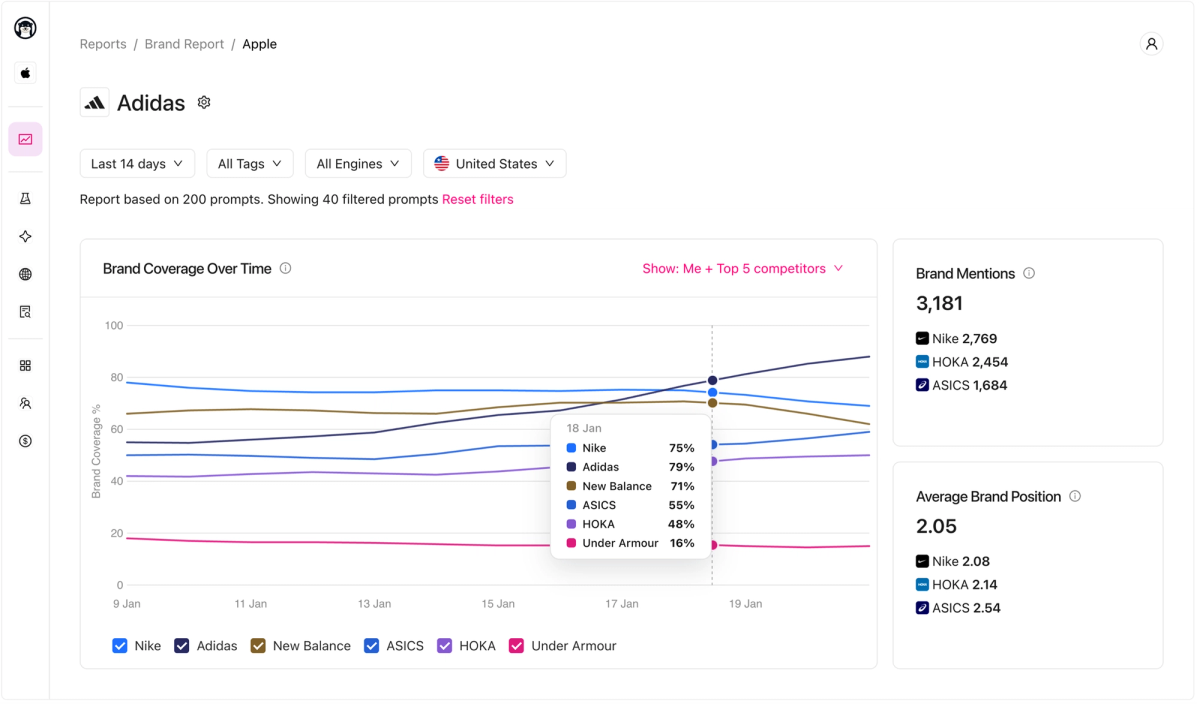
Otterly AI focuses on prompt-level tracking with a clean, intuitive dashboard interface. Rather than trying to be everything, Otterly excels at letting you define specific prompts relevant to your business and then monitoring exactly how AI engines respond to those prompts over time.
The dashboard shows weekly snapshots of each tracked prompt, including which brands are mentioned, whether your URL is cited, and how the response has changed since the last check. This granular approach is especially useful for teams running active generative engine optimization campaigns, because you can directly see whether your optimization efforts are changing AI responses.
Key Dashboard Features
- Prompt monitoring grid: A visual grid showing all tracked prompts with color-coded visibility status (mentioned, cited, absent).
- Response history: Full text of AI responses stored over time, so you can see exactly how answers evolve week to week.
- Multi-engine comparison: Side-by-side view of how different AI engines answer the same prompt.
- Alert system: Email notifications when your brand appears in (or disappears from) a tracked prompt's response.
- Team sharing: Dashboard views can be shared with team members or clients via link.
Pricing
Otterly AI offers three tiers: Lite at $29/mo (15 prompts, 2 AI engines), Standard at $189/mo (100 prompts, 4 AI engines), and Premium at $489/mo (500 prompts, all engines, API access). The Lite tier is one of the most affordable entry points for AI visibility tracking.
Best For
Teams that want to track specific, high-value prompts rather than broad category monitoring. The prompt-level approach works well for brands with a defined set of queries they want to win in AI search, such as "[product category] + best" or "[brand] vs [competitor]" queries.
4. SE Ranking Visible
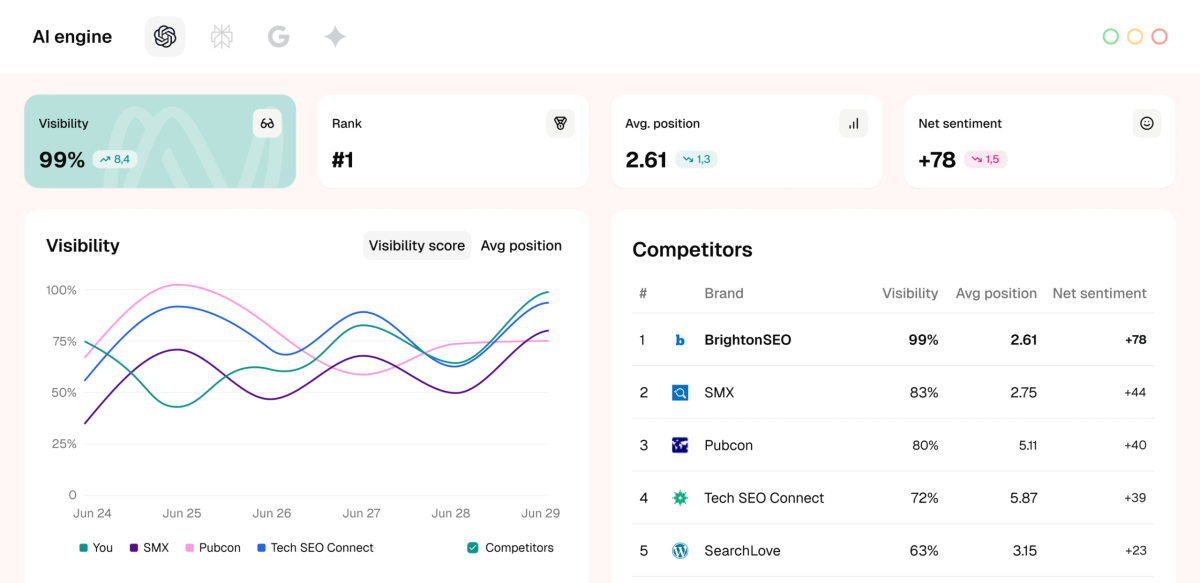
SE Ranking Visible is the AI visibility module from SE Ranking, one of the established SEO platforms. It adds AI search tracking to SE Ranking's existing suite of rank tracking, site audit, and backlink monitoring tools. For teams already using SE Ranking, this is the most natural way to add AI visibility without adopting a separate platform.
The dashboard integrates AI visibility data alongside traditional SEO metrics, so you can see both your Google rankings and your ChatGPT mention rate in the same interface. This unified view is valuable for understanding how traditional SEO and AI visibility interact.
Key Dashboard Features
- Unified SEO + AI dashboard: Traditional rank tracking and AI visibility metrics in one interface.
- ChatGPT, Gemini, Copilot, Perplexity tracking: Covers the four largest AI search engines.
- Brand mention and citation tracking: Monitors both mentions and linked citations across tracked prompts.
- Competitor comparison: Benchmark your AI visibility against competitors on the same prompts.
- Integration with SE Ranking tools: AI visibility data connects to SE Ranking's keyword research, site audit, and content tools.
Pricing
SE Ranking Visible is available as an add-on to SE Ranking plans. The Core AI visibility module starts at $189/mo, Plus at $355/mo, and Max at $519/mo. You need an active SE Ranking subscription (starting at $65/mo) to access Visible.
Best For
SEO teams already using SE Ranking who want to add AI visibility tracking without switching platforms. The integrated approach saves time for teams that want a single dashboard for both traditional and AI search performance.
5. Peec AI
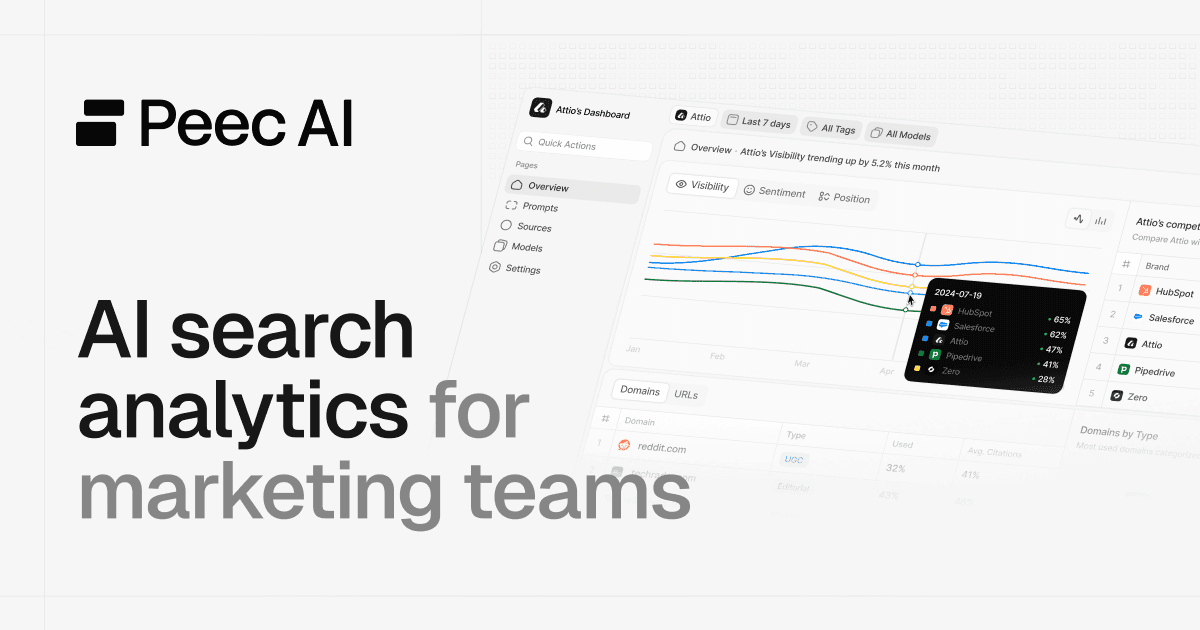
Peec AI is a European-built AI visibility platform with strong multi-language support. The dashboard tracks brand mentions, citations, and sentiment across ChatGPT, Gemini, Copilot, Perplexity, and Claude, with particular strength in handling non-English queries and localized AI responses.
For brands operating across multiple European markets, Peec AI's ability to track AI visibility in German, French, Spanish, Dutch, and other languages is a significant differentiator. Most competing dashboards focus primarily on English-language tracking.
Key Dashboard Features
- Multi-language tracking: Monitor AI visibility in 10+ languages with localized prompt sets.
- Sentiment analysis: Dashboard panels showing whether AI mentions of your brand are positive, neutral, or negative.
- Competitive benchmarking: Track competitors across the same prompts and languages.
- Citation source analysis: See which of your pages get cited most frequently and by which AI engines.
- EU data handling: Data processing compliant with European privacy regulations.
Pricing
Peec AI now offers separate pricing for brands and agencies. Brand plans: Starter at €85/mo (50 prompts, 3 models, 1 project), Pro at €205/mo (150 prompts, 2 projects), Advanced (350 prompts, 5 projects, multi-country, GSC/GA/Looker), and Enterprise with custom pricing. Agency bundles are available for multi-client management. 15% annual discount on all plans.
Best For
European brands and agencies managing multi-market campaigns. If you need to track how AI engines describe your brand in German, French, or other European languages, Peec AI is the strongest option. Also a good fit for brands where sentiment monitoring is a priority.
6. Profound
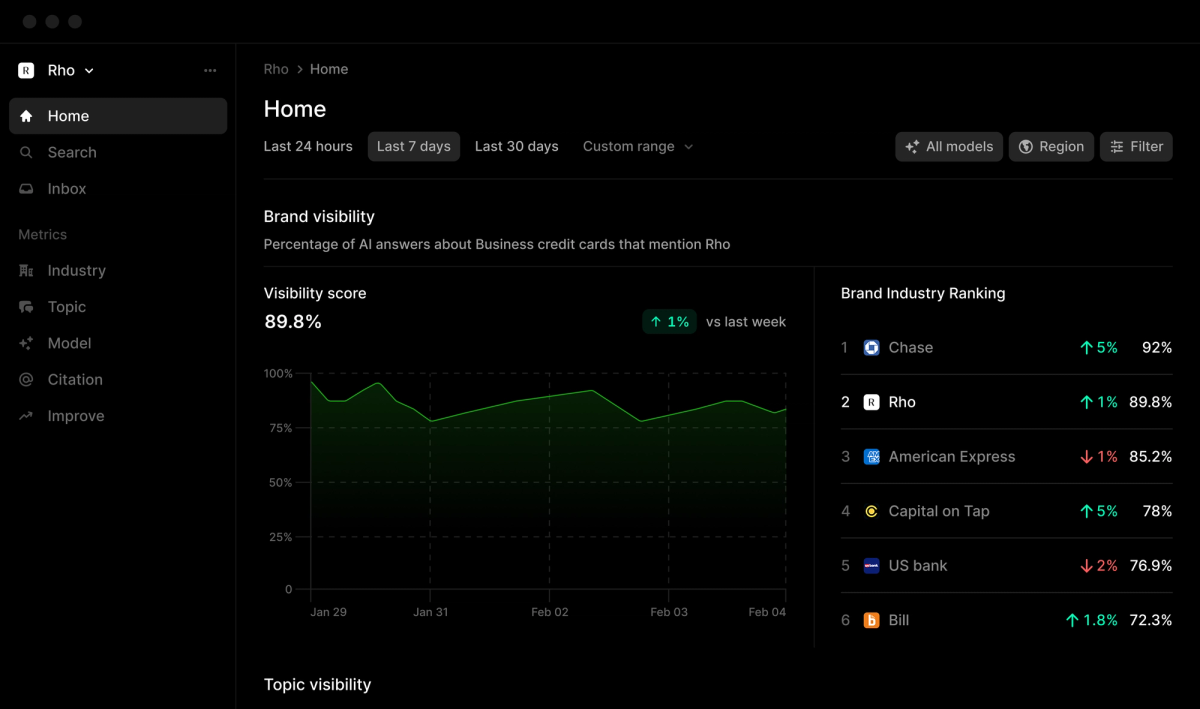
Profound is an enterprise-focused AI visibility platform backed by significant venture funding ($58.5M across Series A and B rounds). The dashboard is built for large organizations that need to track hundreds or thousands of prompts across multiple brands, business units, or client accounts.
Where Profound stands out is in its customization and scale. The dashboard supports custom report builders, API access for integrating AI visibility data into existing BI tools, and multi-brand management for agencies or enterprise teams with complex organizational structures.
Key Dashboard Features
- Custom dashboard builder: Create tailored views with the specific metrics, filters, and visualizations your team needs.
- High prompt capacity: Track 500+ prompts across 6+ AI engines (ChatGPT, Gemini, Copilot, Perplexity, Claude, Meta AI).
- API access: Pull AI visibility data into Looker, Tableau, or custom dashboards via REST API.
- Multi-brand management: Manage multiple brands or client accounts from a single interface.
- Enterprise support: Dedicated account management and onboarding for large deployments.
Pricing
Profound's pricing starts at approximately $99/mo for the Starter plan and $399/mo for Growth. Enterprise pricing is custom and typically runs $500+/mo depending on prompt volume and engine coverage. No public free tier.
Best For
Enterprise marketing teams and large agencies that need high prompt volumes, custom reporting, and API integration. If you're tracking AI visibility across multiple brands or need to feed data into existing BI infrastructure, Profound's enterprise features justify the higher price point.
7. Xofu
Xofu takes a different approach to AI visibility by focusing on bottom-of-funnel queries: the specific prompts where potential customers are comparing products and making purchase decisions. The dashboard is designed to show you where your brand appears (or doesn't) in the AI responses that directly influence buying behavior.
The standout feature is Xofu's free tier, which offers genuine utility rather than a crippled trial. You can track a limited number of prompts across ChatGPT, Gemini, and Perplexity at no cost, making it one of the best ways to start monitoring AI visibility without budget approval.
Key Dashboard Features
- Bottom-of-funnel focus: Dashboard organized around purchase-intent prompts rather than broad informational queries.
- Free tier: Track up to 10 prompts across 3 AI engines at no cost.
- Visibility scoring: Simple 0-100 score for each tracked prompt showing your brand's presence strength.
- Competitor tracking: See which competitors appear in the same prompts and how often.
- Quick setup: Dashboard is functional within minutes of signup, no complex configuration required.
Pricing
Xofu offers a Free plan (10 prompts, 3 engines), Pro at $79/mo (50 prompts, 5 engines), Business at $499/mo (250 prompts, all engines), and Enterprise at $999/mo (unlimited prompts, API access, custom integrations).
Best For
Startups and small marketing teams exploring AI visibility for the first time. The free tier lets you validate whether AI visibility tracking is worth investing in before committing budget. Also useful for product marketing teams focused specifically on purchase-decision prompts.
8. Scrunch AI
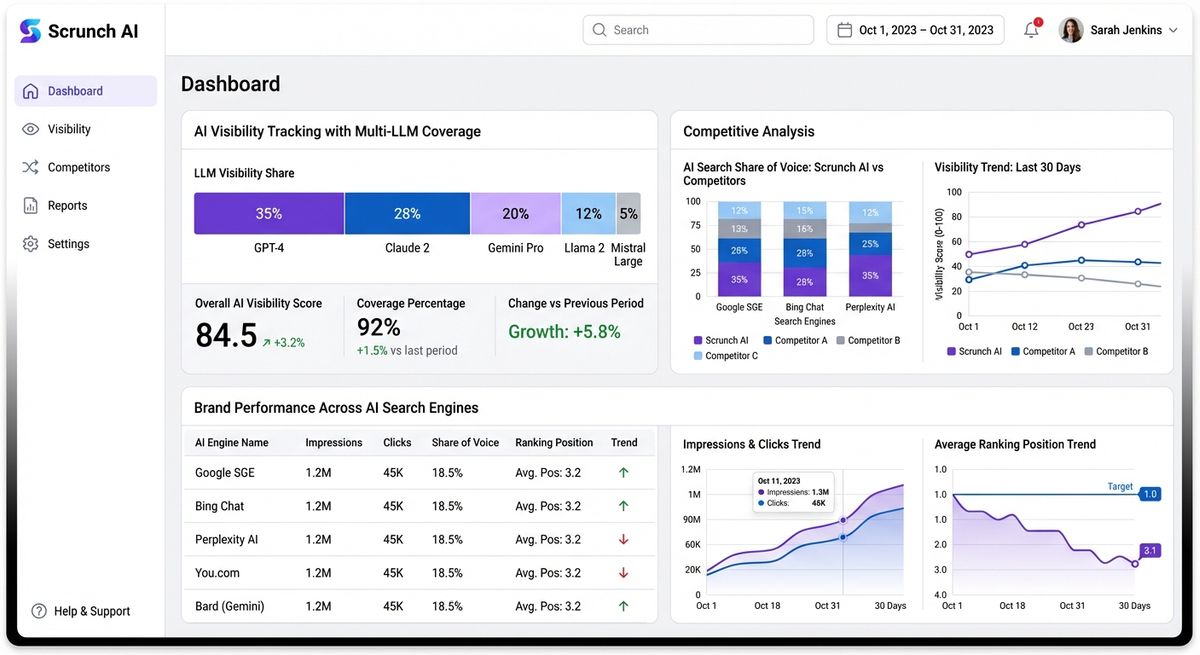
Scrunch AI is an AI search analytics platform that tracks how brands appear across multiple large language models. The dashboard provides a structured view of brand mentions, citations, and competitive positioning, with a focus on quantitative analytics rather than qualitative content analysis.
Scrunch differentiates itself through its LLM coverage model: the Core tier tracks 4 LLMs, while the Enterprise tier expands to 9 LLMs. This tiered approach lets teams start with the most important engines and expand coverage as their AI visibility strategy matures.
Key Dashboard Features
- LLM coverage tiers: Core tracks 4 LLMs, Enterprise tracks 9 LLMs, giving flexibility to scale coverage.
- Citation analytics: Detailed breakdown of which pages get cited, by which engines, and how often.
- Brand mention frequency: Track mention volume over time with trend analysis.
- Competitive positioning: See where you rank relative to competitors in AI-generated responses.
- Prompt library: Pre-built prompt sets for common industries to accelerate setup.
Pricing
Scrunch AI Core starts at $250/mo (125 prompts, 4 LLMs). Enterprise pricing is custom and includes 9 LLMs, higher prompt volumes, and dedicated support.
Best For
Mid-market brands that want structured AI analytics with clear LLM coverage tiers. The prompt library feature is particularly useful for teams that aren't sure which prompts to track, as it provides industry-specific starting points.
9. Semrush AI Toolkit
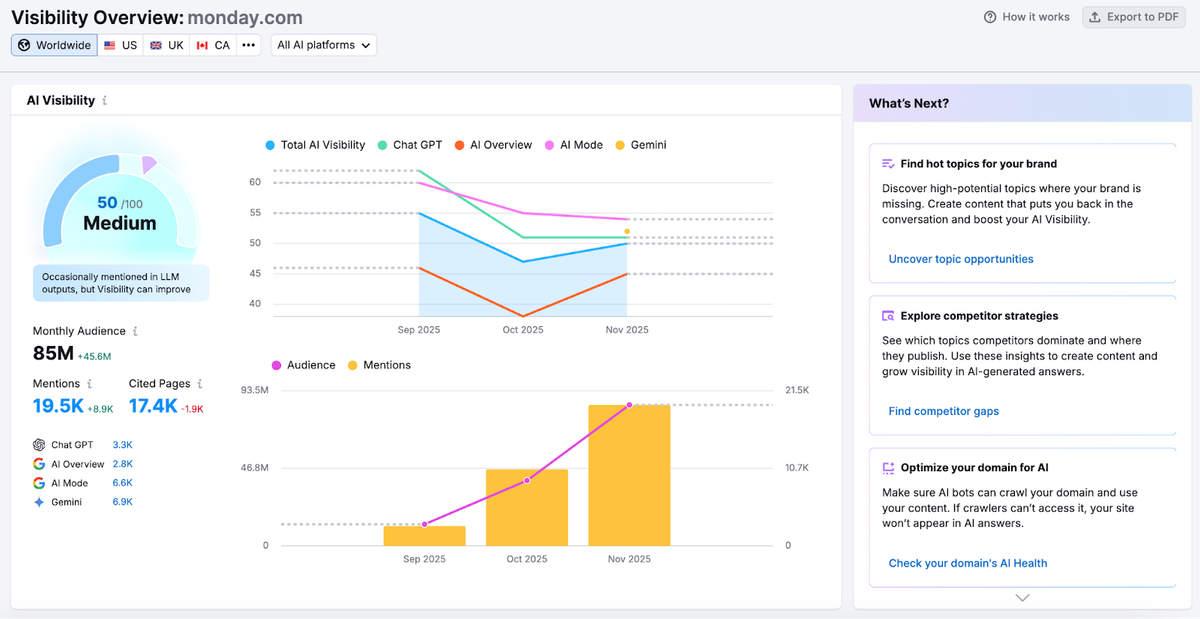
Semrush, the established SEO platform, has added AI visibility tracking through its AI Toolkit module. The dashboard integrates AI search data into Semrush's existing interface, adding brand mention tracking and AI citation monitoring alongside the keyword research, rank tracking, and competitive analysis tools that Semrush is known for.
Semrush currently dominates AI search visibility for many competitive queries. According to our own tracking data, Semrush appears in over 40% of AI responses for queries like "best AI search visibility tools" and "AI overviews rank tracking." Their content strategy and domain authority give them a significant advantage in how LLMs reference their brand.
Key Dashboard Features
- Integrated SEO + AI view: AI visibility data sits alongside traditional Semrush metrics.
- Brand monitoring: Track brand mentions across ChatGPT, Gemini, and other AI engines.
- Competitive analysis: Compare your AI visibility against competitors using Semrush's competitive intelligence infrastructure.
- Content recommendations: Suggestions for optimizing content to improve AI visibility based on gap analysis.
- Large keyword database: Leverage Semrush's existing keyword data to identify high-value AI prompts.
Pricing
The AI Toolkit is available as an add-on at $99/mo per domain on top of existing Semrush plans (Pro at $139.95/mo, Guru at $249.95/mo, Business at $499.95/mo). Total cost for AI visibility tracking starts at approximately $239/mo.
Best For
Teams already invested in the Semrush ecosystem who want to add AI visibility without adopting a separate platform. The integration with Semrush's keyword and competitive data is the main advantage, though the add-on pricing means the total cost is higher than standalone AI visibility tools.
10. Morningscore
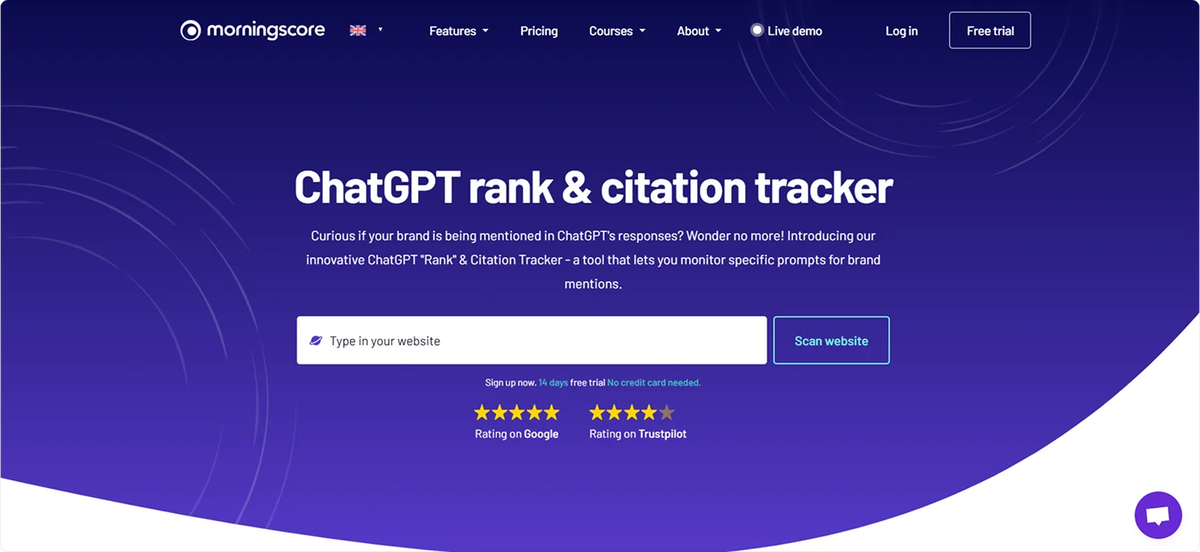
Morningscore takes a gamified approach to SEO and AI visibility tracking. The dashboard presents optimization tasks as "missions" with point values, making it more engaging for teams that find traditional analytics dashboards dry. The AI visibility module tracks brand mentions across ChatGPT and other engines, integrated into Morningscore's broader SEO toolkit.
While the gamification might seem gimmicky, it serves a practical purpose: it helps non-technical team members understand what actions to take and prioritize. For small businesses or marketing teams without dedicated SEO specialists, this guided approach can be more actionable than a raw data dashboard.
Key Dashboard Features
- Gamified interface: Optimization tasks presented as missions with points and progress tracking.
- AI mention tracking: Monitor brand mentions in ChatGPT and other AI engines.
- SEO health score: Combined traditional SEO and AI visibility health metric.
- Competitor tracking: Basic competitive benchmarking for AI mentions.
- Task prioritization: Dashboard highlights the highest-impact actions to take next.
Pricing
Morningscore offers Starter at €89/mo, Pro at €199/mo, and Enterprise with custom pricing. AI visibility tracking is included in all tiers, with higher tiers offering more tracked keywords and competitors.
Best For
Small businesses and marketing teams that want a guided, approachable dashboard rather than a data-heavy analytics interface. The gamified approach works well for teams where multiple people need to understand and act on AI visibility data without deep technical expertise.
11. Daydream
Daydream is a lightweight AI visibility monitoring tool designed for simplicity. The dashboard strips away complexity and focuses on the essentials: is your brand being mentioned by AI engines, and is it being mentioned more or less than last week? For teams that don't need enterprise analytics but want basic awareness of their AI visibility, Daydream offers a clean, minimal interface.
The free tier is genuinely functional, tracking a small number of prompts across major AI engines. This makes Daydream, alongside Xofu, one of the best options for teams testing the waters with AI visibility monitoring.
Key Dashboard Features
- Minimal interface: Clean, distraction-free dashboard focused on core visibility metrics.
- Free tier: Basic monitoring at no cost, with paid tiers for expanded tracking.
- Brand mention alerts: Notifications when your brand appears in or disappears from AI responses.
- Weekly summaries: Email digest of your AI visibility changes each week.
- Quick setup: Functional within minutes, no complex onboarding process.
Pricing
Daydream offers a Free tier (limited prompts), a Starter plan at $10/mo, and paid tiers scaling up based on prompt volume and engine coverage. Exact pricing for higher tiers is available on request.
Best For
Solo marketers, freelancers, and small teams that want basic AI visibility awareness without the complexity or cost of enterprise dashboards. Also useful as a secondary monitoring tool alongside a more comprehensive primary dashboard.
How to Set Up Your AI Search Visibility Dashboard
Choosing a dashboard is only the first step. Here's how to configure it for maximum value:
Step 1: Define Your Prompt Universe
Start by identifying 50-100 prompts that matter most to your business. These should include:
- Brand queries: "[Your brand] reviews," "[Your brand] vs [competitor]"
- Category queries: "Best [your category] tools," "Top [your category] software 2026"
- Problem queries: "How to [solve problem your product addresses]"
- Comparison queries: "[Competitor A] vs [Competitor B] vs [Your brand]"
Most dashboards let you import prompts in bulk via CSV, so prepare your list before setup.
Step 2: Set Your Competitive Benchmark
Add 5-10 direct competitors to your dashboard. Track the same prompts for all competitors so you get true apples-to-apples share of voice data. Include at least one aspirational competitor (a brand that dominates your category in AI search) to understand what "good" looks like.
Step 3: Establish Your Baseline
Run your first full scan and document your starting metrics: mention rate, citation rate, share of voice, and any sentiment data. This baseline is critical because you'll measure all future progress against it. Without a baseline, you can't prove ROI.
Step 4: Set a Weekly Review Cadence
AI search responses change faster than traditional search rankings. Set a weekly calendar reminder to review your dashboard. Look for:
- New mentions or citations (what content triggered them?)
- Lost mentions (did a competitor's content push you out?)
- Sentiment shifts (is the AI describing you differently?)
- Competitive movements (is a competitor gaining share of voice?)
Step 5: Connect to Your Content Workflow
The dashboard should inform your content strategy. When you see a prompt where you're absent but competitors are mentioned, that's a content gap. When you see a prompt where you're mentioned but not cited, that's a citation optimization opportunity. Feed these insights directly into your editorial calendar.
How Often Should You Check Your AI Visibility Dashboard?
Weekly is the minimum cadence for active monitoring. AI engine responses can shift significantly within a single week as models update their training data, re-index web content, or adjust their response patterns.
For brands running active GEO campaigns, daily checks on priority prompts are worthwhile during the first 90 days. After establishing a baseline and seeing consistent trends, you can shift to weekly reviews with monthly deep-dive reports for stakeholders.
The key insight from Averi.ai's research is that AI search traffic converts at 4.4x the rate of traditional organic traffic. This means even small improvements in AI visibility, caught early through dashboard monitoring, can have outsized revenue impact.
What's the Difference Between AI Visibility Dashboards and Traditional SEO Tools?
Traditional SEO tools like Google Search Console, Ahrefs, and Semrush track your position in conventional search engine results pages (SERPs). They tell you that you rank #3 for "best project management software" on Google.
AI visibility dashboards track something fundamentally different: whether AI engines mention your brand and cite your content when generating answers. There's no "position #3" in a ChatGPT response. Instead, you're either mentioned or you're not, cited or you're not, and described positively or negatively.
The metrics are different too. Traditional SEO measures impressions, clicks, and rankings. AI visibility measures mention rate, citation rate, share of voice, and sentiment. Both matter, but they require different dashboards because they track different phenomena.
Most brands in 2026 need both. Dimension Market Research projects the GEO market will reach $1,089.3 million in 2026, growing at a 40.6% CAGR. This growth reflects the reality that AI search is becoming a parallel channel to traditional search, not a replacement for it. Your dashboard stack should cover both.
Common Mistakes When Setting Up AI Visibility Dashboards
Tracking Too Few Prompts
Many teams start with 10-20 prompts and call it done. That's not enough to get a statistically meaningful picture of your AI visibility. Aim for at least 50 prompts at launch, expanding to 100-200 as you learn which prompt categories matter most.
Ignoring Competitor Tracking
A dashboard that only shows your own metrics is half a dashboard. Without competitive benchmarking, you don't know whether your 5% mention rate is good or terrible for your category. Always track at least 5 competitors on the same prompts.
Checking Monthly Instead of Weekly
AI responses change faster than traditional search rankings. A monthly check means you could miss a 3-week visibility drop before catching it. Weekly reviews are the minimum for actionable monitoring.
Not Connecting Dashboard Insights to Content Actions
The dashboard is a diagnostic tool, not a solution. If you review it weekly but never act on the insights (creating content for gaps, optimizing pages that aren't getting cited, addressing negative sentiment), the dashboard is just an expensive report card.
Conclusion
AI search visibility dashboards have moved from "nice to have" to essential infrastructure for any brand serious about appearing in AI-generated answers. The tools reviewed here range from free entry points (Xofu, Daydream) to enterprise platforms (Profound, Rankability) capable of tracking hundreds of prompts across 10+ AI engines.
The right choice depends on your scale, budget, and existing tool stack. For teams just starting out, Xofu's free tier or Otterly AI's $29/mo Lite plan offer low-risk entry points. For enterprise teams needing comprehensive coverage, Rankability and Profound provide the depth and customization required for serious AI visibility programs.
Whatever dashboard you choose, the important thing is to start tracking now. With AI search traffic growing 165x faster than traditional organic and converting at 4.4x the rate, every week without visibility data is a week of missed optimization opportunities.
Superlines offers AI search visibility tracking across 10 AI engines with competitive benchmarking, citation monitoring, and share of voice analysis. If you're evaluating dashboards for your team, it's worth including in your comparison alongside the tools reviewed above, especially if you also want the platform to tell you which actions to take to improve your AI visibility.