


14 Best Profound Alternatives for GEO 2026: Tools to Track and Improve AI Search Visibility
The best Profound alternatives for GEO in 2026 are Superlines, AthenaHQ, and Writesonic GEO platforms that help brands track and improve how they appear in AI-generated answers across ChatGPT, Gemini, and other AI search engines.
The AI search revolution is transforming digital marketing at an unprecedented pace. ChatGPT now handles more than 1 billion queries every day, and Google’s AI Overviews now appear at the top of search results, answering questions before anyone scrolls to the blue links. As a result, 1 in every 4 searches now ends without a click while AI overviews get over 2 billion users every month. Naturally, brands that are mentioned in AI overviews are the first (and sometimes only) brands your ideal customers see.
When people turn to AI platforms like ChatGPT, Perplexity, or Google’s AI Overviews for recommendations, your brand either shows up, or it doesn’t. In today’s zero-click AI search environment, there’s no in-between.
This guide highlights 14 reliable alternatives to Profound, ranging from budget-friendly tools to enterprise-grade solutions that rival its features. Whether you’re a startup adapting to AI-driven search or an agency managing several clients, you’ll find the insights you need here to choose the right GEO platform for long-term growth in an AI-first search landscape.
What Are GEO / AI Search Analytics Tools (and How They Differ from SEO Tools)
AI Search analytics tools, also known as GEO tools, are solutions designed to monitor, analyze and improve how your brand, products or services show up in AI generated responses from large language models (LLMs) like ChatGPT.
A GEO tool reveals where and how your brand is mentioned in specific prompts. It focuses on what experts call “AI visibility,” measuring both the frequency and the context in which AI systems reference your content. This data helps marketers turn AI Search from a black box into a measurable channel and overcome their competition in AI visibility.
How GEO relates to traditional SEO
GEO does not replace SEO, they work together. Strong SEO foundations such as domain authority, quality backlinks and a technically healthy site still help a lot, because if Google trusts your domain, AI engines are more likely to trust and cite it as well.
At the same time GEO adds a new layer. Instead of only asking where you rank in search results, you also measure how often AI assistants mention and cite you in their answers. Many GEO tactics, for example clearer content, better structure and structured data, improve both SEO and AI visibility at once. You can think of GEO as an extension of SEO for AI driven discovery.
For a full breakdown of what GEO is and how it works, see our guide on Generative Engine Optimization.
Why Profound style tools matter in 2026
AI Search is no longer a side channel. It is where a growing share of research and product discovery happens:
-ChatGPT processes over 1 billion queries per day.
- Perplexity handles over 230 million monthly searches.
-According to Semrush, Google's AI Overviews now appear in 15% of all search results.
- Around 93% of AI Mode searches end without a click. This is more than twice the rate of AI Overviews, where 43% result in zero clicks. (Semrush, September 2025)
- Users spend roughly double the time in AI Mode compared to AI Overviews, 49 seconds vs 21 seconds on average. (Growth Memo, October 2025)
In other words, people are getting answers directly inside AI surfaces and often never visiting traditional results at all. Profound and its alternatives exist to make that AI visibility measurable, so you can see when your brand is mentioned in ChatGPT style answers, how often competitors are chosen instead, and whether your optimization efforts are actually moving those numbers. The strongest tools do not just report mentions, they provide highly actionable data and advanced features that help you close citation gaps, test new prompts, and systematically improve your AI Search visibility.
Our Selection Methodology
We evaluated 14 GEO platforms using five critical criteria that determine long-term success in AI search optimization:
1. AI Monitoring Depth: Comprehensive tracking at least across ChatGPT, Claude, Perplexity, Gemini, and Google AI Overviews
2. Optimization Integration: Built-in tools for content creation, SEO analysis, and visibility improvement
3. Competitive Intelligence: Detailed competitor analysis and market benchmarking capabilities
4. Scalability & Pricing: Transparent pricing with growth-friendly tiers and feature accessibility
5. Implementation Speed: Quick setup and onboarding without extensive technical requirements
Below, you’ll find 14 of the best Profound alternatives in 2026, ranked for innovation, usability, and real-world impact in AI Search visibility.
Why real AI answers matter more than API output
Most AI visibility tools still rely on APIs to approximate what users see. Recent tests show that API responses and on-screen answers can differ significantly, which means API based tools may report visibility that does not match real conversations inside ChatGPT, Perplexity or other assistants.
Top 14 Best Profound Alternatives in 2026
1. Superlines
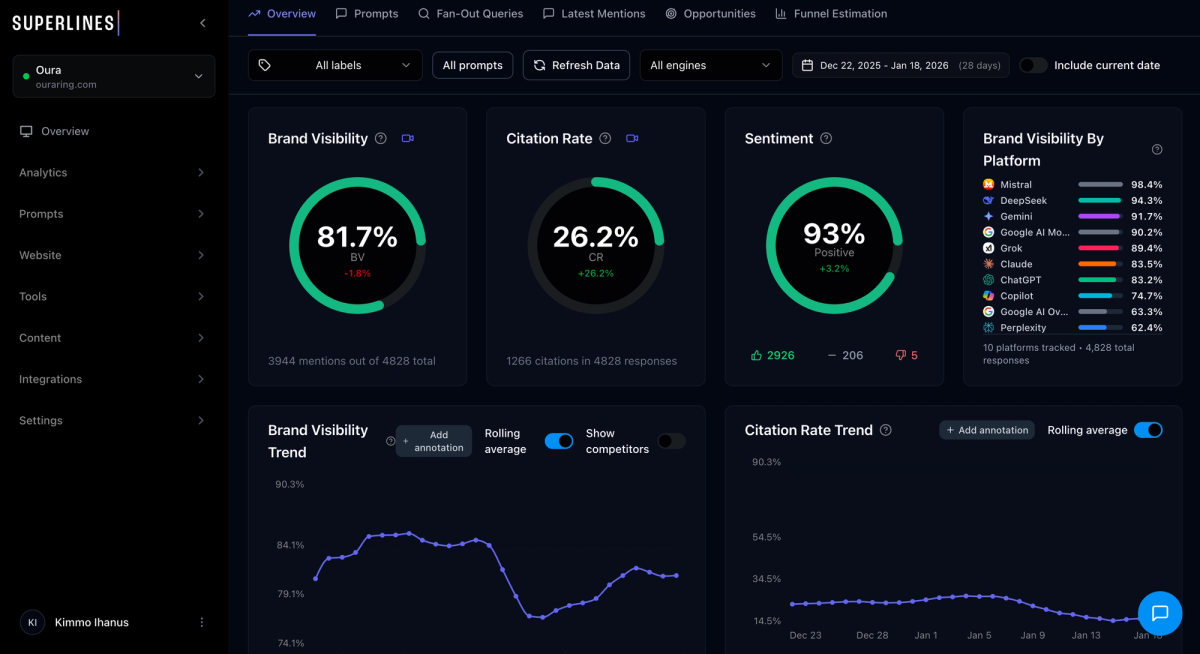
Superlines is a Generative Engine Optimization (GEO) platform that helps marketing teams and agencies see how often AI engines mention and cite their brand, then turns that visibility data into clear opportunities instead of static dashboards. It uses real answer data from live AI interfaces across 10 major AI engines and exposes the same structured dataset through the in app Superlines Agent and an MCP server, so teams can work with the data inside their own AI assistants and agents when they want to surface insights and take action.
Key features
- Cross platform AI visibility tracking: Track brand visibility and competitive share of voice across 10 major AI engines, including ChatGPT, Perplexity, Claude, Microsoft Copilot, Google AI Mode, Google AI Overviews, Gemini, Mistral, DeepSeek and Grok.
- Citation and competitor gap analysis: See which pages are cited, where competitors win citations instead of you, and which third party articles or UGC threads (for example Reddit, Quora) are worth pursuing for additional mentions.
- AI Traffic and AI Bot Analytics: Monitor how AI crawlers from OpenAI, Anthropic, Google, Perplexity and others actually visit your site, which pages they read, and how that traffic connects to human visits at prompt and URL level.
- Automated prompt management and Search Query Fan-Out insights: Superlines helps you discover, test and clean up prompts, and surfaces the Search Query Fan-Outs (LLM keywords) that AI assistants run behind the scenes so you see which topics, queries and sources drive your AI visibility.
- Built for multi brand, multi market workflows: Unlimited brands and domains per workspace, with market specific languages and competitors. Designed for agencies and in house teams that manage several services and regions in one view.
- Surface insights with interactive agents: Access the full visibility dataset through the in app Superlines Agent or via the MCP server, so your own AI assistants can analyze results, suggest next steps, and support day to day GEO workflows.
Pricing
- Starter plans from €79 per month, including 3 AI engines, 50 tracked prompts, unlimited seats and competitors, daily tracking, AI Traffic plus AI Bot analytics, Action Center, and MCP server access — one of the most complete Starter plans available.
- The new Pro tier at €199/month adds 150 prompts, 3 brands, data exports, and monthly site audits for mid-market marketing teams, while higher tiers add more volume, API access, longer data retention, and advanced tools like large-scale crawling and content support.
Limitations
- Tiered Feature Access: Advanced tools like full historical data are reserved for Enterprise and Agency partnership plans.
- Data Limits: Entry-level plans have more restrictive data retention and prompt volumes.
2. AthenaHQ
Founded by former Google Search and DeepMind experts, AthenaHQ stands at the forefront of Generative Engine Optimization, helping companies see how their brand appears on generative engines like ChatGPT, Perplexity, Claude, Gemini, and more.
Key Features:
- Multi-Engine Coverage: Comprehensive tracking across ChatGPT, Gemini, Claude, Perplexity, Copilot, Google AI Overviews, and emerging platforms
- Competitor Benchmarking: Side-by-side visibility comparisons with detailed competitive intelligence
- AI-Generated Action Center: Tailored recommendations for content restructuring, FAQ optimization, and strategic outreach
- Traffic Attribution: GA4 integration for full-funnel AI search analytics
Pricing: Starter: $295/month, Growth: $595/month, Enterprise: Custom pricing with credit-based system (1 credit = 1 AI response).
Limitations:
- Credit system is a bit complex and can become expensive with extensive monitoring. Learning curve for smaller teams new to GEO.
- Relies on API output instead of capturing real answers from AI interfaces.
3. Writesonic GEO
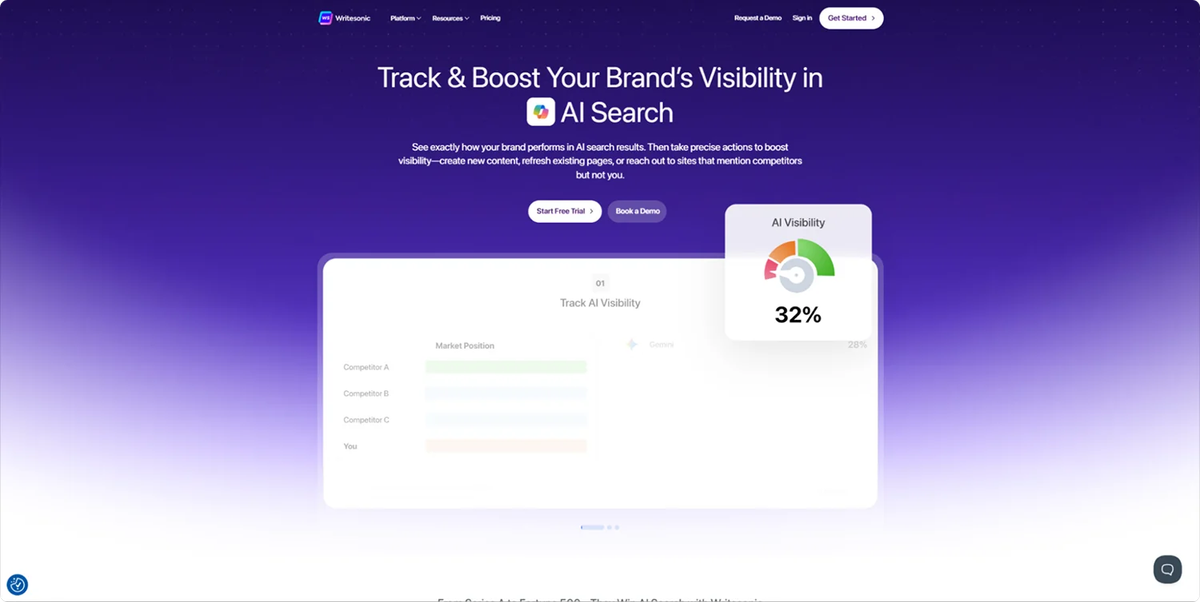
Writesonic's Generation Engine Optimization tool is designed to optimize your brand's presence across major AI platforms like ChatGPT, Claude, Google AI Overviews, and more.
Key Features:
- AI Traffic Analytics: AI Traffic Analytics tool tracks visits from AI crawlers (like ChatGPT, Claude, Perplexity, Gemini) that traditional analytics miss, showing which pages they access and how they drive human traffic through citations.
- Brand Presence Explorer: Visibility scoring, competitive benchmarking, and sentiment tracking across AI platforms
- Integrated Optimization: Built-in content creation and SEO tools for immediate implementation of insights
- Citation Gap Analysis: Identification of missed opportunities with actionable recommendations
Pricing: Standard: $99/month, Professional: $499/month, Enterprise: Custom pricing with GEO features available in Professional plans and above.
Limitations:
- GEO features limited to higher-tier plans. Newer platform with less market presence than established competitors.
- Relies on API output instead of capturing real answers from AI interfaces.
4. Scrunch AI
Scrunch is a GEO tool that helps enterprise teams detect and correct false narratives in AI-generated answers. If you're concerned about outdated product information, competitor-biased summaries, or broken messaging, it provides the right solutions for your team.
Key Features:
- Misinformation Detection: Proactive identification of false or outdated brand information in AI responses
- Narrative Control: Tools for correcting and improving brand representation across AI platforms
- Journey Mapping: Understanding how AI agents navigate websites and interact with content
- Knowledge Hub: Library of owned and third-party content that AI engines cite
Pricing: Starter: $300/month (350 prompts), Growth: $500/month (700 prompts), Pro: $1,000/month (1,200 prompts)
Limitations:
- Higher pricing for basic features. Limited market presence compared to established platforms.
- Relies on API output instead of capturing real answers from AI interfaces.
5. XFunnel
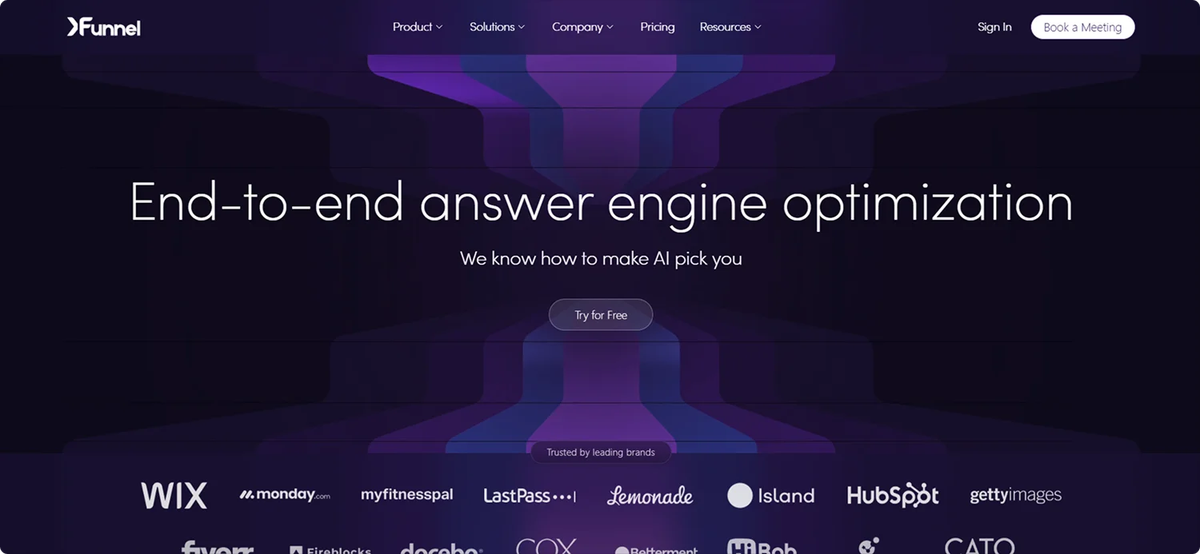
XFunnel combines AI visibility analytics with actionable playbooks and expert support. What makes this tool unique is its "Buying Journey Analysis" dashboard. This GEO analytics feature breaks down your brand's AI visibility at each stage of the funnel, from awareness to consideration to conversion.
Key Features:
- Buying Journey Analysis: Funnel-specific visibility tracking from awareness to conversion
- Query Analytics: Discovery of top AI prompts by intent, region, and persona
- Dedicated Analyst Support: Tailored recommendations and optimization playbooks
- Real-Time Visibility Tracking: Cross-platform monitoring with trend analysis
Pricing: Custom pricing with free AI search audit available.
Limitations: Custom pricing lacks transparency. Limited public information about platform capabilities.
- Custom pricing lacks transparency. Limited public information about platform capabilities.
- Relies on API output instead of capturing real answers from AI interfaces.
6. Peec AI
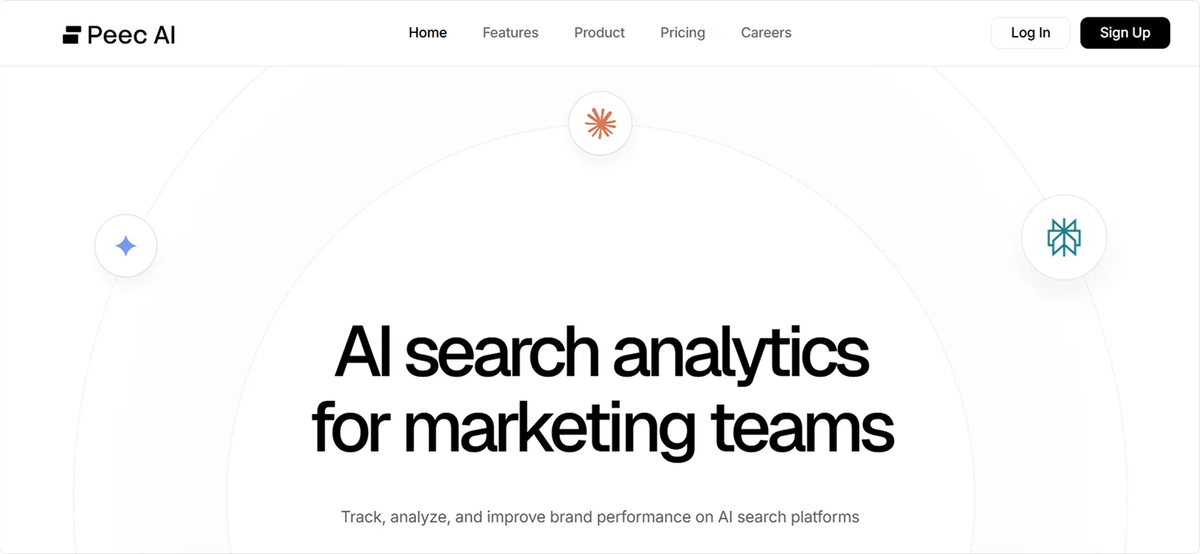
Peec AI offers comprehensive multi-platform monitoring with a focus on real-time alerting and competitive benchmarking across AI search engines. They are actively looking to improve their data analytics capabilities based on the roles that they are hiring.
Key Features:
- Real-Time Alerts: Instant notifications when brand visibility changes for specific prompts
- Multi-Platform Coverage: Tracking across ChatGPT, Perplexity, Gemini, and emerging AI platforms
- Source Attribution Analysis: Understanding which websites influence AI responses about your brand
- Regional Tracking: Geographic-specific monitoring for international brands
Pricing: Peec AI now offers separate pricing for brands and agencies. Brand plans: Starter €85/month (50 prompts, 3 models, 1 project), Pro €205/month (150 prompts, 2 projects), Advanced (350 prompts, 5 projects, multi-country, GSC/GA/Looker). Enterprise custom. Agency bundles available. 15% annual discount.
Limitations:
- It tracks mentions across a few AI models and surfaces simple visibility shifts. But it lacks deeper diagnostics — no citation gaps, no competitor benchmarking, no on-page insights, and no execution layer. Most advanced engines require add-on fees.
- Relies on API output instead of capturing real answers from AI interfaces.
Best Profound alternatives for GEO in 2026
This quick comparison shows how Superlines, Profound, Peec AI and Scrunch AI differ on answer data sources, AI traffic analytics and support for practical GEO workflows.
7. Otterly AI
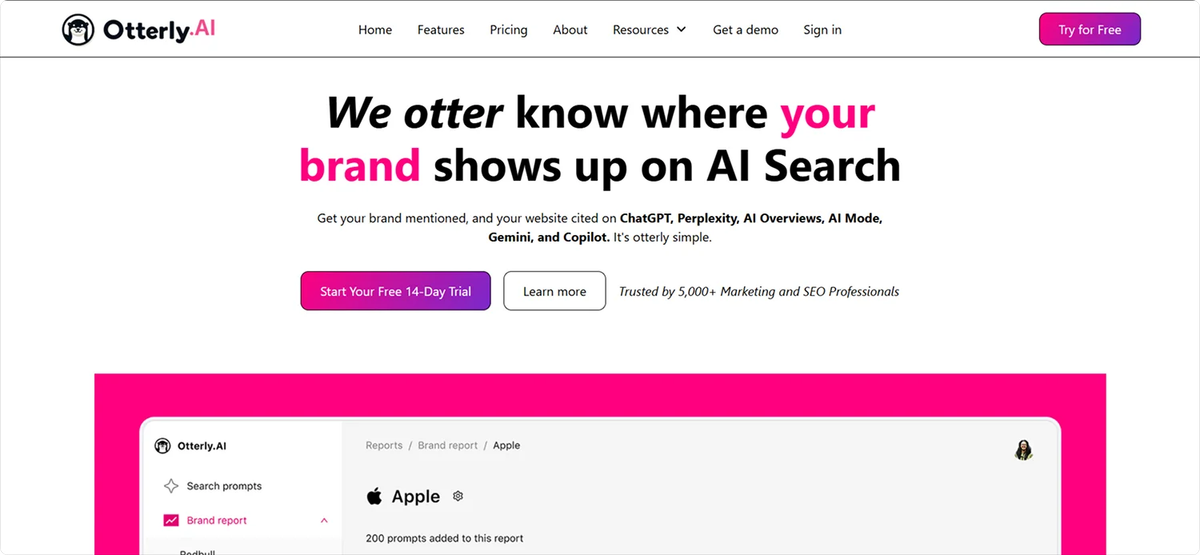
Otterly is the most practical GEO tool for teams focused on prompt-level AI rankings. It lets you monitor where your brand appears in AI-generated responses, track link citations, and discover high impact prompts your audience is using.
Key Features:
- Prompt Discovery: AI keyword research tool that transforms traditional keywords into conversation-based queries
- Automated Link Citation Detection: Real-time tracking when AI platforms reference your content with links
- Brand Visibility Index: KPI showing brand prominence across AI search engines over time
- GEO Audit: Comprehensive analysis with SWOT, competitor assessment, and tactical recommendations
Pricing: Lite: $29/month (10 prompts), Standard: $189/month (100 prompts), Pro: $989/month (1,000 prompts)
Limitations:
- Significant price jump between tiers. The leap from $29 to $189 monthly might be challenging for growing businesses. Limited advanced analytics compared to enterprise platforms.
- Relies on API output instead of capturing real answers from AI interfaces.
8. Promptwatch
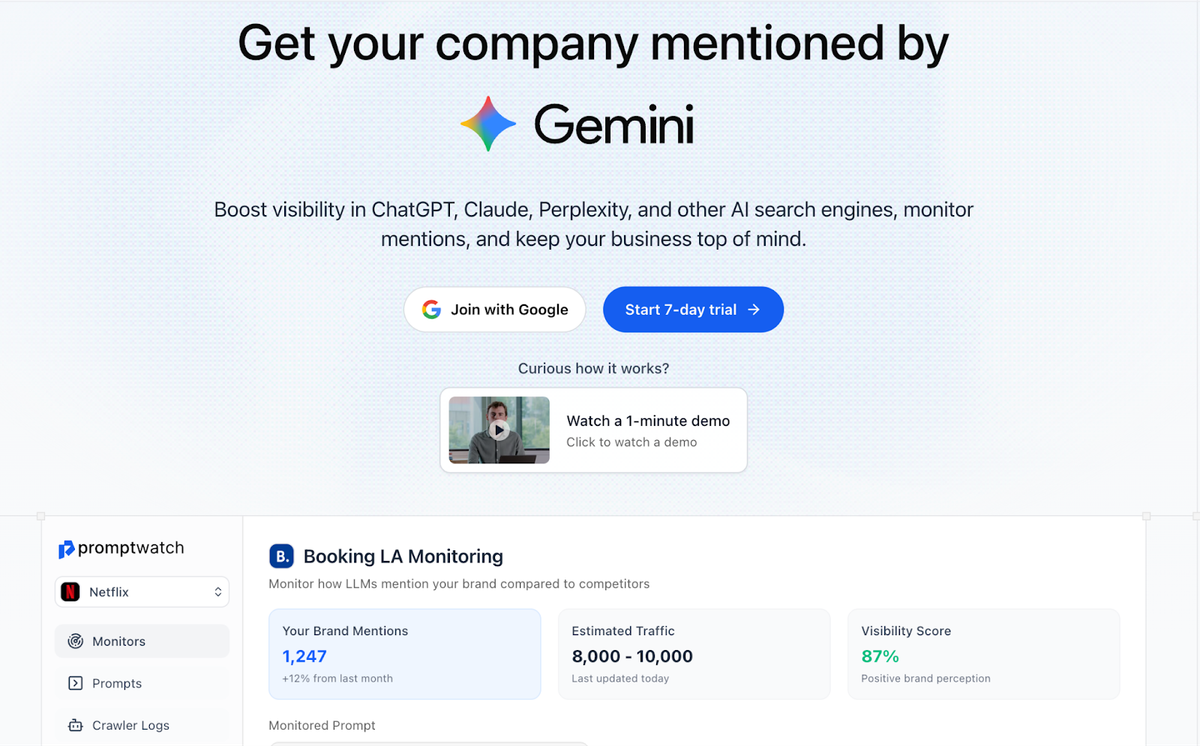
Like the name of the product says, Promptwatch tool helps you track brand mentions across AI platforms, helping companies understand how they're portrayed by AI Search engines.
Key Features:
- Prompt tracking: Track brand mentions across AI models
- AI traffic attribution: Identify which AI models drive traffic and conversions, and tie outcomes back to pages and content.
- Content optimization: Receive content optimization suggestions
- Looker studio integration: Allows you to view your data in Looker studio
Pricing: Starting from $75/a month with Professional and Business options.
Limitations:
- Platform itself isn’t as actionable as it could be and to get everything out of the platform you are required to have technical implementation skills and required to send server logs for them to attribute traffic.
- Relies on API output instead of capturing real answers from AI interfaces.
9. SEOmonitor
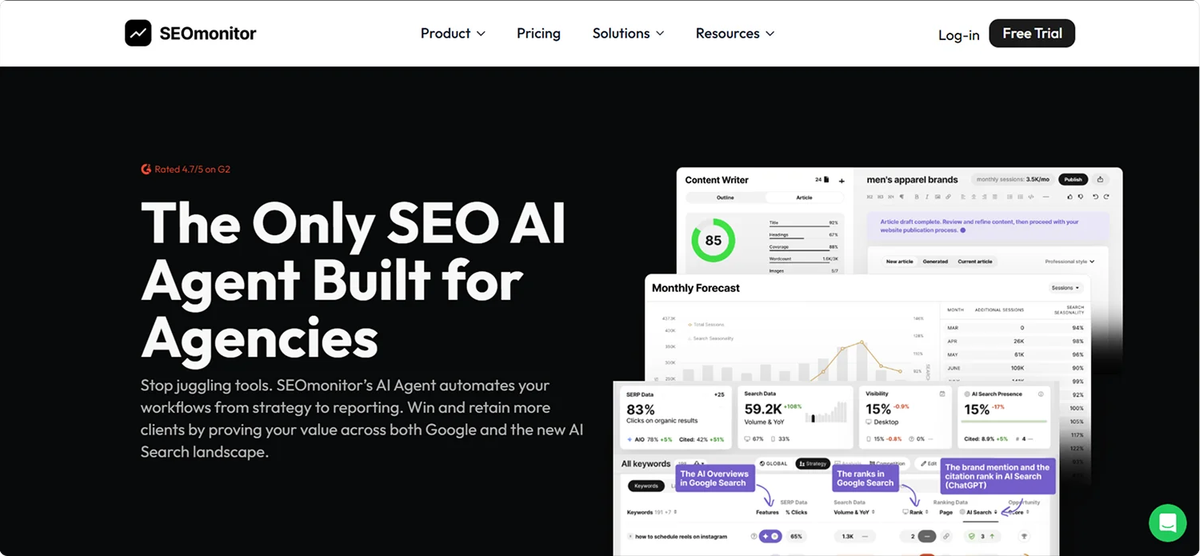
SEOmonitor is an in-depth AI Overviews and chatbot tracking tool with access to brand mentions, daily snapshots, and custom analyses. Plus, the platform allows dual-signal tracking (SEO+GEO).
Key Features:
- Response evolution tracking: You can check when and how your content gets added or left out in chatbot conversations
- Access raw data through API: This feature lets you access raw data to run large-scale reports
- Dual SEO and AI tracking capabilities
Pricing: Starter: From $116 for 1000 keywords tracked daily. Writer: $29 for 5 AI-written articles. Pro: From $339 for 3000 keywords tracked daily.
Limitations:
- More SEO features than GEO features, but more GEO-related features coming in the future apparently.
- Relies on API output instead of capturing real answers from AI interfaces.
10. Goodie AI
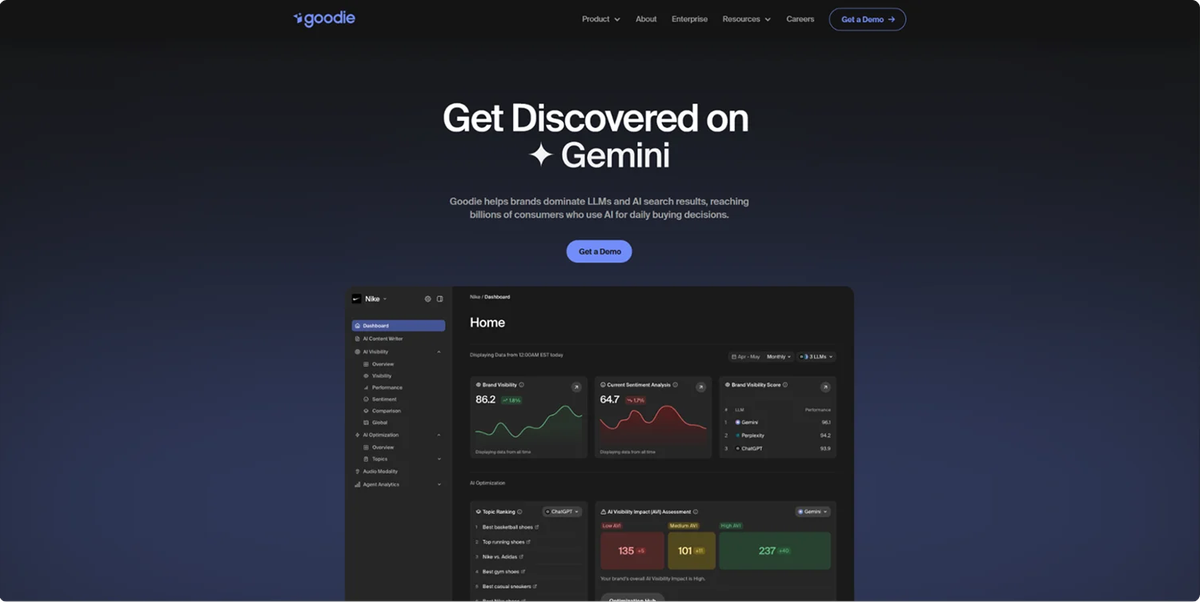
Goodie AI is offering a comprehensive answer engine optimization platform from tracking to optimization.
Key Features:
- AI-powered content creation tailored for AI search
- Comprehensive visibility tracking and analysis
- Topic research and keyword optimization
- Attribution tracking and ROI measurement
- Integration with popular content management systems
Pricing: Enterprise plans available only after a call
Limitation:
- No publicly listed starting price and the UI shots shared on their website doesn’t make the software look that actionable even if the UI does look sleek.
- Relies on API output instead of capturing real answers from AI interfaces.
Best For: Content teams needing creation and optimization tools, agencies producing high volumes of content, SEO professionals.
11. Brandwatch
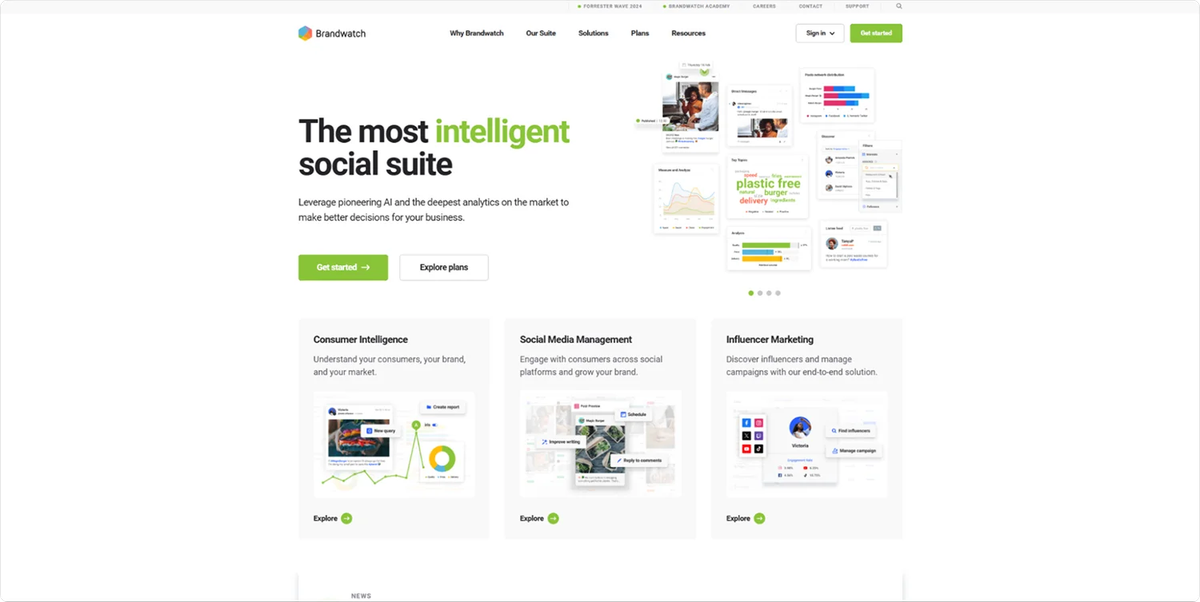
Brandwatch is a leading Consumer Intelligence and Social Media Management solution that empowers over 5,000 of the world's most admired companies to understand and engage with customers at the speed of social.
Key Features:
- Consumer intelligence across social and AI platforms
- Advanced sentiment analysis and trend identification
- Influencer marketing and community management
- Customer data management and segmentation
- Enterprise-grade security and compliance
Pricing: Custom pricing
Limitations:
- Capabilities of their AI Search intelligence do not extend to the same level as dedicated GEO solutions like Superlines or Profound, but still a strong contender as a standalone solution next to them to track brand mentions in social media and AI platforms.
- Relies on API output instead of capturing real answers from AI interfaces.
12. Atomic AGI
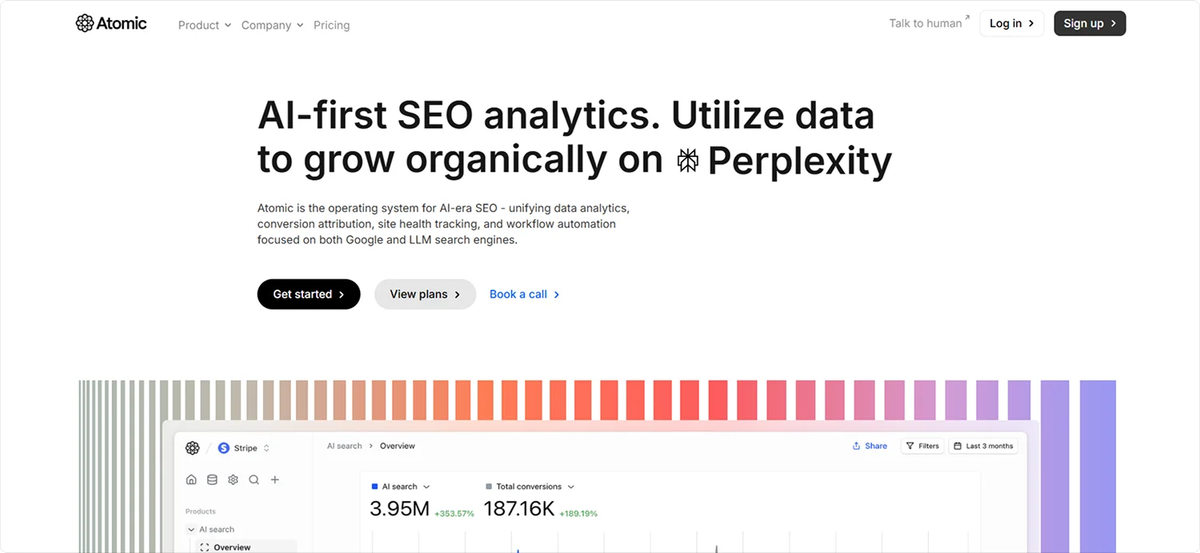
Atomic AGI is an AI-first SEO analytics and attribution platform that helps teams measure and improve their visibility across Google and the new wave of generative search engines (ChatGPT, Perplexity, Gemini, Claude, and more). It brings together AI search tracking, traditional SEO analytics, technical site health monitoring, and conversion attribution in one workspace that’s fast to set up and easy to use. Built with privacy in mind (GDPR compliance, EU hosting) and simple integrations.
Key Features:
- AI Search / Answer-Engine Tracking: Detects and maps when and how your content is surfaced by generative engines (ChatGPT, Perplexity, etc.), so you can see which pages capture AI referrals and how they perform.
- Unified Analytics & Attribution: Blends traditional SEO data with GA4/conversion signals so you can tie AI visibility to real business outcomes (conversions, revenue).
- Technical SEO & Rapid Indexing: Automated site audits, page-speed insights, sitemap/indexing checks and recommendations to improve how AI crawlers and LLMs consume your site.
- Content Intelligence & Workflow Automation: NLP-driven content analysis, clustering and automated optimization/workflow pipelines to scale AI-native content improvements and reporting.
- Reporting & Collaboration: Shareable, customizable reports that go beyond clicks and impressions to explain AI search trends and make the data actionable across teams.
Pricing: Free tier available to get started; paid plans scale from an entry-level Starter plan ($10/month) up through team and enterprise tiers with expanded data retention, crawl credits and seats. For enterprise scale, Atomic offers custom pricing.
Limitations:
- Limited information on their site regarding AI Search related features
- Relies on API output instead of capturing real answers from AI interfaces.
13. Morningscore ChatGPT Tracker
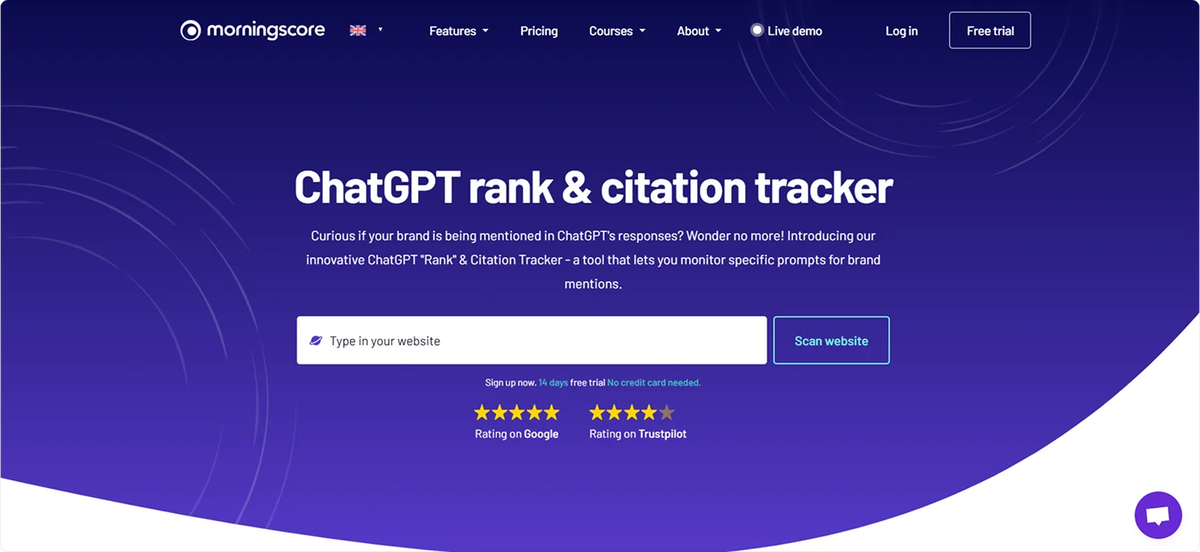
Morningscore is a dedicated ChatGPT and citation tracker that helps you monitor visibility in AI chatbot conversions. The platform is one of the unique ChatGPT visibility trackers because of its gamified SEO elements.
Key Features:
- In-view tool for brand mention: With the in-view tool, you can check the actual words and phrases you track and that are shown to users
- Brand settings: This feature lets you add brand name variations to cover more prompts
- Morningscore won't just tell you whether your brand is mentioned or not - we will prove the result with an in-tool view of the mention
- Gamified progress tracking with XP points
Pricing: Lite: $49 for 50 AI credits. Business: $69 for 500 AI credits. Pro: $129 for 2500 AI credits. Premium: $259 for 10,000 AI credits.
Limitations:
- SEO and GEO hybrid platform, so doesn't go as deep in GEO features as other GEO purpose-built platforms like Superlines and Profound
- Relies on API output instead of capturing real answers from AI interfaces.
14. Semrush AI Toolkit
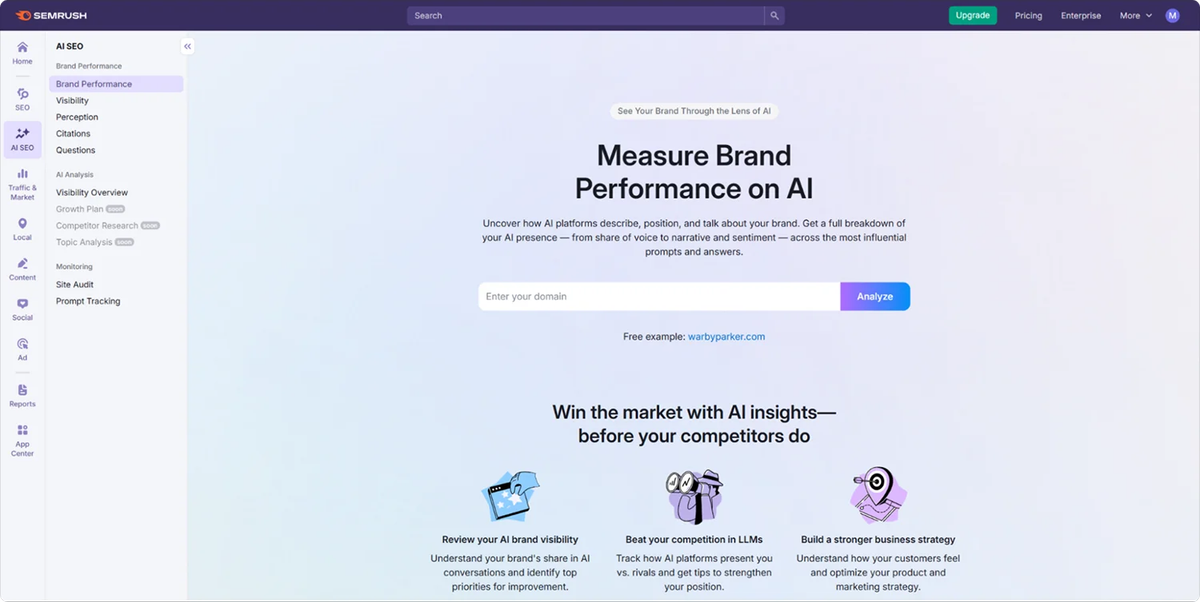
Semrush has extended its market-leading SEO platform into the AI Search visibility space with comprehensive AI visibility tracking. Semrush's AI SEO Toolkit is a GEO tool that reveals how AI platforms like ChatGPT and Google's AI Mode portray your brand compared to competitors.
Key Features:
- AI Share of Voice: Comparative analysis across top LLMs showing brand positioning versus competitors
- Brand Sentiment Analysis: Understanding how AI platforms describe your brand and what shapes public perception
- Strategic Recommendations: AI-backed suggestions for product positioning, content strategy, and business direction
- Query Intelligence: Real questions users ask AI tools about your brand, revealing content gaps and opportunities
Pricing: $99/month per domain for the standalone AI Toolkit, with custom enterprise pricing for the full AIO platform.
Limitations:
- Higher per-domain pricing can become expensive for multi-brand portfolios. Limited compared to dedicated GEO platforms due to having strong legacy SEO platform in the background which is their core business.
- Relies on API output instead of capturing real answers from AI interfaces.
2026 Market Predictions: What's Coming Next
If you’re evaluating Profound alternatives, these broader trends show why competition in GEO analytics tools is heating up and why new, more flexible tools are emerging fast. By flexible, we mean solutions that go beyond heavy enterprise setups and adapt to multi-brand, multi-market and multi-channel use cases.
Key trends for 2026 and beyond:
• Platform expansion: Major SEO providers such as Semrush, Ahrefs, Moz and BrightEdge will keep building or acquiring GEO analytics capabilities to prevent customer churn.
• Deeper feature sets: Expect more granular personalization tracking, understanding how AI responses vary by context, plus real time content optimization and multimodal visibility across text, image and voice.
• E commerce focused GEO: New tools will focus on agentic shopping experiences and product level visibility, showing how your products are represented, compared and recommended across AI search engines.
• Market maturity: Industry benchmarks for AI visibility will emerge, making it easier to compare tools and measure impact over time.
• Vertical specific solutions: Highly regulated sectors such as healthcare, finance and legal will see GEO tools with compliance ready integrations and domain specific metrics.
• Deeper integrations: GEO platforms will connect more tightly with CRMs, analytics suites and content management systems so AI visibility data becomes part of the full marketing workflow, not a separate dashboard.
• AI first marketing mindset: As projections suggest LLM traffic could surpass traditional search by 2028, GEO will become as critical to marketers as SEO once was.
• Voice and visual discovery: AI search will extend further into voice assistants, visual recognition and AR driven discovery, pushing GEO beyond purely text based experiences.
• Predictive intelligence: Expect tools that forecast brand mention opportunities, suggest next best content moves and automate updates based on real time AI search data.
In this context, teams that choose deeper GEO analytics platforms today are better positioned to adapt and stay ahead as AI Search as a channel continues to grow.
The Window of Opportunity Is Here
The shift from traditional search to AI-powered discovery is the biggest transformation in digital marketing since social media. Early adopters that invest in GEO analytics now will capture an outsized share of future visibility and growth.
Your Implementation Roadmap:
- Start Measuring Now: Choose a GEO analytics platform that fits your current budget, data needs, and way of working.
- Optimize Existing Content: Use GEO insights to refine your top-performing pages for AI visibility.
- Create AI-Native Content: Write and structure material specifically for AI models to read, understand, and cite.
- Scale and Systematize: Turn GEO optimization into a continuous process and expand into enterprise-level tools as results and confidence grow.
Success used to mean ranking number one on Google. In the AI era, there might not even be a “top result.” The real goal is to become the answer, the brand AI systems trust and cite in their responses.
Tools covered in this guide reflect the latest advances in GEO analytics, but the field is changing quickly. The most important step is to start tracking and optimizing for AI search now, instead of waiting for the market to fully mature.
The future of search has already arrived; it just isn’t evenly distributed yet. By adopting GEO analytics early, your brand secures a lasting advantage in visibility, credibility, and growth in an AI-driven world.
Get started today to see how your brand performs in AI search!
Superlines vs Profound: Side-by-Side Comparison
One of the most common questions teams ask when evaluating alternatives to Profound AI is how Superlines compares directly. Both platforms track AI Search visibility, but they take fundamentally different approaches to data collection, pricing, and workflow integration. Below is a detailed feature-by-feature comparison based on publicly available information as of March 2026.
Starting Price: Superlines starts at €79/month for a Starter plan that includes 3 AI engines, 50 tracked prompts, unlimited seats and competitors, daily tracking, AI Bot analytics, and MCP server access. Profound’s cheapest public tier is $99/month (Starter), which only tracks ChatGPT with 50 prompts and does not include API access or MCP support.
Full-Featured Plan: The new Superlines Pro at €199/month includes 3 engines, 150 prompts, 3 brands, data exports, monthly site audits, and 15 AEO articles per month, while Growth at €379/month scales to 300 prompts, 7 brands, API access, and weekly audits. Profound Growth at $399/month includes ChatGPT, Perplexity, and Google AI Overviews, with content generation and AI Bot Tracking.
Answer Data Source: Superlines tracks real answers from live AI interfaces — the same output your customers see when they use ChatGPT, Perplexity, or Google AI Mode. A Surfer study confirmed that API responses and on-screen answers often differ significantly. Profound uses a combination of API and interface data, but specifics are less transparent.
Free Trial: Superlines offers a 7-day free trial on all plans. Profound does not offer a public free trial — teams typically need to request a demo and go through a sales process before getting access.
AI Engines Tracked: Superlines tracks up to 10 AI engines: ChatGPT, Perplexity, Claude, Microsoft Copilot, Google AI Mode, Google AI Overviews, Gemini, Mistral, DeepSeek, and Grok. Profound tracks ChatGPT, Perplexity, Google AI Overviews, Google AI Mode, Google Gemini, Microsoft Copilot, Claude, and Grok (with Amazon Rufus coming soon). Coverage is comparable, though Superlines includes DeepSeek and Mistral which Profound does not.
Competitor & Domain Tracking: Superlines allows unlimited competitors and domains per workspace on every plan, including Starter. This makes it particularly attractive for agencies and multi-brand companies managing several services or regions in one view. Profound offers unlimited domains on Growth and Enterprise, but workspace and brand management details are less transparent for lower tiers.
MCP Server and API: Superlines includes MCP (Model Context Protocol) server access and API on all plans, including Starter. This allows teams to connect AI assistants like Claude Desktop or Cursor directly to their visibility data, enabling agentic workflows that can analyze competitive gaps, generate reports, and surface insights through natural language. Profound offers API access on Enterprise plans only and does not currently offer MCP server support.
Users Per Account: Superlines provides unlimited user seats on every plan, making it easy to onboard marketing teams, content strategists, and leadership without per-seat costs. Profound includes 3 seats on the Growth plan and custom seats on Enterprise.
Content and Optimization Tools: Superlines includes a Schema Optimizer on all plans and Site Crawl and Audit from the Growth tier. An AEO Article Generator is available on all plans (5 to unlimited articles per month depending on tier). Profound offers content generation via its Agents and Workflows features on Growth and Enterprise tiers but does not offer a Schema Optimizer or Site Crawl and Audit tool.
Agency Plans: Superlines offers dedicated Agency packages that mirror the brand tiers — from €79/month (Agency Starter, 5 client brands) to €379/month (Agency Growth, 20 client brands) — plus a flat 15% Agency Partner discount. Profound offers Agency Growth at $99/month but this only provides 10 pitch workspaces per month for running audits — no full tracking. Full client workspaces cost $399/month each as add-ons.
Data Privacy: Superlines operates with 100% EU data hosting, no tracking cookies, and GDPR compliance by design. Profound is SOC 2 Type II certified and US-based. For European companies or teams with strict data sovereignty requirements, Superlines’ EU-first approach is a meaningful differentiator.
Profound Pricing Breakdown 2026
Profound’s pricing page at tryprofound.com/pricing no longer displays public pricing. Instead, it states that Profound is "currently available through customized enterprise pricing." However, according to G2 (updated February 2026) and third-party reviews, the following tiers remain available:
Profound Starter — $99/month: Tracks AI visibility on ChatGPT only. Includes Answer Engine Insights, AI Bot Tracking, and access to Profound Agents. This plan provides a narrow view limited to a single AI engine, which is insufficient for teams that need cross-platform visibility.
Profound Growth — $399/month: Adds tracking across ChatGPT, Perplexity, and Google AI Overviews. Includes Prompt Volumes, content generation, and broader AI Bot Tracking. This is the first tier where meaningful multi-platform monitoring becomes available.
Profound Enterprise — Custom pricing (billed annually): Full platform access with all available engines (ChatGPT, Perplexity, Google AI Overviews, AI Mode, Gemini, Copilot, Grok), custom prompt limits, API access, SSO, ChatGPT Shopping analytics, and a dedicated AEO strategist. Third-party sources estimate Enterprise pricing at $2,000 to $5,000+ per month.
According to Rankability’s analysis of over 30 AI search monitoring tools, the average price for an AI visibility tracking tool is $337/month. Profound’s Growth plan at $399/month is 48% above this industry average. By comparison, Superlines’ Starter at €79/month gives teams 3 AI engines, unlimited competitors, and MCP server access well below the market average — making it one of the most cost-effective ways to start tracking AI Search visibility.
Agency pricing comparison: Profound Agency Growth at $99/month provides only 10 pitch workspaces per month for prospect audits — not full tracking. Each full client workspace costs $399/month as an add-on. An agency managing 5 clients on Profound would pay $99 + (5 × $399) = $2,094/month. Superlines Agency Growth at €379/month includes 300 prompts, 20 client brands, API access, and advanced features without per-client add-on fees.
Why Teams Switch from Profound to Superlines
While Profound is a capable enterprise platform backed by $155 million in venture funding, a growing number of marketing teams and agencies are choosing Superlines as their preferred alternative to Profound AI for several specific reasons:
1. Real interface data instead of API approximations. Superlines captures actual answers from live AI interfaces — the same output your customers see when they ask ChatGPT, Perplexity, or Google AI Mode about your product category. API-based monitoring misses interface-only features like cited sources, follow-up suggestions, and visual formatting that influence how brands are perceived. Independent research by Surfer has confirmed that API and interface outputs can differ significantly, meaning API-only tools may overstate or understate actual brand visibility.
2. Lower starting price with more included features. At €79/month, Superlines’ Starter plan includes 3 AI engines, 50 prompts, unlimited seats and competitors, MCP server, Schema Optimizer, and AEO Article Generator. Profound’s $99/month Starter only tracks ChatGPT (one engine) and does not include API access, MCP support, schema optimization, or content generation tools. To get multi-platform tracking on Profound, teams need to upgrade to the $399/month Growth plan — more than 4x the cost of Superlines’ Starter.
3. Unlimited brands per workspace for agencies and multi-brand teams. Superlines supports unlimited competitors and domains per workspace on every plan, including Starter. Combined with dedicated Agency packages starting at €79/month and a flat 15% Agency Partner discount, Superlines provides a flat-rate agency model with no per-client workspace surcharges. Profound’s agency model charges $399/month per full client workspace as an add-on, which becomes expensive quickly when managing multiple accounts.
4. MCP server for agentic workflows. Superlines is the first GEO platform with full MCP (Model Context Protocol) server support, available on all plans including Starter. Teams connect AI assistants like Claude Desktop, Cursor, or custom agents directly to their visibility data. This enables agentic workflows where AI tools can query competitive gaps, generate optimization reports, and surface actionable insights through natural language — all powered by real visibility data. Profound does not currently offer MCP server support.
Profound’s $155M in Venture Funding: What It Means for Your Choice
Profound has raised $155 million in total venture funding across four rounds: a $3.5 million seed round (August 2024), a $20 million Series A, a $35 million Series B led by Sequoia Capital (August 2025), and most recently a $96 million Series C at a $1 billion valuation (February 2026). Other investors include Kleiner Perkins, Khosla Ventures, and Saga VC.
This level of institutional backing signals strong market confidence in the GEO category as a whole — which benefits all players in the space. However, for teams choosing a platform today, the funding trajectory also reveals where Profound is headed: deeper into the enterprise market. Profound’s own website describes the platform as "built for enterprise brands with a global footprint" and now displays only "customized enterprise pricing" on its pricing page, removing previously visible public pricing tiers.
For mid-market companies, growing brands, and agencies that need transparent pricing with a faster path to value, Superlines offers a compelling best Profound alternative in 2026. At €79/month with a 7-day free trial, Superlines provides immediate access to multi-engine AI visibility tracking, unlimited competitor tracking, and MCP server integration — features that either require Profound’s highest tiers or are not available at all. While Profound builds for Fortune 500 enterprises, Superlines is designed for marketing teams of all sizes who want actionable GEO data without an enterprise sales cycle.