


Does YouTube Content Help with AI Search Visibility?
Yes. YouTube content directly supports your AI Search visibility because LLMs do not watch your videos, they read the text around them such as titles, descriptions, transcripts, chapters, comments, and on page schema. In simple terms, YouTube content helps with AI search visibility because AI engines treat each video as a structured text asset that can be cited in answers. This text becomes part of the evidence that AI systems use when deciding which brands to cite or recommend in answers.
AI engines such as ChatGPT, Perplexity, Gemini, and Mistral use YouTube metadata and transcripts as a source when generating responses. Every well structured video you publish becomes another text rich source that potentially increases your Brand Visibility and Citation Rate across AI platforms.
This matters because most B2B companies still treat YouTube as a secondary channel with low priority, even though multimodal AI systems consistently pull information from it. In practice, YouTube is one of the fastest ways to strengthen how AI understands your brand, your expertise, and your category authority.
Below is a complete guide to using YouTube as a GEO lever: how LLMs read your video content, which elements matter most, and how to structure your videos so AI systems can easily retrieve, interpret, and cite them.
How to Optimize YouTube Videos for AI Search and why create them?
To optimize YouTube videos for AI Search, treat every video as a text asset. AI systems such as ChatGPT, Gemini and Perplexity do not watch your video, they read your titles, descriptions, transcripts, chapters, comments and schema. If that text is clear, structured and question based, your videos become easy for AI to retrieve and cite in answers.
For most companies, this is an underused GEO lever. Few B2B brands publish consistent YouTube content, and even fewer structure it in a way that is friendly for AI retrieval. If you do, you can strengthen your authority signals and make it more likely that AI assistants pick your content when users ask questions in your category.
When your YouTube metadata, transcripts and on page embeds are AI Search friendly, every video becomes another surface that increases your Brand Visibility and Citation Rate in AI Search.
TL;DR of these phases:
To make YouTube videos work for AI Search, do three things consistently:
1.Structure everything around clear questions and answers (titles, chapters, FAQ in the description).
2.Give AI clean text to read with accurate transcripts, chapters, and schema when you embed videos on your site.
3.Make key information visible on screen and in pinned summaries so multimodal models can easily pick up your main points.
Phase 1: Metadata & "Intent" Structuring
The easiest way to help AI find your video is to speak its language: Questions and Answers.
1. Name Videos by Intent, Not Just Topic
AI Searches are often problem-based ("How do I fix X?"). Your titles should reflect the user’s intent, not just your internal naming convention.
2. The "Question Block" Description Strategy
LLMs are trained on Q&A pairs. You can "feed" the AI by including a dedicated FAQ section in your video description.
- Action: Add a "Common Questions" block at the bottom of every description.
- Format: Question + Direct Answer + Timestamp.
Example:
- Q: Does this integration require an API key?
A: Yes, you need a V2 API key (explained at 02:15). - Q: Is this available on the mobile app?
A: No, this is currently a desktop-only feature.
3. Strategic Playlists (Context Clusters)
AI views playlists as "context." If a video is short or vague, the playlist tells the AI what category it belongs to.
- Do: Create playlists based on User Goals (e.g., "Troubleshooting," "Getting Started," "Advanced APIs").
- Don't: Dump everything into generic lists like "Uploads" or "Webinars."
Phase 2: Transcription & Navigation
Text is the primary data source for AI. If it isn't written down, it doesn't exist to the algorithm.
4. Hard-Coded SRT Files (No Auto-Captions)
YouTube’s auto-captions are often 80% accurate. That 20% error rate can cause AI to miss your specific keywords or brand names.
- Action: Upload a verified .srt file for every video.
- Why: AI crawlers index this file to find "passage rankings" (specific sentences that answer a query).
5. "Question-Based" Chapters
Timestamps are standard, but AI-optimized timestamps describe the answer found at that time.
- Bad: 02:30 - Settings
- Good: 02:30 - How to configure your privacy settings
- Why: Google’s "Key Moments" feature pulls these directly into search results.
Phase 3: Visuals & Technical Signals
Advanced strategies to future-proof your library.
6. OCR-Friendly Visuals (For Gemini)
Multimodal models (like Google Gemini) use Optical Character Recognition (OCR) to "read" the text that appears on the screen.
- Action: If you are listing "5 Steps" or "Key Stats," ensure they appear on the screen as clear, large text. Do not rely on voiceover alone.
7. The "VideoObject" Schema (For Your Website)
When embedding videos on your company blog or landing pages, you must tell search engines what the video is.
- Action: Wrap video embeds in VideoObject Schema.
- Tip: This allows ChatGPT/Perplexity to cite your website as the source of the video, rather than just sending traffic to YouTube.
8. The "Pinned Summary" Comment
AI agents often scan the comments section to gauge sentiment and summary.
Action: Pin a comment on your own video containing a bulleted "TL;DR" (Too Long; Didn't Read) summary of the video’s key value points.
AI systems now rely on many different content types when deciding which brands to reference. Written articles remain essential, but they are no longer the only material that shapes visibility in AI Search. Video platforms such as YouTube have become significant data sources for retrieval models, which means that your video content now contributes directly to your authority, citation potential, and overall presence across AI engines. This is why YouTube should be considered part of your Generative Engine Optimization (GEO) strategy, not a separate channel.
Why YouTube matters for AI search visibility
Short answer: YouTube improves AI Search visibility because AI engines treat each video as a text asset. They read the title, description, transcript, chapters, and pinned comment, then reuse that text when deciding which brands to mention or cite.
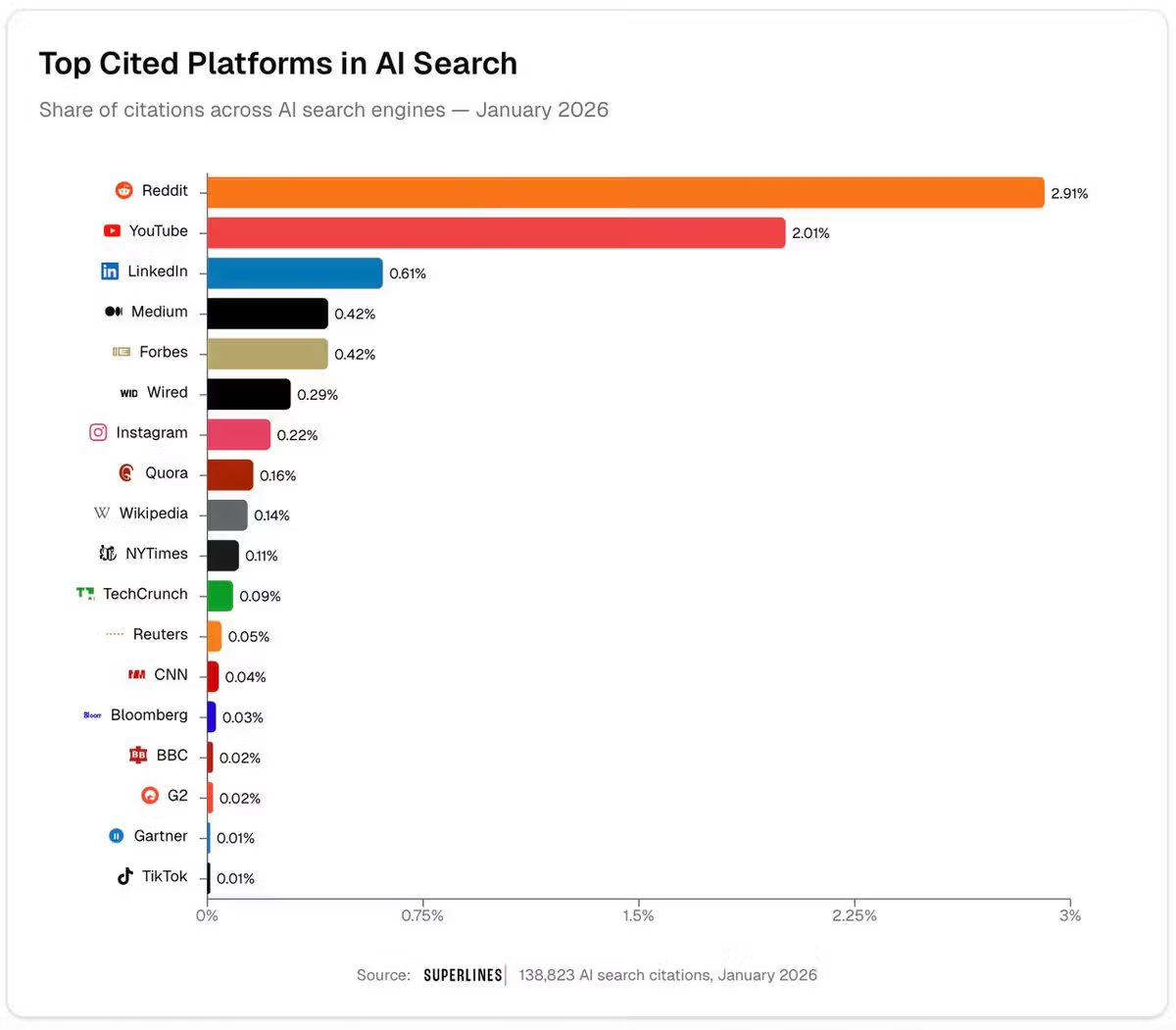
Based on this visualization and original data from Superlines, you can see how YouTube has started to rise as a highly cited source. This further highlights the opportunity to leverage video content to increase your overall AI visibility. Google AI Mode, AI Overviews, and Gemini tend to cite YouTube more frequently than other LLMs, leveraging Google’s ownership of the platform to provide richer, multi-modal answers.
AI engines read the text around your videos
Modern AI engines do not “watch” your videos in the way humans do. They mainly process the surrounding text: transcripts, titles, chapters, descriptions, and sometimes comments. That text becomes retrievable evidence when AI systems generate answers.
YouTube strengthens authority through consistency
AI engines compare what your website says with what your videos say. When the core message is consistent across both formats, it strengthens credibility signals and makes it easier for models to trust your brand as a source.
One video creates multiple searchable assets
A single YouTube upload produces multiple text layers:
- Transcript and captions
- Chapter titles and timestamps
- Description and links
- Pinned summary comment
This increases your “surface area” in retrieval systems and improves your chances of being cited.
Why this is a GEO opportunity for B2B teams
Many B2B companies have strong written content but weak or inconsistent YouTube presence. That creates a visibility gap. A small set of well structured, transcript rich videos can help you stand out faster because competition is often low on the video side.
YouTube works best as a reinforcement layer in your GEO loop: website foundation first, then YouTube for additional evidence, then measure Brand Visibility and Citation Rate over time.
This is why video should be part of a broader GEO strategy. When your content is present across YouTube, your website, LinkedIn, and other platforms, AI engines see you in more places. The more signals they find from you, the more confidently they can cite your brand when answering user questions.
Where YouTube fits in your GEO process
It is tempting to jump straight into YouTube, Reddit and PR. In practice, the most reliable way to grow AI Search visibility is to treat this as a simple loop and add channels in layers.
Start by covering your own corner first, then scale out.
Step 1: Get your website GEO ready
Your website is still the primary source that AI engines use to understand who you are and what you do. Before you invest heavily in video, make sure your core pages already follow GEO basics:
- Answer key questions directly at the top of each page
- Use clear headings, short paragraphs and structured elements such as lists and tables
- Reinforce entities such as your brand, product categories and target audiences
- Add schema markup and a visible “Last updated” date to important articles
Once this foundation is in place, AI has a clear, high quality text layer to work with.
Step 2: Track how AI sees you today
Do not guess. Use tools such as Superlines to:
- Measure Brand Visibility and Citation Rate for your priority topics
- See which domains AI engines currently prefer in your category
- Identify gaps where competitors are cited and you are not
This gives you a baseline and shows whether your website fundamentals are strong enough.
Step 3: Add YouTube as a reinforcement layer
With the basics covered on your site, YouTube becomes a powerful multiplier:
- Turn your best articles into tutorials, explainers and case study videos
- Use intent based titles, accurate transcripts and question based chapters
- Embed those videos back into your key pages with VideoObject schema
Now AI engines see the same message in multiple formats, which strengthens authority and correct brand representation.
Step 4: Extend to other AI readable channels
Once your website and YouTube loop is working, you can add more layers:
- LinkedIn posts and articles that reuse your core explanations
- Short video clips for social platforms that AI systems crawl
- PR coverage and thought leadership on high authority sites
- Relevant Reddit or community threads where your expertise is visible
Each new surface gives AI more evidence that you own your topic cluster.
Step 5: Keep the loop running
Treat this as an ongoing cycle rather than a one off project:
- Track your visibility and citation trends across AI engines
- Improve content where you underperform
- Add new formats such as video when you see clear gaps
- Measure again to see which changes moved the needle
In practice, AI Search optimization is a repeatable loop: track your visibility, improve your content, measure impact, and then expand to new surfaces such as YouTube and LinkedIn.
Tools like Superlines help you connect these dots by tracking the same topics across your website, YouTube and other channels, so you can see which efforts actually improve your Brand Visibility and Citation rate in AI Search.
If you are new to GEO, you can also read our guide on Generative Engine Optimization in simple terms for a full overview of the core concepts.
Repurpose content into the channels AI reads
When creating content, repurpose your articles into LinkedIn posts, YouTube videos, and short clips. These can be shared into other channels that AI systems increasingly use as sources. Wikipedia, Reddit, and PR coverage all help, but the fastest way to begin is by optimizing your own website and signaling to AI that you are the trusted source in your field.
When you are tracking your visibility systematically, you can also measure PR and different campaigns you are doing in a whole new way by using platforms like Superlines to track those topics you are doing PR for and measuring whether your AI Search visibility improves. The main metrics in AI Search are Brand Visibility and Citation Rate, which are much closer to media monitoring than classic SEO or performance marketing KPIs. AI Search as a channel connects product, comms, brand, and marketing teams, which is a positive shift for how companies think about visibility.
Use this checklist to turn every upload into a GEO asset that steadily improves your Brand Visibility and Citation Rate across AI Search platforms.
Summary Checklist for the Content Team
Start Measuring Your Performance in AI Search
The future of search belongs to brands that understand how AI sees the web and how different channels play a role in it. If you track Brand Visibility and Citation Rate, then optimize your content around those insights, you will show up inside the answers your buyers actually read.
Superlines helps you measure and improve your GEO performance across platforms such as ChatGPT, Perplexity, Mistral, Google AI Mode, Gemini, and other AI engines, so you see where you appear today and where you can win next. Start today!