


Best Google AI Mode Rank Tracker Tools in 2026
The best Google AI Mode rank tracker tools in 2026 are Superlines, SE Ranking Visible, Rankability, Profound, Ahrefs Brand Radar, Semrush AI Toolkit, Otterly AI, AIclicks, Nightwatch, Peec AI, ZipTie, Keyword.com, Scrunch AI, Writesonic GEO Tracker, and GetMint. Each takes a different approach to monitoring whether your brand appears inside Google's AI Mode responses.
Google AI Mode is not the same as AI Overviews. While AI Overviews are short answer panels that appear above traditional search results, AI Mode is a fully conversational interface where users ask follow-up questions and receive multi-turn, synthesized answers. Tracking your visibility in AI Mode requires tools that understand this conversational format, not just SERP scrapers looking for a panel.
This guide compares 15 tools for tracking your brand's presence in Google AI Mode, breaks down their features and pricing, and helps you pick the right one for your team.
TL;DR
- Google AI Mode is a conversational search experience distinct from AI Overviews, and it requires dedicated tracking tools that monitor multi-turn responses, not just SERP panels.
- Semrush's AI Overviews study found that brands appear in up to 90% of AI Mode responses for commercial queries, making this a high-stakes visibility surface.
- Most traditional SEO tools do not track AI Mode separately from AI Overviews. Dedicated GEO platforms like Superlines, SE Ranking Visible, and Profound offer explicit AI Mode monitoring.
- Pricing ranges from $29/month for basic prompt tracking to $500+ for enterprise multi-engine suites. Some tools like Superlines offer AI mode tracking in the Starter tier and many tools offer it as an add-on already in the Starter tier.
- The tools that capture real interface data (not just API calls) provide more accurate results, since API outputs can differ from what users actually see in AI Mode.
Our Selection Methodology
We evaluated over 25 AI visibility tools against five criteria specific to Google AI Mode tracking, shortlisted 15 solutions, and confirmed that 11 of them support Google AI Mode. Here is how we scored them:
- AI Mode-specific depth: Does the tool explicitly track Google AI Mode as a separate surface from AI Overviews? Can it capture multi-turn conversational responses, or does it only detect single-query panels?
- Multi-platform coverage: AI Mode is one of many AI search surfaces. Tools that also track ChatGPT, Perplexity, Copilot, Gemini, and others provide a more complete picture of your AI visibility.
- Data collection method: Tools that scrape real AI interfaces capture what users actually see. API-only tools may return different results. We prioritized tools with real-interface data collection.
- Competitive intelligence: The most useful tools show not just whether you appear, but who appears instead of you. Citation gap analysis and competitor benchmarking help you prioritize content improvements.
- Scalability and pricing: We looked at cost per tracked query, tier flexibility, and whether the tool scales for agencies managing multiple brands.
What Is Google AI Mode and How Is It Different from AI Overviews?
Google AI Mode is a fully conversational search interface that lets users ask follow-up questions and receive multi-turn, synthesized answers. It launched in 2025 and has expanded to over 200 countries.
AI Overviews, by contrast, are short AI-generated panels that appear above traditional blue-link results for a single query. They are triggered automatically and do not support follow-up questions.
The key differences for tracking:
- AI Mode is conversational. Users ask follow-up questions, and the AI refines its answers. A single session can generate multiple responses that cite different sources.
- AI Overviews are single-shot. One query, one panel, one set of citations.
- AI Mode pulls from different sources. Because it handles more complex, multi-step queries, AI Mode often cites different URLs than AI Overviews for the same topic.
- AI Mode has higher commercial intent. Semrush's September 2025 study found that 93% of AI Mode searches end without a click to an external site (compared to 43% for AI Overviews). This means the AI Mode response itself becomes the destination, making citation placement even more critical.
This distinction matters for tracking. A tool that only monitors AI Overviews will miss your visibility in AI Mode entirely. You need tools that explicitly track both surfaces.
Why Should You Track Your Brand in Google AI Mode?
AI Mode is growing fast. Google has rolled it out to over 200 countries with access to more than 2 billion monthly users. For many queries, especially commercial and comparison searches, AI Mode is becoming the primary way users interact with Google. Google itself is actively promoting this feature towards users to be used as the ‘main search experience’.
Here is why tracking matters:
Your competitors are already there. SE Ranking's Visible blog reports that brands appear in up to 90% of AI Mode responses for commercial queries. If your competitors show up and you do not, you are losing visibility on a surface that is replacing traditional search for many users.
Citations shift frequently. Semrush's AI Visibility Index found that 40 to 60% of cited sources in AI-generated answers rotate month over month. A page that appears in an AI Mode response today may be replaced next week. Without continuous tracking, you will not notice when a competitor takes your spot.
AI Mode traffic converts differently. Because 93% of AI Mode searches end without a click, the brands that get cited inside the response capture attention even when users never visit their site. Brand visibility in AI Mode is a form of awareness that traditional analytics cannot measure.
Traditional SEO tools miss it. Most rank trackers monitor blue-link positions and, at best, detect AI Overviews panels. They do not separately track AI Mode responses. You need dedicated tools for this surface.
1. Superlines
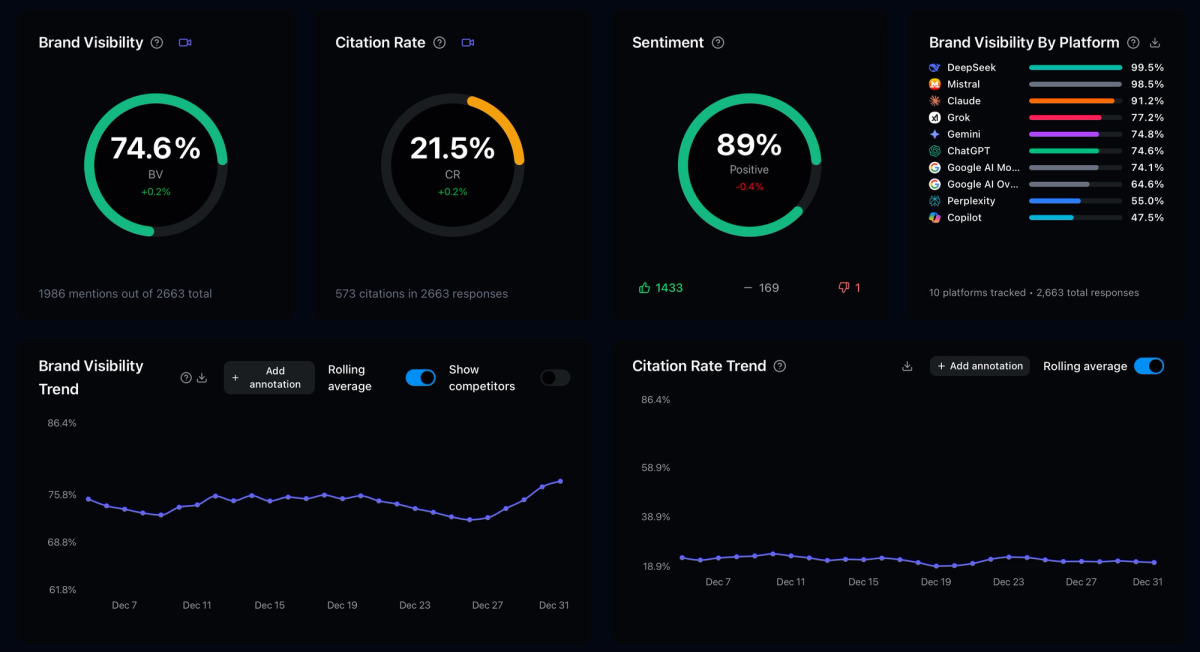
Superlines is an AI search analytics and GEO platform that tracks brand visibility across 10 AI engines, including Google AI Mode and Google AI Overviews as separate surfaces. It captures real interface data (not just API calls) and combines it with query fan-out analytics, competitive gap analysis, and on-site AI bot tracking.
Key features:
- Google AI Mode tracked as a distinct surface alongside AI Overviews, ChatGPT, Perplexity, Claude, Gemini, Copilot, Grok, Mistral, and DeepSeek
- Query fan-out analytics showing the background sub-queries AI engines run when generating answers
- Citation gap analysis identifying where competitors win citations instead of you
- AI bot analytics monitoring how GPTBot, GoogleBot, PerplexityBot, and other crawlers access your site
- MCP server for connecting visibility data to your own AI assistants and automating GEO workflows
- Doesn’t just show data, but also tells you which actions to take to improve your AI visibility
Pricing: Starter plans begin at €69/month (billed annually) or €79/month on a monthly plan. Includes 3 AI engines, 50 tracked prompts, unlimited seats and competitors, daily tracking, and MCP server access — the most comprehensive Starter tier in the AI Search Optimization category. Higher tiers unlock more engines, larger prompt volumes, and deeper historical data.
Best for: Marketing teams and agencies that need multi-engine AI visibility tracking and a solution that doesn’t just show you data but also tells you what to do.
Limitations: The Starter plan includes 3 AI engines, so you can track AI Mode alongside two other platforms from day one. Full 10+ engine coverage requires higher-tier plans.
2. SE Ranking Visible
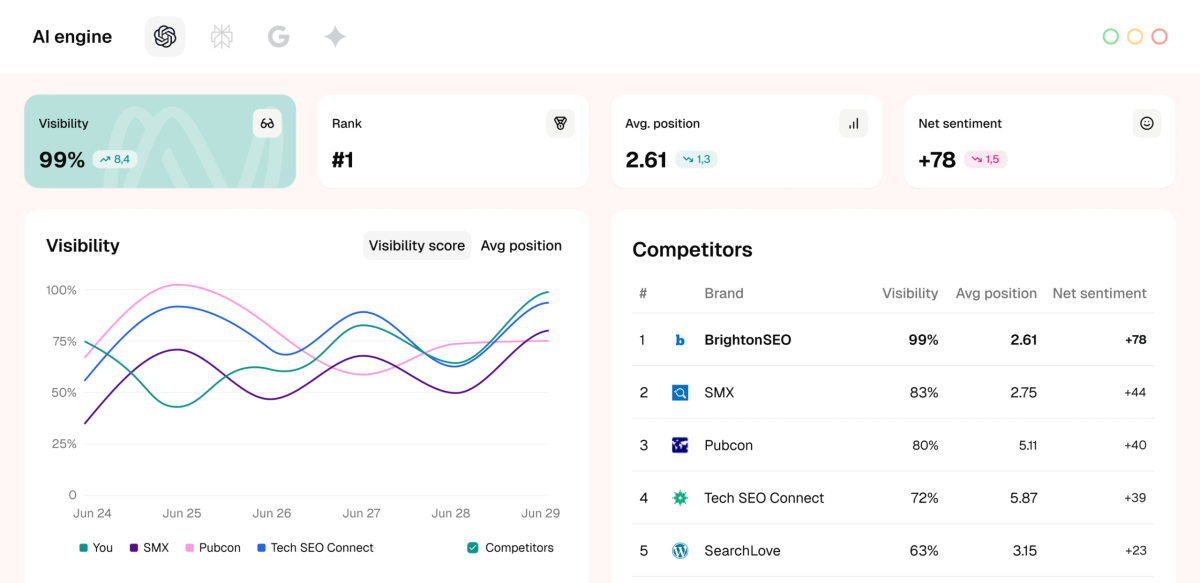
SE Ranking's Visible product is a dedicated AI visibility tool built on top of SE Ranking's established SEO infrastructure. It explicitly tracks Google AI Mode as a separate surface from AI Overviews.
Key features:
- Dedicated AI Mode tracking within keyword monitoring
- Five-category AI visibility taxonomy: AIO appearance, LLM presence, brand mentions, URL detection, and content optimization
- LLM visibility tracking across ChatGPT, Perplexity, and Gemini
- Integration with SE Ranking's broader SEO toolkit for combined SEO + GEO reporting
Pricing: Starts at €109/month with AI Search visibility as an add-on for 79€/mo on top. AI Results Tracker includes: AI Overviews, AI Mode, Perplexity, ChatGPT
Best for: Teams using SE Ranking for SEO that want to add AI Mode tracking without switching platforms.
Limitations: AI visibility features are relatively new. Competitive intelligence capabilities are still being built out. Relies entirely on API-based analysis, which can lead to significant differences from what users actually see in the interfaces.
3. Rankability
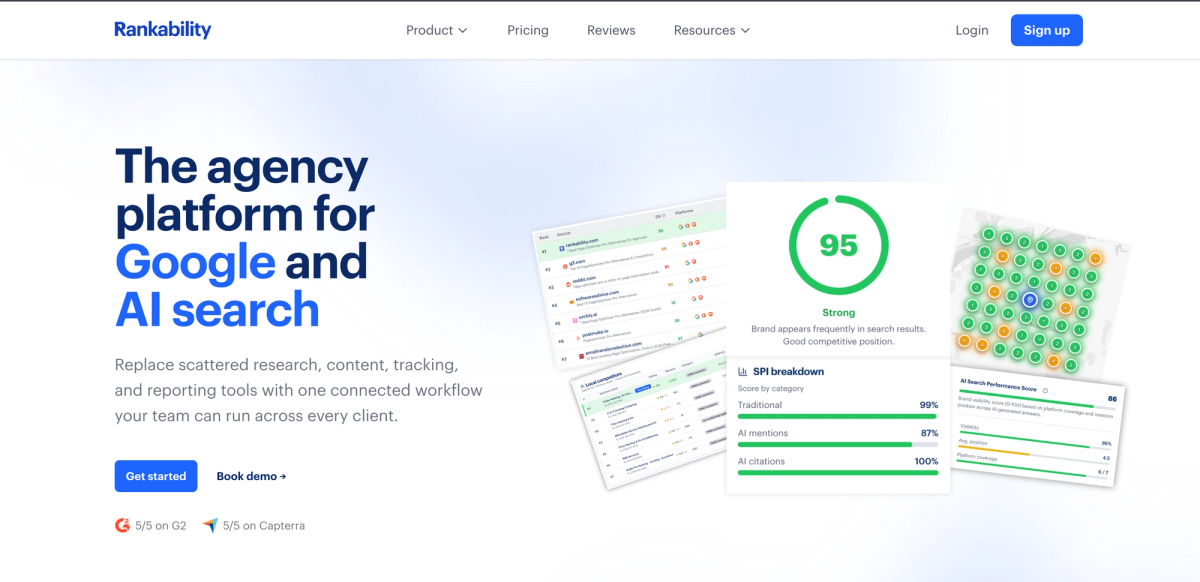
Rankability positions itself as an AI search and SEO visibility platform that is specifically designed for agencies.
Key features:
- Combines different tool with specific ‘roles’ thats purpose-built for agency SEO teams
- Competitive benchmarking across few AI Search surfaces including Google as a whole, but AI Mode isn’t mentioned separately
- Extensive content library with individual tool reviews and a 97-point GEO checklist
Pricing: Starts at $199/month (Core plan). Team at $399/month. Enterprise pricing available.
Best for: SEO agencies that want to replace scattered research, content, tracking, and reporting tools with one connected workflow to run with every client.
Limitations: Newer platform with a smaller user base compared to established SEO tools. Some features are still maturing. Also, hard to understand what the platform delivers without a sales call and live demo.
4. Profound
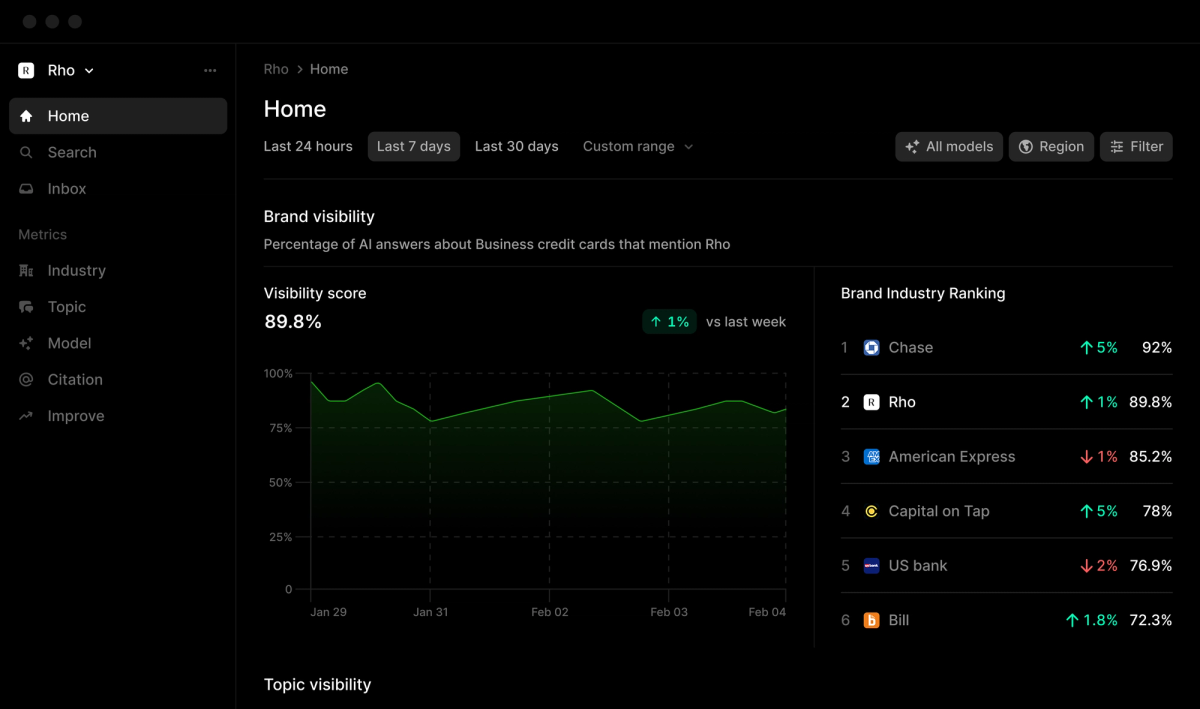
Profound tracks the widest range of AI engines of any tool on this list: ChatGPT, Perplexity, Google AI Mode, Google Gemini, Microsoft Copilot, Meta AI, Grok, DeepSeek, Anthropic Claude, and Google AI Overviews. Enterprise plans unlock all engines.
Key features:
- 10+ AI engines tracked with real interface scraping
- Conversation Explorer with a large prompt database for discovering relevant queries
- Captures answers directly from the UI like Superlines and doesn’t rely API-based analysis only. This gives you more accurate data about what users actually see.
- Content generation and optimization tools based on tracked prompts
- ChatGPT Shopping tracking (unique feature)
- AI bot crawl analytics
Pricing: Profound offers Starter tier from $99/mo and Growth tier from $399/mo not publish pricing on its website. Enterprise pricing is custom. Free demos available but no free trials.
Best for: Fortune 500 brands that need the widest possible engine coverage with content optimization built in and custom help regarding AI Search. Smallest enterprise plan is around $2000/mo according to third-party sources.
Limitations: Highest price point from all service providers in the list. AI Mode only available in the Enterprise package.
5. Peec AI
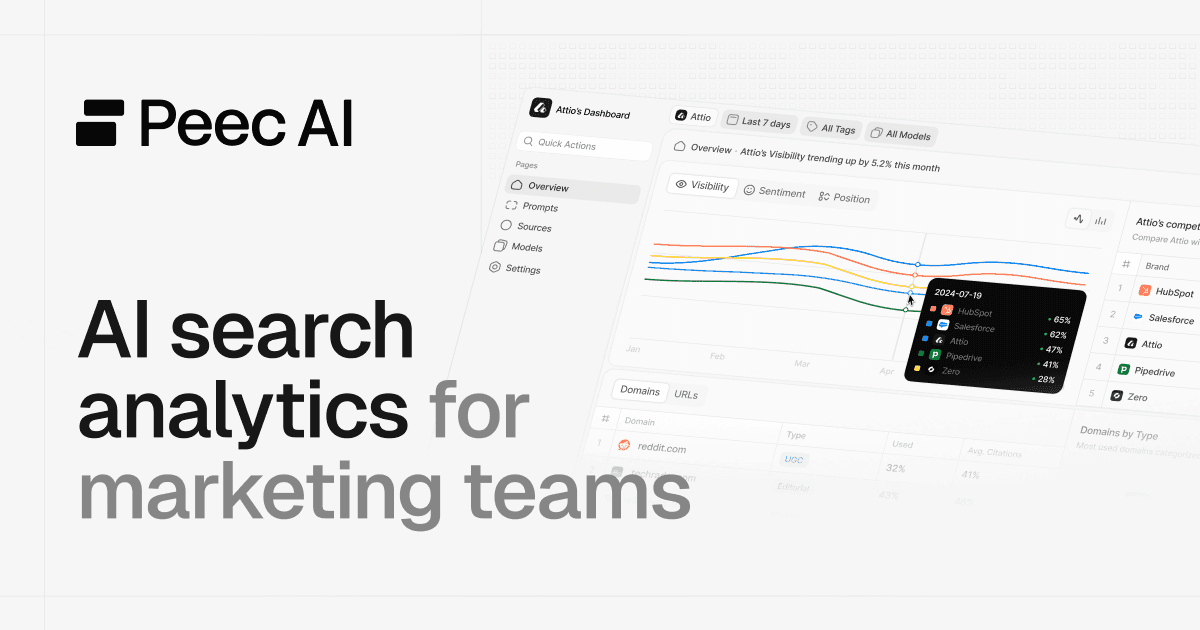
Peec AI offers AI visibility tracking with a focus on smart suggestions and agency-friendly features like Pitch Workspaces for sharing reports with clients.
Key features:
- AI visibility tracking across ChatGPT, Perplexity, and Google AI Overviews (baseline)
- Google AI Mode, Gemini, Claude, DeepSeek, Llama, and Grok available as add-ons
- Pitch Workspaces for sharing AI visibility reports with clients
- Looker Studio connector for custom dashboards
- Smart AI suggestions for relevant prompts and competitors
Pricing: Starts at €89/month (Starter, 25 prompts). Pro at €199/month (100 prompts). Enterprise pricing is custom. AI Mode requires an additional fee.
Best for: Agencies that want client-facing AI visibility reports with optional AI Mode coverage.
Limitations: AI Mode is not included in baseline plans. Lacks actionable insights and trend data compared to top-tier tools. Relies entirely on API-based analysis, which can lead to significant differences from what users actually see in the interfaces.
6. Ahrefs Brand Radar
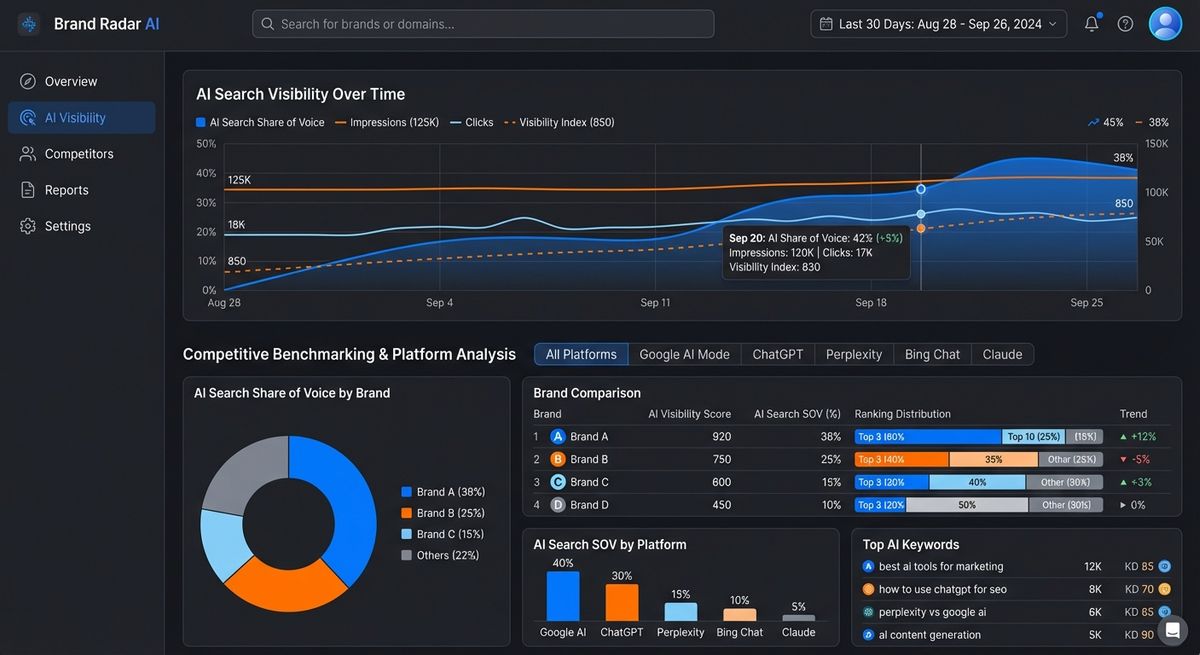
Ahrefs added AI Mode tracking to its Brand Radar product, which monitors brand mentions and citations across AI platforms.
Key features:
- AI Mode detection within Brand Radar add-on
- Competitive benchmarking showing how your brand compares to competitors across AI surfaces
- Integration with Ahrefs' backlink, content, and keyword tools
- Covers Google AI Overviews, Google AI Mode, ChatGPT, Perplexity, Gemini, and Copilot
Pricing: Brand Radar is priced per AI platform index at $199/month each. To track all supported platforms (including AI Mode), the cost is $699/month. This is in addition to your existing Ahrefs plan.
Best for: Teams already using Ahrefs that want AI Mode visibility data alongside their existing SEO workflow.
Limitations: Expensive for full platform coverage. No conversation data or citation context. Relies on API output rather than real interface data.
7. Semrush AI Toolkit
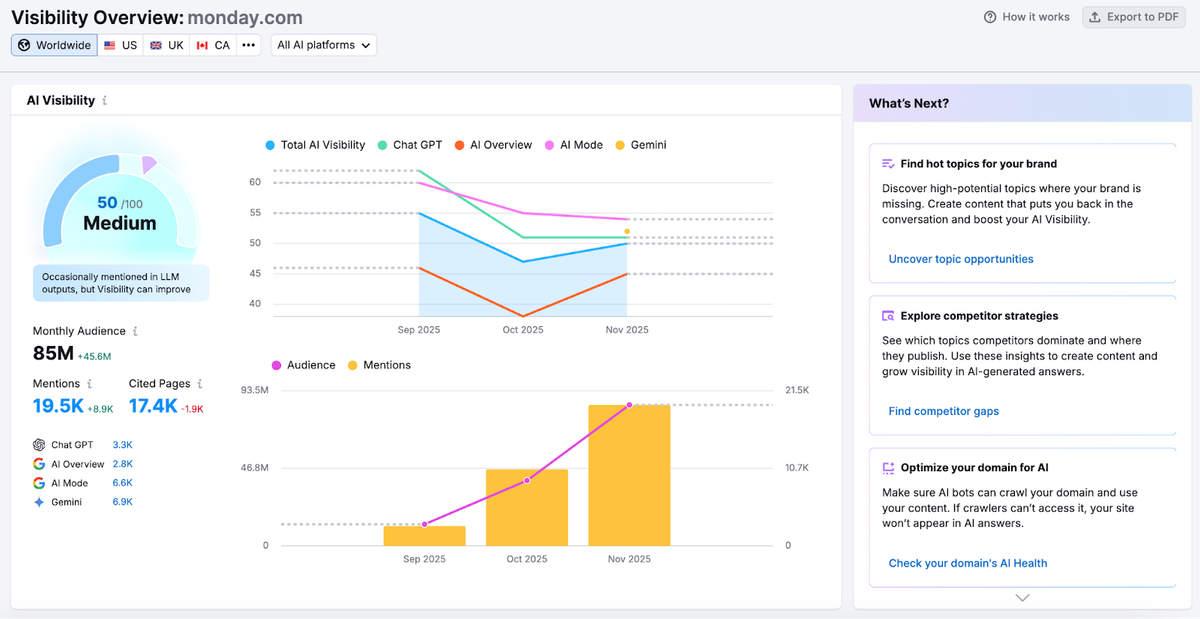
Semrush added AI Mode tracking to its AI Toolkit, which sits alongside its established SEO platform. The AI Visibility Index tracks 2,500+ prompts across the industry.
Key features:
- Google AI detection within the AI Visibility Index
- Site audit for AI readiness with optimization recommendations
- Tracks mentions from ChatGPT, Google AI, Gemini, and Perplexity
Pricing: AI Toolkit starts at $99/month per domain with an annual plan. Includes 1 folder, 1 domain, 300 daily queries in AI Analysis reports, and 25 prompts for prompt tracking.
Best for: Teams already using Semrush that want AI Mode data added to their existing workflow.
Limitations: Charges per user and per domain. Relies on API output. No AI crawler visibility analysis. Dedicated LLM features are less developed than in specialized GEO tools.
8. Otterly AI
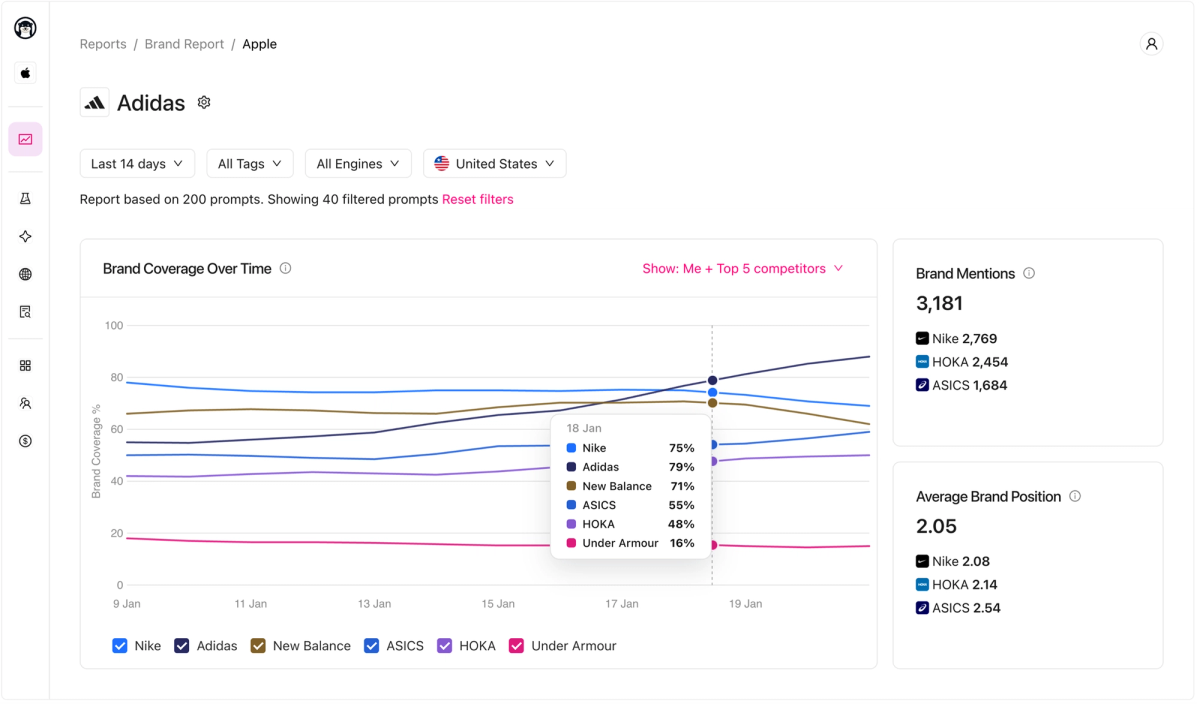
Otterly AI focuses on prompt-level AI rankings with a lightweight, self-service approach. Google AI Mode is available as an add-on to their standard tracking.
Key features:
- Prompt discovery tool for finding AI-relevant queries
- Brand Visibility Index across AI search engines
- Automated link citation detection
- GEO audit with SWOT analysis and recommendations
Pricing: Lite: €29/month (15 prompts, tracks AI Overviews, ChatGPT, Perplexity, and Copilot). Standard: €189/month (100 prompts). Premium: €489/month (400 prompts). Google AI Mode and Gemini are available as extra add-ons.
Best for: Small teams that want an affordable entry point into AI visibility tracking with optional AI Mode coverage.
Limitations: AI Mode requires an add-on purchase. Significant price jump between tiers. Relies on API output rather than real interface data.
9. Writesonic GEO Tracker
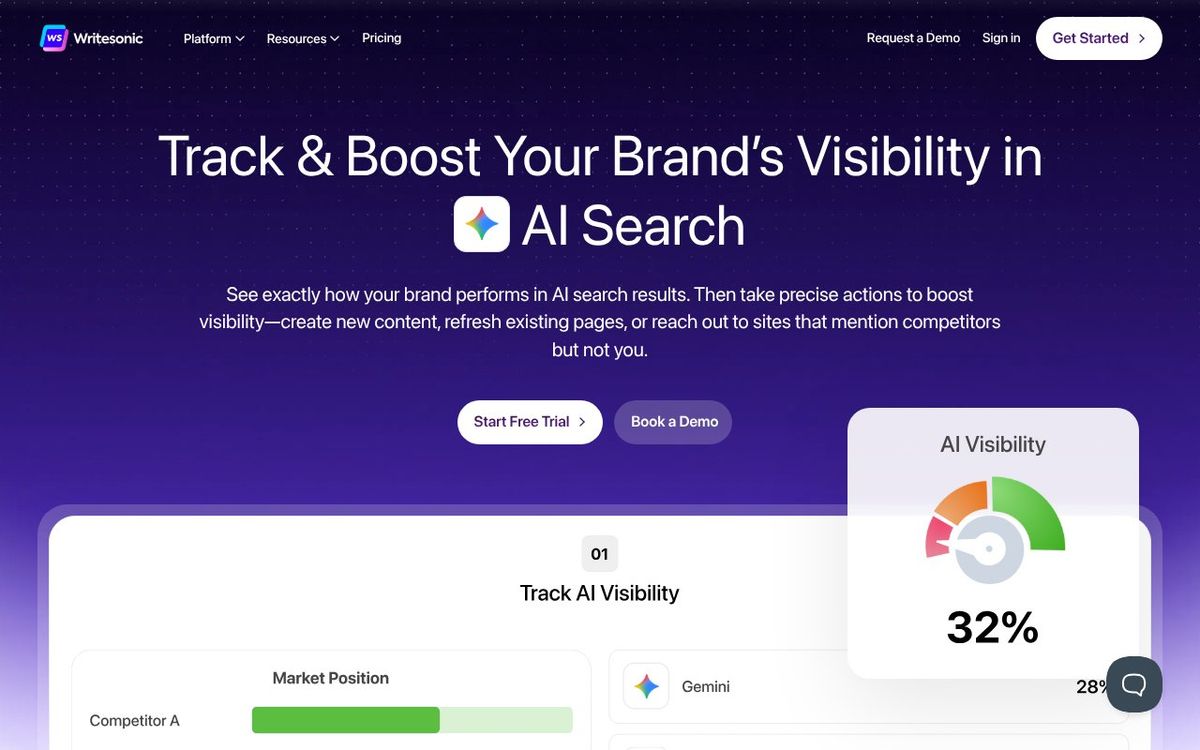
Writesonic expanded from AI content generation into GEO tracking, offering a combined content creation and visibility monitoring platform.
Key features:
- AI visibility tracking across major platforms including Google AI Mode
- AI content generation optimized for LLM visibility
- Content optimization suggestions based on tracked prompts
- Combined content creation and monitoring workflow
Pricing: Five tiers: Starter $99/month, Basic $249/month, Growth $499/month, Enterprise custom. Google AI Mode only available through the Enterprise package
Best for: Content teams that want AI content generation and GEO tracking in one platform.
Limitations: Content generation focus means monitoring depth is lighter than dedicated GEO tools. Relies entirely on API-based analysis, which can lead to significant differences from what users actually see in the interfaces.
10. Scrunch AI
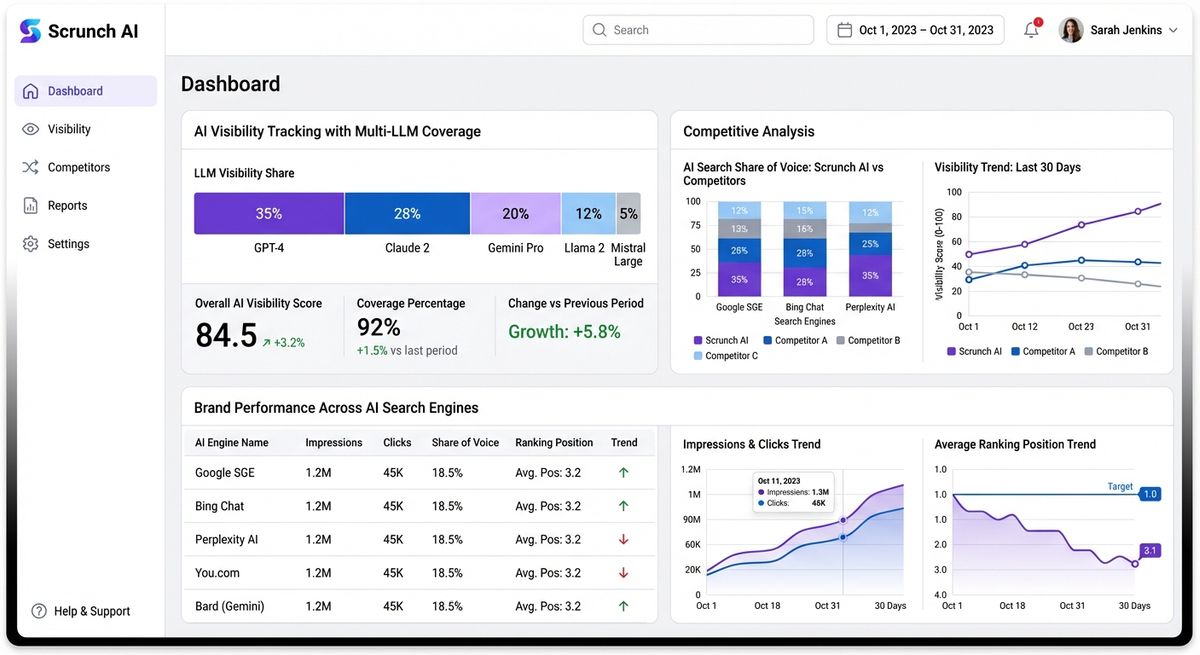
Scrunch AI offers AI visibility tracking with a focus on competitive analysis across multiple LLM platforms.
Key features:
- Multi-LLM tracking including Google AI Mode (Available only in Enterprise package)
- Competitive analysis showing citation share across AI platforms
- Content recommendations based on AI visibility gaps
- 4 LLMs tracked on Core plan, 9 on Enterprise
Pricing: Core: $250/month (125 prompts, 4 LLMs). Enterprise: custom pricing (9 LLMs, higher prompt volumes).
Best for: Mid-market teams that want competitive AI visibility analysis across multiple platforms.
Limitations: Higher entry price than lightweight trackers. Enterprise plan required for full platform coverage including AI Mode. Relies entirely on API-based analysis, which can lead to significant differences from what users actually see in the interfaces.
11. AIclicks
AIclicks focuses on ChatGPT and AI search monitoring with a founder-led, practitioner approach.
Key features:
- ChatGPT rank tracking with detailed response analysis
- AI Overviews and AI Mode monitoring
- Decision framework for choosing optimization priorities
- Case studies with real client results
Pricing: Starts at $59/month (Starter) 30 prompts and 3 AI engines (ChatGPT, Gemini and Perplexity)
Best for: Teams looking to get into AI Visibility tracking at an affordable price point.
Limitations: AI Mode is not included in any of the packages by default and seems like it needs to be purchased as an add-on. Relies entirely on API-based analysis, which can lead to significant differences from what users actually see in the interfaces.
The following tools get an honorable mention, but do not help you track Google AI Mode (at least not at the moment):
12. Nightwatch
Nightwatch added AI search monitoring to its rank tracking platform, covering AI Mode alongside other AI surfaces.
Key features:
- AI Mode detection in rank tracking
- Multi-engine AI visibility monitoring
- Local and global tracking options
- White-label reporting for agencies
Pricing: Base rank tracking starts at $32/month (annual). AI Tracking is a separate add-on at $99/month for 100 prompts.
Best for: Budget-conscious teams and agencies that want basic AI Mode tracking with white-label reporting.
Limitations: AI visibility features are newer and less comprehensive than dedicated GEO platforms. Nightwatch doesn’t explicitly say whether they track Google AI Mode. Relies entirely on API-based analysis, which can lead to significant differences from what users actually see in the interfaces.
13. ZipTie
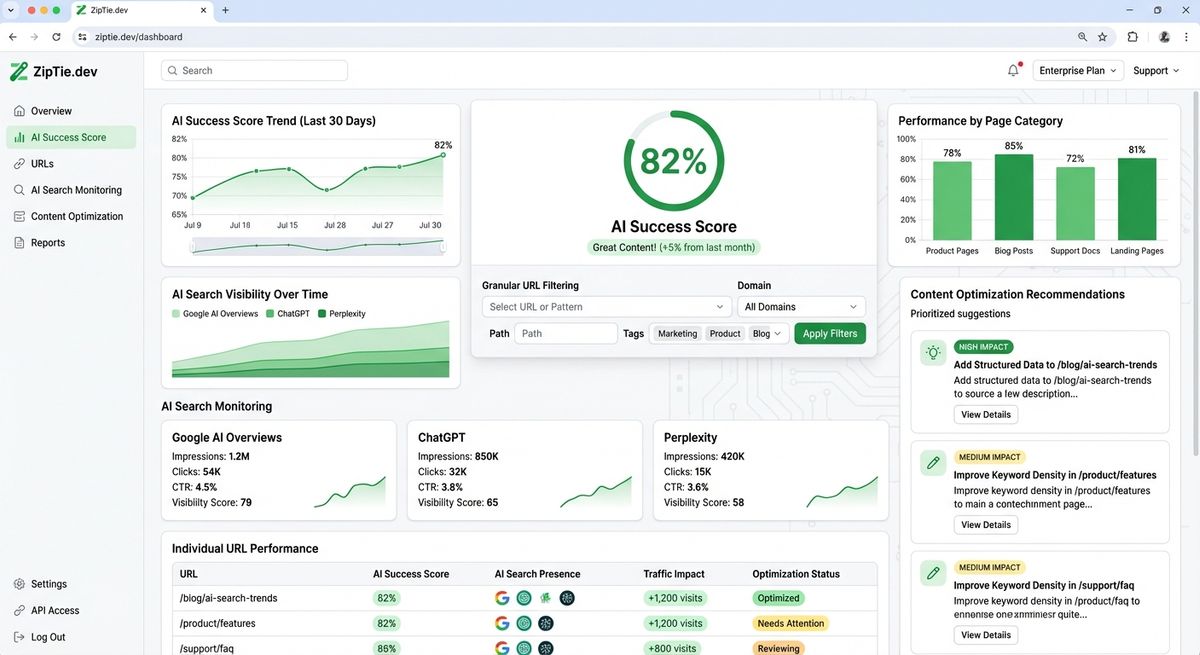
ZipTie excels at granular analysis and reporting, with a proprietary AI Success Score that estimates brand performance based on mentions, sentiment, and citations.
Key features:
- AI Success Score for at-a-glance performance assessment
- Granular filtering at the URL level (not just domain level)
- Content optimization tool identifying questions your content could answer better
- Indexation Audits analyzing URLs for LLM bot accessibility
- Captures data from interfaces just like Profound and Superlines
Pricing: Basic: $58.65/month (annual) or $69/month. Standard: $84.15/month (annual) or $99/month. Includes 500 to 1,000 AI search checks.
Best for: Teams that want deep, granular analysis of their AI visibility with URL-level insights.
Limitations: Currently tracks only Google AI Overviews, ChatGPT, and Perplexity. Does not separately track AI Mode.
14. Keyword.com
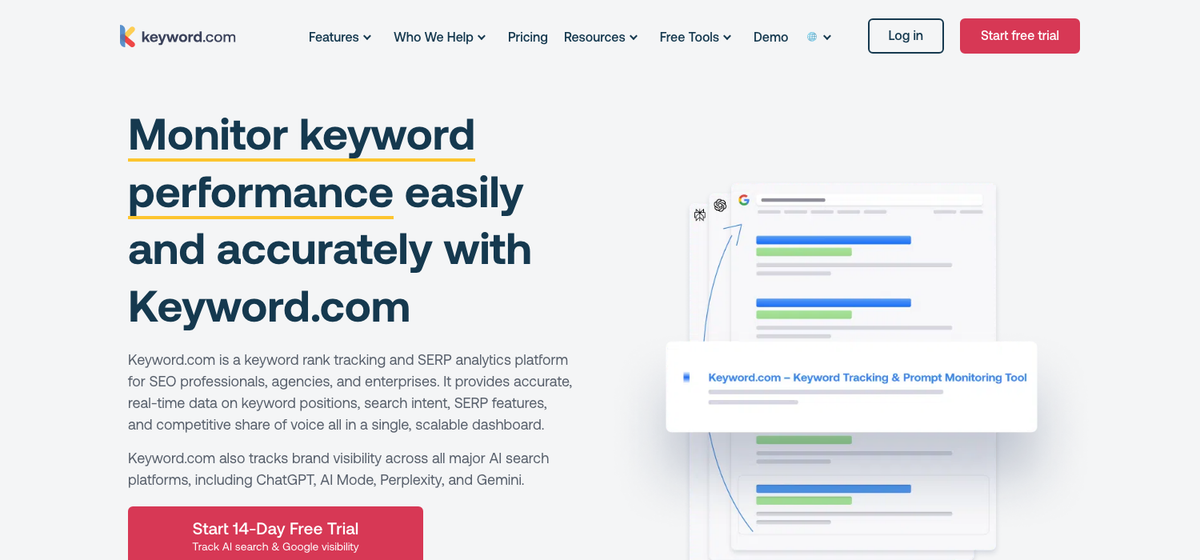
Keyword.com added AI Overviews tracking to its established rank tracking platform, with AI Mode detection included in SERP feature monitoring.
Key features:
- AI Overviews and AI Mode detection within keyword rank tracking
- Daily rank updates with citation data
- SERP feature tracking (featured snippets, People Also Ask, AI panels)
- API access for custom integrations
Pricing: Starts at $69/month for 1,000 keywords.
Best for: Teams that need high-volume keyword tracking with AI Mode detection at a competitive price point.
Limitations: AI visibility features are limited to Google surfaces. Does not track LLM platforms like ChatGPT or Perplexity. Relies entirely on API-based analysis, which can lead to significant differences from what users actually see in the interfaces.
15. GetMint
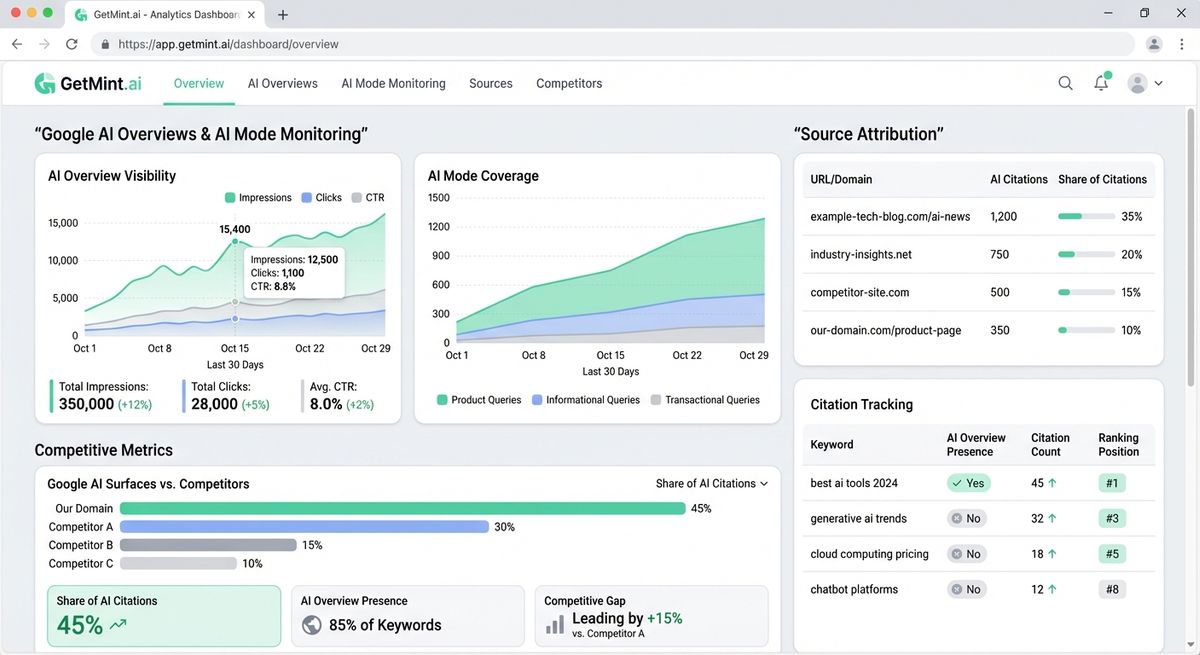
GetMint is an AI Visibility tracking platform that focuses on weekly analysis instead of daily.
Key features:
- Dedicated Google AI Overviews and AI Mode monitoring in the custom package dedicated for Enterprise and Agency clients
- Source attribution showing which URLs are cited in AI responses
- Lightweight setup with quick onboarding
Pricing: €79/mo Starter package.
Best for: Teams who want to get weekly data instead of daily tracking and are looking for a lightweight tracker to get started with visibility tracking.
Limitations: Weekly tracking is also a limitation of this platform, as AI search results change frequently and it’s important to capture daily nuances to understand long-term trends.
AI Mode is only available in their custom package, and the solution relies entirely on API-based responses on top of that.
How to Choose the Right AI Mode Rank Tracker
When evaluating tools, focus on these five questions:
1. Do you need 3-engine Starter tracking, or full multi-engine coverage?
If Google AI Mode is your only concern, tools like Keyword.com or GetMint may be sufficient. If your audience also uses ChatGPT, Perplexity, and Copilot, a multi-engine platform like Superlines or Profound provides broader coverage.
2. How does the tool collect data?
Tools that scrape real AI interfaces capture what users actually see. Tools that rely on API calls may return different results. A Surfer study found that API-based AI visibility data can differ from answers scraped from real ChatGPT and Perplexity interfaces, meaning API-only tools may not reflect the actual user experience.
3. What is your budget?
Entry-level AI Mode tracking starts around $29 to $99/month. Mid-market tools with competitive intelligence run $189 to $500/month. Enterprise suites cost $500+.
4. Do you need competitive intelligence?
Basic tools tell you whether you appear. Advanced tools tell you who appears instead of you and why. If you are in a competitive category, citation gap analysis is worth the premium.
5. How many brands do you manage?
Agencies and multi-brand teams should prioritize tools with unlimited domains per workspace and white-label reporting. Single-brand teams can use simpler setups.
How Does AI Mode Visibility Compare to AI Overviews?
AI Mode and AI Overviews serve different user intents and behave differently for tracking purposes:
| Factor | AI Overviews | AI Mode |
|---|---|---|
| **Format** | Short panel above search results | Full conversational interface |
| **User interaction** | Single query, no follow-ups | Multi-turn conversation with follow-ups |
| **Trigger rate** | Appears in [over 16% of Google searches](https://www.semrush.com/blog/semrush-ai-overviews-study/) | Opt-in experience, growing rapidly |
| **Click-through** | 43% of searches end without a click | 93% end without a click |
| **Citation behavior** | Cites 2 to 5 sources per panel | Cites sources across multiple turns |
| **Tracking complexity** | Moderate (single SERP scan) | Higher (multi-turn response capture) |
The practical implication: you need to track both surfaces separately. A brand that appears in AI Overviews may be absent from AI Mode for the same query, and vice versa. For a deeper look at AI Overviews tracking specifically, see our guide to the best AI Overviews rank tracking tools.
What Metrics Should You Track in AI Mode?
Focus on these five core metrics:
- Brand visibility rate: The percentage of tracked prompts where your brand is mentioned in the AI Mode response. This is your top-level health metric.
- Citation rate: How often your website URL is cited as a source in AI Mode responses. High citation rates mean AI Mode is actively linking to your content.
- Share of voice: Your brand's mention frequency compared to competitors across the same set of prompts. This tells you whether you are winning or losing the AI Mode conversation.
- Citation gap: The specific prompts where competitors appear and you do not. This is your optimization roadmap.
- Source rotation: How frequently the cited sources change for your tracked queries. High rotation means you need to monitor more frequently.
For teams already tracking AI visibility across multiple platforms, AI Mode metrics should be segmented separately to understand platform-specific performance.
What Queries Should You Track in AI Mode?
Start with three categories:
Brand queries: Your brand name, product names, and "[brand] vs [competitor]" comparisons. Check whether AI Mode responses mention you accurately and favorably.
Category queries: "Best [your category]," "top [your product type]," and "[category] tools compared." These are high-intent queries where AI Mode frequently generates detailed comparison responses.
Problem queries: Questions your audience asks that your product solves. These informational queries often trigger detailed AI Mode responses with multiple cited sources.
Track at least 50 to 100 queries across these categories. Fewer than that and you risk drawing conclusions from too small a sample. For guidance on building your prompt list, see our generative engine optimization best practices checklist.
To summarize
Google AI Mode is no longer experimental. It reaches over 200 countries, serves more than 2 billion monthly users, and is becoming the primary way many users interact with Google for complex queries. The brands that track their AI Mode visibility now will have a significant head start as this surface continues to grow.
The tools in this guide range from lightweight add-ons for existing SEO platforms to comprehensive multi-engine visibility suites. If AI Mode is your only concern, Keyword.com or GetMint offer focused coverage. If you need to track visibility across ChatGPT, Perplexity, Copilot, and other platforms alongside AI Mode, a dedicated GEO platform like Superlines provides broader coverage with citation gap analysis, query fan-out insights, and AI bot analytics.
Start by tracking your top 50 to 100 queries across brand, category, and problem searches. Monitor weekly at minimum. And remember that the sources cited in AI Mode shift constantly, so the brands that track continuously will spot opportunities that one-time auditors miss.
For related comparisons, see our guides to the best AI visibility tools, best Copilot rank tracking tools, and best ChatGPT tracking tools.
If you want to start systematically tracking your Google AI Mode visibility and other AI engines, get started with Superlines today!