


AI Search Visibility Tools Comparison 2026: Features, Markets and Pricing
AI search visibility for businesses means measuring where and how a brand is mentioned, described, recommended, and cited in AI-generated answers. A useful tool lets you inspect the answers behind those metrics and compare the same questions across relevant engines and markets over time.
Generative engine optimization (GEO) complements SEO by examining brand presence and source citations inside AI answers. Mentions, citations, sentiment, and AI referral traffic answer different questions, so they should be measured separately.
This guide compares nine platforms and their use cases, with product information checked on 7 October 2026. Superlines publishes the article and is one of the vendors compared.
Nine AI visibility tools and who they’re best suited for
- Superlines for enterprise/in-house marketing teams and marketing agencies
- Profound for large enterprise marketing teams combining AI visibility with agent-driven marketing workflows
- Otterly.AI for in-house marketing teams and marketing/SEO agencies
- Peec AI for in-house marketing teams and agencies
- ZipTie for SEO agencies and in-house teams managing a portfolio of brands
- Similarweb for marketing, SEO and market research teams
- Semrush for SEO teams and agencies already using Semrush
- Ahrefs Brand Radar for SEO teams and analysts already using Ahrefs
- Clearscope for content marketing and editorial teams
How to compare AI search visibility tools
Product capabilities, pricing, geographic coverage, and plan entitlements change frequently. We use current first-party documentation throughout and flag material conflicts where public information is unclear. This comparison is a documentation-based buying guide, not a controlled accuracy benchmark.
An AI visibility tool should help you understand where your brand appears, how it compares with competitors, which sources influence answers, how your brand is perceived, and how visibility changes over time. Compare platforms by how well they answer those questions across the engines, markets and workflows your team needs.
The criteria below help separate a useful marketing workflow from a dashboard that only reports a score.
- Engine and plan coverage: Match the engines to your audience and budget. Included engines, selectable models, and paid add-ons are different. ChatGPT Search, an OpenAI API response, and a shopping response are also different experiences.
- Actionable insights: Look for recommendations tied to actual answers, cited pages, and content gaps. They can guide an update, but do not guarantee that the revised page will gain citations.
- Trends and patterns: Look for clear views of how brand visibility and competitor performance change over time.
- Question coverage: Fixed-prompt monitoring follows your chosen questions; broad indexes help you discover others. Neither represents every question people ask AI. Some products also combine AI visibility with broader SEO, traffic or content intelligence.
- Citation source detection: When LLMs cite sources, you want to know which ones. This helps identify high-performing internal pages, potential misinformation sources, and partnership opportunities.
- Comparable metrics: Brand Visibility measures presence in observed answers; share of voice compares your brand with competitors; Citation Rate measures source citations. Definitions vary by tool, so similarly named scores are not automatically comparable.
- Brand sentiment analysis: It's not just about whether you're mentioned, but how. Sentiment analysis helps you track the emotional tone of AI mentions so you can take steps to safeguard brand perception.
- Competitor benchmarking: Benchmarking against competitors shows whether you're leading, lagging, or keeping pace.
- Crawler diagnostics: Crawlability tests and bot-visit logs can explain access problems. They do not establish that a page was used in an answer, added to training data, or responsible for a citation.
- Team workflows: Look for exports, sharing and integrations that work with the tools your team or clients already use. Access and permissions can depend on the plan.
Different collection methods can produce materially different AI answers. When choosing a tool, ask whether it measures the consumer AI experience your audience uses or a separate API environment. The collection method should match the experience and market your team wants to understand.
Surfer’s original UI/API study found material differences between consumer-interface and API responses in brands mentioned, cited sources and answer characteristics, including length. It compared ChatGPT responses in two scenarios of 1,000 executions each: a clean API and an API using a leaked OpenAI system prompt, then repeated the comparison for Perplexity. The vendor-run report does not clearly specify collection markets or run dates, and its findings apply to the tested configurations. It does not establish that interface collection is universally more accurate. API and consumer-interface responses should not be treated as interchangeable.
AI answers vary between runs, so look for tools that track the same questions consistently over time rather than treating one response as the truth.
Look behind the dashboard
Are the datapoints useful for the decisions your team makes, and are the main metrics clearly explained? Look for a product that lets you inspect the underlying answers and cited sources, understand changes over time, and turn findings into useful actions or recommendations.
Is the interface easy for your team to use, and does it fit your team or client reporting workflow? Where needed, look for ways to use the same data outside the UI through exports, integrations, API or MCP, with access that fits your plan.
During a trial, use the same meaningful business questions repeatedly. Judge whether the answers, sources, insights and recommendations help your team make better decisions.
Global tracking: country, language and collection location
For global tracking, start with your target market, prompt language and AI engines. Ask how the tool applies geographic context when collecting responses, including the collection location and any country settings. A German-language prompt alone does not establish that an answer reflects the German market.
Prioritize the AI engines your target audience actually uses in each market. Use localized questions and review markets separately, so strong visibility in one country does not hide weak performance in another.
How often is the data updated?
AI visibility tools typically collect answers on a schedule, such as daily, weekly or monthly. Compare how often your tracked questions are refreshed and how quickly results appear in the product. Alerts may surface changes, but they do not make scheduled collection continuous or truly real time.
Make the data usable across your team
Agencies need clear client/workspace separation and sharing permissions. Enterprise teams may also need SSO, access controls and a record of account activity. Look for usable exports and integrations, and clear terms for how long data is kept, where it is stored and how it can be deleted. Plan limits and data access should fit your team's reporting workflow.
Here is how the nine platforms fit different marketing and agency workflows.
Superlines: AI Search analytics for enterprise marketing teams and agencies
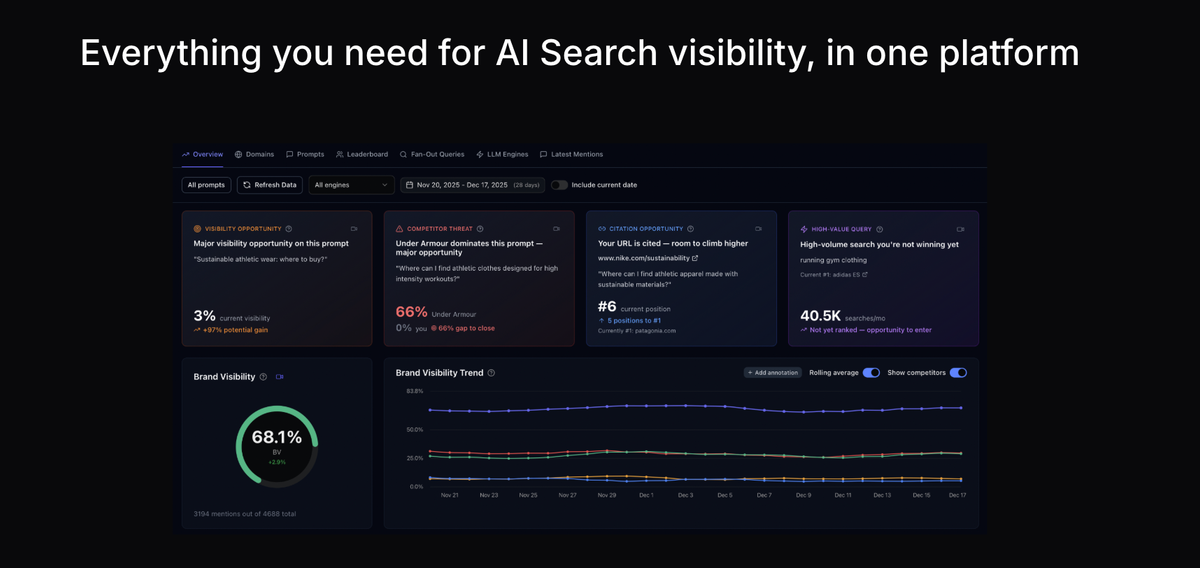
Earlier Superlines interface, retained for illustration; current layouts may differ.
Superlines pros
- Answer inspection: Superlines describes collection from AI interface experiences, with answer, source, and competitor analysis. This methodology is useful when your team wants to understand those consumer-facing experiences. Supported surfaces and collection conditions still vary by engine; it is not a guarantee of every user’s personalized answer.
- Query fan-out analysis: Use exposed subqueries as evidence of adjacent information needs. Coverage depends on what the engine exposes and the collection can observe; this is not a guarantee of every internal query.
- From insights to action: The Action Center turns visibility gaps, source patterns, and competitive findings into concrete recommendations teams can use to improve their AI Search visibility.
- Flexible data access: Teams can work in the Superlines interface or use the same intelligence through exports, API and MCP in their existing analytics and AI workflows. MCP access is listed across plans; API access starts at Growth. Downloadable exports have separate plan entitlements.
- AI bot and traffic analytics: Bot activity and human referral data provide separate diagnostics. A bot visit is not evidence of training, retrieval, or a resulting citation.
- Portfolio workflow: Enterprise marketing teams may manage multiple brands, markets, business units, or product portfolios, while agencies may manage several clients. Superlines supports multi-brand and multi-market workflows. Agency packages and brand packages have different brand allowances; unlimited domains do not mean unlimited brands on every plan.
Superlines cons
- Plan restrictions: Self-service plans select three answer engines. Starter has one month of history and no listed export/API access; longer history, exports, API, and SSO depend on tier.
- Configuration needs: Teams requiring more than three engines, longer retention, or enterprise controls will need to budget for the appropriate package.
Superlines combines tracked answers, citation sources, competitor analysis, query fan-outs, site diagnostics, and actionable recommendations in an AI Search analytics workflow for enterprise/in-house marketing teams and marketing agencies. Its product documentation describes granular prompt, engine, country, and time-based analysis, helping teams understand where performance differs and what to improve.
The pricing page advertises unlimited country and language settings and daily prompt collection. Country settings alone do not establish collection from every physical location on every engine; the supported engine-country-language combinations and collection method matter for a global rollout.
Superlines pricing: Starter is €79/month on monthly billing for 50 prompts and any three selected engines. Pro is €199/month with 150 prompts and exports; Growth is €379/month with 300 prompts and API access. Enterprise is custom, with up to ten engines and SSO/SAML. Agency brand allowances differ. The right tier depends on the engine bundle, history, and data access your team needs.
Profound: enterprise AI visibility and marketing agents
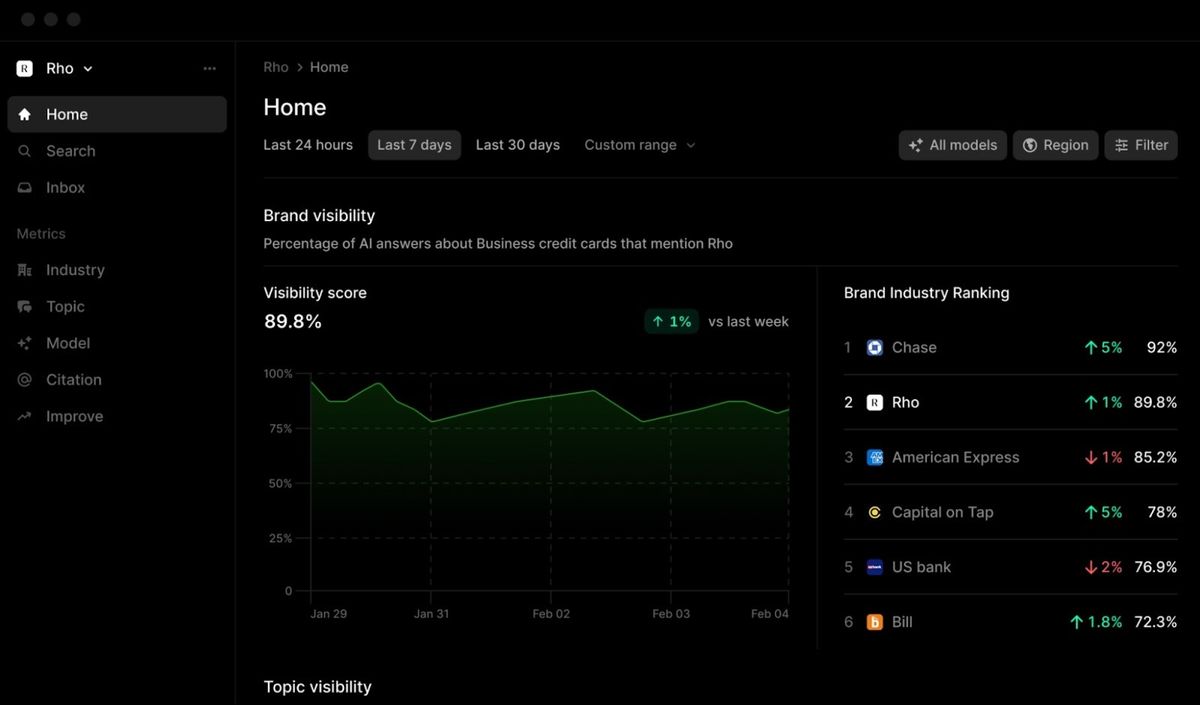
Earlier Profound interface, retained for illustration; current layouts may differ.
Profound pros:
- Enterprise analytics with marketing-agent and content workflows.
- Public help documentation and research to support evaluation.
- Up to nine answer engines are listed for Enterprise; the trial covers three.
Profound cons:
- Tracked-prompt results describe the selected cohort, not all AI conversations or market demand.
- Enterprise pricing and regional scope require a tailored quote.
Profound combines Answer Engine Insights with its AI Marketer and agents. The current Enterprise offering includes tailored tracking, SSO/SAML, and dedicated support. Service levels and regional scope depend on the contracted configuration.
The platform supports citation and competitor analysis alongside Prompt Volumes, ChatGPT Shopping, and Agent Analytics. These products have different evidence bases: tracked answers, user-demand estimates, shopping outputs, and site activity should not be merged into one visibility metric.
Its marketing-agent workflows can help research, write, and report using brand context. Generated content and suggested optimizations still need editorial review and do not guarantee citation gains.
Enterprise capability lists nine answer engines: ChatGPT, Perplexity, Google AI Mode, Gemini, Microsoft Copilot, DeepSeek, Claude, Google AI Overviews, and Exa Search. Engine availability depends on the contracted configuration.
Enterprise pricing lists CSV/JSON exports and API access. The help-center FAQ documents a hosted MCP server. For deeper analysis, look for full answers, citation URLs, and exportable records within the package’s quotas and permissions. A chart image does not provide that underlying data.
Profound pricing: The current page lists a free seven-day trial and custom Enterprise pricing. Trial provides 50 recommended prompts, daily collection, three engines, one region, and one language, without API or exports. Customizable prompts and broader scope are Enterprise features.
Otterly.AI: entry-level daily AI monitoring
Earlier Otterly.AI interface illustration; current layouts may differ.
Otterly.AI offers a relatively low entry price for teams starting with a small prompt cohort. Compare the required engines and integrations as well as the headline subscription cost.
Its workflow includes prompt research, GEO audits, citation reporting, and recommendations. These can support existing content reviews. Recommendation limits and export detail depend on the selected tier.
The current engine bundle includes ChatGPT, Google AI Overviews, Perplexity, and Microsoft Copilot. Claude, Google AI Mode, and Gemini are add-ons. Lite and higher plans list daily collection, which is not continuous monitoring.
Current pricing lists recommendations and Agent Analytics, with plan limits. API, MCP, and the Looker Studio connector are listed from Standard. Answer analysis, technical audits, and actual bot requests provide different kinds of insight.
Country coverage varies by engine. The pricing page says 50+ countries, while the country help page says 70+ and lists engine-specific exceptions. The aggregate country count remains unresolved; the named-country matrix is more useful for selecting your markets. The MCP documentation describes answer and citation access.
Otterly.AI pricing: Monthly Lite is $29 for 15 prompts, Standard $189 for 100, and Premium $489 for 400; annual rates differ. Four engines are included, with three optional engine add-ons. Exports are listed on Lite; API/MCP and Agent Analytics start at Standard. Enterprise adds SSO. Engine add-ons and API/MCP quotas affect the cost and reporting workflow.
Peec AI: prompt and source analytics for teams and agencies
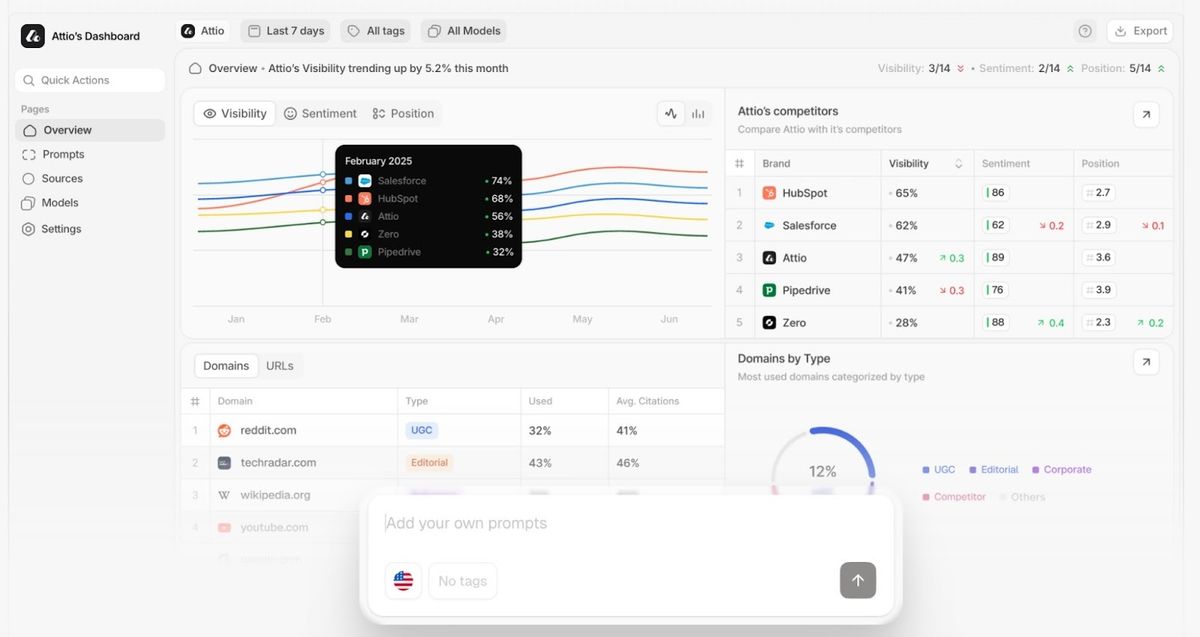
Earlier Peec AI interface, retained for illustration; current layouts may differ.
Peec AI pros:
- Agency-oriented projects and reporting workflows.
- Prompt-level visibility, source, position, and sentiment analysis.
Peec AI cons:
- Public plan descriptions conflict on included models, multi-country support, and data access.
- Current pricing lists three selected models on Starter, Pro, and Advanced.
- Native interface and API collection cover different surfaces.
Peec AI serves marketing teams and agencies with prompt-based visibility and source analysis. The existing review found the interface approachable; agency buyers should look at how projects and pitch reports work for their clients.
Current documentation describes recommendations and crawl insights as well as source analytics. Peec’s product reference distinguishes native ChatGPT collection from a separately offered OpenAI Search API surface. The diagnostic’s source and plan scope determine how it fits your workflow.
Engine and geography entitlements require confirmation. The pricing page lists three selected models on self-service brand tiers and multi-country support on Advanced, while another first-party page claims six engines and unlimited countries on every plan. Do not infer a larger included bundle from that conflict.
The Peec MCP server is documented. API, exports, and Looker Studio permissions require confirmation where descriptions differ: the pricing page places API on Enterprise and Looker/multi-country on Advanced, while other public copy implies broader access. For reporting, the important question is whether that access includes full answers and citation URLs.
Peec AI pricing: Current pricing lists Starter with 50 prompts, Pro with 150, and Advanced with 350, each with three selected models and daily collection. Enterprise lists daily or weekly collection and API/SSO. Current numerical subscription prices require confirmation for the selected models, markets, and integrations.
ZipTie: configurable AI monitoring and reporting
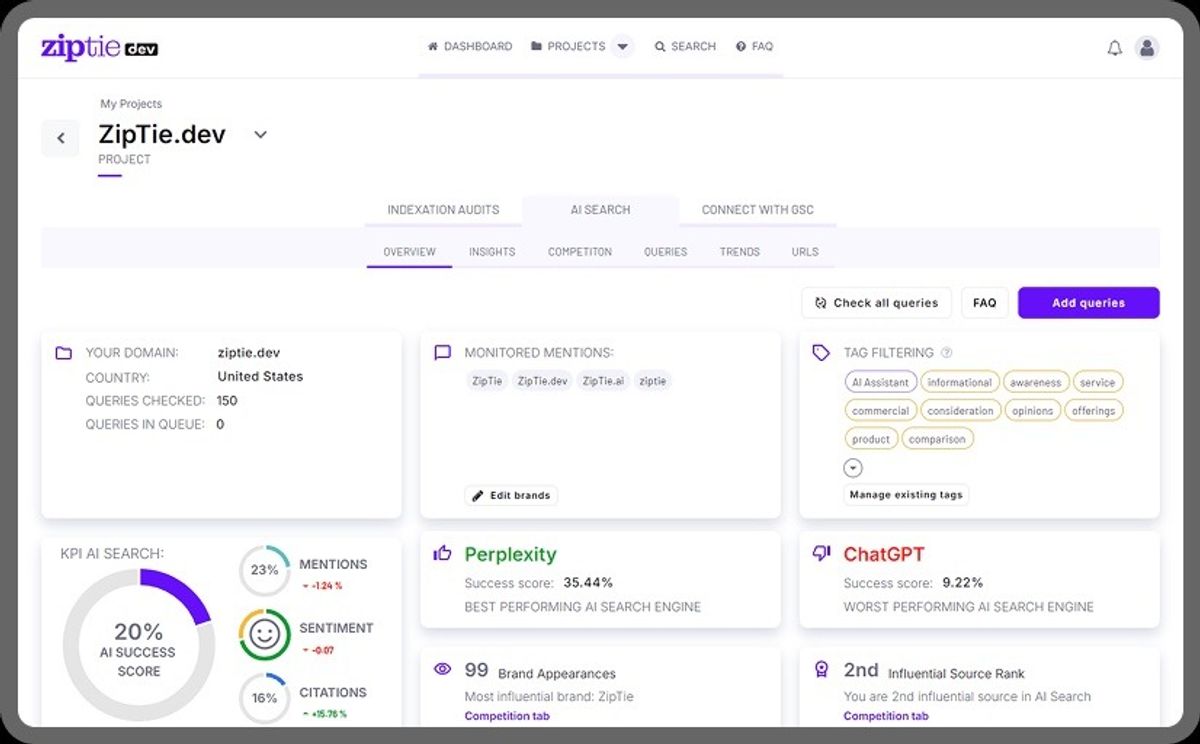
Legacy ZipTie interface, retained for illustration. The current ziptie.ai product and pricing differ from the earlier ziptie.dev offering.
ZipTie pros:
- Detailed answer, citation, and competitor reporting.
- Configurable engine selection and collection cadence.
- Separate source and UGC analysis options for deeper investigation.
ZipTie cons:
- Configuration-based pricing needs a like-for-like quote to compare costs.
- Public documentation does not establish the supported target countries and collection locations.
ZipTie supports inspecting answers and citations alongside competitor analysis. For reporting, focus on the current answer records and filters; the retained legacy screenshot is illustrative.
The current pricing configurator offers daily, weekly, and monthly prompt slots across selected engines. A preset name is a starting configuration, not a fixed plan with immutable entitlements.
UGC Impact Analysis and content generation are separate add-ons. UGC analysis can help investigate cited third-party sources; generated briefs and articles still require independent factual and editorial review.
Seven engines are selectable: ChatGPT, Google AI Overviews, Perplexity, Google AI Mode, Microsoft Copilot, Bing AI Overview, and Gemini. API and MCP access are a $10/month add-on exposing prompts, responses, citations, and metrics. Export formats, history, and target locations are not fully specified in the public material reviewed here. SSO is a separately enabled workspace entitlement, not automatically included by selecting the Enterprise preset.
ZipTie pricing: Price follows engines, prompt slots, and cadence. The seven-day trial has 25 daily prompts on ChatGPT, Google AI Overviews, and Microsoft Copilot; paid add-ons are unavailable during trial. A saved configuration gives a more useful cost comparison than a preset name; governance terms are separate.
Similarweb: AI answers alongside search and traffic intelligence
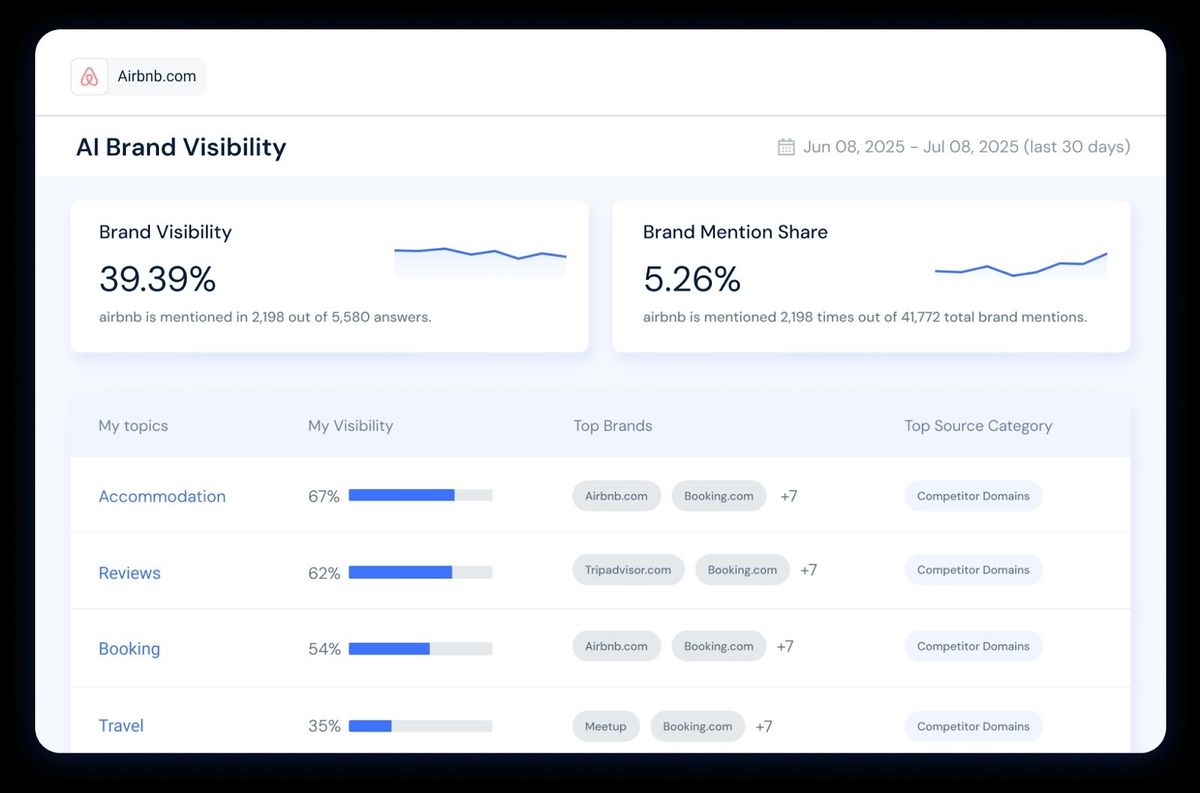
Earlier Similarweb interface, retained for illustration; current layouts may differ.
Similarweb is relevant when a team wants AI-answer reporting alongside a broader search and web-traffic intelligence workflow. Evaluate AI Brand Visibility separately from referral traffic: a citation does not prove a visit, and a visit does not establish brand inclusion in a tracked answer.
The AI Brand Visibility help documentation supports brand and competitor presence, prompt review, cited sources, and sentiment analysis. These answer-derived signals should be reviewed alongside their source records.
The country-by-engine matrix covers ChatGPT, Perplexity, Google AI Mode, and Gemini with different country availability. Use that matrix to match your priority markets, alongside prompt language and collection context; coverage is not identical across engines.
Current public documentation reviewed here does not establish full raw-answer export formats or AI Brand Visibility-specific API/MCP entitlements. That module-specific access remains unclear. General Similarweb API availability should not be presented as proof of access to this module’s answer and citation records.
Similarweb pricing: Request a current AI Brand Visibility quote for the engines, markets, history, data access, and governance required. Public information leaves module price, trial terms, collection and alert timing, and integration permissions unresolved. A demo offer alone does not establish whether a trial is available.
Semrush: AI visibility within an SEO suite
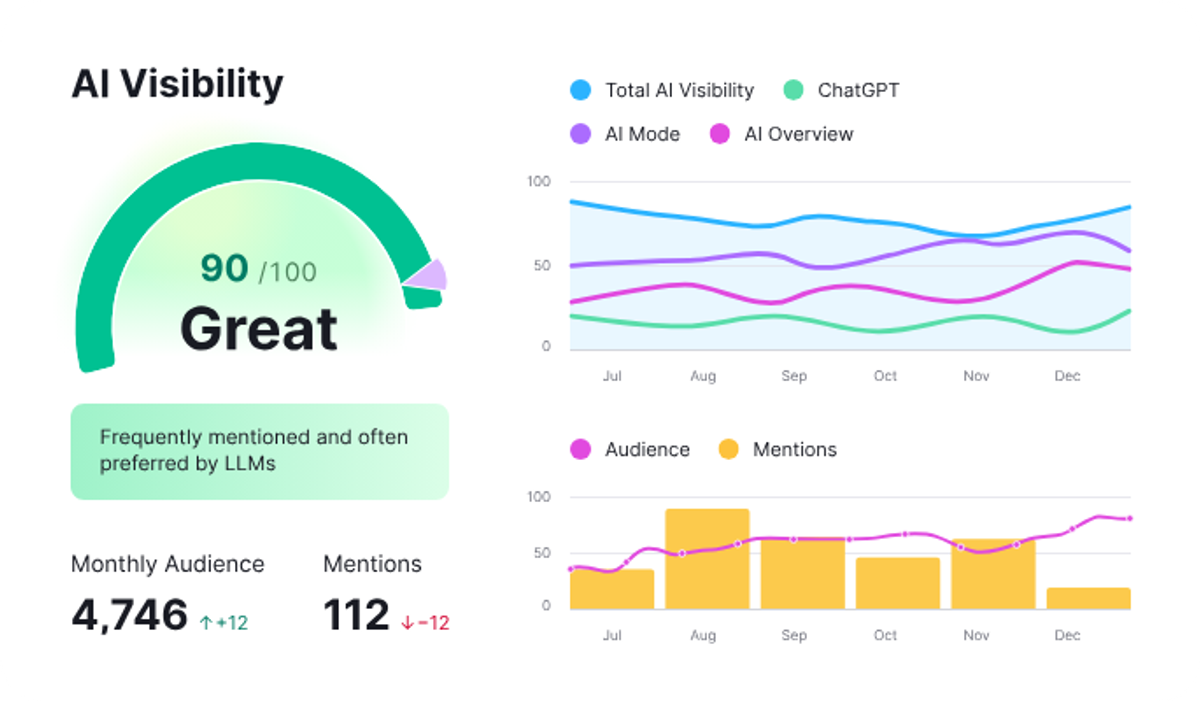
Earlier Semrush interface, retained for illustration; current layouts may differ.
Semrush pros:
- SEO and AI visibility reporting within one suite
- Daily custom-prompt tracking alongside broader AI discovery reports.
Semrush cons:
- User, domain/location, and additional-prompt costs can materially change the total.
- Site Audit crawlability checks are not equivalent to continuous AI bot-request logs.
- Different reports use different prompt sets, locations, and refresh schedules.
Semrush is a practical candidate for existing users if its AI reporting meets the required engine, location, and evidence-access criteria. Existing SEO subscriptions should not be assumed to include every AI module or user entitlement.
Separate AI Visibility Toolkit reports from Site Audit. An AI search health audit checks technical accessibility through a site crawl; it is not a live census of visits from AI crawlers.
According to Semrush’s data methodology, custom Prompt Tracking runs daily across ChatGPT Search, Google AI Mode, Google AI Overviews, and Gemini. Brand Performance uses a different query collection and updates weekly. Country/location choices vary by report and engine; do not combine their location counts into one universal coverage claim.
For the broad AI Analysis index, the exact update schedule is unclear across the first-party pages reviewed, which describe freshness differently. Semrush has a public MCP offering, but the AI visibility skill describes combining accessible contextual data with supplied AI reports. Public documentation does not clearly establish direct raw Prompt Tracking or citation access through MCP.
Semrush pricing: AI Visibility Toolkit is $99/month with 25 tracked prompts; extra prompt packs, additional domain/location reports, and user entitlements affect cost. The toolkit-specific documentation says it has no free trial; generic Semrush trial banners should not be treated as AI Toolkit trial terms. CSV exports have report and daily limits. Full-answer/citation access, API scope, and enterprise controls need to be assessed at the module level.
Ahrefs Brand Radar: broad discovery and custom monitoring
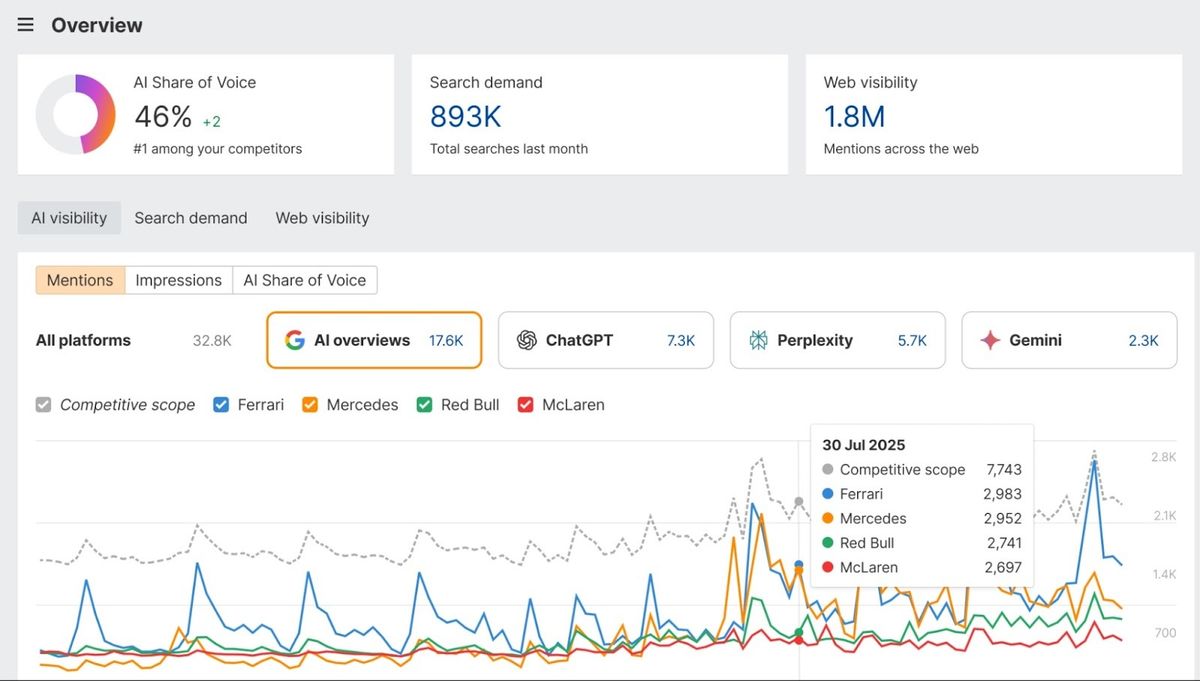
Earlier Ahrefs Brand Radar interface, retained for illustration; current layouts may differ.
Ahrefs pros:
- AI visibility alongside Ahrefs search and web reporting
- Broad discovery index alongside configurable custom-prompt tracking.
Ahrefs cons:
- Search-backed index questions are not a representative census of all AI conversations.
- Index subscriptions and custom-check allowances use different pricing units.
- Collection method and availability differ by engine.
Ahrefs Brand Radar combines AI-answer discovery with custom prompts and related search/web reporting. Its methodology describes search-backed questions entered into AI web interfaces; this does not make the entire product API-only or establish that its questions represent every business’s demand.
The established surfaces include Google AI Overviews, AI Mode, ChatGPT, Perplexity, Gemini, and Copilot. Current documentation also lists Grok but says new collection is temporarily paused; Claude is custom-prompt-only via API and consumes eight checks per run. Current platform status matters when Grok is part of your required monitoring scope.
Citation metrics and API/MCP access are documented; the Brand Radar API reference includes AI-response and cited-page/domain endpoints. The Looker Studio documentation lists Advanced or higher access. Subscription quotas and available answer fields determine how much analysis those integrations support. The shared chatbot index is described as monthly and AI Overviews as every few days; custom prompt freshness follows its configured schedule. Index source location and custom target location should be evaluated separately.
Ahrefs Brand Radar pricing: $199/month per index or $699/month for all platforms. Basic custom tracking is $50/month for 2,500 checks, or $0.02 per included check; other allowances and purchase options depend on the subscription. Checks are not monthly prompt slots: engine, location, frequency, and Claude’s higher check weight change consumption. Purchase eligibility and engine-country support also shape the configuration available to your team.
Clearscope: content optimization with AI query tracking
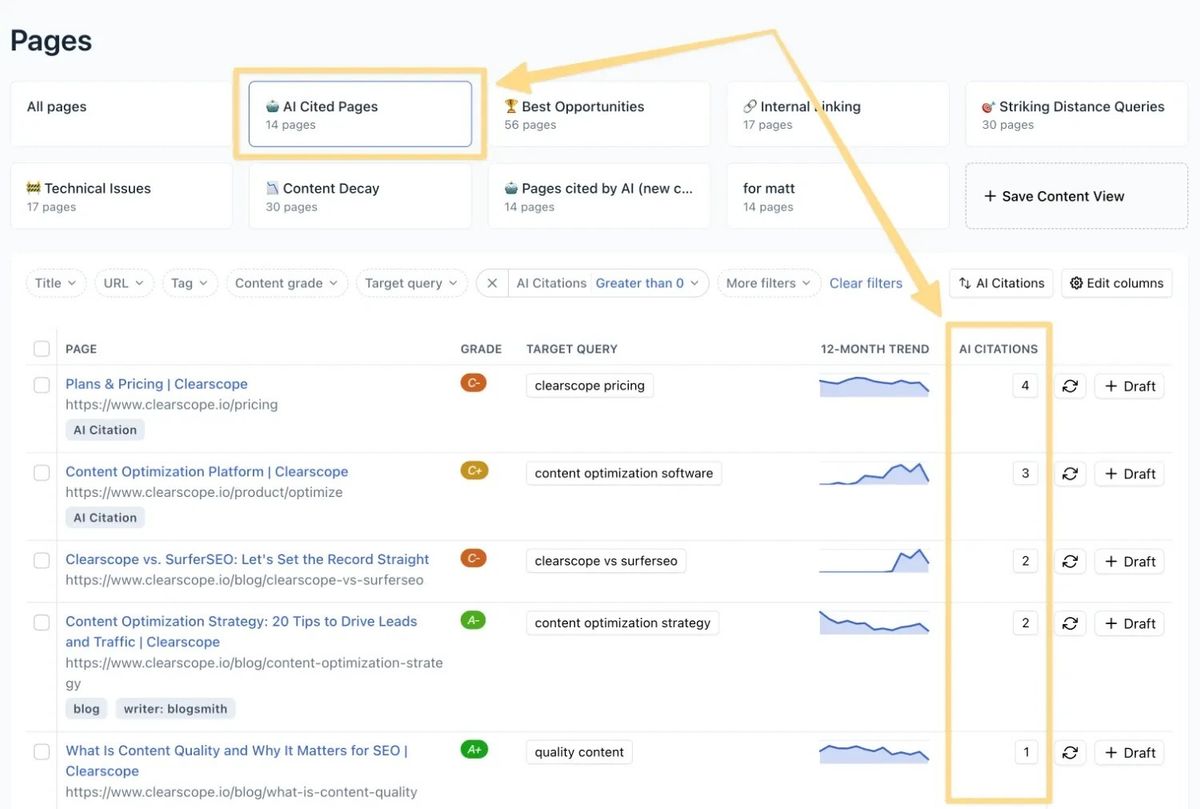
Earlier Clearscope interface, retained for illustration; current layouts may differ.
Clearscope pros:
- Content optimization combined with AI query tracking
- Topic exploration and AI drafts in the content workflow
Clearscope cons:
- Content exports do not, by themselves, establish full raw-answer and citation exports.
- Pricing and the query-tracking announcement differ on Claude availability.
- Public documentation leaves collection method, cadence, and geographic configuration unclear.
Clearscope combines a content workflow with AI query tracking. Its current offering includes tracked queries, page inventory, topic exploration, and drafts. Teams can evaluate these together rather than assume content optimization and answer monitoring always need separate products.
For a broader comparison of these overlapping capabilities, see our guide to content optimization and AEO platforms.
Query tracking helps review how a brand appears over time, while content inventory and topic exploration help identify pages to strengthen. Current feature documentation also lists query fan-out awareness and recommendations; neither capability should be treated as exclusive to Superlines.
AI Drafts can support a content brief or first pass, but editors still need to check sources, factual density, and duplication. Existing useful content should be preserved when a query reveals only a narrow gap.
The query-tracking announcement names ChatGPT, Gemini, and Claude, while pricing explicitly names ChatGPT and Gemini. Claude availability and plan entitlement require confirmation; do not assume it is included in every plan.
For a global deployment, the open questions are engine-country-language support, collection location and frequency, full answer/citation exports, and API/MCP availability. Unlimited content sharing/exporting does not establish raw monitoring-data access. Enterprise pricing lists SSO; retention, roles, and data residency depend on the agreed terms.
Clearscope pricing: Essentials is $129/month with 50 tracked queries, 50 pages, 20 monthly topic explorations, and 20 monthly drafts. Business is $399/month with 300 queries and 300 pages; Enterprise is custom. A 14-day trial is advertised.
Choose a tool for your required workflow
Choosing the right AI visibility tool depends on your team's size, budget, and how deeply you want to integrate GEO into your workflow. Here's a quick framework:
- For enterprise marketing teams and marketing agencies, shortlist Superlines when you need tracked answers with inspectable source data, competitor intelligence, actionable recommendations, and flexible ways to work with the data through the UI, exports, API or MCP. Engine and brand allowances determine which package fits.
- For enterprise monitoring with shopping analysis and marketing agents, evaluate Profound on the regional scope and answer access your team needs. A larger advertised catalog does not establish better measurement in every market.
- For a small daily cohort, evaluate Otterly.AI’s Lite configuration. Peec AI and ZipTie are alternatives when their project, model, and reporting configuration fits; their total pricing and unresolved entitlements remain part of that decision.
- For an existing SEO or content stack, compare Semrush, Ahrefs, Similarweb, and Clearscope on the specific AI module and monitoring requirements. Broad discovery, traffic intelligence, and content recommendations can complement fixed-prompt monitoring but do not replace it automatically.
During a trial, test the questions, markets and AI engines that matter to your business. Look at whether the data is understandable, whether the insights are useful, and whether the workflow fits how your team actually works.
For a deeper look at how specific tools compare head-to-head, see our Superlines vs. Profound vs. Peec AI comparison and our guide to the best GEO analytics tools.
How to compare pricing
Platforms package usage differently, so compare the package your team actually needs: relevant AI engines and markets, prompt allowance, history, reporting and exports, integrations, and user access. Prompt, query and check allowances are not equivalent across vendors, and bundled capabilities differ, so dividing price by those units does not provide a fair value comparison.
Self-service pricing is often public, while enterprise pricing is generally custom. The table shows published entry points and packaging in each vendor’s published currency, not a value ranking. For your shortlist, ask for the total price of the package that meets your requirements.
See how Superlines works for your team
Interested in improving how your brand appears across AI Search? Book a Superlines demo to see the platform in action, explore relevant AI visibility data, and discuss how Superlines could fit your team’s workflow. You can also review our current plans.