


Superlines vs Frase: How do these agentic GEO platforms compare?
Superlines is an AI Search Intelligence platform built for tracking and improving brand visibility across AI engines. Frase is a content optimization platform that has added AI search tracking and agentic workflows on top of its SEO content tools. Both now call themselves "agentic" and both target GEO, but they approach the problem from opposite directions.
If you need deep AI visibility analytics, citation gap analysis, and real answer data from live AI interfaces, Superlines is the stronger fit. If you need an all-in-one content creation and optimization tool with AI search tracking layered in, Frase covers more of the content production workflow.
This guide breaks down the differences across features, data quality, pricing, and use cases so you can pick the right platform for your team.
TL;DR: Superlines vs Frase at a glance
Our comparison methodology
We evaluated Superlines and Frase across five criteria that matter most when choosing a GEO platform:
- AI Engine Coverage and Data Accuracy: How many AI platforms does each tool track, and how does it collect answer data? Tools that capture real UI answers reflect what users actually see, while API-only tools may show different results.
- Analytics Depth: Does the platform provide citation gap analysis, competitor benchmarking, query fan-out data, and source-level insights, or does it stop at basic visibility scores?
- Content Workflow Integration: Can the tool help you create, optimize, and publish content, or is it purely an analytics platform?
- Scalability: Does the platform support multiple brands, markets, languages, and team members?
- Pricing Transparency: Are plans clearly structured with predictable costs as you scale?
Quick decision matrix
What is Superlines?
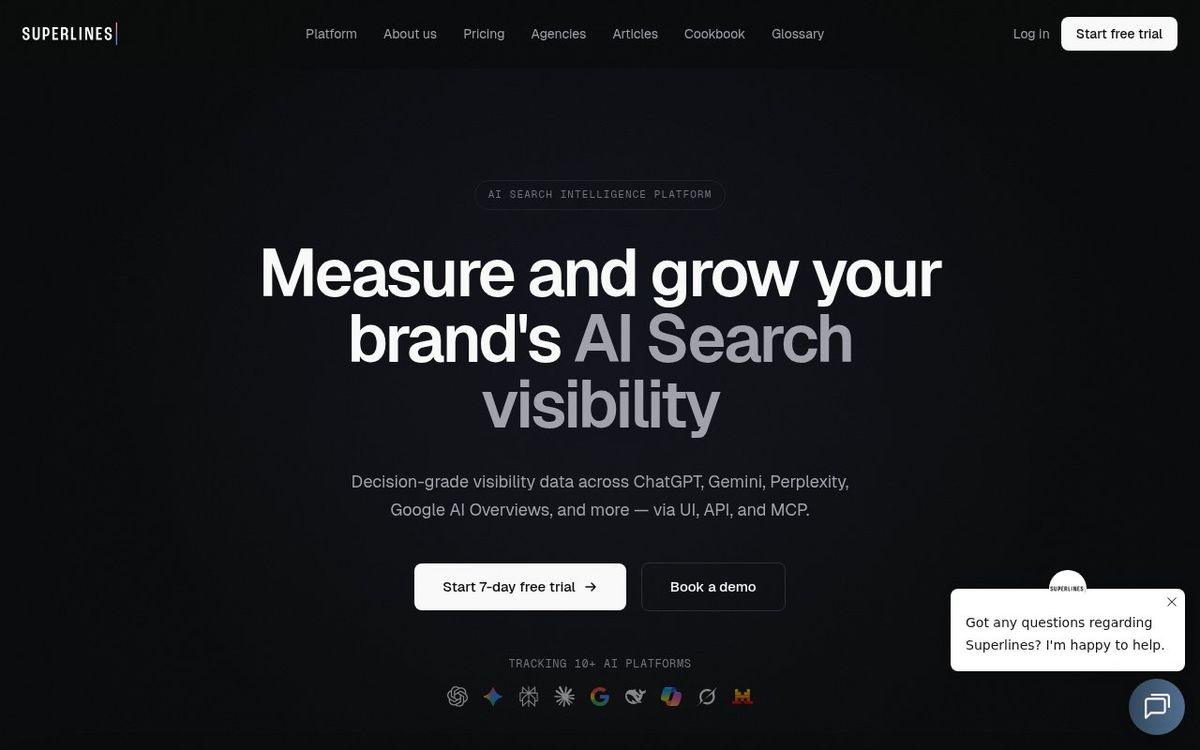
Superlines is an AI Search Intelligence platform that tracks how AI engines mention and cite your brand across ChatGPT, Perplexity, Claude, Copilot, Google AI Mode, Google AI Overviews, Gemini, Mistral, DeepSeek, and Grok.
The platform captures real answers from live AI interfaces, not just API samples. This matters because API responses can differ from what users actually see when they ask questions in ChatGPT or Perplexity. A study referenced by Matt Diggity comparing API-based data with real UI captures found meaningful differences between the two, which means API-only tools may not reflect actual user experience.
Superlines focuses on the analytics side of GEO. It shows Brand Visibility (how often AI mentions your brand), Citation Rate (how often AI links to your content), competitor citation gaps, query fan-out data (the hidden searches AI runs behind the scenes), and source-level insights. It doesn’t just show you data, but also tells you which actions to take to improve your AI visibility. Teams can also export data, use the API, or connect via an MCP server to pull insights into their own AI assistants and workflows.
Superlines key features
- 10 AI engine coverage: ChatGPT, Perplexity, Claude, Copilot, Google AI Mode, AI Overviews, Gemini, Mistral, DeepSeek, Grok
- Real UI answer capture: See what users actually see, not just API approximations
- Citation gap analysis: Identify where competitors win citations and you don't, with source-level detail
- Query fan-out data: Surface the hidden search queries AI engines run behind the scenes for each prompt
- Action Center: Tells you concretely which actions to take based on your visibility data
- AI bot analytics: Universal pixel tracks visits from OpenAI, Anthropic, Google, Perplexity, and other AI crawlers at the URL level
- MCP server: Connect Superlines data to your own AI assistants and agentic workflows
- Multi-brand, multi-market: Unlimited brands and domains per workspace with language and competitor set support
- Website audits: AI Readiness Score with actionable optimization recommendations
Superlines pricing
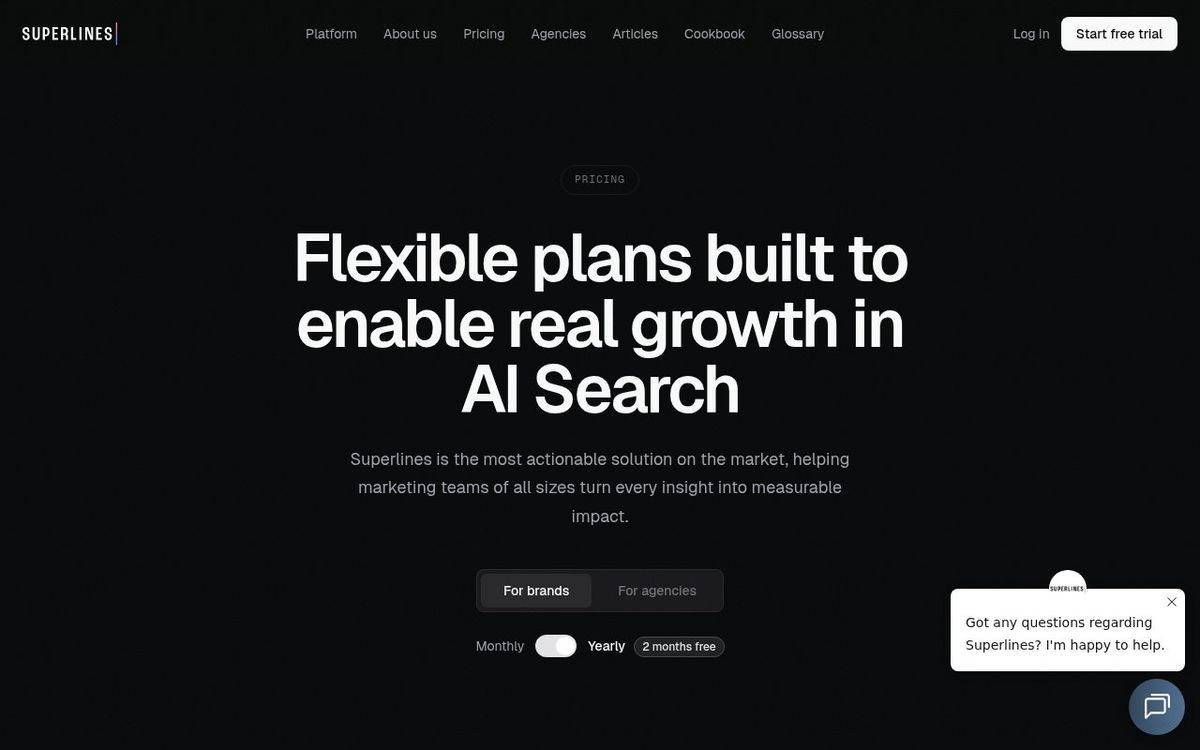
- Starter: €89/mo (€74/mo billed annually). 3 AI engines, 50 tracked prompts, unlimited users & brands, daily tracking, AI Bot analytics, MCP server & API, Article Generator (5 AEO articles/month), Schema Optimizer.
- Growth: €379/mo (€315/mo billed annually). 3 engines, 150 tracked prompts, Article Generator (15 AEO articles/month), Schema Optimizer, monthly Site Crawl & Audit, data exports.
- Enterprise: Custom pricing. Up to 10 AI engines, unlimited Article Generator, weekly Site Crawl & Audit, dedicated AEO strategist, all-time data history.
Who should choose Superlines?
Superlines is a full-stack AI Search Intelligence platform for marketing teams and agencies that want analytics, content generation, and agentic workflows in one place. It combines deep visibility data (citation gaps, query fan-outs, real UI answer capture) with built-in content tools (Article Generator, Schema Optimizer, Site Crawl & Audit) and an MCP server that connects to external AI assistants. If your primary question is "how does AI talk about our brand, and what should we do about it?", Superlines gives you both the data and the tools to act on it.
Unlike traditional content-first tools, Superlines approaches GEO from the intelligence side: start with what AI engines actually say about your brand, then generate optimized content based on those insights. The Article Generator creates AEO-optimized articles informed by your visibility data, the Schema Optimizer structures your existing pages for AI discoverability, and the MCP server lets your team build custom agentic workflows on top of all of it.
What is Frase?
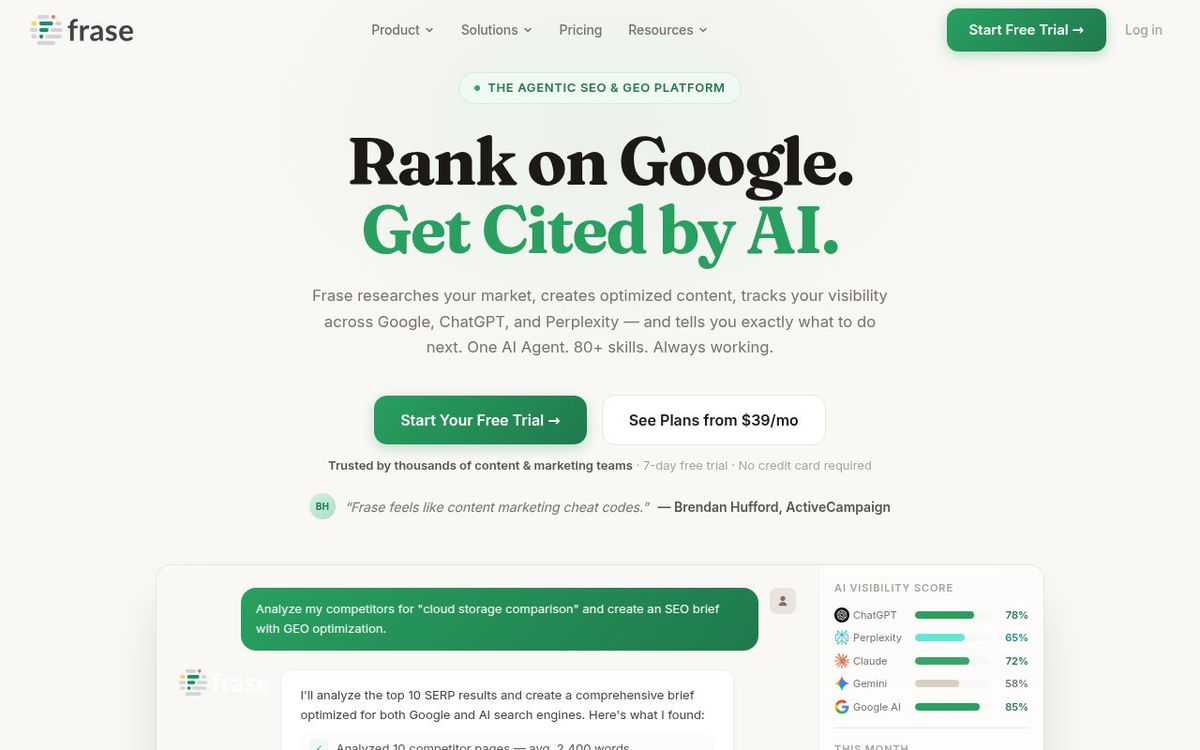
Frase is a content optimization platform that has expanded into GEO. It started as an SEO content tool (AI-generated briefs, SERP analysis, content scoring) and has recently added AI search tracking and what it calls an "agentic" workflow layer.
Frase positions itself as "The Agentic SEO & GEO Platform" with the tagline "Rank on Google. Get Cited by AI." It claims to replace multiple tools (SEMrush, Jasper, Surfer, Canva, WordPress) with a single AI agent that handles research, creation, optimization, publishing, and tracking.
The platform tracks AI visibility across 8 engines and provides GEO content optimization scoring. However, its core strength remains content production: generating briefs from SERP data, writing drafts, scoring content against competitors, and publishing directly to CMS platforms.
Frase key features
- AI content briefs: Automatically generates content outlines based on SERP analysis of top-ranking pages
- AI writer: Drafts content using your brief as a guide, with tone and style controls
- Content scoring: Rates your content against top-ranking competitors for topic coverage
- SERP analysis: Pulls data from top Google results to inform content strategy
- GEO content optimization: Scores content for AI citation likelihood
- AI search tracking: Monitors brand visibility across 8 AI platforms (ChatGPT, Perplexity, Claude, Gemini, Google AI Mode, AI Overviews, Copilot, DeepSeek)
- Publishing integrations: Direct publishing to WordPress and other CMS platforms
- 80+ AI agent skills: Automated workflows for research, writing, and optimization tasks
Frase pricing
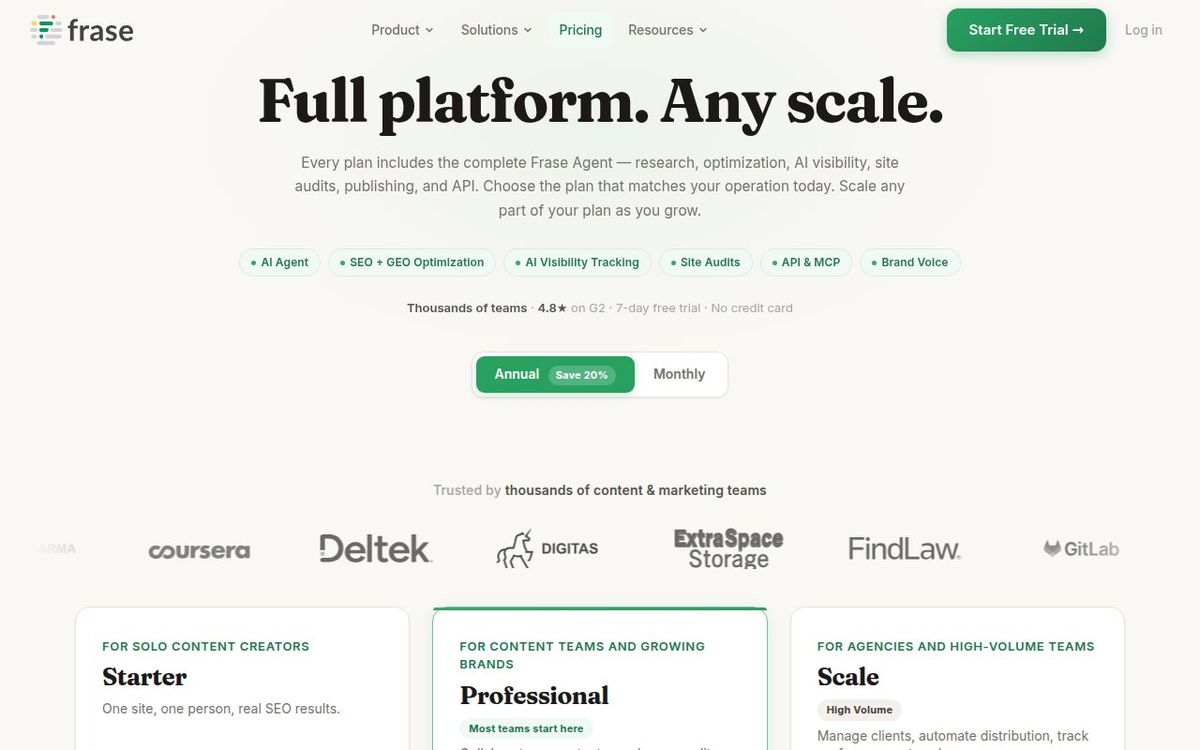
- Starter: $49/mo. 1 user, 1 domain, 10 AI-optimized articles/month, AI Visibility tracking (2 platforms), 50 audit pages/month, SEO + GEO optimization, API & MCP access.
- Professional: $129/mo. 3 seats, 5 domains, 40 articles/month, AI Visibility tracking (3 platforms), 250 audit pages/month, 90-day history.
- Scale: $299/mo. 5 seats, 10 domains, 100 articles/month, AI Visibility tracking (5 platforms), 1,000 audit pages/month, 1-year history, data exports.
- Enterprise plans available with SSO/SAML, white-label portal, and 8 AI platforms tracked. All plans include a 7-day free trial.
Who should choose Frase?
Frase works best for content teams that need a single platform for research, writing, optimization, and basic AI visibility tracking. If your primary question is "what content should I create and how should I optimize it for both Google and AI?", Frase covers that workflow.
It is not a deep analytics platform. You will not find citation gap analysis, query fan-out data, AI bot analytics, or real UI answer capture inside Frase. The AI tracking layer provides visibility scores but limited diagnostic depth.
How does AI engine coverage compare between Superlines and Frase?
Superlines tracks 10 AI engines: ChatGPT, Perplexity, Claude, Copilot, Google AI Mode, Google AI Overviews, Gemini, Mistral, DeepSeek, and Grok. Frase tracks 8: ChatGPT, Perplexity, Claude, Gemini, Google AI Mode, AI Overviews, Copilot, and DeepSeek.
The two engines Superlines covers that Frase does not are Mistral and Grok. This matters depending on your audience. Mistral is growing in European markets, and Grok is integrated into X (formerly Twitter) with a growing user base.
More important than the count is how each tool collects data. Superlines captures answers from live AI interfaces, which means the data reflects what a real user would see when asking a question in ChatGPT or Perplexity. Frase uses API-based collection, which can produce different results than the live interface.
Conductor's 2026 AEO Benchmarks Report analyzed over 17 million AI responses and found that AI referral traffic now accounts for 1.08% of all web traffic, with 87.4% of that coming from ChatGPT alone. This concentration means accuracy on ChatGPT specifically is critical, and the gap between API and UI data matters most on the platform that drives the most traffic.
What analytics does each platform provide?
This is where the two platforms diverge most sharply.
Superlines analytics depth
Superlines provides:
- Brand Visibility and Citation Rate across all tracked engines, with trend data over time
- Competitor benchmarking showing how rivals perform on the same prompts
- Citation gap analysis identifying specific prompts where competitors win citations and you don't
- Query fan-out data revealing the hidden searches AI engines run behind the scenes
- Source-level insights showing which URLs and domains AI engines cite
- AI bot analytics tracking crawler visits from OpenAI, Anthropic, Google, and Perplexity at the URL level
- AI Readiness Score from website audits with specific optimization recommendations
Frase analytics depth
Frase provides:
- AI visibility scores across tracked engines
- GEO content optimization scores rating content for AI citation likelihood
- SERP analysis showing top-ranking pages and their content structure
- Content scoring comparing your content against competitors for topic coverage
- Basic competitor tracking in AI search results
The difference is clear: Superlines tells you why AI engines cite (or don't cite) your brand and what specific actions to take. Frase tells you whether your brand appears and helps you create content that might improve that appearance.
SE Ranking's research found that 65% of pages cited by Google AI Mode include structured data markup, and 71% of pages cited by ChatGPT include structured data. This kind of source-level insight (understanding what makes cited pages different) is the type of analysis Superlines' citation gap and source analysis enables, while Frase's tracking stays at the visibility score level.
How do content creation capabilities compare?
Both platforms now include content creation capabilities, though they approach it differently. Frase offers a broader content production suite while Superlines focuses on AEO-specific content generation powered by visibility intelligence.
- AI content briefs generated from SERP analysis
- AI writer that drafts content based on your brief
- Content editor with real-time optimization scoring
- Topic research identifying content gaps and opportunities
- Direct CMS publishing to WordPress and other platforms
- 80+ AI agent skills for automated content workflows
The key difference: Frase builds content from SERP and keyword data (traditional SEO intelligence). Superlines generates content from AI visibility data — what AI engines actually say, which competitors get cited, and where citation gaps exist. For teams focused on AI search performance, Superlines' approach produces content that directly targets the gaps AI engines reveal. For teams focused on traditional Google rankings with AI tracking layered on top, Frase covers more of the SEO workflow.
Semrush research found that AI search traffic grew 527% year-over-year through late 2025. This growth means both content creation and visibility analytics are essential for GEO. Superlines now covers both through its Article Generator and analytics suite, while Frase covers both through its content editor and visibility tracking layer.
How does pricing compare between Superlines and Frase?
Both platforms now offer full-stack GEO capabilities, so the pricing comparison is more direct than it used to be.
Frase starts at $49/mo with content tools and basic AI visibility tracking:
- Starter ($49/mo): 10 articles/month, AI Visibility on 2 platforms, 50 audit pages, 1 user, 1 domain
- Professional ($129/mo): 40 articles/month, AI Visibility on 3 platforms, 250 audit pages, 3 seats, 5 domains
- Scale ($299/mo): 100 articles/month, AI Visibility on 5 platforms, 1,000 audit pages, 5 seats, 10 domains
Superlines starts at €89/mo with full analytics, content generation, and agentic tooling:
- Starter (€89/mo): 3 AI engines, 50 prompts, Article Generator (5 AEO articles/month), Schema Optimizer, MCP server & API, unlimited users & brands
- Growth (€379/mo): 3 engines, 150 prompts, Article Generator (15/month), Site Crawl & Audit, data exports
- Enterprise (custom): Up to 10 engines, unlimited Article Generator, weekly Site Crawl, dedicated strategist
Superlines' Starter at €89/mo includes features that require Frase's Professional ($129/mo) or Scale ($299/mo) plan to match: deeper AI visibility analytics, real UI answer data, citation gap analysis, query fan-out insights, AI bot analytics, and an MCP server for agentic workflows. Superlines also includes the Article Generator and Schema Optimizer at every tier, making it a complete platform from day one.
Frase's strength is volume: at the Scale tier ($299/mo), teams get 100 AI-optimized articles per month with SERP-driven briefs, internal linking, multi-channel publishing, and site audits of up to 1,000 pages. If your primary need is high-volume SEO content production with GEO tracking added on, Frase's Scale plan delivers more content output. If your primary need is AI visibility intelligence with content generation that targets citation gaps, Superlines delivers more strategic value at a lower price point.
What about the "agentic" positioning?
Both Superlines and Frase now use the word "agentic" in their marketing. This is worth unpacking because the term means different things in each context.
Frase's agentic approach centers on a single AI agent with "80+ skills" that automates content workflows: researching topics, generating briefs, writing drafts, optimizing content, and publishing. The agent replaces manual steps in the content production process.
Superlines' agentic approach is built around the MCP server and API, making the full platform — analytics, Article Generator, Schema Optimizer — accessible to external AI agents and workflows. Teams can connect Superlines data to Claude, ChatGPT, or custom agents to ask questions about visibility data, trigger content generation based on citation gaps, automate reporting, or build end-to-end GEO pipelines. This makes Superlines a full-stack agentic platform: the UI provides the dashboard experience, and the MCP server provides the programmable layer for teams that want to orchestrate AI search workflows autonomously.
The distinction: Frase's agent automates content production steps (research → write → optimize → publish). Superlines' agentic layer exposes intelligence and action to any AI workflow (analyze visibility → identify gaps → generate content → optimize schema → monitor results). Superlines gives teams the building blocks to create custom GEO workflows; Frase provides a pre-built content production pipeline.
Dimension Market Research estimates the GEO market will reach $1.09 billion in 2026, growing at a 40.6% CAGR. As this market matures, the "agentic" layer will likely become table stakes for both analytics and content platforms. The question today is whether you need an agent that creates content or an agent that analyzes visibility data.
How do Superlines and Frase handle multi-brand and agency workflows?
Superlines supports unlimited brands and domains per workspace. Teams can set up market-specific languages, competitor sets, and prompt groups for each brand. Data exports, API access, and MCP server connections make it straightforward to integrate Superlines data into client reporting workflows.
Frase supports team collaboration on its Team plan ($99/mo) with shared workspaces. However, its multi-brand capabilities are more limited. Frase is primarily designed for single-brand content production, with team features focused on collaboration rather than multi-client management.
For agencies managing 5+ brands, Superlines' architecture is built for that use case. For agencies managing 1-2 brands where content production is the bottleneck, Frase's workflow may be more practical.
What are the limitations of each platform?
Superlines limitations
- No content creation tools: You need separate tools for writing, briefs, and optimization
- Higher entry price: €89/mo minimum vs Frase's $12/mo starting point
- Learning curve for analytics: The depth of data (fan-outs, citation gaps, source analysis) requires time to interpret and act on
- Starter plan restrictions: Entry-level plans have limited data retention and prompt volumes
Frase limitations
- API-based data collection: AI tracking may not reflect what users actually see in live AI interfaces
- Shallow analytics depth: No citation gap analysis, query fan-out data, or AI bot analytics
- Limited multi-brand support: Not built for agencies managing many clients
- No MCP server or external API for AI data: Cannot feed visibility data into external workflows
- GEO features only in higher tiers: Solo plan ($12/mo) has no GEO capabilities at all
When should you use both Superlines and Frase together?
Some teams get the best results by using both platforms for different parts of the GEO workflow:
- Use Frase for content production: Generate briefs from SERP data, write and optimize content, score against competitors, publish to CMS
- Use Superlines for AI visibility intelligence: Track how AI engines respond to your content, identify citation gaps, monitor competitor visibility, analyze query fan-outs
- Close the loop: Use Superlines' insights to inform what content Frase should create or update next
This approach costs roughly €128/mo at the entry level (Frase Basic + Superlines Starter) and gives you both content production and deep analytics without compromise.
Knotch data suggests that visitors referred by LLMs convert at roughly 2x the rate of traditional organic search visitors. This means the ROI of getting AI visibility right is higher than traditional SEO on a per-visitor basis, which can justify investing in both a content tool and an analytics platform.
How do existing users compare the two platforms?
User feedback on G2 and Capterra highlights the different strengths:
Frase users consistently praise the content creation workflow: "Frase saves me hours on content briefs" and "the AI writer produces solid first drafts." Criticisms focus on the learning curve for the content editor and occasional AI output quality issues.
Superlines users highlight the analytics depth: the ability to see exactly which prompts drive visibility, where competitors win citations, and what sources AI engines rely on. The MCP server and API access are frequently mentioned by technical teams.
Neither platform has extensive negative reviews about its core strength. The complaints tend to come from users who expected the other platform's capabilities: Frase users wanting deeper analytics, or Superlines users wanting content creation tools.
Which platform should you choose for GEO in 2026?
The answer depends on your team's biggest gap:
- Choose Superlines if you already create content but lack visibility into how AI engines use it. You need citation gap analysis, real answer data, query fan-outs, actions to improve your visibility and AI bot analytics to guide your strategy.
- Choose Frase if you need a content production platform that also tracks AI visibility. You want briefs, AI writing, content scoring, and basic GEO monitoring in one tool.
For a broader comparison of GEO tools beyond these two, see our guide to the best generative engine optimization tools in 2026. If you are evaluating other head-to-head matchups, our Superlines vs Profound vs Peec AI comparison covers three analytics-focused platforms in detail.
Superlines is an AI Search Intelligence platform that helps teams measure and improve brand visibility across AI engines. If understanding how AI talks about your brand is the problem you need to solve, Superlines provides the data to answer that question.