


Best GEO tools in 2026: Top Generative Engine Optimization platforms for AI Search visibility
The best GEO tools track how often AI assistants mention your brand (Brand Visibility) and link to you (Citation Rate) across engines like ChatGPT, Gemini, Perplexity, and Google AI Mode.
Generative Engine Optimization (GEO) is quickly becoming the missing layer between classic SEO and how AI assistants describe your brand. Buyers now ask AI to recommend "the best X for Y," and those answers often mention only a handful of companies.
If you want to stay visible in AI Search, you need more than rank tracking. You need a GEO platform that shows your mentions and citations across engines, the competitors you share answers with, and the sources and pages that drive visibility.
In this guide we compare the best GEO tools in 2026. You will see how Superlines, Rankscale AI, GetCito, SE Visible, Writesonic AI, Goodie AI, Peec AI, and Profound differ in data quality, AI engine coverage, pricing, and workflow support.
What Is Generative Engine Optimization (GEO)?
Generative Engine Optimization (GEO) is the practice of improving how often AI assistants mention your brand and cite your content inside AI-generated answers. GEO builds on SEO: SEO helps engines crawl and rank your pages, while GEO focuses on visibility and citations inside ChatGPT, Gemini, Perplexity, and Google AI Mode.
The GEO market is growing fast. Dimension Market Research estimates the generative engine optimization market will reach $1.09 billion in 2026, growing at a 40.6% compound annual growth rate. That growth reflects how quickly brands are investing in AI search visibility.
SEO vs AI SEO vs AEO vs GEO
- SEO: rankings and indexing in traditional search engines
- AI SEO tools: automation for classic SEO workflows (content, briefs, audits)
- GEO/AEO: optimizing for brand mentions and citations inside AI answers across multiple AI engines
Our Selection Methodology
We evaluated each GEO platform using five critical criteria that determine long-term success in AI search optimization:
- AI Engine Coverage: How many AI platforms does the tool track? The best tools cover ChatGPT, Perplexity, Gemini, Google AI Mode, Claude, Copilot, and more.
- Data Accuracy: Does the tool capture real answers from live AI interfaces, or rely only on API calls that may differ from what users actually see?
- Actionable Insights: Does the platform go beyond dashboards to show citation gaps, competitor weaknesses, and specific pages to improve?
- Workflow Support: Can teams export data, use APIs, or connect via MCP servers to integrate GEO into existing reporting and automation?
- Scalability and Pricing: Are there growth-friendly tiers with transparent pricing that work for both startups and enterprise teams?
Why tools that use only APIs can miss real AI answers
Conductor's 2026 AEO Benchmarks Report analyzed over 17 million AI responses and found that AI referral traffic now accounts for 1.08% of all web traffic, with 87.4% of that coming from ChatGPT alone. This means the tools you use to track AI visibility need to accurately reflect what happens in real AI interfaces, not just API approximations.
Before we dive into the full list, here are the tools at a glance.
Quick Decision Matrix
1. Superlines
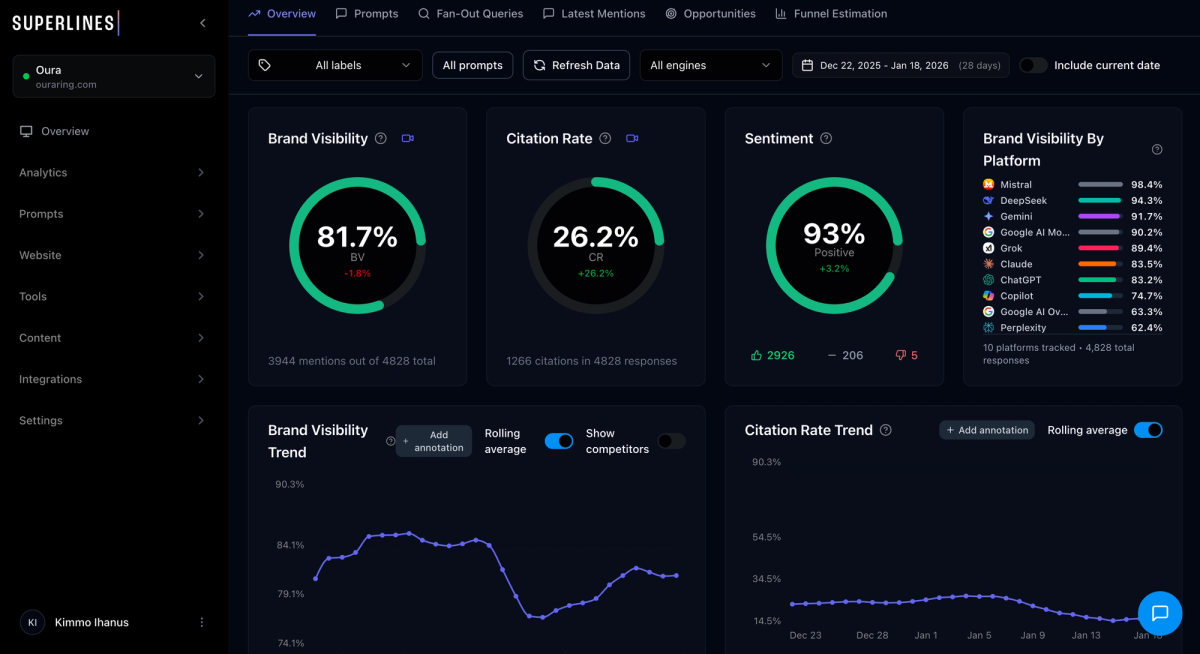
Superlines homepage showing the AI Search analytics dashboard with brand visibility, citation rate, and share of voice metrics.
Superlines is an AI Search Intelligence platform that captures real answers from live AI interfaces, so you see exactly what users see in AI Search. It surfaces the insights that matter most for visibility: Brand Visibility, Citation Rate, competitor citation gaps, query fan-outs, and the exact pages and third-party sources to improve. Teams can work with the data in-app, export it to reporting, or pull the same dataset into their own AI assistants via an MCP server.
Key features:
- Cross-platform AI visibility tracking and competitor benchmarking: Measure Brand Visibility and Citation Rate across 10 major AI engines, including ChatGPT, Perplexity, Claude, Microsoft Copilot, Google AI Mode, Google AI Overviews, Gemini, Mistral, DeepSeek and Grok.
- Real answer data, not only from APIs: Capture full interface answers from live AI chats so you see what users actually see, instead of relying purely on API samples.
- Citation and competitor gap analysis: See which of your pages and which third-party URLs AI engines cite, where competitors win citations instead of you, and which articles, directories or UGC threads (such as Reddit or Quora) are worth pursuing for extra mentions.
- Query fan-out data: Surface the hidden search queries and keywords AI assistants run behind the scenes for each prompt, giving you a practical roadmap for new content, updated headings and schema work.
- AI traffic and AI bot analytics: Use a universal pixel to track AI bot visits from OpenAI, Anthropic, Google, Perplexity and others alongside human visits on URL level.
- Built for multi-brand, multi-market workflows: Unlimited brands and domains per workspace, with support for market-specific languages and competitor sets.
- Surface insights with interactive agents: Ask questions directly from the data through the in-app Superlines Agent, or plug the same dataset into your own assistants via the MCP server.
- Website audits: Scans site structure to provide an AI Readiness Score and actionable optimization recommendations.
Best for: Enterprise marketing teams and agencies that need deep GEO analytics across multiple brands, markets and AI engines, plus many ways to work with the data, such as agentic workflows.
Pricing: Starter plans begin at €79 per month (€69/mo billed annually) and include 3 AI engines, 50 tracked prompts, unlimited seats and competitors, daily tracking, AI Traffic plus AI Bot analytics, Action Center, and MCP server access. Growth plans start at €379/mo (€333/mo annual) with more engines, larger prompt volumes, and longer data retention. Enterprise pricing is custom.
Limitations:
- Entry-level plans have more restrictive data retention and prompt volumes
- Native integrations not yet available in lower tiers
- Not for teams that solely want a content generation tool
2. Rankscale AI
Rankscale AI dashboard showing performance metrics, competitor insights, and citation data.
Rankscale AI is a GEO software that monitors brand mentions across AI search engines. It turns AI responses into detailed data for easier reporting and tracks how different models cite a brand.
Key features:
- Dashboard collects performance metrics, competitor insights, and citation data in one place
- Performance tracking monitors visibility scores and mention positions across multiple AI engines
- Competitor benchmarking to identify rivals in AI results and compare their sentiment and authority
- Citation analysis reveals which domains drive AI answers
- Sentiment analysis visualizes positive and negative keywords
- Website audits with AI Readiness Score and optimization recommendations
G2 users share that despite "the UI feels a little bit overwhelming at first, Rankscale is actively working on improving the UX and UI, which makes it the best bang for the buck right now."
Best for: CMOs and agency owners who need dedicated GEO software to manage company reputation.
Pricing: Plans start from approximately €20 per month, scaling up based on prompt volume and features. Contact Rankscale for current tier details.
Limitations:
- Requires manual effort to apply suggested content optimizations
- Technical dashboards may take time to master
- API-based data collection
3. GetCito
GetCito Queries Overview showing AI visibility tracking and citation monitoring.
GetCito is a GEO tool that helps track brand visibility across AI search engines with an emphasis on open-source transparency.
Capterra users share positive experiences: "The interface is clean, setup was fast, and the real-time tracking of AI citations and sentiment added real value."
Key features:
- AI Visibility Checker tracks brand mentions across popular AI platforms
- AI Competitor Radar monitors rival presence in AI responses
- AI Crawlability Clinic audits websites for AI readability
- TrafficIQ measures redirection from AI engines
- Sentiment and perception analysis for brand reputation management
Best for: Agencies and B2B companies looking for open-source transparency in AI monitoring.
Pricing: Growth Plan is $299 per month. Scale Plan is $499/month. There is a free Self-Host option (open-source, MIT license). Enterprise plans are custom.
Limitations:
- No API for automated data integration
- Absence of multi-user features for larger teams
- API-based data collection
4. SE Visible
SE Visible dashboard showing visibility scores, sentiment analysis, and competitor benchmarking.
SE Visible is a GEO analysis platform built by SE Ranking with a clear focus on visibility, perception, and competitive positioning across AI search. It shows how your brand appears in ChatGPT, Perplexity, Gemini, AI Mode, and AI Overviews.
According to SE Ranking's own research, ChatGPT now has 800 million weekly active users, underscoring why AI visibility tracking has become essential for brands.
Key features:
- Visibility score shows how often your brand appears in AI answers
- Competitor benchmarking compares rivals' visibility and sentiment
- Prompt and topic insights show questions driving AI mentions
- Source insights reveal which domains AI engines rely on
- Net sentiment analysis across AI platforms
SE Visible is also available as an add-on within SE Ranking's broader SEO platform, with AI Search tracking starting from $71.20/mo as an add-on to SE Ranking plans (Core from $103.20/mo annual, Growth from $223.20/mo annual).
Best for: CMOs, agencies and PR teams that want clear dashboards without heavy setup.
Pricing (standalone SE Visible): Basic: $99/mo (200 prompts, 3 brands). Core: $189/mo (450 prompts, 5 brands). Plus: $355/mo (1,000 prompts, 10 brands). 10-day free trial available.
Limitations:
- Data exports currently limited to CSV
- Supports a limited number of answer engines, languages, and regions
- API-based data collection
5. Writesonic AI
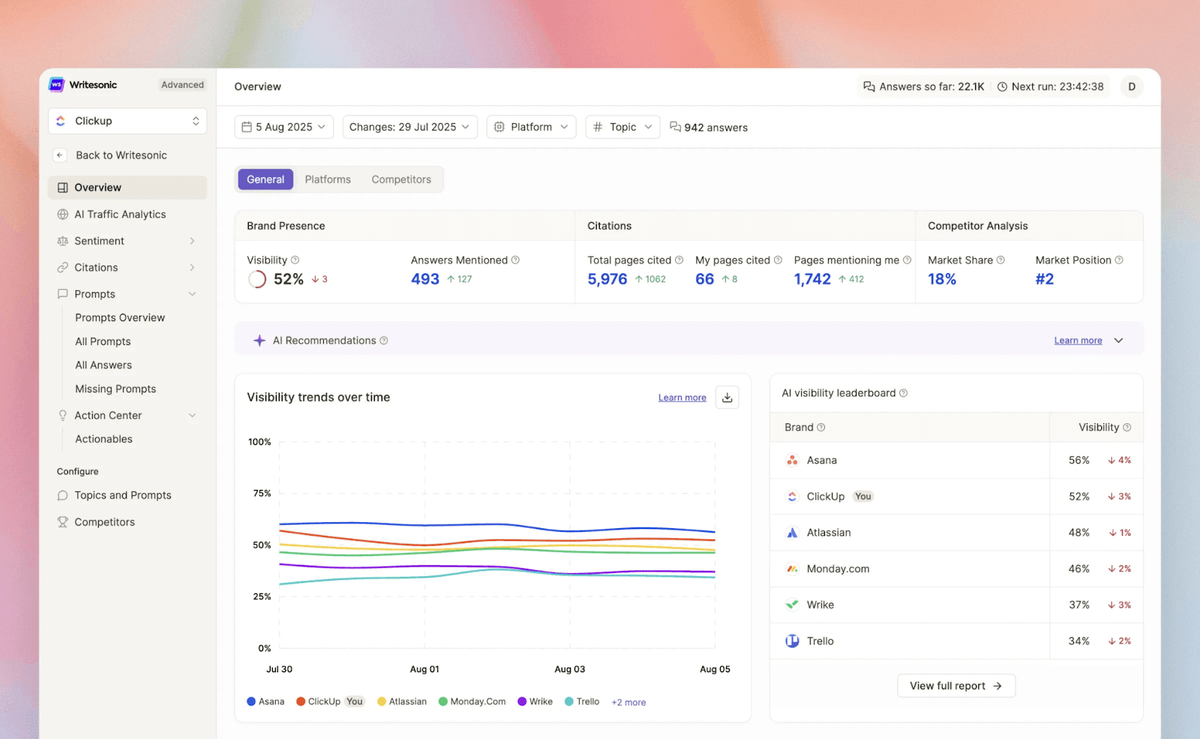
Writesonic AI overview showing multi-platform tracking and citation gap analysis.
Writesonic AI is an AI-powered platform that integrates traditional SEO with a layer of generative engine optimization. It allows brands to track their presence across major engines from one dashboard.
Key features:
- Multi-Platform Tracking monitors brand mentions and rankings across AI models
- Action Center identifies citation gaps and suggests ways to outrank competitors
- AI Crawler Analytics tracks bot visits
- Sentiment Analysis measures the tone of mentions
- Competitor Benchmarking compares visibility scores against rivals
Best for: Agencies and marketing teams who need GEO software to combine traditional visibility with AI search tracking.
Pricing: Standard: $99/month. Professional: $499/month. GEO features available in Professional plans and above. Free trial available.
Limitations:
- Complex and restrictive credit system
- Web-only access
- API-based data collection
6. Goodie AI
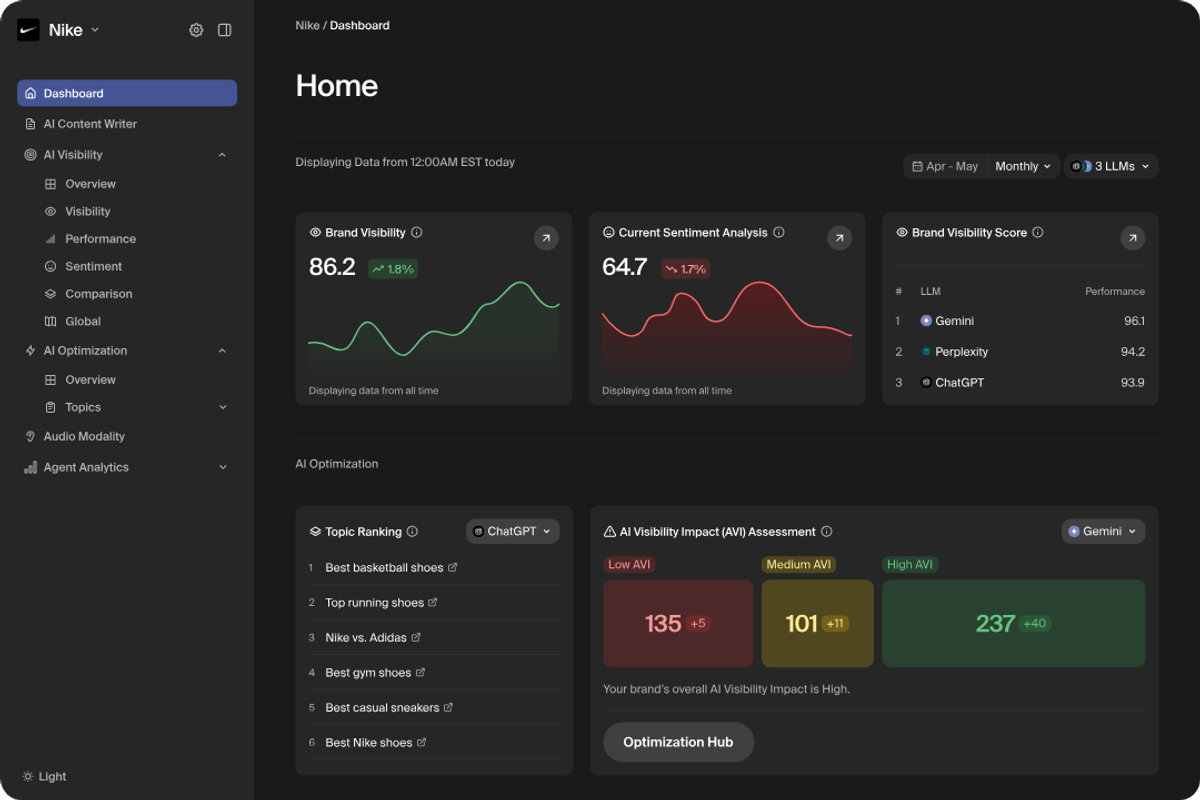
Goodie AI dashboard showing AI visibility monitoring and semantic optimization tools.
Goodie AI is a cloud-based generative engine optimization tool that monitors brand performance and global presence across AI search.
Key features:
- AI Visibility Monitoring tracks brand presence across AI platforms
- AI Optimization Hub suggests semantic content and schema tags
- Topic Explorer identifies content gaps and important themes
- AEO Content Writer drafts text designed for AI engines
- Agentic Commerce Optimizer monitors product visibility in shopping results
Best for: Growth teams and PR specialists that want semantic guidance and global coverage.
Pricing: Enterprise plans available only after a call. No publicly listed starting price. Previously offered self-serve plans, but pricing has been restructured to custom/enterprise-only.
Limitations:
- No publicly listed pricing
- Lacks tools like backlink crawlers or site audits
- API-based data collection
7. Peec AI
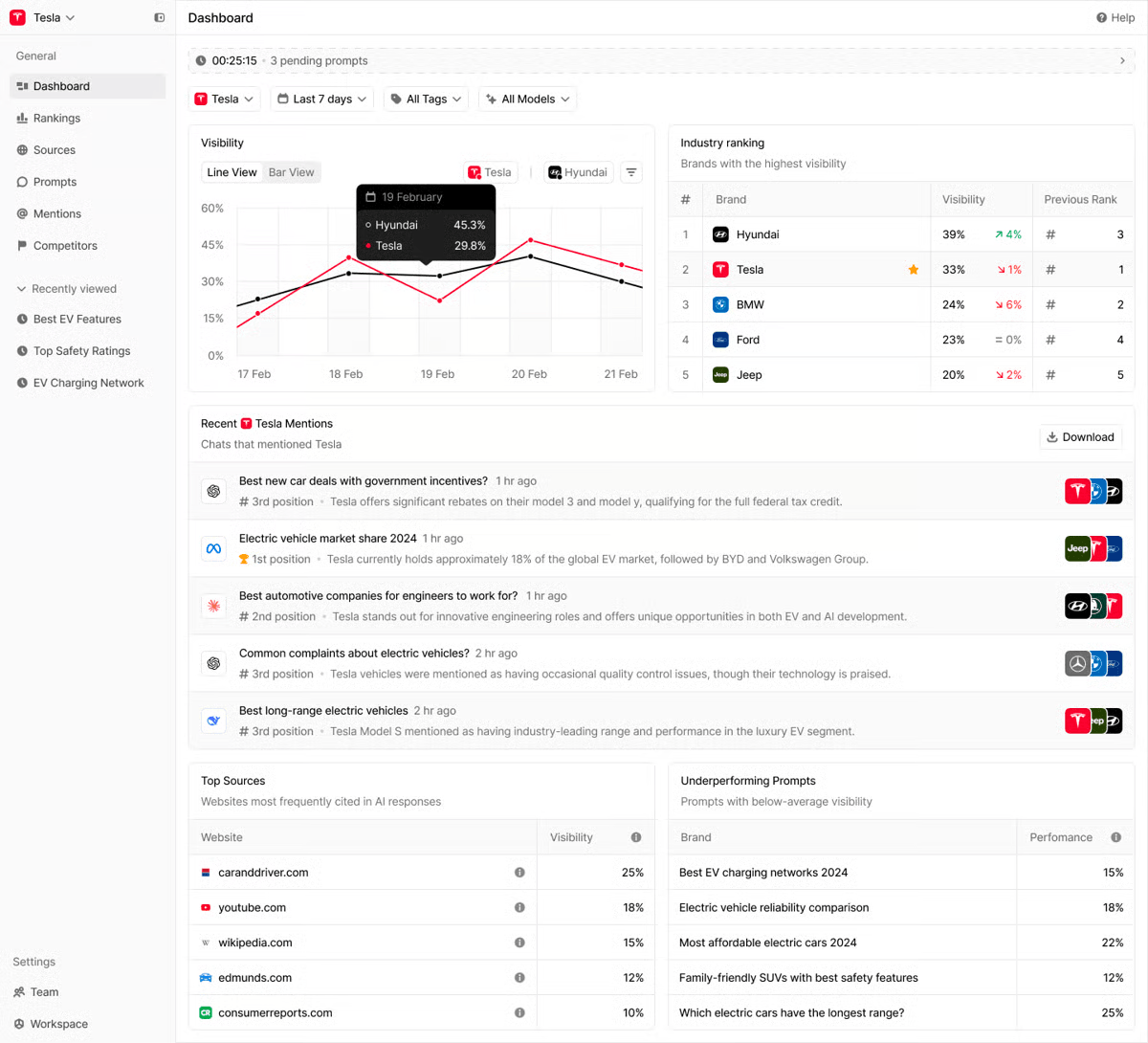
Peec AI dashboard showing prompt organization and daily AI visibility tracking.
Peec AI is a GEO analysis software that helps marketing teams track and analyze brand performance across AI models.
Users on G2 like how simple yet useful the tool is: "It's easy to use, setup is extremely fast, you get immediate insights, and you finally get some data to better understand where and how your brand is mentioned in LLMs."
Key features:
- Prompt Organization uncovers and organizes the queries most relevant to your AI search strategy
- Brand Ranking monitors your position against key competitors
- AI Model Selection tracks visibility across the models driving the most traffic
- Source Identification spots the specific citations influencing your search results
- Actionable Recommendations provides strategy insights
Best for: Marketing teams that need reliable multi-engine tracking with fast setup.
Pricing: Starter plan is €79 per month (50 tracked prompts). Pro plan costs €199 per month (100 prompts, adds Slack support). Annual billing provides a 15% discount. 7-day free trial and custom Enterprise plans available.
Limitations:
- Features like SSO and API access not yet available
- Lacks deep technical insights into why specific sources are selected
- Does not track traffic volume from LLMs
- API-based data collection
8. Profound AI
Profound AI dashboard showing visibility tracking and Conversation Explorer.
Profound AI is a GEO platform focused on enterprise-grade monitoring of brand mentions in AI-generated answers.
Users on G2 say, "I like how easy Profound is to use. The visibility tracking is particularly useful, allowing you to dig as deep as you see fit."
Key features:
- Visibility Dashboard tracks visibility score and compares your brand against competitors
- Conversation Explorer reveals real-time AI search volume data and identifies trending questions
- Multi-Platform Coverage across ChatGPT and additional engines on enterprise plans
- Prompt Designer for managing custom queries and automating workflows
- SOC 2 Type II security compliance with AWS and Cloudflare integrations
Best for: Marketing leaders at large-scale organizations and agencies managing high-profile clients.
Pricing: Starter plan is $99 per month (50 prompts, ChatGPT only). Growth plan costs $399 per month (100 prompts, 3 platforms). Enterprise pricing is custom and unlocks all engines. Annual billing includes a 17% discount.
Limitations:
- Most advanced features behind custom enterprise plans
- Data-heavy interface requires analysts to interpret results
- Lacks traditional tools (technical site audits, keyword research)
Future of GEO Tools: Predictions for 2026 and 2027
Search is changing fast. Users no longer type keywords into a search bar and visit many websites. They go directly to AI and ask questions. Conductor's benchmarks report found that 25.11% of Google searches now trigger AI Overviews, based on analysis of 21.9 million searches. This means brands must appear inside AI responses to stay relevant.
According to Semrush research, AI search traffic grew 527% year-over-year through late 2025, and Knotch data suggests that visitors referred by LLMs convert at roughly 2x the rate of traditional organic search visitors.
Here are some predictions about the future of GEO tools:
- Prompts and intent clusters will replace keywords as the primary unit of tracking
- Citation Rate will become the trust KPI, and Brand Visibility will become the reach KPI
- Tools will shift from dashboards into workflows, with agents, APIs, and MCP-style integrations
- Pre-publish simulation and benchmark testing will become standard
- GEO and SEO will merge operationally, with shared reporting and shared content templates
How to choose a GEO tool
- If you want accuracy, prioritize tools that capture answers from the live UI, not only API calls
- If you want scale, prioritize engine coverage, prompt volume limits, and data retention
- If you want adoption, prioritize exports, API access, and MCP support so GEO fits your existing reporting
- If you want business impact, look for AI traffic attribution, bot analytics, and competitor citation gap analysis
For a deeper look at how specific tools compare head-to-head, see our Superlines vs. Profound vs. Peec AI comparison and our guide to the best GEO analytics tools. You can also check our GEO checklist for a step-by-step optimization framework.
To summarize
There is no single best GEO platform for every company. The right choice depends on how mature your GEO practice is, how complex your stack looks and how deeply you want to connect AI visibility data into day-to-day workflows.
If you are just getting started, your first priority is a clear baseline for Brand Visibility and Citation Rate across a focused set of prompts in ChatGPT, Gemini, Perplexity and Google AI Mode. Any tool you choose should at least show where your brand appears today, which competitors dominate answers and which sources AI engines already trust in your category.
If you already run a 90-day GEO plan or follow a GEO maturity framework, look for platforms that go beyond static dashboards. The most useful GEO tools give you real answer data from AI interfaces, expose query fan-out and sources, support APIs or MCP servers and help you turn insights into concrete next steps for content, schema and third-party coverage.
Whichever platform you pick, treat AI Search visibility as a performance channel, not a side project. Review your AI KPIs alongside SEO and paid performance, refresh key pages regularly with original data and expert input, and keep testing how AI engines actually talk about your brand in live conversations.
Start Measuring Your Performance in AI Search
The future of search belongs to brands that understand how AI sees the web. If you track Brand Visibility and Citation Rate, then optimize your content around those insights, you will show up inside the answers your buyers actually read.
Superlines is your AI Search Intelligence platform that helps you measure and improve your AI Search visibility across platforms such as ChatGPT, Perplexity, Mistral, Google AI Mode, and Gemini, so you see where you appear today and where you can win next.
Start using Superlines today to measure and improve your AI visibility systematically!