


Does AI Search Optimization Replace Traditional SEO?
SEO has been the backbone of digital marketing for decades, helping businesses rank higher in search results and drive organic traffic. But with the rise of AI powered search engines like ChatGPT, Google Gemini and Perplexity, many marketers are asking a new question: Does AI Search optimization replace traditional SEO?
The scale of this shift is now measurable. As of early 2026, ChatGPT has surpassed 900 million weekly active users processing over 2.5 billion prompts daily. Perplexity handles 230+ million monthly searches. Google's share of the overall search market has declined from 91% in January 2024 to approximately 78% — with AI search platforms now handling 18–22% of informational queries. The GEO market itself has reached $1.09–1.48 billion, growing at a 34–45% CAGR. This is not a theoretical future — it is the current reality for every marketing team.
The short answer: No, but it does fundamentally changes the game from what we are used to. Traditional SEO remains important, but businesses need to now adapt their strategies to also optimize for AI-generated search results through Generative Engine Optimization (GEO). In other words, SEO isn’t going away, but it has a new AI-powered sidekick that demands attention. Forward-thinking marketers are treating AI Search as another channel for growth rather than a replacement for Google.
“Think AI Search as just a new channel where you can start driving growth.” –Hannes Jersenius, Growth Lead of Superlines
In this article, we break down the key differences between traditional SEO and AI Search optimization, and how to approach both in 2026 so your brand stays visible wherever people ask questions.
Will GEO Replace SEO?
Short answer: No, it won't. Traditional SEO is still needed, since GEO builds on top of that. It's also good to understand that SEO itself isn't enough anymore, since even the "traditional channels" such as Google is transforming fully into an AI-first channel.
The hype around GEO being something revolutionary, or the fear that AI Search will replace traditional search altogether, has marketers scrambling for answers. That’s where this myth comes from.
But here’s what’s actually happening: AI Search is growing as a complementary discovery channel to traditional search, not a replacement.
People still use Google to find websites, compare options, and click through to content. What’s changed is that some of those searches now start with ChatGPT or Perplexity instead.
People discover brands through conversations with AI, then use traditional search engines to research more. The underlying behavior (seeking information and solutions) remains the same.
The search data also shows the same: interest in “GEO” and “AEO” has spiked as marketers recognize AI Search as a new touchpoint.
But SEO still dominates search volume by a wide margin, which tells us marketers aren’t abandoning traditional search or SEO. Instead, they’re expanding their strategies to cover both.
Google is an AI Search channel too
When people hear GEO, they often think only about assistants like ChatGPT or Perplexity. In reality, Google itself has become an AI Search surface through AI Overviews and AI Mode. High-volume AI experiences such as Google AI Overviews and AI Mode sit in Layer 2 of AI Search, where visibility is only as fast as your SEO and site indexing allow.
For many informational and research queries, the main user experience is now an AI generated answer at the top of the page, with traditional results pushed down or ignored.
The same GEO work that helps you appear in chatbot answers also helps you get cited inside these Google AI surfaces, because they rely on structured, machine readable content and clear sources in exactly the same way.
Recent studies around Google AI Mode show how strongly user attention is shifting inside AI generated answers:
- Around 93% of AI Mode searches end without a click. This is more than twice the rate of AI Overviews, where 43% result in zero clicks. (Semrush, September 2025)
- Users spend roughly double the time in AI Mode compared to AI Overviews, 49 seconds vs 21 seconds on average. (Growth Memo, October 2025)
- The median time spent on different tasks in AI Mode is 77 seconds for comparing brands or products, 71 seconds for learning information, and 52 seconds for choosing or purchasing products. (Growth Memo, October 2025)
- In 75% of AI Mode sessions, users never leave the pane, which means most AI Mode sessions end without external visits. (Growth Memo, October 2025)
- Clicks in AI Mode are mostly reserved for transactions, rather than exploratory research. (Growth Memo, October 2025)
How Traditional SEO Works
Traditional search engines like Google and Bing rely on algorithms to crawl, index, and rank web pages based on several factors:
•Keywords and Search Intent – Matching page content to the terms and intent users search for.
•Backlinks and Domain Authority – Prioritizing content from trusted sources (quality and quantity of other sites linking to you).
•On-Page SEO Factors – Optimizing titles, meta descriptions, headings, and using structured data (schema) to help search engines understand your content.
•User Engagement Metrics – Measuring how users interact (click-through rates, bounce rates, time on site) as signals of content quality.
Businesses have refined these tactics to climb the Search Engine Results Pages (SERPs) and attract organic traffic. Traditional SEO is about getting to the top of Google’s results. But AI-powered search doesn’t work the same way.
How AI Search Engines Are Changing SEO
AI Search changes how content is consumed in three main ways:
•Answers Instead of Links: A classic Google search might show 10 blue links for “best marketing automation tools.” An AI Search might give you a spoken or written answer: e.g. “The top marketing automation tools are X, Y, and Z, each with these features…” – all within the chat interface. The AI might cite or list sources in small print, but the user gets the answer without clicking through to each provider’s website.
•Different Citation and Credit: AI engines cite sources differently (if at all). Some AI chat tools provide reference links, but others may just give an answer sourced from many places. Your content could be used in an answer and the user might never realize it came from your site.
Example: A user searches on Google for “best marketing automation software” and gets a list of results (you’d better hope your blog post is #1). The same user asks ChatGPT the same question and gets a conversational answer like “Based on expert reviews, the best marketing automation tools include HubSpot, Marketo, and ActiveCampaign…” The AI’s response might mention those brands (possibly drawn from various articles or reviews) without the user visiting any single website.
The impact: This AI-driven approach dramatically reduces direct website traffic from search engines. Users get what they need in one go. Bain & Company found that about 80% of consumers now rely on these “zero-click” AI results for at least 40% of their searches, which has already reduced organic web traffic by an estimated 15–25%. In short, people are clicking fewer links because the answer is already served up. For businesses, that means it’s not enough to rank #1 on Google – you also need to be part of the answer when the AI responds.
AI Search Optimization vs. Traditional SEO: Key Differences
GEO isn’t a completely new playbook written from scratch – it inherits a lot of SEO’s DNA. Here are several ways Generative Engine Optimization is like traditional SEO:
- Visibility & Traffic Goals: Both GEO and SEO ultimately aim to increase the visibility of your content online and attract more targeted audience attention. The end goal is the same: get your brand in front of people searching for something you offer.
- Keyword & Content Strategy: Just as with SEO, GEO relies on understanding what topics, questions, and keywords your audience is searching for, and then creating high-quality, relevant content to match those queries. In both cases, doing solid research on search queries (whether they’re typed into Google or spoken to an AI assistant) is foundational.
- User Experience Focus: Both SEO and GEO reward content that delivers a good user experience. That means easy-to-read, well-structured content that answers real user needs. If your content is engaging and genuinely helpful to a human reader, it’s more likely to be favored by Google’s algorithm—and also to be understood and used by AI models in their responses.
For the past couple of years, we’ve seen too much thin content written “for the algorithm.” But that approach won’t cut it anymore. Today, you should be writing for humans—because AI now reads and evaluates content like a human. And when it finds high-quality, conversational content that clearly answers a question, it’s far more likely to use that content in its responses. Sure, technical best practices and formatting still matter. But the main focus should be creating useful, well-articulated content that directly addresses the questions your audience is asking.
- Technical Foundations: The technical best practices of SEO also support GEO. Fast load times, mobile-friendliness, clean site architecture, and structured data (schema) all help traditional search engines crawl your site—and they help AI algorithms parse and understand your content just as effectively. Ensuring your content is machine-readable and well-formatted benefits both search bots and AI systems alike. If you want to go deeper on how to structure content specifically for AI-driven results, I’ve written a full guide on how to optimize for generative AI. I highly recommend giving it a read. It breaks down the tactical and strategic moves that can boost your AI visibility today.
- Authority & Trust: Building credibility is crucial in both realms. SEO has long emphasized earning backlinks and demonstrating E-E-A-T (Experience, Expertise, Authoritativeness, Trustworthiness) to climb rankings. Similarly, AI engines favor information from sources they perceive as trustworthy. If your brand is consistently mentioned by reputable websites or backed by expert content, that trust carries over into both Google’s results and AI-generated answers.
Here’s where it gets interesting and opens a real window for smaller players in the AI Search space. You don’t need to be a household name to show up in ChatGPT’s or Perplexity’s answers. Instead, you should double down on creating high-quality content around your niche topics.
That alone can begin building your credibility in the eyes of AI models. And don’t stop at just your website, share your insights across the broader web: LinkedIn, Quora, Reddit, Medium, industry forums. These platforms are not just for people anymore; RAG-based AI engines actively pull information from them when generating responses.
The more your voice appears in relevant, trusted places, the more likely an AI is to recognize and cite your content. At Superlines, we call this MSO – Multi-Source Optimization. It’s the practice of ensuring your brand’s presence, expertise, and insights are distributed across multiple authoritative sources, not just for SEO, but to influence how AI models perceive and surface your brand. Every marketing team should start incorporating MSO into their strategy right now.
My advice to you: Start now, even if you’re small. AI rewards consistent, credible content across the web. If you become the go-to voice on your niche topic, the AI will notice and start including you in its answers that leads to more high-intent traffic and revenue.
- Continuous Adaptation: Both SEO and GEO require ongoing effort and adaptation. Google updates its search algorithms regularly, and in the AI world, models like GPT, Gemini, Perplexity, Claude, and Gemini also evolve—frequently changing how they interpret and prioritize content. Marketers need to continuously monitor performance and adapt strategies as these models shift. Neither SEO nor GEO is a “set it and forget it” game—they’re ongoing processes of refinement. And especially in the case of GEO, things are moving fast. That’s why it’s critical to stay up to date on your current visibility across AI platforms—and improve it just like you would with traditional SEO.
To summarize: GEO and SEO share the same purpose (more visibility) and many of the same best practices – creating quality content, optimizing for relevant keywords, providing a good user experience, and building authority. If you’re already doing good SEO, you’ve laid much of the groundwork for GEO!
How GEO Differs from SEO
Why SEO tactics do not fully translate
Keyword density barely matters for GEO. AI engines understand semantic meaning and context far better than traditional search algorithms. Stuffing your content with exact match keywords will not help you get cited.
Meta descriptions and title tags still matter for SEO, but AI engines often ignore them when they evaluate content quality. They are reading your actual content, not just your metadata.
User behavior signals like bounce rate and time on page do not apply in the same way. When an AI cites your content, the user might never visit your site, yet you still achieved the GEO goal of being recognized as an authority.
Link building remains valuable, but for different reasons. Backlinks help establish authority signals that AI engines consider when they evaluate source credibility, but they do not create classic “link juice” in the way they do for traditional rankings.
While GEO builds on SEO fundamentals, it also introduces new dynamics and challenges. Optimizing for an AI generated answer is not identical to optimizing for a Google results page.
Search results vs direct answers
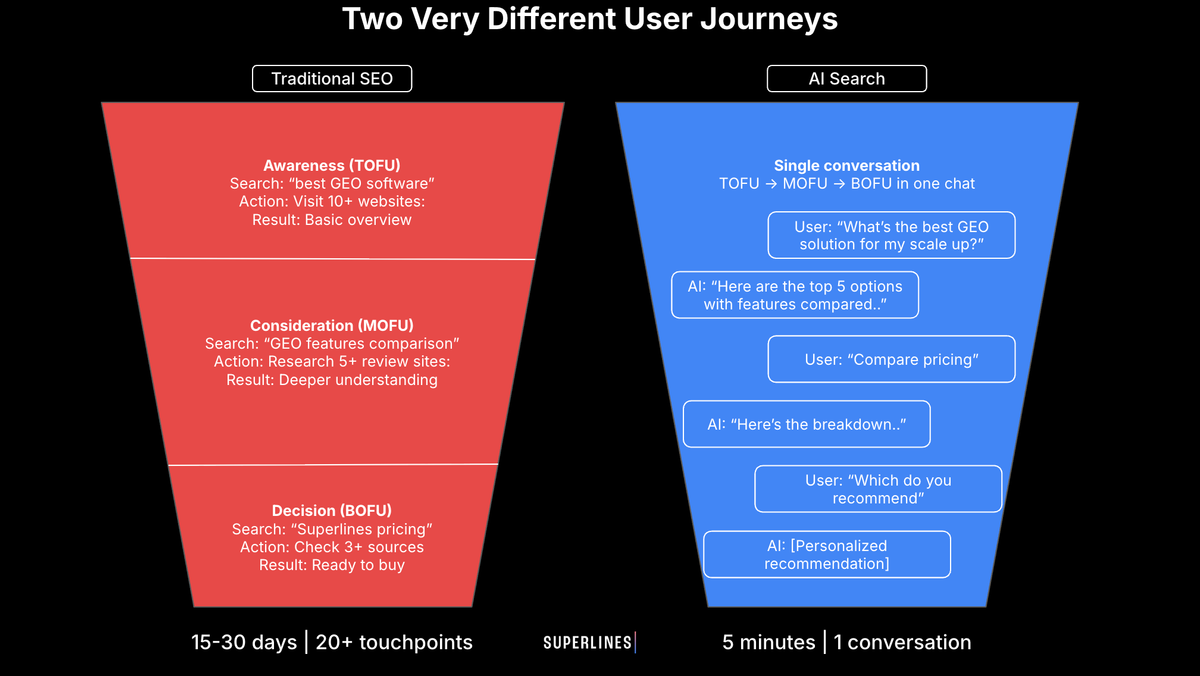
Traditional SEO is about earning one of the ten blue links on a search engine results page. In contrast, GEO is about getting your content woven into a single AI generated answer or conversation.
In SEO you fight to be the result. In GEO you aim to be part of the result.
An AI like Bing Chat or ChatGPT does not present a long list of links, it synthesizes an answer from multiple sources. Instead of asking “How do I rank number one?”, GEO marketers ask “How do I get included in what the AI says?”
One winner vs many sources
On Google, one page can “win” a query and take the top position. In an AI answer, many sources can win at the same time. The model often pulls information from several articles, tools, reviews, and forums.
No single website wins outright. Your GEO strategy cannot rely on one hero page that dominates. You need a presence across the information ecosystem.
If someone asks an AI “What are the best 4K TVs for a small living room?”, the model might compile its answer from multiple buying guides and discussion threads. If your brand or your content is missing from those sources, you are simply not in the answer at all.
Keywords vs natural language
SEO has traditionally been about targeting specific keywords and phrases that users type into a box. Generative AI understands context and natural language much more deeply. It is not looking for an exact match, it is looking for content that semantically answers the question.
This means GEO is less about keyword density and more about covering topics in a way an AI can easily interpret.
An SEO minded blog post might focus on the keyword “email marketing best practices”. A GEO optimized version will make sure it directly answers questions like “What are the best practices for email marketing in 2026?” in a clear, self contained way.
The content should be written in a conversational, Q and A style so an AI can lift a paragraph and use it as a complete answer.
Click traffic vs zero click answers
With SEO, success usually means a user clicks through to your website from the search results. With AI answers, the assistant might give the user everything they need without a single click.
That means you can get brand exposure in an answer without getting a visit to your site. It is a double edged sword: the user hears your brand mentioned, which is good for awareness, but you might not see that reflected as direct traffic.
This is the old “zero click search” phenomenon turned up to eleven. Users receive an AI generated summary that often bypasses websites entirely. Marketers have to adjust their expectations and metrics. In GEO the mention itself can be valuable, even when the click does not follow immediately.
GEO differs from SEO in how results are delivered and what “success” looks like. Instead of climbing a ranking ladder, you’re aiming to be included in AI-driven answers. That means optimizing content for direct answers, spreading your expertise across the web, and adjusting how you measure impact. The core principle—provide valuable, authoritative information—remains, but the context in which that information is found and presented is new. A welcome change where quality matters again instead of spammy thin content made for algorithms only.
What are the three layers of AI Search and how fast are they?
AI Search can potentially produce faster results than traditional SEO but the reality is of course nuanced. AI Search operates on three distinct layers, each with its own speed dynamics:
Layer 1: Training data (the slowest layer)
This is where LLMs learn about your brand during their training process. It's the slowest layer, but not as slow as you might think. Based on Superlines research, we're seeing bots visiting sites almost every other day, suggesting they might be fine-tuning parts of their models quite rapidly. Still, getting into the base training data of major LLMs can take months.
Layer 2: High-volume AI Search (speed depends on your SEO)
This includes free ChatGPT, Google's AI Overviews, and similar tools or interfaces that rely heavily on existing search engine indexes. Here's the key insight: this layer is only as fast as your SEO is good.
If you have strong domain authority and consistently publish quality content, your visibility can improve rapidly. Potentially faster than traditional SEO because AI engines can surface your content in synthesized answers immediately after indexing. If your SEO fundamentals are weak, this layer can be just as slow as traditional search optimization. The speed advantage comes from understanding the connection between prompts, query fan-outs, and how your content addresses both.
Layer 3: Agentic AI (real-time & lightning fast)
This is where things get really interesting. Pro and advanced tools like Perplexity Pro, ChatGPT's Research and Shopping Assistant, and Claude Desktop with MCPs (Model Context Protocols) actually scrape and read your pages in real-time. These agents are intelligent, autonomous, and fast. Usage is growing rapidly, and this is where we're heading into true "agentic shopping" territory.
To summarize: AI Search isn't inherently faster than SEO but it's built on top of SEO infrastructure for high-volume queries. The speed advantage exists primarily in Layer 3 (agentic tools) and potentially in Layer 2 if your SEO is already strong.
How to Optimize for Both SEO and AI Search
To stay ahead, you’ll want to adjust your content strategy to serve two masters: the traditional search engines and the new AI answer engines. Fortunately, many SEO fundamentals still help with AI, but there are additional steps to take. Here’s how to optimize for both:
1.Structure Content for AI Models and Search Engines – Good structure is universal. Use clear headings and subheadings (H2s, H3s) and break up content with bullet points or numbered steps. This not only helps human readers scan, but also helps AI models parse your content. Consider adding FAQ sections, concise summaries, or “key takeaways” boxes in your articles.
An AI is more likely to quote or cite text that is already in a neat, digestible format (e.g. a list of tips or a definition in bold). The easier you make it for an AI to grab the answer, the more likely your content will be featured.
2.Implement Schema Markup and AI-Friendly Metadata – Schema markup (structured data) is like secret sauce for helping algorithms understand the context of your content. Adding Schema.org markup for FAQs, How-tos, Organization info, Products, etc., can boost your chances in both regular and AI Search. For example, FAQ schema on a page might make Google show those FAQs in search results and make it easy for an AI to identify Q&A pairs to learn from. Also pay attention to metadata that might not have mattered before: ensure your open graph and meta descriptions are clear (AI tools pulling URLs might use those), and even experiment with new meta tags that some AI crawlers might look for (as standards evolve).
In short, speak the language of machines by structuring your data – it helps Google today and will help AI models ingest your content accurately.
3.Track AI Search Visibility – You can’t optimize what you don’t measure. Just as you track your Google rankings and organic traffic, start tracking how your brand appears in AI-generated answers. Regularly test prompts on ChatGPT, Bing, Gemini, and emerging AI Search tools to see if and how your content is mentioned. Better yet, use dedicated AI Search tracking tools (for example, Superlines’ AI Search Tracker) that show where your content is being cited in AI outputs.
This kind of report can be eye-opening: it will reveal queries where competitors are getting named by the AI but you aren’t. Those gaps are opportunities to create content or optimizations so you do get mentioned next time. Tracking AI visibility over time also lets you gauge the impact of your GEO efforts (e.g. “We updated our FAQ page and now ChatGPT is citing it for relevant questions!”).
4.Optimize Content for AI Queries and Intent – Start publishing content that specifically addresses the kinds of questions users are asking AI. This might differ slightly from your usual SEO keyword research. Think about conversational queries or complex questions that someone might pose to ChatGPT or a voice assistant. For instance, instead of just a blog titled “Benefits of CRM software,” you might create one titled “What’s the best CRM for a mid-sized e-commerce business?” or “How to choose a CRM in 2026” – phrased like a question someone might ask an AI. Within that content, answer the question directly and succinctly (so an AI can lift the answer), then elaborate. Focus on high-intent, informational queries.
Additionally, aim to get your brand and content into AI-friendly sources. That includes being cited on Wikipedia pages, getting mentioned in industry reports or reputable blogs, or even publishing your own research with data. These are sources LLMs are likely to train on or reference. The more the AI sees your brand associated with authoritative information, the better your chances of appearing in answers.
Pro tip: Don’t neglect optimizing your existing content as well. You can update top-performing SEO pages to be more AI-friendly by adding a brief summary or Q&A section at the top. For example, start an article with a “In a nutshell” summary in 2-3 sentences – perfect for an AI to grab. Many companies are now doing content refreshes with AI in mind, not just Google.
SEO & AI Search Optimization Must Work Together
Traditional SEO isn’t dead – but businesses that only focus on Google rankings will miss out on a growing share of voice in search. To stay competitive in the age of AI, brands should combine their classic SEO tactics with AI Search optimization (GEO) to maximize visibility across all platforms. Think of it like covering both search boxes: the one where users hit “enter” and the one where they ask an AI assistant.
The marketing leaders who master this balancing act stand to reap big rewards. Early movers in GEO are already seeing small but meaningful traffic streams from AI referrals – often highly qualified visitors who trust the AI’s recommendation. And as AI adoption in search skyrockets, those trickles could turn into streams. In short, this isn’t about choosing SEO vs. AI. It’s about integrating AI into your SEO.
The future of search is hybrid. Companies that maintain their traditional SEO and optimize for generative AI will be the ones visible everywhere – whether a customer is scrolling Google at 8am, or asking Alexa or ChatGPT for advice at midnight. So, build your content strategy to win on both fronts. Your goal should be simple: when someone searches – on any platform, by typing or talking – your brand is there with the answer.
How Superlines helps you do AI Search Optimization
Superlines is a full-stack AI Search Intelligence platform that gives you analytics, content generation, and agentic workflows in one place:
Tracks brand mentions and citations across engines
- Monitors how often your brand and competitors are mentioned in answers in ChatGPT, Gemini, Perplexity, Claude, Copilot and others, and turns that into Brand Visibility, Citation Frequency and AI Share of Voice metrics.
Captures real interface answers, not only API calls
- Superlines analyzes what users actually see in the UI, including full answers and citation lists, so you are not relying on sampled or synthetic API responses.
Shows which sources and prompts drive your visibility
- For each answer, you see which URLs and domains the AI used, how often it chose competitors instead of you, and how query fan out keywords map to your existing content.
Creates AEO-optimized content from visibility data
- The built-in Article Generator produces AEO-optimized articles informed by your citation gaps and visibility insights. The Schema Optimizer structures your existing pages with the right markup for AI discoverability. And the Superlines Agent lets you ask questions like "Where did we lose visibility this week?" or "Which pages should we update first for Gemini?" and returns with instructions grounded in live data.
Supports modern agentic workflows via MCP
- With the Superlines MCP server, your team can pull live AI Search data directly into your favorite AI assistants, combine it with other sources, and drive content and SEO decisions without logging into another dashboard.
Connects AI visibility to traffic and behavior
- A universal, privacy friendly tracking pixel lets you see AI bot visits and human visits side by side at URL level. You can spot which pages agents are reading, which ones actually receive human traffic, and where there is a mismatch.
Tells you which actions to take
- Superlines’ agents analyze your visibility data on your behalf and create concrete actions on a weekly basis in the Superlines Action Center. These actions relate to opportunities such as creating new content, optimizing existing content, engaging in discussions on UGC forums like Reddit or Quora, media outreach, and technical optimization.
Together, this gives marketing, SEO, PR and growth teams a single place to:
- See how visible the brand is in AI answers today
- Understand why competitors might be ahead
- Decide which pages, topics and sources to fix next
- Measure the effect of each optimization on real AI answers over time
- The exact actions you need to take to improve visibility based on the visibility data
For deeper dives on specific topics covered in this article, explore: Ghost Citations: Why 73% of AI Citations Are Invisible (understanding the gap between mentions and citations), How to Optimize for Generative AI (practical GEO playbook), Agentic Content Strategy for AEO (building automated content pipelines), and How Big is the GEO Market? (market size and growth data).
Get started today with Superlines. A GEO platform that doesn’t just show you data, but also tells you which concrete actions to take to improve your AI visibility!