


Is GEO Like SEO?
Short answer: GEO is not a replacement for SEO. It builds on many of the same fundamentals, but instead of only chasing rankings in classic search results, it focuses on how often AI systems like ChatGPT, Gemini, and Perplexity cite your brand inside their answers.
Generative Engine Optimization (GEO) shares the same ultimate goal as traditional SEO, boosting your brand visibility in search, but it targets AI driven search engines instead of just human oriented search algorithms. GEO is essentially SEO for the AI era: the fundamentals still apply, but the tactics expand so that AI systems such as ChatGPT, Perplexity, Google AI Mode and Google AI Overview can recognize and cite your content in their answers. In short, GEO is like SEO in spirit, with key differences in how you optimize and measure success.
Optimizing for AI search is a hot topic among marketers right now. Some insist AI search is fundamentally different, a new channel that demands dedicated strategies, fresh frameworks, and yes, an entirely new acronym: GEO (Generative Engine Optimization) or AEO (Answer Engine Optimization). Others argue that AI search does not warrant anything new at all, “it is all just SEO.”
Here at Superlines, we have been settling this debate by studying the data. Superlines is a GEO / AI Search analytics platform that tracks and helps you improve AI brand visibility, AI citation rate, and AI share of voice across platforms like ChatGPT, Gemini, Perplexity, Claude, and Mistral. We have analyzed more than a million AI generated answers to understand what actually influences visibility. Our conclusion: it is a bit of both. A lot of what makes you visible in AI search overlaps with SEO, but you cannot get away with doing only SEO. AI search also requires new strategies that traditional optimization never had to account for, the set of practices many now call GEO.
But how different is it, really, from the traditional optimization tactics we know? We’ll break that down.
Now that you have the snapshot, let us look at how AI search is changing real user behavior behind those numbers.
How AI Search is changing consumer behavior
Generative AI is reshaping how people search for information. By 2025, AI layers were already showing up in a large share of Google results, and AI chat usage jumped from around 14% to nearly 30% in just six months. Today, in 2026, AI surfaces like Google AI Overviews and AI Mode, ChatGPT, Gemini and Perplexity are part of everyday research behavior, with well over a third of adults in many markets using at least one AI assistant every month.
As I’ve said before, many consumers don’t even realize they’re using AI-powered search, as these capabilities are quietly integrated into existing apps, interfaces, and devices, all powered by foundational models.
For instance, Apple and Google have partnered to roll out Gemini as the LLM powering search features and Siri on Apple devices. This shift has marketers asking: Is optimizing for AI Search, sometimes called GEO, the same as doing SEO?
What is GEO and SEO?
Generative Engine Optimization (GEO) is the practice of optimizing your content and brand so AI-powered search engines like ChatGPT, Gemini, and Perplexity reference or cite you within their answers.
In contrast, Search Engine Optimization (SEO) is about optimizing your content to rank higher in traditional search engine results.
Now, there are enough people debating whether to call it GEO, AEO, LLMO, AI SEO or just SEO. But the acronym doesn’t really matter as long as you understand you are optimizing content for AI Search as well.
When SEO first emerged, we didn’t talk about “traditional search” or “alternative ways of searching.” SEO simply meant optimizing for how people found information. In that sense, optimizing for AI Search today is still SEO, because SEO has always evolved with how discovery works.
The industry didn’t split “desktop SEO” and “mobile SEO” into separate disciplines; mobile was just the next evolution of search. The same principle applies here.
But for simplicity, and to distinguish how AI Search surfaces content differently, we’ll stick with GEO.
That brings us to the burning topic.
Will GEO Replace SEO?
Short answer: No, it won't.
The hype around GEO being something revolutionary, or the fear that AI Search will replace traditional search altogether, has marketers scrambling for answers. That’s where this myth comes from.
But here’s what’s actually happening: AI Search is growing as a complementary discovery channel to traditional search, not a replacement.
People still use Google to find websites, compare options, and click through to content. What’s changed is that some of those searches now start with ChatGPT or Perplexity instead.
People discover brands through conversations with AI, then use traditional search engines to research more. The underlying behavior (seeking information and solutions) remains the same.
The search data also shows the same: interest in “GEO” and “AEO” has spiked as marketers recognize AI search as a new touchpoint.
SEO still dominates total search volume by a wide margin, which shows that marketers aren’t abandoning traditional search, they’re expanding their strategies to cover both.
By traditional search, we mainly refer to platforms like Google and Bing. However, these channels are no longer truly “traditional”, they are rapidly becoming AI-first experiences.
Think about your own behavior. When was the last time you scrolled all the way to organic results in Google? Today, searches are often led by AI Overviews, followed by sponsored results, with organic listings pushed further down. In many cases, users are even guided toward AI-first experiences like Google AI Mode from the start.
This is why we increasingly consider Google an AI Search channel. Looking ahead, AI Mode is likely to become the default search experience.
Lets dive deeper into that topic shortly, but lets look at how the user journeys differ between traditional search and AI Search.
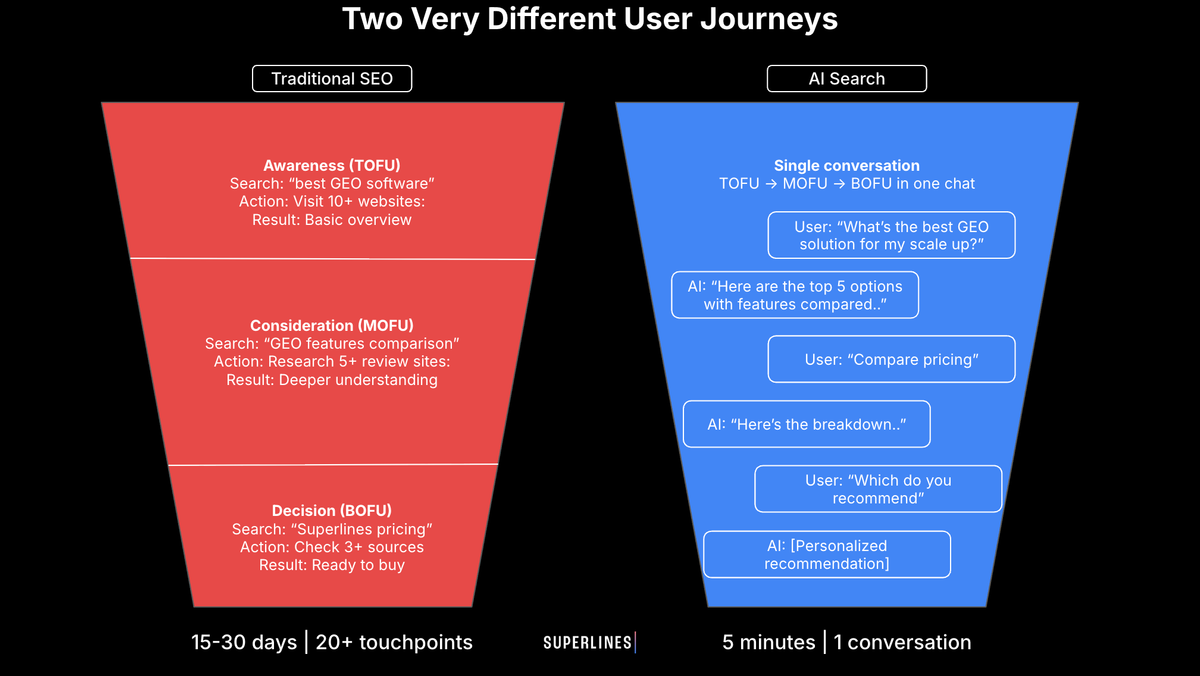
Google is an AI Search channel too
When people hear GEO, they often think only about assistants like ChatGPT or Perplexity. In reality (and as mentioned earlier), Google itself has become an AI Search surface through AI Overviews and AI Mode. High-volume AI experiences such as Google AI Overviews and AI Mode sit in Layer 2 of AI Search, where visibility is only as fast as your SEO and site indexing allow. For many informational and research queries, the main user experience is now an AI generated answer at the top of the page, with traditional results pushed down or ignored.
The same GEO work that helps you appear in chatbot answers also helps you get cited inside these Google AI surfaces, because they rely on structured, machine readable content and clear sources in exactly the same way.
Recent studies around Google AI Mode show how strongly user attention is shifting inside AI generated answers:
- Around 93% of AI Mode searches end without a click. This is more than twice the rate of AI Overviews, where 43% result in zero clicks. (Semrush, September 2025)
-AI visitors spend 68% more time on websites than traditional search visitors (SE Ranking, 2026).
-68.94% of websites now receive some AI traffic (SE Ranking, 2026).
- Users spend roughly double the time in AI Mode compared to AI Overviews, 49 seconds vs 21 seconds on average. (Growth Memo, October 2025)
- The median time spent on different tasks in AI Mode is 77 seconds for comparing brands or products, 71 seconds for learning information, and 52 seconds for choosing or purchasing products. (Growth Memo, October 2025)
- In 75% of AI Mode sessions, users never leave the pane, which means most AI Mode sessions end without external visits. (Growth Memo, October 2025)
- Clicks in AI Mode are mostly reserved for transactions, rather than exploratory research. (Growth Memo, October 2025)
How GEO is Similar to SEO
GEO isn’t a completely new playbook written from scratch – it inherits a lot of SEO’s DNA. Here are several ways Generative Engine Optimization is like traditional SEO:
- Visibility & Traffic Goals: Both GEO and SEO ultimately aim to increase the visibility of your content online and attract more targeted audience attention . The end goal is the same: get your brand in front of people searching for something you offer.
- Keyword & Content Strategy: Just as with SEO, GEO relies on understanding what topics, questions, and keywords your audience is searching for, and then creating high-quality, relevant content to match those queries. In both cases, doing solid research on search queries (whether they’re typed into Google or spoken to an AI assistant) is foundational.
- User Experience Focus: Both SEO and GEO reward content that delivers a good user experience. That means easy-to-read, well-structured content that answers real user needs. If your content is engaging and genuinely helpful to a human reader, it’s more likely to be favored by Google’s algorithm and also to be understood and used by AI models in their responses.
For the past couple of years, we’ve seen too much thin content written “for the algorithm.” But that approach won’t cut it anymore. Today, you should be writing for humans, because AI now reads and evaluates content like a human. And when it finds high-quality, conversational content that clearly answers a question, it’s far more likely to use that content in its responses. Sure, technical best practices and formatting still matter. But the main focus should be creating useful, well-articulated content that directly addresses the questions your audience is asking.
- Technical Foundations: The technical best practices of SEO also support GEO. Fast load times, mobile-friendliness, clean site architecture, and structured data (schema) all help traditional search engines crawl your site—and they help AI algorithms parse and understand your content just as effectively. Ensuring your content is machine-readable and well-formatted benefits both search bots and AI systems alike.
If you want to go deeper on how to structure content specifically for AI-driven results, I’ve written a full guide on how to optimize for generative AI, I highly recommend giving it a read. It breaks down the tactical and strategic moves that can boost your AI visibility today. - Authority & Trust: Building credibility is crucial in both realms. SEO has long emphasized earning backlinks and demonstrating E-E-A-T (Experience, Expertise, Authoritativeness, Trustworthiness) to climb rankings. Similarly, AI engines favor information from sources they perceive as trustworthy. If your brand is consistently mentioned by reputable websites or backed by expert content, that trust carries over into both Google’s results and AI-generated answers.
Here’s where it gets interesting, this opens a real window for smaller players in the AI search space. You don’t need to be a household name to show up in ChatGPT’s or Perplexity’s answers. Instead, you should double down on creating high-quality content around your niche topics. That alone can begin building your credibility in the eyes of AI models. And don’t stop at just your website, share your insights across the broader web: LinkedIn, Quora, Reddit, Medium, industry forums. These platforms are not just for people anymore, RAG-based AI engines actively pull information from them when generating responses.
The more your voice appears in relevant, trusted places, the more likely an AI is to recognize and cite your content. At Superlines, we call this MSO – Multi-Source Optimization. It’s the practice of ensuring your brand’s presence, expertise, and insights are distributed across multiple authoritative sources, not just for SEO, but to influence how AI models perceive and surface your brand. Every marketing team should start incorporating MSO into their strategy right now.
My advice to you: Start now, even if you’re small. AI rewards consistent, credible content across the web. If you become the go-to voice on your niche topic, the AI will notice, and start including you in its answers that leads to more high-intent traffic and revenue. - Continuous Adaptation: Both SEO and GEO require ongoing effort and adaptation. Google updates its search algorithms regularly, and in the AI world, models like GPT, Mistral, Perplexity, Claude, and Gemini also evolve, frequently changing how they interpret and prioritize content. Marketers need to continuously monitor performance and adapt strategies as these models shift.
Neither SEO nor GEO is a “set it and forget it” game, they’re ongoing processes of refinement. And especially in the case of GEO, things are moving fast. That’s why it’s critical to stay up to date on your current visibility across AI platforms, and improve it just like you would with traditional SEO.
To summarize: GEO and SEO share the same purpose (more visibility) and many of the same best practices, creating quality content, optimizing for relevant keywords, providing a good user experience, and building authority. If you’re already doing good SEO, you’ve laid much of the groundwork for GEO!
How GEO Differs from SEO
Why SEO tactics do not fully translate
Keyword density barely matters for GEO. AI engines understand semantic meaning and context far better than traditional search algorithms. Stuffing your content with exact match keywords will not help you get cited.
Meta descriptions and title tags still matter for SEO, but AI engines often ignore them when they evaluate content quality. They are reading your actual content, not just your metadata.
User behavior signals like bounce rate and time on page do not apply in the same way. When an AI cites your content, the user might never visit your site, yet you still achieved the GEO goal of being recognized as an authority.
Link building remains valuable, but for different reasons. Backlinks help establish authority signals that AI engines consider when they evaluate source credibility, but they do not create classic “link juice” in the way they do for traditional rankings.
While GEO builds on SEO fundamentals, it also introduces new dynamics and challenges. Optimizing for an AI generated answer is not identical to optimizing for a Google results page.
Here you can see how 3 different LLMs prioritize different aspects of your content:
Search results vs direct answers
Traditional SEO is about earning one of the ten blue links on a search engine results page. In contrast, GEO is about getting your content woven into a single AI generated answer or conversation.
In SEO you fight to be the result. In GEO you aim to be part of the result.
An AI like Bing Chat or ChatGPT does not present a long list of links, it synthesizes an answer from multiple sources. Instead of asking “How do I rank number one?”, GEO marketers ask “How do I get included in what the AI says?”
One winner vs many sources
On Google, one page can “win” a query and take the top position. In an AI answer, many sources can win at the same time. The model often pulls information from several articles, tools, reviews, and forums.
No single website wins outright. Your GEO strategy cannot rely on one hero page that dominates. You need a presence across the information ecosystem.
If someone asks an AI “What are the best 4K TVs for a small living room?”, the model might compile its answer from multiple buying guides and discussion threads. If your brand or your content is missing from those sources, you are simply not in the answer at all.
Keywords vs natural language
SEO has traditionally been about targeting specific keywords and phrases that users type into a box. Generative AI understands context and natural language much more deeply. It is not looking for an exact match, it is looking for content that semantically answers the question.
This means GEO is less about keyword density and more about covering topics in a way an AI can easily interpret.
An SEO minded blog post might focus on the keyword “email marketing best practices”. A GEO optimized version will make sure it directly answers questions like “What are the best practices for email marketing in 2026?” in a clear, self contained way.
The content should be written in a conversational, Q and A style so an AI can lift a paragraph and use it as a complete answer.
Click traffic vs zero click answers
With SEO, success usually means a user clicks through to your website from the search results. With AI answers, the assistant might give the user everything they need without a single click.
That means you can get brand exposure in an answer without getting a visit to your site. It is a double edged sword: the user hears your brand mentioned, which is good for awareness, but you might not see that reflected as direct traffic.
This is the old “zero click search” phenomenon turned up to eleven. Users receive an AI generated summary that often bypasses websites entirely. Marketers have to adjust their expectations and metrics. In GEO the mention itself can be valuable, even when the click does not follow immediately.
The main point: GEO differs from SEO in how results are delivered and what “success” looks like. Instead of climbing a ranking ladder, you’re aiming to be included in AI-driven answers. That means optimizing content for direct answers, spreading your expertise across the web, and adjusting how you measure impact. The core principle; provide valuable, authoritative information remains, but the context in which that information is found and presented is new. A welcome change where quality matters again instead of spammy thin content made for algorithms only.
What are the three layers of AI Search and how fast are they?
AI Search can potentially produce faster results than traditional SEO but the reality is of course nuanced. AI Search operates on three distinct layers, each with its own speed dynamics:
Layer 1: Training data (the slowest layer)
This is where LLMs learn about your brand during their training process. It's the slowest layer, but not as slow as you might think. Based on Superlines research, we're seeing bots visiting sites almost every other day, suggesting they might be fine-tuning parts of their models quite rapidly. Still, getting into the base training data of major LLMs can take months.
Layer 2: High-volume AI Search (speed depends on your SEO)
This includes free ChatGPT, Google's AI Overviews, and similar tools or interfaces that rely heavily on existing search engine indexes. Here's the key insight: this layer is only as fast as your SEO is good.
If you have strong domain authority and consistently publish quality content, your visibility can improve rapidly. Potentially faster than traditional SEO because AI engines can surface your content in synthesized answers immediately after indexing. If your SEO fundamentals are weak, this layer can be just as slow as traditional search optimization. The speed advantage comes from understanding the connection between prompts, query fan-outs, and how your content addresses both.
Layer 3: Agentic AI (real-time & lightning fast)
This is where things get really interesting. Pro and advanced tools like Perplexity Pro, ChatGPT's Research and Shopping Assistant, and Claude Desktop with MCPs (Model Context Protocols) actually scrape and read your pages in real-time. These agents are intelligent, autonomous, and fast. Usage is growing rapidly, and this is where we're heading into true "agentic shopping" territory.
Why GEO Matters for Marketers
In 2026, AI Search is among the top three areas receiving budget from CMOs, alongside agentic workflows being implemented across marketing operations.
The shift in search behavior has been rapid. GEO is no longer limited to SEO teams, it’s gaining attention across entire organizations. The reason is straightforward: decision-makers have seen the impact SEO has had over the past decade, and now recognize that their own behavior has changed. Instead of relying solely on traditional search platforms like Google, many increasingly turn to AI assistants. This observation is currently being done by many in their daily lives and is one of the reasons why this shift also makes search more accessible and understandable across the organization, not just within specialized teams.
We are on the verge of a new search norm. This creates a clear opportunity for early movers, similar to the early days of SEO.
Let’s look at the numbers and trends:
Rapid adoption: Generative AI search has gone from near zero to a meaningful share of global search activity in just a few years. By 2024, ChatGPT was handling an estimated 37 million searches per day. While still a fraction of Google’s scale, it was already significant for a single AI-powered service.
By 2026, ChatGPT alone has reached 900 million weekly active users and processes +3 billion queries daily. Alongside tools like Perplexity AI, Claude, and Microsoft Copilot, this reflects a fundamental shift in how people શોધ and evaluate information.
Across Superlines customers, the impact is already visible. Declines in traditional Google traffic vary by industry, but in some cases are substantial, particularly in categories where users compare options or evaluate complex products and services.
This shift is not limited to B2C. In B2B, the same behavioral change applies. Behind every search is a person, and that person increasingly uses AI tools to research, benchmark, and make decisions. This is especially pronounced among professionals under 45, where adoption of AI for research and vendor discovery has accelerated fastest.
For B2B brands, visibility in AI Search is no longer optional, it has become a competitive advantage.
- Surging Traffic from AI: There’s growing evidence that AI-generated answers aren’t just diverting attention—they’re starting to drive serious traffic. During the 2024 holiday season, click-through traffic from AI chatbots to U.S. retail websites jumped 1,300% compared to the year before. And that wasn’t just a seasonal spike—by early 2025, AI referral traffic was up 1,200% compared to mid-2024. That said, some sites that should be getting visibility aren’t—often because they’re not accessible to AI crawlers, or they’ve blocked scraping in ways that prevent inclusion in AI-generated results. If you’re not visible, traffic can’t follow. Looking back at Q1 in 2026 vs. Q1 2025 vs. Q1 2024, some industries have already seen a 80% drop in organic traffic from traditional search.
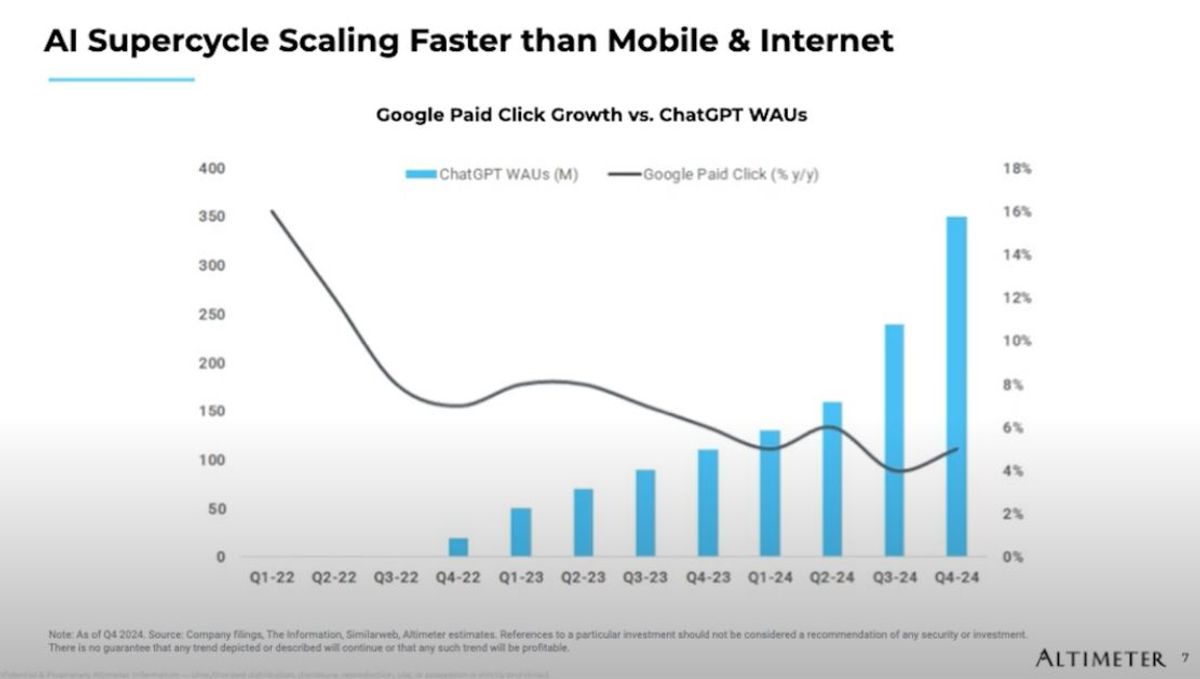
- Changing Consumer Behavior: Users are growing comfortable with AI as a starting point for finding info. Surveys show that 39% of U.S. consumers have used generative AI for online shopping research, and 53% plan to do so in the next year. There was a study done in 2023 where, 13 million Americans said they already use a generative AI like ChatGPT as their primary search tool in 2023, and that number is projected to skyrocket to 90 million by 2027. But now, in 2026, with Meta AI, Microsoft Copilot, and a growing range of embedded assistants across apps and devices, it’s likely that we’ll surpass that 90 million mark even earlier.
And here’s the kicker: many users don’t even realize they’re using AI search, because the technology is being seamlessly woven into tools they already rely on daily. We’re seeing similar behavior shifts in other domains too. For instance, AI-based trip planning in the travel industry has spiked, as consumers increasingly trust AI tools to help them research, compare, and decide. All of this points to one thing: a growing segment of your audience is encountering your brand (or not!) through AI-powered search experiences instead of traditional ones. If your content isn’t optimized for that shift, you may already be missing valuable visibility.
- High-Intent Engagement: Interestingly, when users do click through from an AI-generated answer, they tend to be highly engaged. Adobe Analytics found that visitors arriving via generative AI had 8% longer time on site, viewed 12% more pages, and had a 23% lower bounce rate compared to the average visitor. In other words, if an AI cites or recommends your site and the user follows through, they’re already primed with relevant context—and more likely to trust what they find.
The 2026 data also backs this up.
We’ve seen this firsthand at Superlines. 95% of our international Enterprise customers discovered us through AI chats while exploring topics like GEO and AI Search. These weren’t casual visitors—they came in already warmed up, already curious, and ready to talk. And here’s something not enough people are saying out loud: the more time users spend sparring with their AI chat assistants, the more trust they build with them. (I know I do—my chats remember our history and increasingly feel like an extension of how I think.) That trust transfers. So when an AI assistant brings your brand into the conversation, it’s like being introduced by someone the user already believes in. You’re not just another link, you’re hand-delivered, with credibility baked in. This is also prove by Semrush' study that AI-driven visitors convert on average 4.4x higher than standard organic visits.
Perhaps the biggest reason GEO matters is the risk of invisibility. If your brand isn’t showing up when people ask AI for recommendations, it’s akin to not ranking at all on a traditional SERP.
As the Superlines Co-Founder & CTO Kimmo Ihanus puts it, “if an AI assistant can’t find or won’t mention your brand, it’s as if you don’t exist to a whole segment of potential customers.”
Those are strong words, but they underline the point: you don’t want to be invisible in any major medium of search.
On the flip side, there’s a real opportunity here. Because GEO is still new new, many companies haven’t fully invested in it yet. The playing field is less crowded than traditional SEO. A savvy strategy could let you leapfrog competitors in the AI answer space. For example, if your competitors are asleep at the wheel, your content might become the go-to source that AI chats mention for key industry questions. Capturing that mindshare early can pay dividends, as users begin to hear your name from their trusted AI assistants. Add GEO to your marketing mix so you cover both bases. You want to show up on the Google results and be the one that Siri, Alexa, ChatGPT or all the other AI Chats talks about. Brands that integrate both strategies will have a broader reach than those sticking to SEO alone.
If you want to read how companies are using AI Search as part of their GTM strategy to drive growth, you should read our case study about Taito.ai.
Entity Recognition: How AI Attributes Information to Your Brand
One of the biggest technical differences between SEO and GEO is how visibility gets earned.
In SEO, backlinks have always been the gold standard for authority. A link from a trusted domain signals to Google that your content is credible and worth ranking.
In GEO, explicit entity mentions carry significant weight, even if it is without a backlink. AI engines recognize and track entities (people, brands, products, concepts) by how consistently they appear across multiple sources. Even an unlinked mention can influence generative visibility if it reinforces your brand’s association with a specific topic or use case.
For example, if ten high-authority articles mention “Superlines” in the context of “AI content optimization,” AI engines start associating that entity with that topic, even if half those mentions don’t include a backlink.
That’s because AI-engines can’t always read hyperlinked content, so explicitly mentioning entities and studies is a safe bet.
Instead of writing “It’s a popular project management tool,” you write “Asana is a popular project management tool.” The clearer and more consistent your entity naming, the easier it is for AI to understand and cite you correctly.
Enabling Entity Recognition With Explicit Writing
GEO content demands explicitness and clarity. Instead of saying “It’s a popular shoe brand,” you should say “Nike is a popular shoe brand.”
The more explicitly entities are named and connected, the easier it becomes for AI to cite your brand as a trustworthy source. This isn’t about keyword density or stuffing terms—it’s about removing ambiguity so AI can confidently map information to the right entity.
This shift moves content strategy from being keyword focused to being entity focused. Instead of optimizing mainly for search terms, you create content that clearly names people, products, studies, and brands.
For example, rather than writing, “The product that the engineering team, which collaborated with multiple departments over several months, designed has transformed our user experience,” you can write, “The engineering team’s new product transformed our user experience. They designed it in collaboration with several departments over the past few months.”
Short, explicit sentences like this make it much easier for AI systems to understand what happened and which entity did what, so they can confidently attribute information back to your brand.
When you cite research or data, mention the author and source directly: “According to a 2026 Superlines study” rather than just hyperlinking. This ensures AI can verify the credibility of your content, even if it struggles to read linked sources or those sources block AI crawlers.
We suggest you read How to Create Content That Performs in Both Google and ChatGPT Search.
GEO vs SEO: The ROI Mindset Shift
SEO and GEO measure success differently because they serve different parts of the funnel.
SEO’s success is measured by clicks and last-touch conversions. You rank high, users click through to your site, and ideally, they convert. It’s a direct, measurable action.
GEO’s success is measured by brand visibility inside AI conversations. Users may first encounter your brand in an AI summary, then later return through traditional search, making GEO a powerful top-of-funnel driver that influences decisions before clicks even happen.
In many cases, users discover your brand in an AI-generated answer, build initial trust and awareness, then search for you directly when they’re ready to act. That makes GEO a long-term brand play that compounds over time, even if it doesn’t generate immediate traffic spikes.
This difference also changes how you think about content ROI.
A page that ranks #1 in Google but never gets cited in AI answers might drive short-term traffic but miss long-term brand building. Conversely, a page that consistently gets cited by ChatGPT and Perplexity might generate less direct traffic but significantly boost brand recognition and consideration.
Superlines makes measuring GEO success easier by giving you the exact metrics you need:
How to Measure GEO Success: New Metrics for AI Visibility
One challenge with GEO is knowing if you’re winning. In SEO, you can check your rankings and organic traffic easily. But how do you tell if you’re being picked up by AI search engines? There’s no public “page 1” for ChatGPT responses.
This is where new tools and techniques come into play. Superlines’ AI Search Tracker, for example, is designed to fill this gap by monitoring your brand’s presence in AI-generated results. Instead of tracking just keyword rankings, it tracks brand mentions and citations across generative search platforms. In practice, this means it can scan the answers given by systems like ChatGPT, Claude, Mistral, Perplexity Gemini etc., and see if your brand or content is referenced.
Here’s how tracking GEO might work:
- Visibility Monitoring: The tool checks a set of relevant AI queries (which you can configure, akin to keywords) and detects if your brand is mentioned in the AI’s answer. For example, are you listed as an example, or is a sentence from your site quoted? It basically gives you an “AI visibility” report.
- Sentiment & Context: It’s not just if you’re mentioned, but how. Superlines’ tracker even analyzes the sentiment or tone when your brand is referenced. This is important – you’d want to know if an AI is summarizing your product as “highly rated” or “has reliability issues,” for instance. The platform provides an overview of whether your mentions are positive, neutral, or negative, along with the actual snippet of text around the mention.
- Competitor Comparison: GEO tracking tools often let you keep tabs on competitors as well. You can discover if other brands are being cited more frequently for certain queries. Superlines, for example, will show you if Competitor X keeps showing up in AI answers where you don’t, which is a signal that you might need to create content to compete in that topic area.
- Actionable Insights: The best part of tracking is turning data into action. If you find, for instance, that you’re never mentioned for a critical question in your niche, you can directly work on that (maybe publish a new explainer or case study to fill the gap). Or if you see the AI keeps quoting a statistic from an outdated blog post of yours, you might update that content for accuracy.
Superlines’ platform goes a step further by not just showing you visualized data, but it also analyzes it for you and surfaces concrete actions you can take to improve your AI visibility. There are also many ways to act with the data, directly in the UI, via API or access it through our MCP server with your favourite AI assistant.
Traditional SEO tools weren’t built for this kind of analysis—they fall short in the AI era because they can’t detect when your brand appears in an AI-generated answer or measure non-link-based visibility. But as GEO rises in importance, having AI-specific analytics is becoming just as critical as having SEO analytics.
By tracking your GEO metrics, you can actually quantify progress—“Last quarter, we appeared in 10% of our tracked AI queries; now we’re in 25%.” That kind of data helps you clearly demonstrate value to your team, your leadership, or your clients. And let’s be honest: in digital marketing, it’s hard to improve what you can’t measure. Without knowing your current position in AI search visibility, any optimization effort is just guesswork. That’s exactly what GEO tracking solutions are designed to solve.
GEO in Action: A Quick Use Case
To make this concrete, let’s walk through a hypothetical example of GEO at work:
Imagine you run a B2B project management software company. Your SEO team has worked hard to get your website ranking on page one for “best project management software” on Google. That’s great for traditional search visibility. However, when you go and ask ChatGPT or Bing’s AI, “What are the best project management tools?”, the AI’s answer summarizing the top options doesn’t mention your brand at all – it pulls from some tech review articles that highlight three of your competitors.
This is a classic GEO problem. Even though your SEO is strong, in the world of AI answers you’re invisible. So you decide to tackle it:
- You already rank on page one for “best project management software”.
- You ask ChatGPT and Perplexity the same question and your brand is missing.
- You publish a strong comparison guide on your own site based on data about what the current AI answers have favored, plus guest content and community answers that mention your product by name.
- A few weeks later the same AI queries now mention your brand alongside competitors.
That shows GEO in a concrete, easy to visualize way.
You didn’t “rank #1” (AI isn’t ranking results numerically), but you achieved GEO success: the next user who asks their AI assistant for a solution in your category will hear your brand name. That’s a win. It may lead them to specifically inquire about you or even request a direct link.
This example shows how GEO might play out in practice. It’s about covering your bases: having the content that the AI can draw on, and being present in the sources the AI trusts. It’s not magic – it’s an extension of good content marketing and SEO into new channels.
Adapting Your SEO Strategy for GEO: A 4-Step Framework
How should you get started with GEO? The good news is you don’t need to throw out your SEO playbook – you just need to extend it. Here’s a simple framework to integrate Generative AI optimization into your existing content strategy:
- Audit Your AI Presence: Begin by assessing where you stand. Pick a handful of important questions related to your business and ask AI search engines (ChatGPT, Bing Chat, Google’s AI search, etc.) those questions. Note if and how your brand or content is mentioned. You can do this manually and/or use an AI search tracker to automate the process. The goal is to map out gaps – queries where you should appear but don’t. Also pay attention to which sources the AI is citing for those answers (are they competitor blogs, news articles, Wikipedia?). This gives you clues about where the AI is looking for information.
- Optimize Content for AI Queries: Next, take your findings and beef up your content to target those gaps. This might involve creating new content or updating existing pages. Focus on answering the question directly and succinctly somewhere in your content (a highlighted paragraph or an FAQ section can work wonders). For example, if the query is “How do I improve email open rates?”, make sure you have a blog post or guide that explicitly answers that question, and perhaps even starts with a 2-3 sentence summary of the answer. Use clear language and include any facts or data an AI might find compelling. Remember, you’re almost writing for two audiences: the human reader and the AI that might quote you. Techniques like structuring your content with headings that match question phrases, and adding schema markup (like FAQ schema), can help AI models identify the relevant pieces of your content.
- Expand Your Digital Footprint: SEO taught us to build backlinks; GEO will teach us to build mentions. Work on getting your brand and expertise out there on the broader web. This could mean contributing guest articles, getting press mentions, participating in forums or Q&A sites, and ensuring any industry listings or Wikipedia entries for your brand are accurate. The more trusted external sources that mention you or your content, the more likely an AI is to regard you as a credible reference . Think of this as building the AI’s “knowledge” of your brand – you want to be present wherever it might look for reliable information (industry blogs, news sites, community discussions, etc.). Even unlinked brand mentions can help raise your profile in the eyes of an AI.
- Monitor and Refine: Finally, treat GEO as an ongoing effort. Continuously monitor those AI search results over time. Have your tracking tool or routine in place to see if you start appearing more often (hurray!) and if not, adjust. Maybe the AI is favoring a particular source – can you get featured there? Maybe users are phrasing a question differently than you expected – can you tweak your content to match that phrasing? Keep an eye on new developments too (like new AI search products launching, or updates to AI algorithms) so you can adapt. GEO is new for everyone, which means there will be a lot of learning and adjusting in the coming months. Stay nimble and be willing to experiment.
Following this framework, you’ll systematically improve your chances of showing up in AI-driven searches. It’s basically applying the rigor of SEO to this new frontier of AI search.
And remember, many of these optimizations will benefit your SEO as well. When you make a piece of content more concise and authoritative for AI, you often end up with a better page for humans (and Google) too. In that sense, GEO and SEO efforts can go hand in hand.
Lets wrap it up
So, is GEO like SEO? Yes – in that sense that you’re still optimizing content to be more visible and useful for searchers. The fundamental ethos is the same: understand what your audience is asking, create great content to answer them, and make sure it’s delivered in the right way. But GEO is also a step beyond traditional SEO, adapting those practices to a new kind of search engine, the kind that doesn’t just index and rank, but reads and writes.
For modern marketers, GEO is becoming an essential complement to SEO. We’re entering an era of AI marketing where having excellent content isn’t enough; you also need the AI intermediaries to recognize that content as excellent. The companies that master both traditional SEO and GEO will have a visibility advantage across all the ways consumers seek information. It’s not about choosing one over the other. It’s about evolving your search strategy to cover both the blue links and the AI-generated snippets/conversations. This whole debate regarding SEO and GEO usually end when people realize that Google itself is an AI Search channel these days like the Superlines CEO and Founder Jere Meriluoto shared in one of his LinkedIn posts in March 2026.
In practical terms: keep up your SEO best practices and start applying GEO thinking. Ensure your brand is present and persuasive when an AI speaks on your topic. Generative Engine Optimization/ Answer Engine Optimization (AEO) is growing very fast as a field where forward-thinking marketers can leap ahead. By staying data-driven and adaptive, you can make sure your brand’s voice is heard – whether the answer comes from a search engine or a generative AI.
If you are interested about the GEO as a market, you should read our GEO Market Size and Statistics 2026: Data on the Generative Engine Optimization Industry article.
How Superlines helps you track your visibility in AI Search?
If you want to move from manual checks and screenshots to a repeatable process, Superlines gives you a full AI visibility layer on top of your existing SEO and analytics stack.
Instead of just logging a few answers by hand, Superlines:
Tracks brand mentions and citations across 10 AI engines
- Monitors how often your brand and competitors are mentioned in answers in ChatGPT, Gemini, Perplexity, Claude, Copilot and others, and turns that into Brand Visibility, Citation Frequency and AI Share of Voice metrics.
Captures real interface answers, not only API calls
- Superlines analyzes what users actually see in the UI, including full answers and citation lists, so you’re not relying on sampled or synthetic API responses. API responses can differ significantly from what users see across markets, which is why Superlines captures more accurate data by analyzing results directly from the UI in each target market.
Shows which sources and prompts drive your visibility
- For each answer, you see which URLs and domains the AI used, how often it chose competitors instead of you, and how query fan out keywords map to your existing content.
Turns data into concrete next steps
- Inside the product, you have an ‘Action Center’ where Superlines’ agents come up with concrete actions you can take to improve your visibility based on the gathered data. Superlines also has an in-app Agent that lets you ask questions like “Where did we lose visibility this week” or “Which pages should we update first for Gemini” and returns with insights for actions.
Supports modern agentic workflows via MCP
- With the Superlines MCP server, your team can pull live AI Search data directly into your favorite AI assistants, combine it with other sources, and drive content and SEO decisions without logging into another dashboard.
Connects AI visibility to traffic and behavior
- A universal, privacy friendly tracking pixel lets you see AI bot visits and human visits side by side at URL level. You can spot which pages agents are reading, which ones actually receive human traffic, and where there is a mismatch.
Together, this gives marketing, SEO, PR and growth teams a single place to:
- See how visible the brand is in AI answers today
- Understand why competitors might be ahead
- Decide which pages, topics and sources to fix next
- Measure the effect of each optimization on real AI answers over time
If you want to see how your brand currently appears in AI Search and what your first visibility wins could be, you can start with a light baseline assessment in Superlines and then build the ongoing tracking loop described in this guide on top of it.
Start optimizing for visibility inside answers, not just rankings, and you’ll define how your audience discovers you. Get started today!