


From SEO to GEO (Generative Engine Optimization): How Brands Stay Visible in AI Search
In 2026, search has quietly split into two worlds. Google and classic SEO still matter for rankings and organic traffic, but more and more buying journeys now start inside AI assistants like ChatGPT, Gemini, Perplexity and Copilot. In those conversations, there is no first page of results, only a single answer that either mentions your brand or leaves you out completely.
In simple terms, this guide answers a single question: How can brands stay visible when buyers start their journey in AI assistants instead of the Google search box?
You will see how GEO (Generative Engine Optimization) sits on top of SEO as the AI Search layer, what to measure with Brand Visibility and Citation Rate, what to look for in modern GEO tools, and how to roll out a practical 90 day GEO plan inside a marketing team or portfolio company.
Why AI Search is impossible to ignore in 2026
In 2026, traditional search is undergoing a rapid "zero-click" transformation. As traditional Google shifts results into AI Overviews/AI Mode and assistants like ChatGPT and Perplexity become default research tools, companies face three concrete strategic risks:
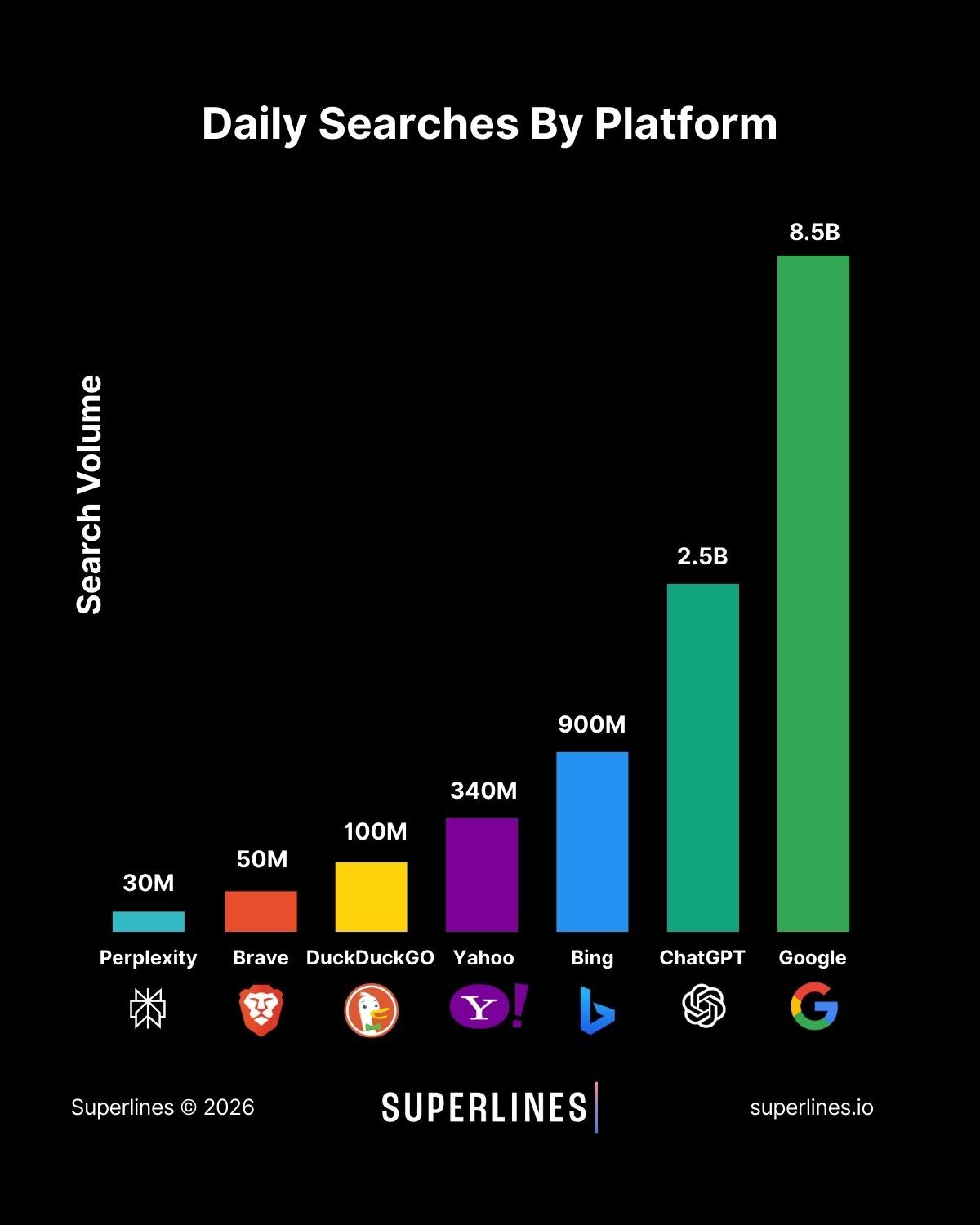
1. Brand Awareness Leakage: A company can rank #1 on Google for its key terms but remain invisible if AI assistants never mention it in category-level answers (e.g., "Which B2B CRM is best for Series A?").
2. Funnel Compression: AI Search moves users from "What is the best X" to "Which one would you pick for me" in a single session, bypassing several traditional touchpoints (see picture below).
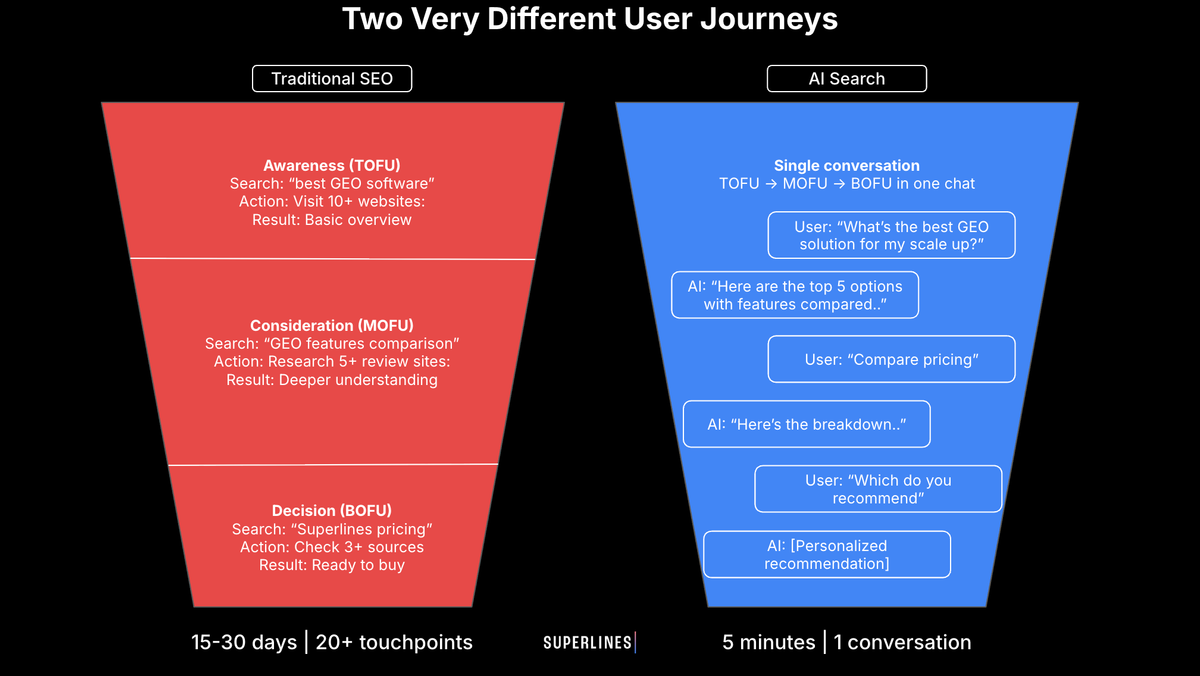
3. The Visibility Gap: There is often a significant delta between a brand’s organic search traffic and its "Share of Voice" in AI-generated answers.
The mechanics are the same for B2C and B2B. In consumer journeys, AI assistants compress product discovery and comparison into a few prompts. In B2B journeys, they shortlist vendors, summarize complex topics, and shape the first impression of who the category leaders are. In both cases, brands that are not visible in AI answers simply fall out of the consideration set.
What is Generative Engine Optimization (GEO)?
Generative Engine Optimization (GEO) is the AI era layer on top of SEO. GEO does not replace SEO, it builds on it. SEO keeps your site fast, crawlable and high quality so search engines and AI crawlers can access your content. GEO adds an AI specific layer on top by making your content easy to reuse in answers, spreading your brand facts across the sources AI assistants trust, and measuring how often you are mentioned and cited so you can improve visibility over time.
Some people refer to similar practices as AEO (Answer Engine Optimization), AI SEO or LLMO (Large Language Model Optimization), but they all describe the same idea in practice. These are just acronyms created by marketers.
Let's look at the differences between traditional SEO and GEO.
Google is an AI Search channel too
When people hear GEO, they often think only about assistants like ChatGPT or Perplexity. In reality, Google itself has become an AI Search surface through AI Overviews and AI Mode. High-volume AI experiences such as Google AI Overviews and AI Mode sit in Layer 2 of AI Search, where visibility can only move as fast as your SEO and site indexing allow. For many informational and research queries, the main user experience is now an AI generated answer at the top of the page, with traditional results pushed down or ignored.
The same GEO work that helps you appear in chatbot answers also helps you get cited inside these Google AI surfaces, because they rely on structured, machine readable content and clear sources in exactly the same way.
Recent studies around Google AI Mode show how strongly user attention is shifting inside AI generated answers:
- Around 93% of AI Mode searches end without a click. This is more than twice the rate of AI Overviews, where 43% result in zero clicks. (Semrush, September 2025)
- Users spend roughly double the time in AI Mode compared to AI Overviews, 49 seconds vs 21 seconds on average. (Growth Memo, October 2025)
Can GEO produce faster results than traditional SEO?
GEO can potentially produce faster results than traditional SEO, but the reality is, of course, nuanced. AI Search operates on three distinct layers, each with its own speed dynamics:
Layer 1: Training data (the slowest layer)
This is where LLMs learn about your brand during their training process. It's the slowest layer, but not as slow as you might think. Based on Superlines research, we're seeing bots visiting sites almost every other day, suggesting they might be fine-tuning parts of their models quite rapidly. Still, getting into the base training data of major LLMs can take months.
Layer 2: High-volume AI Search (speed depends on your SEO)
This includes free ChatGPT, Google's AI Overviews, and similar tools or interfaces that rely heavily on existing search engine indexes. Here's the key insight: this layer is only as fast as your SEO is good.
If you have strong domain authority and consistently publish quality content, your visibility can improve rapidly. Potentially faster than traditional SEO because AI engines can surface your content in synthesized answers immediately after indexing. If your SEO fundamentals are weak, this layer can be just as slow as traditional search optimization.
The speed advantage comes from understanding the connection between prompts, query fan-outs, and how your content addresses both.
Layer 3: Agentic AI (real-time & lightning fast)
This is where things get really interesting. Pro and advanced tools like Perplexity Pro, ChatGPT's Research and Shopping Assistant, and Claude Desktop with MCPs (Model Context Protocols) actually scrape and read your pages in real-time. These agents are intelligent, autonomous, and fast. Usage is growing rapidly, and this is where we're heading into true "agentic shopping" territory.
To summarize: GEO isn't inherently faster at producing results than SEO, but it's built on top of SEO infrastructure for high-volume queries. The speed advantage exists primarily in Layer 3 (agentic tools) and potentially in Layer 2 if your SEO is already strong.
We suggest reading How AI crawlers and bots read your site differently from humans and why it matters.
Now that you know what GEO is and how it differs from SEO, the next step is to understand the KPIs and how to measure success.
Main KPIs to track in GEO
It is important to understand your competitive positioning in AI Search, both against direct competitors and against brands you might not even think of as competitors but who share the same answers and visibility.
GEO tools do not only show your own visibility, they also reveal which competitors dominate AI answers for your core topics. For most companies, reaching 20 to 30% brand visibility on non branded category queries is a strong first year target. The brands that consistently measure their AI share of voice against competitors, then close the gaps with better content and stronger authority, will win this new channel.
You can expand this view by drilling down to overall share of voice and brand presence by engine. On top of these, you should also track AI referral traffic and pipeline, as well as AI bot traffic, since you are now serving both AI agents and humans. Sudden increases may indicate that agents are using your content. Sudden drops can be an early warning that you lost visibility.
So in practice, how can companies improve their AI visibility? You can find The 12 Principles of AI Friendly Writing at the end of this guide, but before diving deep into the content creation part, let’s take a look at the overall process.
Why do companies need GEO tools?
Companies need GEO tools because you cannot manage AI visibility without clear data. At minimum, teams need to know:
What their current visibility is
Which prompts and categories already mention the brand and where it is completely absent. This shows exactly which topics need attention.
Which queries, keywords and sources AI uses to build answers
GEO tools reveal query fan outs (the search terms AI uses to fetch information) and the sources that appear in answers. This tells teams what content they need to beat and which terms to mirror in their own content to fast track their way to becoming the preferred source for the answer.
Whether optimizations actually work
AI Search is volatile. One bad change can drop a brand from answers while competitors move in. This accumulates as MoM trend data.
How AI agents and humans interact with their content
Teams need to see human visits, AI bot visits and AI originated pipeline on a URL level so they can attribute impact and understand how both people and agents use their site.
Without this level of insight, GEO becomes guesswork. With it, AI Search turns into a measurable performance channel.
What to look for in a GEO solution (and how Superlines helps)
Data quality and transparency
Many solutions in the market are lightweight trackers that rely only on API based calls. The problem is that API results can differ a lot from what users actually see in the interface. To ensure data quality, you should choose a solution that analyzes the conversation in the UI as well, so you get real answer data instead of just API samples.
Superlines captures full interface level answers and the actual query fan out information, the keywords that AI uses behind the scenes to conduct searches. Combined with the current top ranking content, this gives companies a practical cheat sheet for winning visibility.
Real world example:
One Superlines customer reached a
Google AI Overview
spot
within 10 hours
for a highly competitive “best X software for SMBs in 2026” query by using Superlines data to craft their article. They used the exact search query fan out and benchmarked what content they needed to beat. The same article then started performing strongly in both ChatGPT and Perplexity as well.
Having the right data, makes all the difference at the end of the day.
From dashboards to decisions
Are you just buying a dashboard, or a solution that actually helps you analyze and act on the data? Many tools provide static dashboards based on API calls and stop there. Superlines goes further. It provides real answer data directly from the UIs and includes an interactive Agent inside the platform so users can “talk with the data,” ask questions, surface insights and turn them into actions. It also supports modern agentic workflows that we look at next.
Modern workflow support
A modern GEO solution should not lock you into one UI. It should have an API and, ideally, a modern MCP server so you can work with the data inside your favorite AI assistants instead of manually clicking through dashboards.
Superlines ships with its own MCP server. Many clients already combine Superlines AI Search data with other external data sources to drive deeper analysis and automated actions.
Advanced supportive features
There are quite a few aspects, including technical ones, that affect GEO, and the best tools help here as well. Superlines can create and optimize state of the art schema markup and support the content creation process. You can use these capabilities directly in the UI, through the Superlines Agent, or with your own preferred AI assistant via the MCP server.
AI traffic and AI agent attribution
Many solutions measure referral traffic through GA4 integrations, but that is only one part of the picture. A GEO platform should also capture AI bot visits to your site and connect them to prompt level data so you can see human versus bot traffic on a URL level.
Superlines does this in a privacy friendly way through a universal pixel installed on the site.
You can also read more about the best AI visibility tools from our article.
In summary
Superlines is a GEO platform that covers the full GEO workflow with real answer data. It helps companies analyze and improve their AI visibility for both humans and AI agents, and it is designed to turn GEO from a dashboard into a repeatable growth process.
How to improve AI visibility in practice?
To begin improving your AI visibility, you need to do the following:
1. You need to understand your current visibility among the most important topics that your target group is searching for. Tools like Superlines can help you with this.
2. After you understand your current visibility and whether you appeared in the answers or your competition did, you need to make sure that there are no technical blockers for AI to fetch information from your site and then:
A) update existing content if you already have content answering those questions, but still have low or no visibility:
Benchmark the AI’s current preferred sources. Look at their format, structure and level of detail.
- Use query fan out data to see which exact wording the AI uses to search. Turn those queries into H2 style headings and answer them directly in the first one or two sentences.
- Apply AI friendly writing principles so each section is easy for assistants to lift into an answer.
You can find a separate guide that goes deeper into best practices for optimizing content for generative AI, with more concrete examples.
B) Create new content where you have gaps.
When no suitable page exists yet:
- Start from the real questions people ask AI assistants and use those as headings.
- Follow the same best practices as in A: clear structure, direct answers, FAQ blocks, and schema where relevant.
- Treat every new article as a test. Publish, then recheck AI answers and iterate based on how visibility moves.
It all starts with your own site, which is good news, since that is the easiest source to shape and improve.
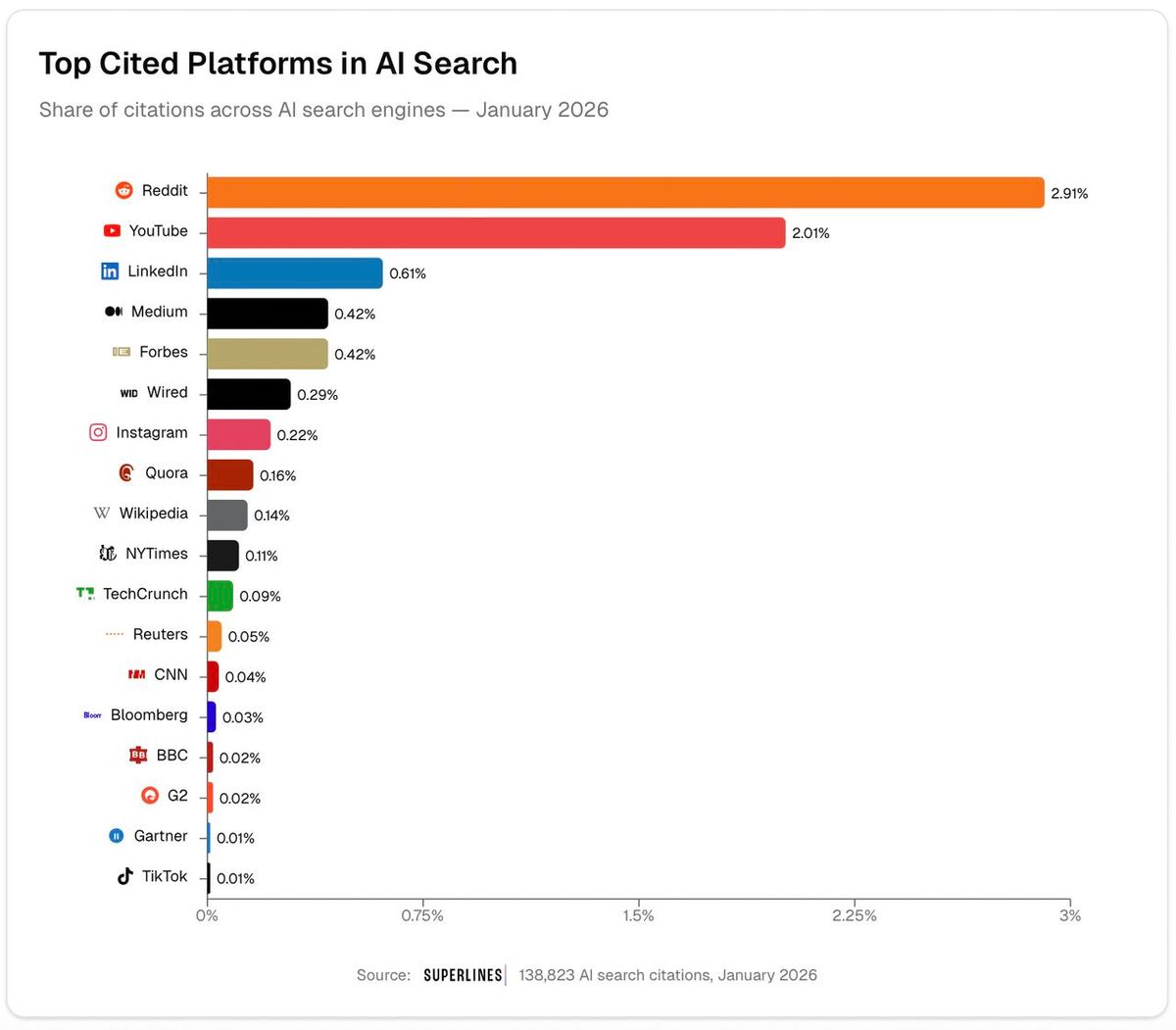
A big part of AI Search visibility also comes from third party sources that AI uses for information, such as UGC platforms like Reddit and Quora, video platforms like YouTube, editorial outlets such as Forbes and Wired, and reference sources like Wikipedia.
You can think of these third-party sources as a fast track, like skipping a long queue all the way to the front, since you know those sources are driving visibility already and it's your job to try to ask them to include your brands name there as well so your name appears alongside the other brands that are already mentioned.
Superlines also shows, at URL level, which third party sources drive mentions for you and your competitors so you know exactly which sites to approach for inclusion.
Below, you can also see original Superlines data about where AI fetches its information from. You can see from the picture that YouTube is becoming a big source for AI where it fetches fact and cites information from. This is still heavily underutilised channel for many companies, especially on the B2B side.
How to start with GEO in 90 days
The same 90 day pattern works for both B2C and B2B. The questions change, but the mechanics are the same: map real prompts, fix foundations, update on site content, then expand into third party sources and make GEO part of the reporting rhythm.
Assume you are using a GEO tool like Superlines. If you do not, you can approximate some steps manually, but you will lose precision and speed.
Days 1 to 14: Baseline and foundations
Goals
- Understand current AI visibility for your most important non branded topics.
- Remove obvious technical blockers so AI can read and reuse your content.
Actions
- Run a GEO baseline for 10 to 20 high intent prompts.
Example prompts:
B2B: “Best GEO tools for in house marketing teams”, “Top SaaS onboarding platforms for enterprise”.B2C: “Best running shoes for flat feet”, “Most reliable home insurance in Finland”.
For each prompt, check:
Does your brand appear in the answer.Which competitors are mentioned.Which sources are cited. - Create a one page baseline view.
Brand visibility and citation rate per prompt.List of the three to five most dangerous “citation gaps” where competitors dominate and you are absent. - Check and fix foundations.
Review robots.txt and intentionally allow the AI crawlers you want to work with.Confirm that your top revenue pages are indexable, use clean headings, and load fast enough for AI agents (target under 0.4 seconds where possible).Implement basic schema:
Organization schema on the homepage.Product or Service schema on at least one core offer page.
Outputs
- One page baseline report: current AI share of voice, top competitors, and immediate issues.
- Short list of priority pages and prompts that matter most for revenue and GEO work.
Days 15 to 45: Fix your own house with data
Goals
- Turn your most important pages into AI ready answers.
- Start making the first data backed content decisions instead of guessing.
Actions
- Pick three to five high value pages tied to critical prompts.
Typical candidates:
Category or solution overview page.Pricing page.One main product or service page.One cornerstone guide. - For each page, decide based on GEO data:
Update existing content if you already have a page but low visibility.
Benchmark what the AI currently prefers: format, structure, angle.Improve your version so it is more complete, clearer, and easier to quote.Use query fan out data to lift the real search wording into H2s and answer those questions directly.
Create new content if you have no page at all for an important prompt.
Structure it directly around the way people ask the question in AI assistants.Use the same AI friendly structure and schema. - Apply the AI friendly writing checklist to each page.
Clear H1 that matches a real question or intent.
Two to three sentence answer at the top in plain language.Short sections with H2 and H3 headings.A compact FAQ block that covers real sales or support questions.Updated Article, Product or Service schema and FAQ schema where relevant.
Outputs
- First batch of “AI ready” pages that follow best practices.
- Internal examples that writers, SEO and product marketing can copy for future work.
Days 46 to 90: Expand, measure, and make GEO repeatable
Goals
- Strengthen your presence in external sources AI trusts.
- Connect GEO to business metrics and make it a standing part of the GTM engine.
Actions
- Use GEO data to identify the biggest external citation gaps.
For three to five core prompts, list:
Which competitors are winning AI answers.Which external domains are most often cited.
- For each priority gap, do two things.
Create or update one strong guide or comparison page on your own site.Secure at least one external presence:
Guest article or quote in an industry blog.Updated profile in a key directory or marketplace.Mention on a partner site, association site, or niche community. - Standardize how you talk about your company and product.
Make sure descriptions are consistent across your own site, directories, partner pages, LinkedIn, and other key surfaces.If you are notable enough, review and update any existing Wikipedia or Wikidata entries carefully. - Set up GEO as a recurring practice, not a side project.
Define quarterly GEO targets, for example:
“Increase AI brand visibility from 8 percent to 20 percent for three core category queries by the end of Q4.”
“Bring at least five qualified deals per quarter that originate from AI Search or that mention AI as the discovery channel, including Google AI Mode and AI Overviews.”Add GEO checks to existing workflows:
New content templates include AI friendly structure and schema by default.Quarterly review of robots.txt and schema on key pages.Monthly GEO KPI report in the marketing or growth review alongside paid, social, and classic SEO metrics.Continue monitoring in your GEO tool:
AI citations and mentions across engines.Referral traffic and pipeline where visible.Bot and agent traffic patterns on key pages.
Outputs
- Simple GEO dashboard or recurring report that leadership sees every month.
- Clear owner and routine so the work continues beyond the first ninety days instead of stopping after the first sprint.
The 4-Stage GEO Maturity Framework
This framework helps B2B and B2C companies see how prepared they are for GEO and AI Search. It combines two views:
1. How visible your brand is today in AI generated answers.
2. How far your organization has gone in turning GEO into a repeatable, measurable practice instead of one off experiments.
Use it as a quick self assessment and as a map for what to do next.
Level 1 – Ad Hoc (Legacy & Immature)
The brand is optimized for traditional search (SEO) but is virtually invisible in AI Search results. While they may rank #1 on Google, they suffer from Brand Awareness Leakage, meaning AI assistants fail to mention or cite them in category-level answers.
- The Problem: Content is created only for human readers and keyword-based bots, ignoring conversational "answer engines".
- Signal: If you ask ChatGPT or Gemini for a recommendation in your category, the brand is either ignored or misrepresented with generic, outdated data.
- Next Step: Start monitoring. Run a light audit on 10 high-intent category prompts (e.g., "What is the best enterprise GEO tool?" or "What are the most reliable running shoes?") to identify your current "Citation Gap".
Level 2 – Emerging (Aware & Reactive)
The organization recognizes the shift and begins small-scale experiments. Marketing teams start mapping the conversational intent of their buyers—understanding that users now ask "How do I...?" or "What is the best X for Y?" instead of typing single keywords.
- Action: Experimenting with one or two AI-targeted pieces, such as a "Question-Style" blog or an updated FAQ section.
- The Hurdle: No formal process exists; GEO is often a side project for the SEO lead without board-level metrics.
- Next Step: Formalize the intent mapping. Get input from sales and customer service to build a repository of real questions that AI engines can retrieve and use to cite your brand.
Level 3 – Integrated (Operational & Multi-Layer)
GEO strategies are integrated into core marketing operations. The focus shifts from "ranking" to "extractability" across the three layers of AI Search: training data, indexed search, and real-time agents.
- The Execution: Teams actively update existing high-value content to follow the 12 Principles of AI Friendly Writing, such as using highly extractable rich elements with schemas, clear H1s, front-loading 2-sentence answers, and making every paragraph "quotable" on its own.
- The Strategy: Beyond their own site, the brand ensures visibility on third-party pages (Wikipedia, Reddit, LinkedIn, and niche directories) because AI is 6.5 times more likely to cite a brand when it finds verified consensus across multiple sources.
- Next Step: Optimize technical performance. Ensure your top-tier pages meet the 0.4s speed signal to ensure real-time AI agents can "scrape" and cite your site under tight time budgets.
Level 4 – AI-First (Strategic & Best-in-Class)
The brand operates with an AI first mentality and aims to be the default answer for its entire category. Content creation starts by asking “How would an AI answer this, and how do we ensure our perspective is the primary source?”, and every decision is backed by AI Search analytics, not guesses.
The team monitors brand visibility and citation rate across engines with GEO tools, reviews changes weekly, and uses this data to decide which topics to defend, which gaps to close, and which new queries to target. AI Search visibility sits on the same level as core SEO and paid performance dashboards in leadership reporting.
- The Main KPIs: Success is measured by brand visibility, the percentage of mentions in AI results, and brand citation rate, how often the AI provides a direct, clickable link back to your content. These KPIs are tracked over time and against competitors for each high intent query cluster.
- Dominance: The brand uses advanced workflows, for example connecting its visibility data to AI assistants via MCP (Model Context Protocol), so operators can ask “Where did we lose share this week?” or “Which queries are trending up in Gemini and Perplexity?” directly from their assistant. Actions and content updates are then prioritized from this data, which keeps AI share of voice high and defensible.
- Next Step: Continuous iteration. High-authority pages are refreshed every 60–90 days with fresh expert quotes and original data to maintain "Primary Source" status in LLM knowledge sets.
To summarize: A company at Level 1 is essentially flying blind in a zero click world.
A company moving toward Level 4 is building a defensible visibility moat, with GEO embedded into its go to market engine and its brand becoming one of the most trusted, extractable and cited sources in its category.
Who is responsible for GEO in a company?
TLDR; In most companies GEO should start inside the marketing and GTM team, with SEO and content owning the practice, then gradually extend to PR, customer service and data as the program matures.
The most natural home for GEO is the marketing and go to market function. It plugs into existing SEO, content and demand generation workflows, but uses new data and a new performance lens. Typically the Head of SEO or Growth owns the platform and visibility reporting, feeds this into the CMO or VP Growth, and that leader includes AI Search in the overall GTM strategy.
In most teams you do not need an entirely new GEO workflow. You extend the SEO process you already have. The same people write briefs, publish articles and optimize pages, but they now prioritize topics, headings and updates based on AI visibility gaps instead of only Google rankings.
A state of the art GEO setup gets support from several roles and teams:
•SEO and content team: Own day to day GEO operations, visibility reporting and content updates.
•GTM and growth team: Decide which categories, segments and queries matter most and connect GEO work to pipeline and revenue goals.
•Internal content creators: Create and update website content to win specific prompts and topics.
•UGC and community outreach team: Make sure you have presence in forums like Reddit and other communities and that you take part in relevant conversations.
•Data or analytics team: Help extract information from GEO data, build prediction models once enough data is available and move GEO metrics into BI dashboards inside the organization.
•Customer service and success team: Support active review gathering and optimization in Google, Trustpilot, G2 and other platforms.
•PR and communications team: Secure presence in publications that work as drivers for AI visibility.
If you compress this into a single hire, you are looking at an AI First Content Manager and the profile should look something like this.
Role Profile: The AI-First Content Manager
In 2026, the AI First Content Manager is less of a classic “brand storyteller” and more of an AI aware technical writer. They write from the company’s point of view, but base every article, page and update on concrete visibility data from GEO tools and on the content that already wins in AI Search.
Their mission is simple: turn GEO insights into content that beats live benchmarks in ChatGPT, Gemini, Perplexity and Google AI results.
Core Profile
- Hybrid Skillset: Combines the creative flair of a content strategist with the technical rigor of an SEO and data analyst.
- Tech-Fluent: Deeply familiar with LLM behaviors, GEO tools, and multimodal search (visual, voice, and text).
- Agile Mindset: Capable of pivoting strategy in real-time based on emerging AI Search trends and "slang" discovered in retrieval data.
High-Impact Responsibilities
1. Intent-Driven Content Strategy
- Aligns the content calendar with the specific questions buyers ask AI assistants.
- Maps conversational intent to ensure content is optimized for "answer engines" (ChatGPT, Perplexity, Gemini) and voice assistants.
2. Real-Time Trend & Consensus Monitoring
- Monitors trending queries and ensures the brand’s perspective is included in AI training sets.
- Manages the brand's presence on third-party "consensus" sites (Reddit, Wikipedia, LinkedIn) to trigger positive AI citations.
3. Product Extraction & Lifecycle Optimization
- Standardizes product/service descriptions to be "machine-readable" (H2 questions, TL;DRs, JSON-LD schema).
- Closes the loop between customer support and marketing by turning common user questions into extractable FAQ nodes.
4. GEO Experimentation & Integration
- Runs A/B tests to see which content structures earn the "Default Answer" or "Citation Lift."
- Integrates AI tools (like MCP servers or site-side chatbots) to analyze how agents interact with the site’s data.
- Knows how to use modern workflows that include using MCP servers to combine data and drive actions from it with AI assistants instead of manually analyzing data and results.
Strategic Ownership: The "Brand Advocate"
This role owns AI Share of Voice. They are responsible for:
- Accuracy: Identifying and correcting brand misinformation in AI outputs through content updates or platform feedback.
- Authority: Evangelizing GEO wins internally (e.g., "We are now the cited source for [Category Keyword] in Gemini").
- Enforcing the goal: Shifting the goalpost from "getting clicks" to "owning the answer" in a zero-click world and helping to spread the results across organization.
If a company cannot hire for this specific role yet, they should form a GEO task force that includes a senior SEO, a content marketer and a GTM lead. This team should meet weekly, own the GEO roadmap and execute the 90 day plan.
GEO in practice: three real world examples
1. Established bank fixing invisible and outdated AI presence
A well known Nordic bank started its GEO project by running a baseline across key topics such as business loans, ESG reporting and SME banking.
What they found surprised everyone.
- Several strategically important topics did not surface the bank at all in AI answers.
- In others, AI assistants used outdated descriptions, while competitors were presented as the default modern choice.
With GEO analytics in place, the team identified the pages and external sources that fed those answers. They then:
- Updated on site content and schemas
- Corrected information on key third party profiles
- Updated each page per topic and included rich elements
Within two months their brand visibility and citation rate for those topics overtook the main competitors in several AI engines. Without GEO data they would not even have known that they were losing ground in AI Search.
2. Helsinki SaaS startup going from zero to international visibility
A B2B SaaS startup in Helsinki wanted to compete against established global vendors in its category. Traditional SEO was slow and dominated by better known brands, so they treated GEO as their wedge.
At the start they had:
- Zero AI brand visibility for their core category queries
- No citations in AI answers at all
Using GEO data they:
- Identified fifty high intent prompts where international competitors were already visible
- Created content that directly beat those live examples in clarity and structure
- Repurposed every AI Search optimized article into LinkedIn posts, a YouTube explainer and short form content
Within three months they had reached roughly 25 percent citation rate in their niche and appeared alongside international competitors in ChatGPT, Perplexity and Gemini. This AI driven visibility started bringing in international trials and pipeline that they would not have reached through classic SEO alone. This is the company that reached an AI overview spot within 10 hours for a highly competitive "best x software for SMBs in 2026" topic.
3. Agency turning GEO into a data backed service line
A digital agency wanted to offer GEO services to its clients, but ran into a familiar problem.
Prospects saw the plan as “soft work” because it was not tied to concrete data or measurable outcomes.
After adopting GEO analytics, the agency changed its approach:
- Every new business conversation starts with a simple AI visibility baseline for the prospect
- The agency shows exactly where the client appears today, which competitors dominate answers and what the citation gaps are
- Proposals now include a clear set of GEO KPIs and before / after comparisons
This shifted the perception from “nice to have content ideas” to “data backed visibility program” and opened the door for deeper, technology supported retainers. The agency now uses GEO both to win new deals and to extend existing ones.
What are the 12 Principles of AI Friendly Writing
AI friendly content means writing so clearly that both humans and machines can follow your thinking. This is the craft side of GEO: how to make your ideas both machine readable and human resonant.
1. Do not bury the point (BLUF)
Start with the main takeaway, then explain it.
When you open a section, give the answer in the first one or two sentences, then add context and proof.
Example
Bad: "In today’s fast-paced digital landscape, businesses are constantly looking for ways to improve visibility and stay competitive. One of the most effective ways to do that is through optimizing content for AI-driven search engines."
Instead of starting with a long setup about the “fast paced digital landscape”, open with:
Better: “To rank in AI Search, start your article with the answer, not the setup. AI engines (and readers) both reward clarity over buildup.”
2. Ask a question, answer it immediately
If your heading is a question, the first sentence under it should contain a direct answer in plain language.
Example
Bad: Heading: “What is AI friendly-writing?”
Body: Before we define it, let’s talk about how writing itself has evolved with the rise of large language models and changing search behavior…
Good: Heading: What is AI friendly writing?
Body: AI friendly-writing is writing that’s easy for both humans and machines to interpret, clear, structured and impossible to misquote.
This pattern keeps both readers and models on the same track and satisfied: question, answer, proof.
3. Keep grammatical dependencies low
Use short sentences with a clear subject and verb. Avoid long chains of clauses that delay the main point.
Example
Bad:
- By implementing these strategies, you can boost engagement across your content.
- While SEO has evolved significantly over the past decade, the core principles of E-A-T remain foundational to ranking success.
- Whether you’re just starting with GEO or already running AI visibility campaigns, this framework will help you optimize faster.
Good:
- Use these strategies to boost engagement.
- SEO has evolved, but E-A-T still determines what ranks.
- This framework works for beginners and experienced GEO practitioners alike.
4. Say what you mean before you get clever
State the point literally first. You can add personality, metaphors or jokes after the core idea is clear.
Example
Bad: When it comes to AI Search, most brands are still flying blind.
Good: A lot of brands don’t yet understand how AI Search discovers and cites their content.
5. Use clear pronouns and references
Every “it”, “this”, or “that” should have an obvious referent in the same sentence or the one before it.
Example
Bad: This is why it’s important to simplify your structure.
Good: Clear antecedents make your writing easier for both readers and AI to follow; that’s why simplifying your structure matters.
6. One topic at a time
Each paragraph should support one main idea. If you introduce a new claim, start a new paragraph.
This makes it easier for models to assign a single topic to that block of text, which increases the chance that the whole idea is lifted and cited correctly.
Example
Bad: AI friendly writing requires clear structure. It also changes how we think about storytelling and creativity. Some writers worry this means the death of nuance, but that’s not necessarily true if you understand how LLMs process language.
Good: AI friendly writing requires clear structure. Use short sentences, explicit antecedents, and one idea per paragraph. These patterns help both humans and machines follow your argument without getting lost.
7. Use a clear heading hierarchy
Treat headings as a map of your reasoning. Use H2 for core sections, H3 for subpoints, and keep the order logical: claim, explanation, proof.
This helps models understand which ideas are primary and which are supporting details, and helps readers scan the piece quickly.
Example
Bad: One endless block of text where points bleed together and there’s no relationship between ideas.
Good: A clean outline where every section serves a role: claim → explain → prove. The structure itself tells the story.
8. Keep terminology and names consistent
Pick one term for each important concept and use it throughout.
If you want to be known for “Generative Engine Optimization (GEO)”, avoid switching between GEO, AI SEO and “AI content tuning” inside the same article. Consistency strengthens your entity signal.
Example
Bad: Superlines helps marketers create better content for search. SL also supports AI visibility tracking. Our platform offers several AI-powered tools to help improve content visibility.
Good: Superlines helps brands track, optimize, and grow their visibility in AI Search, from monitoring AI visibility to identifying citation opportunities.
The first version fragments your brand into three separate mentions. The second reinforces that everything described is Superlines.
9. Write confident, evidence backed statements
When you know something, say it directly and support it. Avoid constant hedging like “it seems” or “it might” unless you genuinely do not know.
Example
Bad: It seems like AI Search might change how brands approach SEO.
Good: AI Search is rewriting how brands approach SEO.
10. Use semantically related terms
Do not only use your main keyword. Surround it with the natural vocabulary of the topic: related tools, concepts, metrics and use cases.
If you write about “AI Overviews”, it is natural to mention “Google”, “search visibility”, “citations”, “GEO”, and “AI Search behavior”. This helps models see your content as deep coverage, not thin content.
Example
Bad: AI Search is changing how people find information online.
Good: AI Search, through features like Google’s AI Overviews and the broader GEO layer, is changing how people discover and trust information online.
11. Define acronyms and technical terms once
Spell out any acronym the first time you use it.
Example
Bad: GEO is changing how brands approach search visibility.
Good: Generative Engine Optimization (GEO)—the practice of optimizing content for AI-powered search engines—is changing how brands approach visibility.
12. Make every paragraph quotable on its own
Write each paragraph so it can stand alone as a small answer. One clear idea, stated directly, with enough context that it still makes sense if an AI lifts only those two or three sentences.
Example
Bad: AI friendly writing requires structure, clarity, and empathy. You need to think about formatting, semantics, and tone, because LLMs read differently than people do, and readers still want personality.
Good: AI friendly writing starts with structure. One idea per paragraph makes your content easier to parse for humans and for machines.
When you follow these 12 principles, you give both humans and AI a clear, predictable structure. Next, you can layer schema markup and metadata on top of this foundation to make your content even easier to understand and reuse.
Start Measuring Your Performance in AI Search
The future of search belongs to brands that understand how AI sees the web. If you track Brand Visibility and Citation Rate, then optimize your content around those insights, you will show up inside the answers your buyers actually read.
Working to emphasize your business’s strengths and mitigate its weaknesses allows you to generate more positive coverage in AI responses. And ultimately attract more customers.
Superlines is your AI Search Intelligence platform that helps you measure and improve your AI Search visibility across platforms such as ChatGPT, Perplexity, Mistral, Google AI Mode, and Gemini, so you see where you appear today and where you can win next.
Start using Superlines today to measure and improve your AI visibility systematically!