


How To Make AI Engines Recommend Your Brand (AI Visibility Explained)
AI visibility is how often your brand appears and is recommended inside AI generated answers in tools like ChatGPT, Gemini, Perplexity and Mistral. When your AI visibility is high, these engines mention your brand by name and cite your content in the answers that your buyers actually read.
In this guide you will learn what AI visibility is, why it matters, and how to improve your AI search visibility so that AI engines start recommending your brand.
Case example: Taito.ai
Taito.ai, a modern AI performance enablement software, secured number one positions in GEO and SEO for key search terms such as “AI native performance management software”. Even with heavy global competition, they boosted their visibility around their most important topics and attracted international interest from their ideal customers by focusing on one thing: AI visibility, not just classic SEO
It wasn’t through another SEO-optimized blog post or paid ads. It was through something that too many brands are still stuck debating: AI visibility.
Their approach works, and it’s not proprietary magic. It’s about becoming the kind of brand AI engines can’t help but cite and surface repeatedly, across relevant prompts, throughout the entire buyer’s journey.
Easier said than done, but let's take a look at how it’s done.
What Is AI Visibility?
AI visibility is the measure of how frequently your brand, content, or products appear in relevant AI-generated answers and overviews. High AI visibility means you show up in ChatGPT responses, Perplexity summaries and Claude recommendations consistently, across the prompts that are relevant to your business and/or industry.
The mechanics are different from traditional search. Google, Bing and their siblings rank pages; AI engines actively synthesize their own answers by pulling information from multiple sources based on thousands of authority signals across the web.
Your brand, here, isn’t competing to be one of the many blue links. Instead, it’s competing to be part of that one answer a potential customer reads. Be a part of these answers and your audience (those that turn to AI engines during the decision-making process) will discover you, build trust faster and potentially convert.
The possible outcomes of being visible in AI answers are obvious (and potentially rather lucrative). But with other discovery channels like traditional search and paid ads still driving results, why, exactly, is AI visibility so critical right now?
Why Is AI Visibility Important?
AI visibility is important because AI engines are rapidly becoming a channel that enable brand discovery and influence purchase decisions.
People go to AI engines with questions like “Which is the best project management tool for my business?” or “I want to do more email marketing. How do I do that?” much like they would to a mentor or a business consultant.
The list of tools or strategies that AI provides becomes the starting point of the product purchase journey.
This instant trust on AI and the fact that very few tools get recommended in one go is exactly why you should expand your marketing strategy to include AI Search visibility.
Millions Already Rely on AI Engines for Answers
The combined user base of major AI platforms is already a massive market opportunity for any brand:
- ChatGPT has +900 million weekly active users in April 2026
- Gemini has 187.5 million weekly active users in April 2026
- Perplexity has another 20 million weekly active sers
Together, these platforms process billions of queries every day. Each of these interactions is an opportunity for your brand to capture the attention of a potential customer.
Google isn’t going anywhere, but AI engines are growing fast enough that the question isn’t whether to pay attention, but whether you can afford not to. You didn’t ignore SEO when it mattered. You certainly didn’t skip social when your audience moved there. This is the same calculus. AI visibility isn’t a replacement for those channels. It’s another place your audience is making decisions, and the brands showing up there are already gaining ground.
The better news: what makes you visible to AI engines (authority, clarity, cited expertise) makes you stronger everywhere else, too.
Traditional Search Is Also Leaning on AI
AI visibility isn’t confined to ChatGPT and Perplexity. Just like how paid ads and social media or organic search overlap, AI visibility also helps you stay visible across channels. Google itself is an AI Search channel these days. It might not feel like it, but it is. Google’s AI Overviews now appear at the top of search results and is triggered by 48% of the search queries according to Brightedge’s research, answering questions before anyone scrolls to the blue links. So the new normal in the order is, AI Overview, sponsored results and then comes the organic results. When is the last time you’ve scrolled all the way down there?
Zero-click behavior dominates. Around 93% of AI search sessions end without a website click, and AI Overviews reduce clicks to the top-ranking page by 58%, making answer visibility more important than traditional rankings. Naturally, brands that are mentioned in AI overviews are the first (and sometimes only) brands your ideal customers see.
If you are counting on attracting leads through traditional search, you want to optimize your brand for both SEO and AI. Especially, if you are targeting the younger lot.
How different buyers use AI as a shopping and decision advisor
First, GenZ used social media to support their purchase decisions and now AI visibility might just turn your Gen Z audience into paying customers.
According to Commerce, 1 in 3 Gen Z shoppers (33%) use AI engines for product research—about the same percentage that still use traditional search engines (37%). This generation already treats AI tools as trusted shopping assistants that help them discover, compare, and decide what to buy.
Millennials and Gen X also increasingly lean on AI for “research before buying”, especially for higher ticket purchases such as software, travel and electronics. Instead of reading 10 reviews, they ask AI to summarise the best options, pros and cons and price ranges. In practice, AI answers become the shortlist that they compare vendors against.
In B2B, AI is already acting as an assistant across the buying cycle. Decision makers ask questions like “what are the best AI Search analytics platforms for mid market SaaS” or “which GEO tools integrate with GA4 and HubSpot”. The brands that appear in these answers end up on vendor shortlists, get checked on LinkedIn and G2 and are more likely to be invited into RFP processes. AI visibility does not replace outbound or sales, it quietly supports them by pre qualifying interest.
And AI platforms are also quickly adapting to this demand.
OpenAI introduced Instant Checkout in 2025 which allows people to directly discover and buy from Etsy sellers on ChatGPT. Bringing Glossier, Vuori, and many other Shopify sellers to the platform is also in OpenAI’s roadmap.
This means AI platforms are now turning from just product discovery platforms to complete purchase funnels. Brands that are visible get discovered, trusted, and bought from, all in one single conversation.
At this point, it’s only fair to admit that AI engines are a core growth channel, and it's time to make this channel measurable.
The AI Visibility Loop
At a practical level, AI visibility follows a simple loop:
The ten strategies in the next section are concrete ways to move through this loop systematically instead of guessing.
How To Improve AI Visibility: 10 Strategies
If SEO is about being findable, AI visibility is about being mentionable and citable. While there’s overlap between what helped you climb up the SERPs and what gets you mentioned by LLMs, AI engines don’t just index your content. They decide whether it’s trustworthy enough to recommend. These strategies are the practical playbook for improving your AI search visibility and making your content the default source engines rely on.
1. Publish Content AI Can Easily Understand
AI doesn’t read like humans; it uses tokenization and relies on schema to understand what each content piece contains. If your content is ambiguous, meandering, or poorly structured, it gets deprioritized. Not because it’s bad, per se, but because it’s harder for the engine to extract clean, confident answers from.
To make your content easy for AI to understand and cite::
- Write short, direct sentences and lead each section with the most important takeaway.
- Use a clear, hierarchical structure (H1 → H2 → H3) so AI can understand topic relationships.
- Add schema markup (Article, FAQ) and internal links to reinforce context and improve discoverability.
2. Focus on Content Depth and Clarity
A content piece that covers a topic comprehensively, considering all the subtopics, might have a better chance to get used by AI as a source.
When AI engines search, they don’t focus just on the main keyword. Instead, they use a technique called query fan-out through which they run multiple searches for all queries related to the main prompt, creating one comprehensive answer. You can use these query fan-outs in your URL slug, H1/H2s and in body content.
Say you ask AI for “best performance management tools for startups.” Instead of pulling only from articles that match this query, AI will also search and pull info from:
- “best performance management software”
- “Taito.ai vs. Cultureamp”
- “tools for team performance”
Content that naturally addresses most of these subqueries becomes a stronger, more comprehensive source for AI to cite.
To create such comprehensive content:
- Consider all possible long-tail and related keywords, and include them naturally within your writing. This helps AI connect your content to a broader set of related queries and intents.
- Look at “People Also Ask” sections on Google and questions from Reddit or Quora to identify real user queries, and address them directly in your content. A good place to include them is in the FAQs section or as subheadings within an article.
- Start each section by answering the main question or sharing the key takeaway before diving into details, so AI can easily identify the core message.
Optimizing content, however, is only half the job. If you do nothing else, cleaning up structure like this will already improve your AI visibility, because models can extract and reuse your answers with far more confidence. To actually get your brand recognized and cited, AI engines need to connect your content back to a strong, well-defined brand entity. This brings us to the next step.
3. Strengthen Your Brand’s Entity Footprint
AI engines need to recognize your brand as a distinct, coherent entity before they’ll cite you consistently. An entity, in AI terms, is how systems identify and connect information about a specific thing (a brand, person, product, or concept) across different sources.
Think of how you recognize a brand like Apple: the logo, the iPhone, the stores, even the packaging all tie back to your idea of the brand. AI does something similar: it links mentions, products, and references across the web to understand that they all belong to the same entity.
Here’s how to build a clear, unified entity footprint:
- Explicitly mention brand name in your content instead of using “it,” “this,” or other determiners. For example: Instead of “It offers generative engine optimization (GEO) features” write “Superlines’ offers generative engine optimization features.”
- Keep your brand name, product names, feature offerings, and other important details consistent across all platforms.
- Send brand guidelines to any third party publishing your content to uphold said consistency.
- Create or update author and company pages with bios, credentials, and external links to authoritative sources (LinkedIn, Crunchbase, Wikipedia, etc.).
Basically, make sure your brand is clearly associated with the information you want AI engines to see and display.
Along with entity recognition, you also need to focus on credibility. AI won’t mention just any entity if it can’t verify the information surrounding the brand.
4. Back Every Claim With Data and Authority
AI systems cross-check your content with recognized entities, reputable domains, and verified data sources. If your content consistently aligns with credible signals, it becomes easier for AI to cite it in its answers.
One of the best ways to signal credibility is to back your content with surveys, reports, and other authoritative data. Another strategy is to add quotes from well-known professionals in the field.
This is quite similar to how Google follows E-E-A-T. AI engines, too, value experience and expertise.
The difference is that here, you need to make the citation explicit. So, instead of just hyperlinking a stat, you can write: “According to the 2026 Gartner report…”
This is for two reasons:
- We are not sure if AI models can read hyperlinked content. Some models, such as GPT-4, struggled to read content in a given link and there’s no official verification that the more recent models such as the GPT-5.2 are any better.
- Even if we assume they can, many hyperlinked content pieces might have blocked AI crawlers on their end, making it impossible for AI to know what’s in those links.
Instead of taking a chance, explicitly stating the source and data ensures AI can verify the credibility of your content.
5. Earn Brand Mentions From Trusted Websites
AI engines pick information related to your brand from throughout the web, not just the brand’s website. Getting contextual, third-party mentions is one way to ensure AI engines come across brand-related information as much as possible.
The easiest way to achieve success is (you guessed it) within Superlines itself. Through the list of URLs driving Citations, users get a list of pages that are already cited in relevant AI answers.
If you haven’t signed up for Superlines yet, click here to get started today!
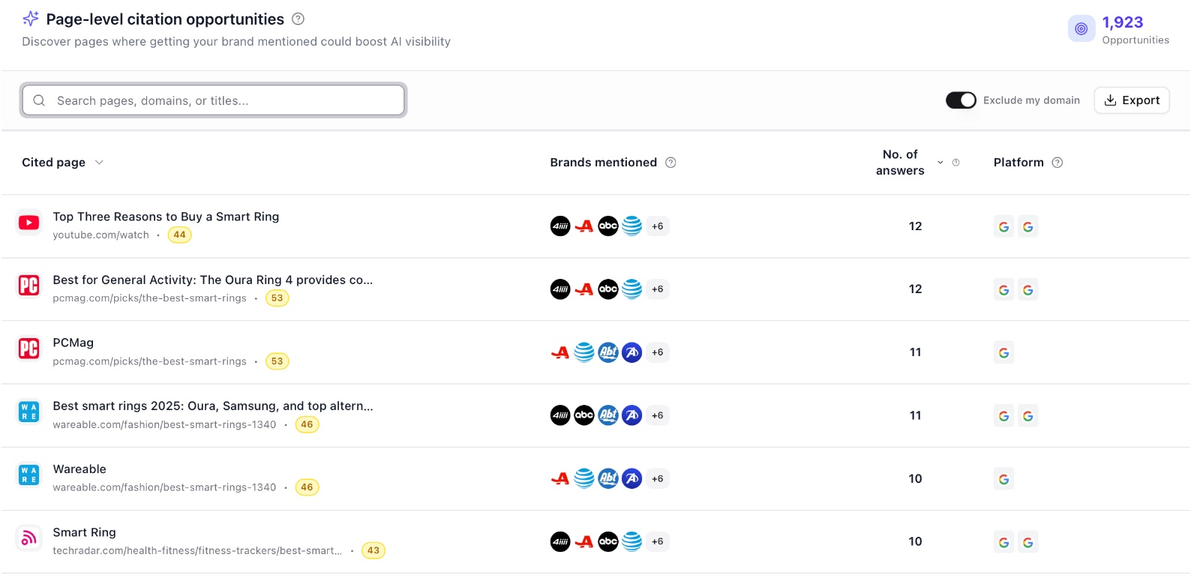
From there, you can pick five to ten third-party pages that are cited in the answers and reach out to their editors asking them to include your brand in the article.
6. Show up on Community and UGC Platforms
Building a positive brand presence in these websites, especially in discussions that are already cited in AI answers, naturally improves your AI visibility.
You can start manually by identifying which UGC threads rank or get cited most often in your space. Search Reddit or Quora for questions around your core topics, contribute to those threads meaningfully, and also keep an eye out for any of these discussions being cited in AI answers.
Of course, doing this at scale is tedious. That’s why, inside Superlines, we make it simpler by showing you which Reddit, Quora, and other UGC discussions are already cited in AI answers.
This way you know exactly which discussions to involve yourself in while skipping the research part.
Here’s how you can do it:
- You can filter the citations by domain source to find Reddit and Quora from the tracked prompts answers inside Superlines and other similar tools.
- Participate in ongoing discussions by offering helpful suggestions and insights, mentioning your brand where relevant, without being overly salesy or promotional.
- Absorb the overall questions that your target group is asking in these forums since they clearly didn’t find the answer they were looking for from anywhere else and use this as intel on what kind of content you could produce since they probably aren’t the only people looking for answers to these topics
- Initiate your own threads or discussions around relevant keywords and topics where your brand has expertise, so your content becomes part of conversations AI may later reference.
- Address customer feedback, reviews, or doubts shared about your brand on these platforms directly and transparently to strengthen trust and credibility.
Keep all interactions natural. Users of platforms like Reddit rarely tolerate overly salesy, fake, or undercover promotional posts. So, make sure your brand doesn’t toe the line between being helpful and being manipulative or self-absorbed, since that's a fast track of getting your account banned.
7. Ensure Your Site Is Accessible To AI Crawlers
Even the best content and authority signals won’t help if AI engines can’t access your website in the first place.
Just as SEO depends on Googlebot being able to crawl your site, AI visibility depends on allowing AI crawlers, like those from OpenAI, Anthropic, or Perplexity, to index your pages.
When these crawlers can’t reach your site, your content effectively becomes invisible to AI engines, meaning it can’t be referenced or cited in answers.
Here’s how to make sure your website is AI-accessible:
- Check your robots.txt file to confirm you’re not blocking AI crawlers such as GPTBot, OAI-SearchBot, and ChatGPT-User (OpenAI), ClaudeBot (Anthropic), or PerplexityBot.
- If you use automated bot-blocking tools or firewalls, whitelist these crawlers so they can access your content safely.
- Avoid unnecessary no-index or anti-scraping scripts on pages you want AI engines to read and reference.
- Review your site’s accessibility regularly, especially after technical SEO changes, to ensure you haven’t unintentionally restricted AI bots.
Quick tip: When you audit your page with Superlines, it can automatically detect if AI crawlers like GPTBot or ClaudeBot are being blocked and flag the issue for you, so your site stays fully accessible to AI engines.
8. Manage Your Brand Image Proactively
As we’ve covered, AI engines form their understanding of your brand based on what’s publicly available across the web: articles, reviews, discussions, and mentions. If incorrect, negative, or outdated information exists online, AI may surface or even amplify it in its responses.
That’s why managing how your brand is represented across digital channels is as much an AI visibility effort as it is a PR effort.
For the most part, you’re probably already tracking how people talk about your brand on social media and review platforms. But AI refers to a broader set of sources: everything you are already tracking plus UGC sites like Reddit, third-party mentions, expert roundups, and so on.
That means, its version of your reputation can look very different from what you see, so you’ll need to track it from an AI perspective.
We’ve already factored this into Superlines. Using the Sentiment page, you can see exactly how AI engines describe your brand, where those impressions come from, and what needs correcting.
Here’s how to do it effectively:
- Keep a check on your brand’s sentiment using the Brand Sentiment page on Superlines.
- If you notice any incorrect or negative themes associated with your brand, click on the keyword to check which source AI is referring to. This will give you an idea of where the idea is coming from.
- If the information is wrong, reach out to the respective domain to correct it.
- If the negative theme stems from genuine customer frustrations, involve your support team to proactively address the issue.
Using an AI visibility tool like Superlines makes sentiment tracking much easier. That said, an AI visibility tool can help you with a lot more, especially if you’re trying to scale your AI presence.
9. Repurpose content into the channels AI reads
Even the best citation worthy article will not get picked up if it only lives on your blog. AI systems learn from patterns that appear across many surfaces, not from a single isolated page.
Turn your best guides into LinkedIn posts, YouTube videos, short clips, and guest articles on relevant industry sites. These channels feed back into the web that AI crawlers use as training and retrieval data.
When you track AI visibility systematically, you can also measure the impact of PR and campaigns in a new way. Platforms like Superlines show whether your Brand Visibility and Citation Rate improve around the topics you are promoting, so you see if distribution work is actually turning into more mentions, citations and traffic.
10. Use AI Visibility Tools To Scale Results
Managing AI visibility manually is nearly impossible at scale. AI-generated answers and the sources they reference change constantly, sometimes even daily, based on new data, content updates, and user behavior.
Keeping track of these changes, fixing the visibility gaps, and monitoring the outcomes constantly without automation is not just time consuming, it’s also prone to error.
Superlines fixes this exact problem. In a few sections above, you’ve already seen how Superlines can help by spotting citation opportunities, identifying relevant UGC discussions, and monitoring sentiment. That’s just a glimpse of what Superlines can do.
With both monitoring and action tools built in, Superlines condenses this entire AI visibility strategy into one single platform.
Here’s what you can do with Superlines:
- See where your brand stands right now. Check if your brand appears in ChatGPT, Gemini, Perplexity, or Copilot or any other AI answer engine, and see which sources those mentions come from.
- Find what’s missing. Identify where competitors are being cited instead of you, and get clear direction on which pages or queries to target next.
- Act without second-guessing. The Action Center shows you specific steps based on your current AI visibility, like adding schema, fixing content gaps, or earning mentions, to improve your visibility right away.
- Track real progress over time. Monitor how your brand visibility, citations, and sentiment evolve week over week as AI models refresh their knowledge.
No more scattered tools or guesswork. Superlines is purpose built AI Search analytics that supports the full GEO workflow by showing what is missing and giving you the actions to fix it through structured data, all in one platform.
For a deeper dive into citations specifically, see our guide on how to get cited by AI.
Measuring AI Visibility: Key Metrics To Track
SEO brings to mind organic traffic and keyword rankings. Important metrics, both of them. But as AI engines emerge as new discovery surfaces, you need new metrics that allow you to measure success and double-down on what works.
Brand Visibility: The percentage of relevant AI answers where your brand is mentioned by name, whether or not there is a link. This shows how present you are in the conversation.
Citation Rate: The percentage of relevant AI answers where your content is explicitly cited as a source, usually with a clickable link. This shows how often AI tools actually rely on your pages as evidence.
For example, if you track 100 relevant AI answers in your category and your brand appears in 40 of them, your Brand Visibility is 40 percent. If 10 of those 100 answers include a direct link or source reference to your content, your Citation Rate is 10 percent.
Once you start tracking these KPIs, it makes AI search visibility measurable and far more intentional rather than a blurry concept. You know what to do more of, what to fix, and how to keep your brand showing up in the conversations that drive conversions.
Turn AI Visibility Into Your Next Growth Channel
Each citation your brand earns in an AI-generated answer strengthens the next one. AI engines notice patterns: which brands get mentioned most, where credible sources link, and what entities appear repeatedly in authoritative contexts. The more visible you become now, the easier it is to stay visible when competitors catch up.That compounding effect is what makes AI visibility so powerful. The brands building those signals today are creating momentum that will be hard to catch six months from now. You don’t need to dominate every AI engine overnight. But you do need to start.
Superlines gives you everything you need to build that momentum: real-time visibility tracking directly from the UIs instead of using APIs only(so the answers you see are what the users see), competitive insights and advanced features that support the full GEO workflow. Claim your space in the next era of search.
Start building your AI Search visibility with Superlines today!