.svg)
.svg)
.svg)
.svg)



100+ AI SEO Statistics for 2026: The Ultimate Guide to AI Search & GEO
GEO, AEO, LLMO, AI SEO — whatever acronym you want to use — is a hyper-growing field. Marketers, SEOs, and content teams are doing lots of experiments and studies on the topic, and it can be hard to keep up. That’s why we’ve pulled everything together in this article, so you can track the latest findings, news, and trends on AI Search. We’ll keep updating this guide with relevant statistics in the months to come.
Summary
- The Emergence of the Agentic Internet: This guide provides a central knowledge hub for 2026, helping brands navigate the shift from traditional search to AI-driven discovery and GEO.
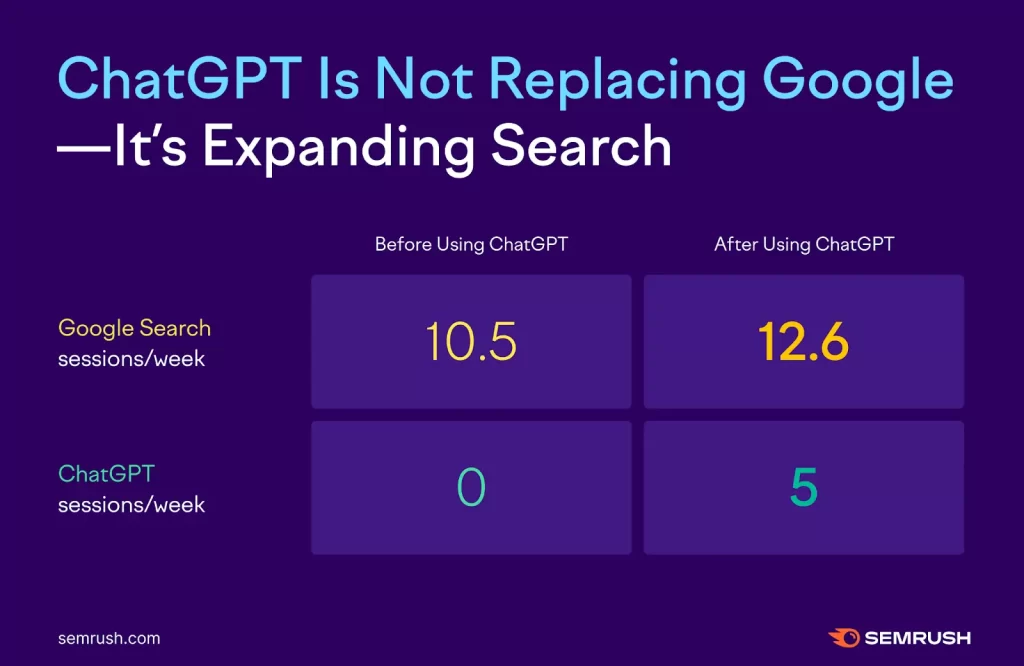
- AI Search is a Growth Catalyst: Far from replacing legacy engines, AI Search is expanding behavior; average Google usage increased to 12.6 sessions per week after users adopted ChatGPT.
- The New Visibility Paradigm: With organic CTR dropping by 61% in AI Overviews, the priority for marketers is now securing direct AI citations to earn a 35% CTR boost.
- Winning through Third-Party Authority: Data confirms brands are 6.5x more likely to be cited in AI answers through third-party sources like Reddit and Wikipedia than through their own domains.
- A New Blueprint for Content Quality: To maximize AI Search visibility, teams must prioritize "node-based" structured content and technical speed over traditional backlink-heavy strategies.
Key Takeaways
- The "Citation Lift" is Vital: While an AI Overview can drop organic CTR by 61%, being cited as a source within that AI Search answer boosts your brand's organic CTR by 35%.
- Third-Party Authority is the New Battlefield: Brands are 6.5x more likely to be cited through third-party sources, making off-site GEO presence critical for visibility.
- AI Mode is the New "Zero-Click" Frontier: 75% of users never leave the AI Mode pane, requiring brands to win visibility directly inside the generated answer interface.
- Content Depth Trumps Traditional SEO Metrics: For securing AI citations, factors like content depth, readability, and freshness correlate more with success than traditional traffic or backlink counts.
- Websites with more organic traffic tend to get more mentions in AI Overviews and Perplexity. But that’s not the case with AI Mode and ChatGPT.
- Technical Speed and Structure are AI Signals: Fast-loading pages are 3x more likely to be cited by ChatGPT, and structured "node-based" content is the most effective format for extraction by AI assistants.
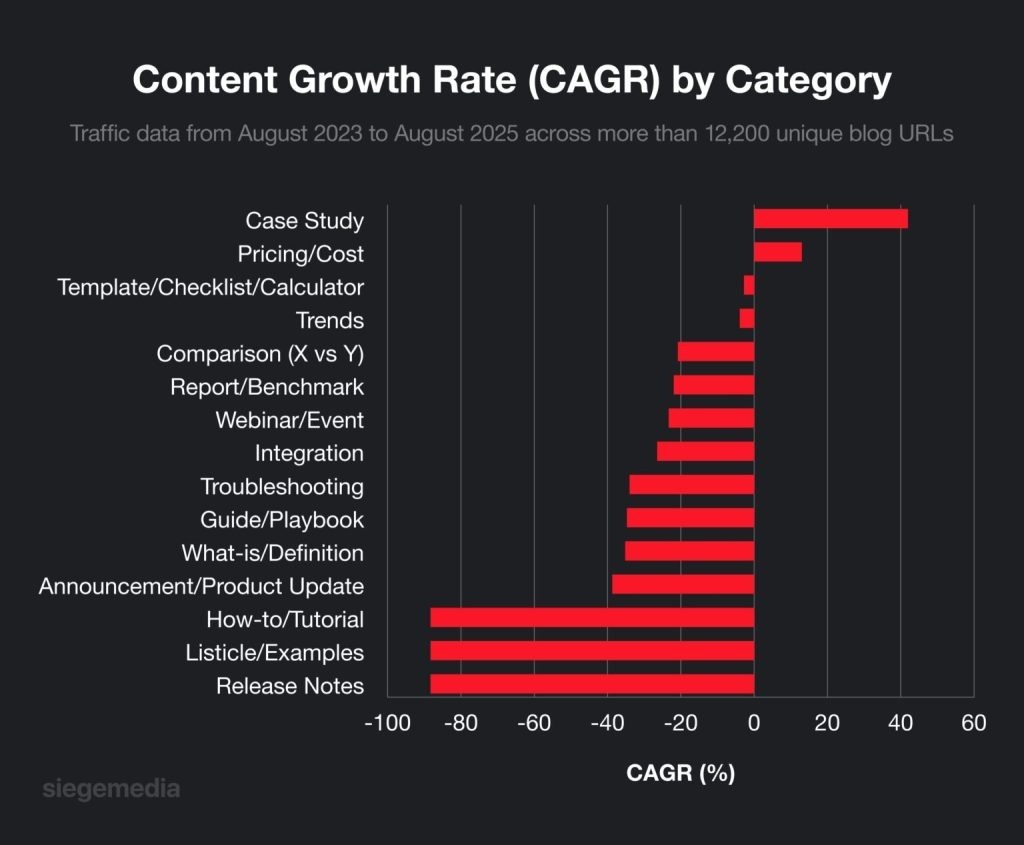
- Bottom funnel content like case studies and pricing pages get the highest AI referral traffic, while top funnel content (what is and how-to guides) saw massive drops in the past two years.
What is actually different about AI Search compared to classic SEO?
AI search uses the same indexing foundations as SEO, but shifts the decision making from the user to the LLM, which breaks the classic “click into websites” funnel. LLMs haven't rewritten the rules of how websites are built or how indexing works, but they've created a new intelligent layer on top of it. The real difference is that it used to be the human user who at least to some extent decided the keywords and conducted to-the-point searches. Google and other search engines returned links that the user needed to click and scrutinize in order to validate whether the source was valuable. Now the LLM does this and provides the answers, often leading to so-called "zero-click" experiences as the scrutiny has already been done and content summarized in the AI's response.
So the real struggle for marketers isn't the "is it SEO?" question but rather the issue that the traditional performance funnel gets broken and the user experience is now different. If attribution was ever correct, now it's even more inaccurate. In AI Search, we don't have control anymore over the user's actions or the "funnel." That's why marketers are moving to adopt visibility metrics regarding their position in the conversations and using this as a critical KPI when measuring the success of their marketing and brand.
What are the three layers of AI Search and how fast are they?
AI Search can potentially produce faster results than traditional SEO but the reality is of course nuanced. AI Search operates on three distinct layers, each with its own speed dynamics:
Layer 1: Training data (the slowest layer)
This is where LLMs learn about your brand during their training process. It's the slowest layer, but not as slow as you might think. Based on Superlines research, we're seeing bots visiting sites almost every other day, suggesting they might be fine-tuning parts of their models quite rapidly. Still, getting into the base training data of major LLMs can take months.
Layer 2: High-volume AI Search (speed depends on your SEO)
This includes free ChatGPT, Google's AI Overviews, and similar tools or interfaces that rely heavily on existing search engine indexes. Here's the key insight: this layer is only as fast as your SEO is good.
If you have strong domain authority and consistently publish quality content, your visibility can improve rapidly. Potentially faster than traditional SEO because AI engines can surface your content in synthesized answers immediately after indexing. If your SEO fundamentals are weak, this layer can be just as slow as traditional search optimization. The speed advantage comes from understanding the connection between prompts, query fan-outs, and how your content addresses both.
Layer 3: Agentic AI (real-time & lightning fast)
This is where things get really interesting. Pro and advanced tools like Perplexity Pro, ChatGPT's Research and Shopping Assistant, and Claude Desktop with MCPs (Model Context Protocols) actually scrape and read your pages in real-time. These agents are intelligent, autonomous, and fast. Usage is growing rapidly, and this is where we're heading into true "agentic shopping" territory.
AI Search Engine Usage Statistics
AI chatbots like ChatGPT, Perplexity, and Gemini are becoming popular search channel alternatives, especially for ultra-long and super-specific queries.
But interestingly, according to recent data, people haven’t abandoned traditional search engines just yet.
Google is an AI Search channel too
When people hear GEO, they often think only about assistants like ChatGPT or Perplexity. In reality, Google itself has become an AI Search surface through AI Overviews and AI Mode. High-volume AI experiences such as Google AI Overviews and AI Mode sit in Layer 2 of AI Search, where visibility is only as fast as your SEO and site indexing allow. For many informational and research queries, the main user experience is now an AI generated answer at the top of the page, with traditional results pushed down or ignored.
The same GEO work that helps you appear in chatbot answers also helps you get cited inside these Google AI surfaces, because they rely on structured, machine readable content and clear sources in exactly the same way.
Here are AI search adoption statistics for 2026:
- Google is still the most popular search engine with over 5 billion users globally, processing an estimated 16.4 billion searches per day. (Demandsage, August 2025)
- AI adoption rate has increased massively: from 14% in February to 29.2% in August. (HigherVisibility, August 2025)
- ChatGPT is the most dominant force in the LLM space, driving 800 million weekly users and processing 2.5 billion prompts each day. (Exploding Topics, August 2025)
- Nearly 40% of Americans use at least one AI chatbot once per month or more. (SparkToro, August 2025)
- 20% of Americans are heavy users of LLMs. They use ChatGPT, Perplexity, Claude, Copilot, Gemini, and Deepseek more than 10 times a month. (SparkToro, August 2025)
- Despite a high AI adoption rate, 95% of Americans continue using traditional search engines like Google, Bing, Yahoo, and DuckDuckGo. (SparkToro, August 2025)
- The average Google Search usage went up to 12.6 sessions per week after people began using ChatGPT, compared to 10.5 weekly sessions before ChatGPT adoption. (Semrush, August 2025)
- ChatGPT usage for general information searches has tripled from 4.1% to 12.5% in just 6 months (February to August 2025). (HigherVisibility, August 2025)
- The most common use cases of ChatGPT are Practical Guidance (29%), Seeking Information (24%) and Writing (24%). These account for 77% of all ChatGPT conversations. (OpenAI and Harvard, September 2025)
- AI Mode usage has increased roughly 4x since its launch, growing from 0.25% in May to over 1% in July. (Semrush, September 2025)
- AI Mode hits 75 million users, said Google’s Nick Fox. (Search Engine Journal, December 2025)
Brand Mentions & Citations in AI Answers
Search visibility isn’t just about ranking in traditional SERPs anymore. It’s about being consistently recommended and cited by AI-generated answers.
But, in order to win the war for AI inclusion, you have to know the battlefield first.
- The average AI Mode answer contains 12.6 links. (SE Ranking, August 2025)
- In comparison, AI Overviews link to 13.3 sources on average. (SE Ranking, August 2025)
- Despite being Google products, AI Overviews and AI Mode show limited response overlap: just 10.7% of URLs and 16% of domains. (SE Ranking, August 2025)
- AI Mode has extremely high volatility. When performing three tests for the same query, AI Mode had overlapping results with itself just 9.2% of the time. (SE Ranking, August 2025)
- 90.8% of AI Mode links are placed in a separate block, while only 8.9% are embedded directly within the answer. (SE Ranking, August 2025)
- AI assistants hallucinate links nearly 3x more often than Google Search. ChatGPT is the biggest offender with 2.38% of all cited URLs returning a 404 error code. (Ahrefs, September 2025)
- When users enter a specific product (e.g MacBook Air), AI Mode will show the brand’s product page. If the prompt is more general (e.g laptop), it prefers to show marketplaces instead. (Growth Memo, October 2025)
- Brands are 6.5x more likely to be cited through third-party sources than their own domains. (Airops, October 2025)
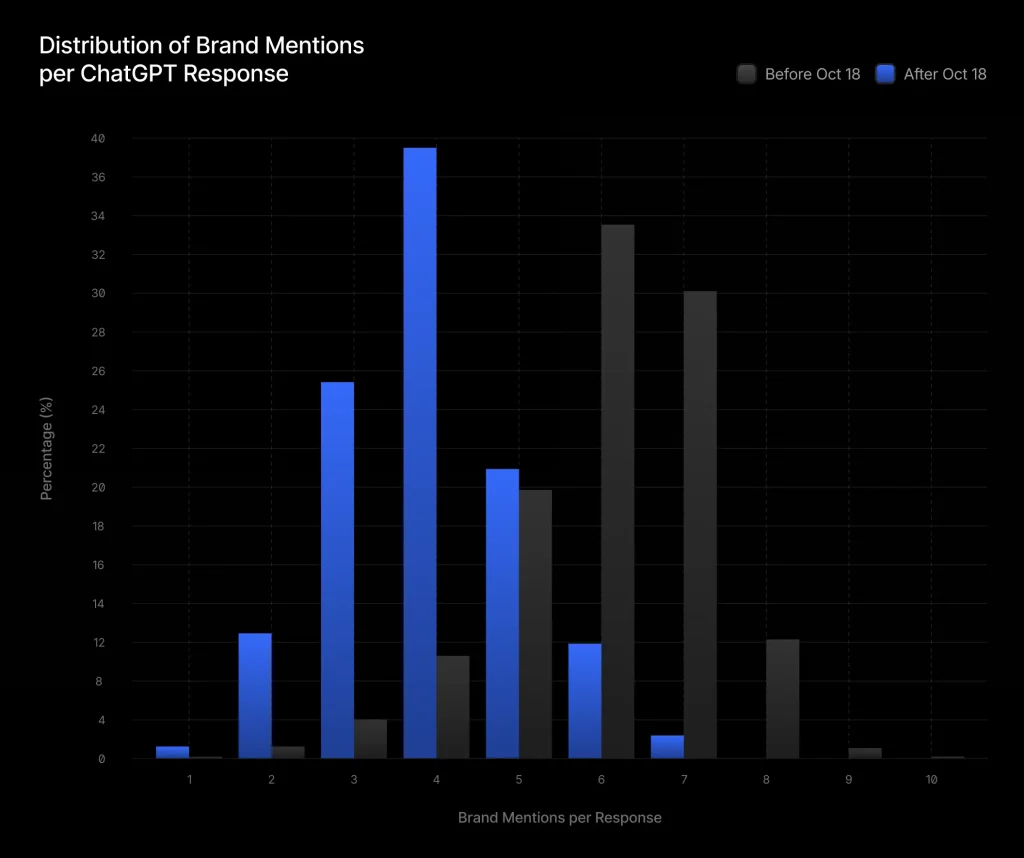
- ChatGPT now show fewer brand mentions in its responses after the recent October algo update, dropping from around six–seven to three–four per answer. (Profound, November 2025)
- AI Overview content changes 70% of the time for the same query. And when it generates a new answer, 45.5% of citations get replaced with new ones. (Ahrefs, November)
- YouTube mentions and branded web mentions are the top factors that correlate with AI brand visibility in ChatGPT, AI Mode, and AI Overviews. (Ahrefs, December 2025)
- AI Overviews and AI Mode cite different sources: only 13.7% of citations overlap between the two Google AI features. (Ahrefs, December 2025)
You can read our full article about what is the difference between AI brand mention and AI citations.
ChatGPT Statistics
Find out how exactly ChatGPT’s query fan-out works and how the chatbot decides which brands to surface and which sources to cite.
- Out of 8,500+ prompts analyzed in ChatGPT, around 31% trigger a web search. (Nectiv, October 2025)
- Prompts with a local intent trigger a web search in 59% of all instances. (Nectiv, October 2025)
- General “Commerce” is also likely to trigger the search function (41% of the time). Credit Cards and Fashion were the least likely to have ChatGPT perform a search with only 18% and 19% of instances respectively. (Nectiv, October 2025)
- On average, ChatGPT performs 2 searches per query. Each search is typically between 5-6 words long. (Nectiv, October 2025)
- Jobs & Career and Software have an average of nearly 3 fan-out searches, the highest of any sectors. (Nectiv, October 2025)
- The most common terms that trigger the search function in ChatGPT are ‘reviews‘, ‘2025‘, ‘free‘, ‘features‘, and ‘comparison‘. (Nectiv, October 2025)
For a deeper look at specific usage trends, query fan-out logic, and exclusive 2026 data, see our full guide to ChatGPT Statistics.
ChatGPT ranking factors:
- LLMs.txt doesn’t matter but domain authority does. Sites with over 32K referring domains are 3.5x more likely to be cited by ChatGPT than those with up to 200 referring domains. (SE Ranking, November 2025)
- Domains with millions of brand mentions on Quora and Reddit have roughly 4x higher chances of being cited than those with minimal activity. (SE Ranking, November 2025)
- Domains with profiles on platforms like Trustpilot, G2, Capterra, Sitejabber, and Yelp have 3x higher chances to be chosen by ChatGPT as a source, compared to sites without such presence. (SE Ranking, November 2025)
- Pages with FCP under 0.4 seconds average 6.7 citations, while slower pages (over 1.13 seconds) drop to just 2.1. This means that fast-loading pages are 3 times more likely to be cited by ChatGPT compared to slower ones. (SE Ranking, November 2025)
- Content depth, structure, and freshness also matter a lot if you want to secure ChatGPT citations. (SE Ranking, November 2025)
User Behaviors in AI Mode
AI has a massive impact on the way people find information and interact with websites.
Here are some interesting findings from recent studies:
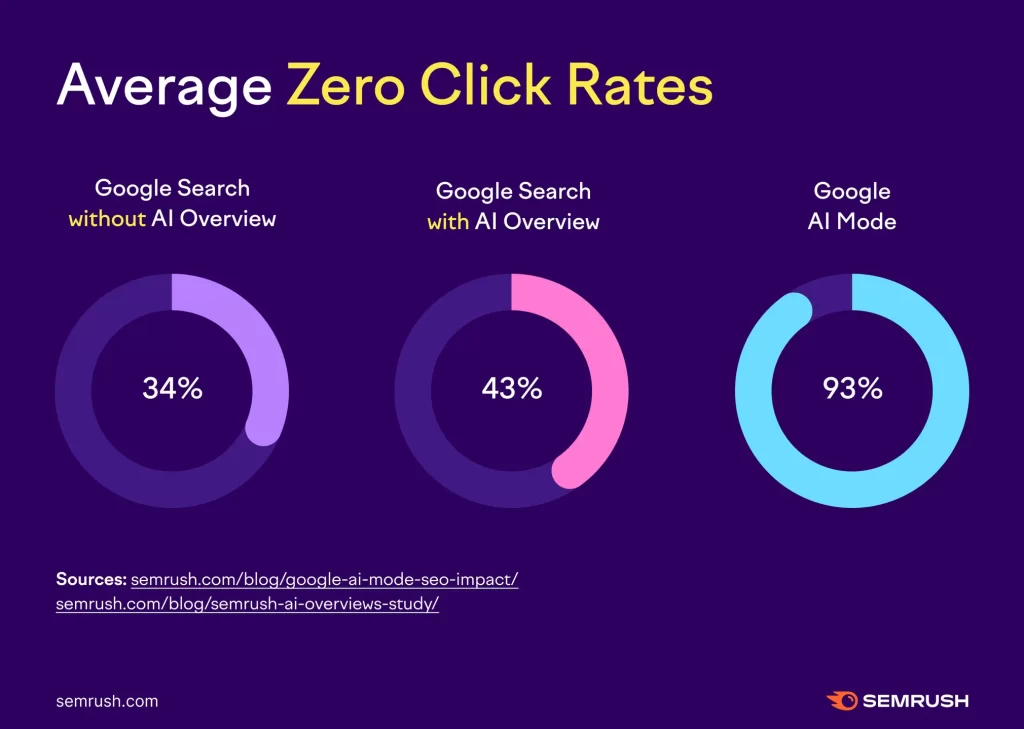
- Around 93% of AI Mode searches end without a click. This is more than twice the rate of AI Overviews, where 43% result in zero clicks. (Semrush, September 2025)
- Users spend double the time in AI Mode compared to AI Overviews (49 seconds vs 21 seconds in average). (Growth Memo, October 2025)
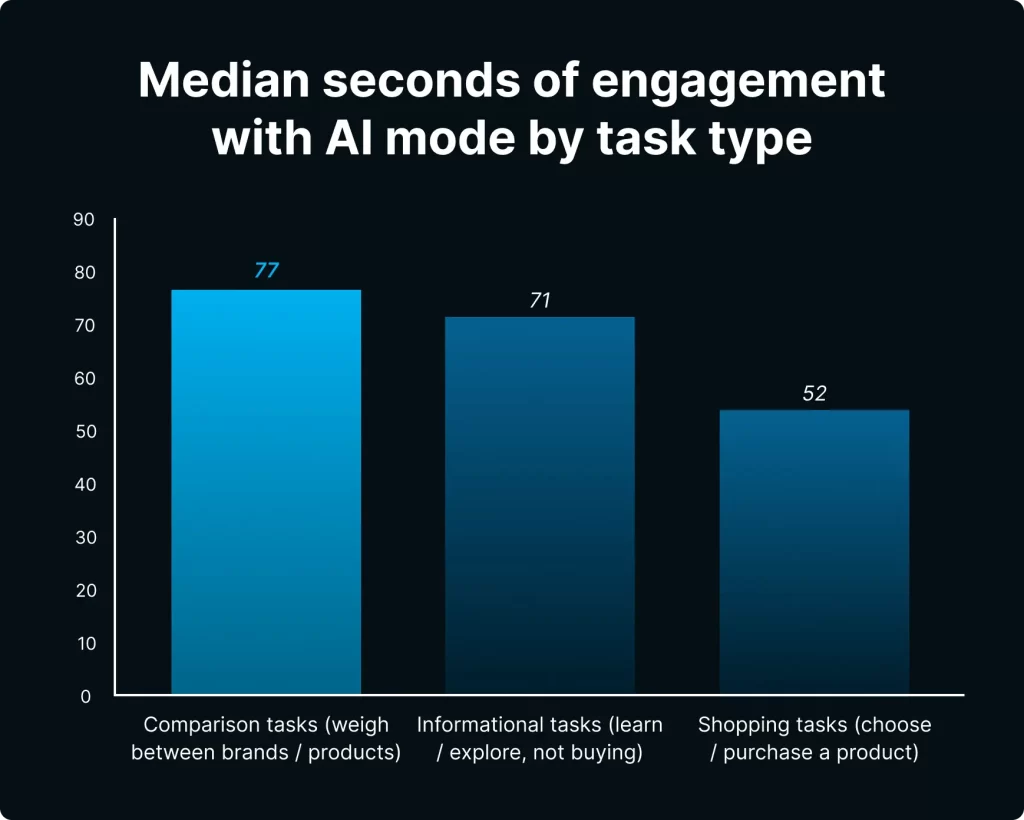
- The median time spent on different tasks in AI Mode: 77 seconds for comparing brands or products, 71 seconds for learning information, and 52 seconds for choosing or purchasing products. (Growth Memo, October 2025)
- In 75% of AI Mode sessions, users never left the pane. In other words, most AI Mode sessions end without external visits. (Growth Memo, October 2025)
- Clicks in AI Mode are mostly reserved for transactions. (Growth Memo, October 2025)
Top Cited Domains in AI Answers
Understanding which domains are most frequently cited in AI answers is crucial for marketers and publishers alike.
This data tells you where you should build your brand presence and which content formats AI systems are likely to pull from.
- Brand popularity (measured by search volume) has a high correlation with mentions in AI chatbots, especially ChatGPT. (Growth Memo, March 2025)
- Wikipedia is the most cited source in ChatGPT (7.8%), followed by Reddit (1.8%), Forbes (1.1%), and G2 (1.1%). (Profound, June 2025)
- Google is more likely to pull data from Wikipedia, YouTube, Reddit, and Quora for AI Overview responses. (Ahrefs, June 2025)
- The top mentioned domains in Perplexity answers are YouTube, Wikipedia, Apple, and Google. (Ahrefs, June 2025)
- AI Overviews prefer websites with strong brand signals (like brand mentions and branded searches) more than ChatGPT and Perplexity. (Ahrefs, July 2025)
- Besides Wikipedia and Reddit, review and affiliate sites like Forbes, Nerdwallet, Investopedia, Value Penguin, and others are heavily cited in LLM responses. (Amsive, August 2025)
- The top cited domains in ChatGPT in the US are Reddit, Wikipedia, Amazon, Forbes, and Business Insider. (Ahrefs, September 2025)
- Wikipedia, YouTube, Google’s blog, and Reddit are the most cited domains in Google’s AI Mode. (Ahrefs, September 2025)
- G2 is the most cited software review platform on ChatGPT, Perplexity, and Google’s AI Overviews. (Radix)
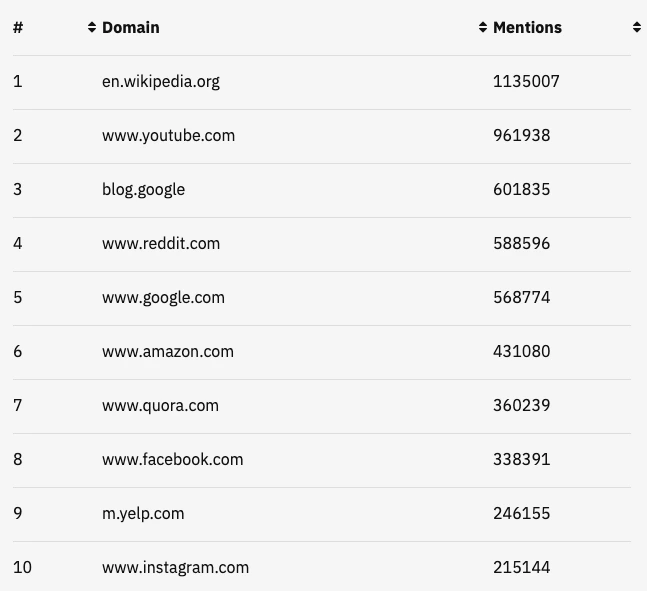
See our guide for more information on How to use Reddit to improve AI search visibility?
Google AI Overview Statistics
We’re entering the era of zero click search.
AI Overviews are pushing down organic search results and stealing clicks from publishers.
But what keywords actually trigger an AI Overview? How significant the effect is on traffic? And what sectors are impacted the most?
Let’s look at the numbers.
- 60% of searches in traditional search engines end without a click due to AI summaries. (Bain, February 2025)
- AI Overviews reduce clicks to top-ranking pages by 34.5%. (Ahrefs, April 2025)
- Click-through rate (CTR) drops from 15% to 8% when an AI Overview is present (Pew Research Center, July 2025)
- Only 1% of searches lead to users clicking a link within an AI Overview. (Pew Research Center, July 2025)
- Users tend to end their search session more often when an AI answer is shown – 26% compared to 16% for results pages without AI Overviews. (Pew Research Center, July 2025)
- AI Overviews show up 25% of the time. When a video is shown, it’s almost always coming from YouTube. (Conductor, November 2025)
- Organic CTR for queries where an AI Overview is present has dropped 61% YoY (June 2024 – September 2025). (Seer Interactive, November 2025)
- But when your brand is cited in the AI Overview, organic CTR is 35% higher. (Seer Interactive, November 2025)
- AI Overviews appear in 99.9% of informational keywords. 46% of which are long-tail queries (7 words or more) and 57.9% are question queries. (Ahrefs, November)
- Sectors with the highest AI Overview share are Science (43.6%), Health (43.0%), Pets & Animals (36.8%), and People & Society (35.3%). (Ahrefs, November)
- While sectors with the lowest share of AI Overviews include Shopping (3.2%), Real Estate (5.8%), Sports (14.8%), and News (15.1%). (Ahrefs, November)
- Only 7.9% of local searches trigger an AI Overview. (Ahrefs, November)
Overlap Between Organic and AI-Driven Search
Does better SERP performance translate into higher visibility in AI-generated answers? The answer will depend on the platform.
What we so far from multiple studies, AI Overviews have the strongest correlation with traditional search rankings.
In contrast, LLMs like ChatGPT and AI Mode tend to draw from a wider range of sources, often citing lower-ranking or even non-ranking pages if they provide contextually relevant information.
- Websites with more organic traffic tend to get more mentions in AI Overviews and Perplexity. (Ahrefs, June 2025)
- However, there’s a weak correlation between high organic traffic with ChatGPT inclusion. (Ahrefs, June 2025)
- 76.1% of URLs cited in AI Overviews also rank in the top 10 of Google search results. (Ahrefs, July 2025)
- ChatGPT Search primarily cites lower-ranking pages (position 21+) about 90% of the time. (Semrush, July 2025)
- Only 12% of URLs cited by ChatGPT, Perplexity, and Copilot rank in Google’s top 10 search results. (Ahrefs, August 2025)
- 80% of LLM citations don’t even rank in Google’s top 100 for the original query. (Ahrefs, August 2025)
- AI Mode also has limited overlap with traditional Google results. Only 14% of URLs cited by AI Mode rank in the top 10. (SE Ranking, August 2025)
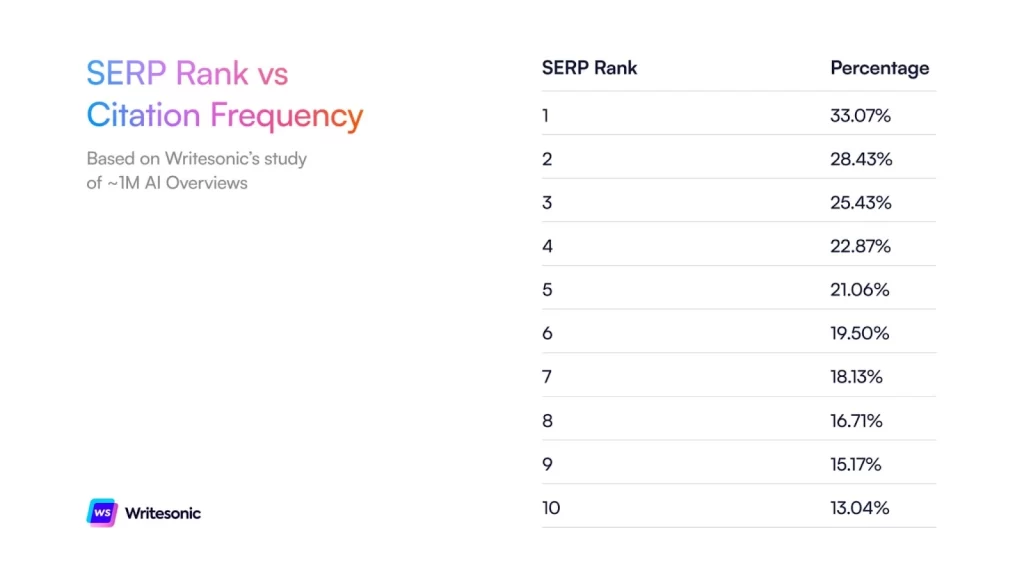
- If your website ranks first on SERP results, there’s a 33.07% chance that it will also appear in AI Overviews. (Writesonic, August 2025)
- Just 10% of ChatGPT’s short-tail query results overlap with Google SERPs. (Ahrefs, September 2025)
- 28.3% of ChatGPT’s most cited pages have zero organic visibility. (Ahrefs, October 2025)
AI Referral Traffic and Conversions
Traffic from AI is still relatively small (only 0.1% of the total web traffic), but it’s growing fast.
Early research also showed that AI referral visitors convert better than traditional search visitors. Although more recent studies say otherwise.
These stats highlight the current size and quality of AI traffic.
- AI traffic has grown by 9.7% since 2024. (Ahrefs, June 2025)
- Gen AI traffic is growing 165x faster than organic search traffic. (WebFX, June 2025)
- ChatGPT is the biggest AI referrer, now sending more referral traffic than Reddit and LinkedIn. (Ahrefs, June 2025)
- AI traffic drove 12.1% more signups for Ahrefs, despite making only 0.5% of all visitors. (Ahrefs, June 2025)
- Users from LLMs like ChatGPT and Perplexity browse fewer pages and spend less time on your website. (Ahrefs, June 2025)
- 50% of links in ChatGPT 4o responses point to business or service websites. (Semrush, July 2025)
- LLM visitors convert 4.4x better than organic search visitors. (Semrush, July 2025)
- AI-referred sessions saw a 527% year-over-year increase. (Search Engine Land, August 2025)
- Consultancy-driven sectors like legal, finance, health, and insurance seem to drive higher AI visitors compared to other industries like SaaS and eCommerce. (Search Engine Land, August 2025)
- ChatGPT’s referral traffic to e-commerce websites generates lower conversion rates and revenue per session than Google’s organic and paid search visitors. (Maximilian Kaiser and Christian Schulze, October 2025)
- Despite strong growth earlier this year, AI referral traffic has dropped -42.6% since July. (Kevin Indig, November 2025)
- On average, traditional organic traffic accounted for 25% of all website traffic, while AI referral traffic accounted for just 1.08%. (Conductor, November 2025)
- 87.4% of all AI referral traffic comes from ChatGPT. (Conductor, November 2025)
Content Optimization for AI Search
Optimizing content for search engines is a bit different than optimizing for LLMs.
Generative AI engines no longer just match exact keywords – they interpret intent and context. These systems look for comprehensive, semantically rich answers that align with what the user is really asking.
- (Suggested reading: How to get cited by AI)
Some models also demonstrate a clear bias towards content freshness more than the others.
These stats will give you a better picture of what it takes to create AI-friendly content that gets picked up by AI Overviews, ChatGPT, and other LLMs.
- When it comes to securing AI mentions and citations, content depth (sentence and word counts) and readability matter most, while traditional SEO metrics like traffic and backlinks have little impact. (Growth Memo, March 2025)
- Response time is another strong factor: content that loads faster is more likely to be included by AI. (Growth Memo, March 2025)
- Q&A is the best format for AI search. Structured content (headings and lists) is almost as effective for non-question queries, while dense paragraphs perform worst. (Chris Green, June 2025)
- 85% of AI Overview citations were published in the last two years. 44% are from 2025. (Seer Interactive, June 2025)
- 50% of Perplexity citations are content published in 2025 alone. (Seer Interactive, June 2025)
- ChatGPT is more likely to reference older content than AIO and Perplexity, with 29% of its citations dating back to 2022 or earlier. (Seer Interactive, June 2025)
- AI Overviews are more likely to cite AI-generated content than human-written content. (Ahrefs, July 2025)
- 86.85% of the time, AI Overviews don’t include the exact search query. (Writesonic, August 2025)
- Case studies and pricing pages are the best content types to drive traffic in the age of AI. Top funnel content (what is, how-tos, guides) saw massive drops in past two years. (Siege Media, September 2025)
- Content freshness score is a major ranking factor across seven AI models: GPT-4o, GPT-4, GPT-3.5, LLaMA-3 8B/70B, and Qwen-2.5 7B/72B. (Metehan Yesilyurt, October 2025)
- Content translation can boost your AI visibility. Translated sites gain 327% more visibility in AI Overviews compared to untranslated sites. (Weglot, October 2025)
- Google is pushing content that demonstrates expertise and unique perspective in AI Overviews. Low-quality content that just repeats what’s already out there without adding something new will be down-ranked. (Liz Reid, VP of Google Search, October 2025)
- More G2 reviews lead to higher visibility, but the number isn’t significant: a 10% increase in reviews leads to a 2% increase in AI citations. (Kevin Indig, October 2025)
- Most cited pages in ChatGPT by content type: Wikipedia (29.7%), Homepage/Landing Page (23.8%), and Educational Page (19.4%). (Ahrefs, October 2025)
- AI Overviews love factual statements: the typical AIO-cited article covers 62% more facts than the typical non-cited one. (Surfer SEO, November 2025)
- Core sources (pages that are cited every time AI Overview is generated for a topic) cover 42% of key facts for their topic. (Surfer SEO, November 2025)
- Google’s John Mueller said you don’t need to create bot-only Markdown or JSON clones of existing pages just to be understood by LLMs. Clean HTML works just fine. (John Mueller, November 2025)
- Articles over 2,900 words average 5.1 citations, while those under 800 get 3.2. For smaller domains, content length has roughly 65% more impact on ChatGPT citations than it does for top domains. (SE Ranking, November 2025)
- Content updated in the past three months averages 6 citations versus 3.6 for outdated pages. (SE Ranking, November 2025)
- In terms of structure, pages that use 120–180 words between headings receive 70% more ChatGPT citations than pages with sections under 50 words. (SE Ranking, November 2025)
- Using question-based headings and FAQ sections also boost your chances of being cited by ChatGPT. However, FAQ schema markup isn’t essential. (SE Ranking, November 2025)
- “Best X” listicles are the most cited page types in ChatGPT responses, accounting for 43.8% of all page types. (Ahrefs, December 2025)
Read our full in-depth guide on What is Generative Engine Optimization (GEO) to understand all the aspects
Technical Implementation for Agentic AI
Beyond retrieving information, AI assistants are now capable of making purchases on behalf of users.
If you want to protect (and improve) conversions, you need to make sure your website is optimized for these AI agents.
- 92% of the time, ChatGPT agents rely on the Bing Search API (instead of the live SERPs) to search for information. (Search Engine Land, October 2025)
- 46% of ChatGPT bot visits begin in reading mode, a plain HTML version of a webpage with no images, CSS, JavaScript, and schema markup. (Search Engine Land, October 2025)
- After landing on a page, 63% of ChatGPT agents leave immediately. (Search Engine Land, October 2025)
- Common reasons for AI agents bouncing include HTTP errors (4XX and 5XX), 301 redirects to unexpected URLs, loading issues (including slow load time), CAPTCHAs, and bot blocking. (Search Engine Land, October 2025)
The Relationship Between SEO and GEO
GEO doesn't replace SEO; they're complementary strategies.
Strong SEO foundations help GEO. Domain authority, quality backlinks, and technical site health all contribute to your credibility in the eyes of AI engines. If Google trusts your site, AI platforms are more likely to cite it.
Many GEO tactics improve SEO. Writing clearer, more authoritative content helps with both. Implementing structured data benefits both approaches. Building genuine expertise and authority works across all platforms.
Think of GEO as an extension of SEO for a new distribution channel. You're still doing content marketing and building online authority. You're just optimizing for how that content gets discovered and referenced in AI-generated responses rather than traditional search result pages.
Start Measuring Your Performance in AI Search
The future of search belongs to brands that understand how AI sees the web.
Superlines is your Visibility Engine for the Agentic Internet that helps you measure and improve your AI Search visibility across platforms such as ChatGPT, Perplexity, Mistral, Google AI Mode, and Gemini, so you see where you appear today and where you can win next.