


What Is The Difference Between AI Brand Mentions And AI Citations?
AI brand mentions are when AI tools reference your brand by name in an answer, even if they do not link to you. AI citations are when AI tools explicitly credit your content as the source, often with a clickable link. Mentions mainly build awareness and mindshare, citations signal authority and trust and send traffic. The most effective AI visibility strategies deliberately grow both. Together, AI brand mentions and AI citations form the two primary KPIs for AI search visibility: Brand Visibility and Citation Rate.
In this article you will learn how to tell mentions and citations apart in practice, how they show up in AI search results, how to measure Brand Visibility and Citation Rate, and how to improve both through content and technical optimization.
What is an AI Brand Mention?
A brand mention in AI is when an AI tool references your brand by name, in its answer, summary, or recommendation. No link, no explicit source – just recognition.
In the world of LLMs this matters more than most marketers realize.
Example:
Let’s say you ask ChatGPT, “What are the best Generative Engine Optimization tools?”
If the response says, “Superlines, Profound, AthenaHQ, and more” – that’s a brand mention for Superlines. No link. No citation. But suddenly, your brand is in the running.
Brand mentions can be:
- In lists and comparisons (“Top 5 AI Search Analytics Platforms: Superlines, Profound, Peec AI…”)
- As an example (“Some brands, like Superlines, use advanced tracking methods…”)
- In industry conversations, user prompts, or AI-generated reviews
Why do brand mentions matter?
Because mentions = mindshare.
Every time an AI includes your brand, you’re influencing what millions see as credible or relevant, even if they never visit your site.
In simple terms, these brand mentions:
- Signal brand recognition in AI responses
- Anchor your brand authority across AI platforms
- Build familiarity, trust, and recall, even without clicks
If you are new to the concept of GEO, start with our guide What Is Generative Engine Optimization (GEO)?
How AIs Choose What to Mention
Large language models are “trained” on massive amounts of public data. When your brand appears across news sites, blogs, forums (like Reddit, Quora, Youtube), and social posts, AI learns to associate your name with your niche.
Consistency and reputation are key.
Brands that keep getting mentioned, positively, are more likely to show up in AI answers, regardless of search ranking.
What is an AI Citation?
AAn AI citation is when an AI model directly references your brand’s content as the source for its answer, often with a link, a footnote, or an explicit acknowledgment of your website or article. This is the AI’s way of saying, “Here is where this information comes from,” so it is the generative search equivalent of a high quality backlink. If brand mentions are the digital equivalent of word of mouth, AI citations are the modern gold standard of credibility and influence in the age of generative search.
When the answer includes a clickable citation to the original Superlines How to Optimize for AI Search Results guide. This is not just a shout-out, it is the AI world’s version of a backlink, now baked directly into the zero click answers that users see before they even scroll down.
Why do citations matter?
- They prove your brand is a “trusted authority”
- They drive traffic, even in a zero-click world
- They increase the chances of your content being used in other answers, summaries, or news stories
- They build trust with users and the AI engines themselves
How AIs Choose What to Cite
LLMs and AI Search platforms don’t cite content randomly. They are programmed to pull from:
- Authoritative, well-structured content (original research, industry guides, expert interviews)
- Frequently referenced pages on reputable domains (your blog, whitepapers, trusted news outlets)
- Content that answers specific queries in clear, direct, evidence-backed language
Citations often appear as:
- Inline quotes (e.g., “According to…”)
- Footnotes or endnotes (e.g., Perplexity’s numbered citations)
- Source boxes or cards in AI Overviews (e.g., Google’s new AI-powered snippets)
April 2026 announcement from Google and highlighted by Cyrus S. + Glenn Gabe. The latest version of Chrome introduces another massive change to AI Mode. When a user clicks a link in AI Mode, they're no longer pushed to the site. Instead a new "side by side" view has been introduced.
This view open a new window in the right hand side of the screen. The web page still opens but the AI Mode experience is still on the left hand side of the screen. This will 100% keep users inside the primary AI Mode experience.
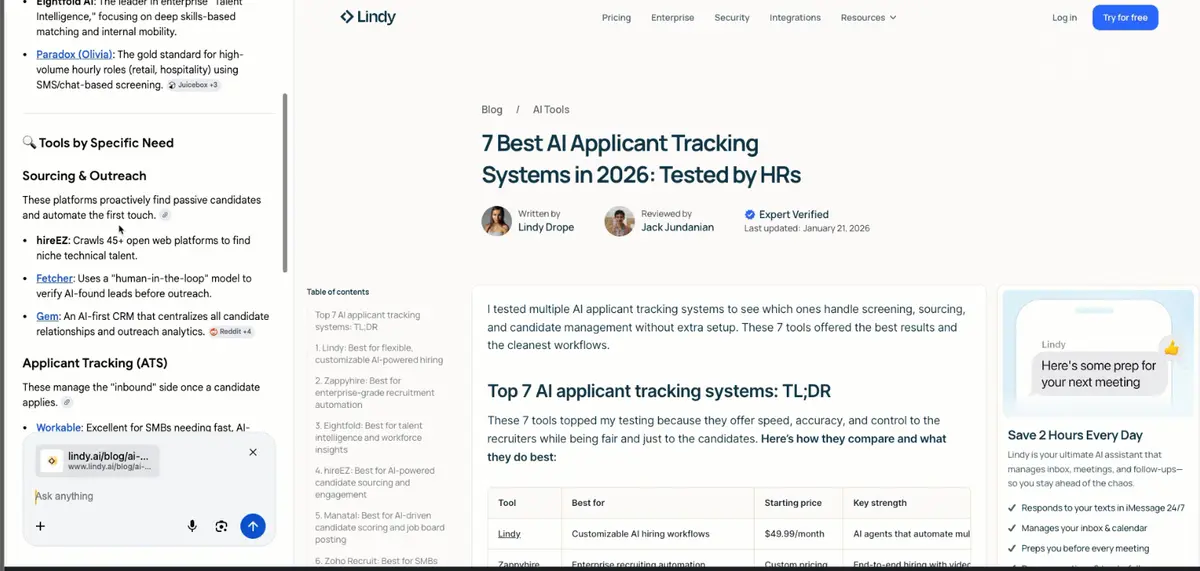
Even clicking around on the website still retains the AI Mode sidebar. This gives Google the power to run their experience directly on top of any content you own as long as it was surfaced through Google results.
This is another drop in the "AI Mode is coming soon as the main experience" bucket.
Pro tip: The more your content is cited, the more likely future AI models are to reference you again. AI “remembers” trusted sources and learns from usage patterns.
Brand Mentions vs AI Citations: Key differences
Brand mentions get your name into the conversation, AI citations turn your content into the source the AI trusts and sends users to.
How to Optimize for Brand Mentions
Here are a few things you can take into consideration if you want to optimize your AI Search visibility for brand mentions.
1. Get Your Name Out There
- Be present on podcasts, webinars, industry news, and guest posts
- Encourage third-party reviews on G2, Trustpilot, Reddit, Quora, and LinkedIn
- Respond to trends and participate in relevant online discussions
- Identify high-performing sources in AI answers where you are not yet mentioned, and work to get included in those articles and publications.
2. Monitor Your Mentions
- Use Superlines AI Search Intelligence platform to track where (and how) AIs mention your brand
- Check for negative mentions or competitor comparisons
3. Be Consistent in Messaging
- Use your full brand name (“Superlines,” not just “WS”) across all touchpoints
- Reinforce your unique value proposition everywhere you show up
Example:
We saw an increase in visibility for “Superlines” for the term “best AI tools” after we started participating more in the relevant online discussions.
These tactics increase your AI search visibility by getting your brand mentioned in more relevant AI answers, even when there is no link.
How to Optimize for AI Citations
Here is how you can optimize your content and website for AI citations and AI search visibility:
1. Publish Citation-Worthy Content
- Create original research, deep-dive guides, and data-driven studies
- Answer key industry questions with evidence and clarity
2. Use Structured Data and Schema
- Add FAQ, HowTo, Organization, and Author schema to all key pages (AI loves structured info)
- On top of that, you can use an llm.txt (or similar LLM instructions file) to tell AI crawlers which pages matter most, which actions they should take, and how you want your brand to be represented in AI answers. This isn’t a silver bullet, but doesn’t hurt to be added to your site. If you want to read more about llm.txt files and whether it improves your visibility, read our article about it here.
3. Be Transparent & Authoritative
- Include clear author bios, publication dates, and sources on your pages
- Reference your sources—AIs recognize and reward this
4. Keep Content Fresh
- Update key resources regularly (every 90 days). AI devalues outdated content, even if it’s linked elsewhere. With BOFU content, you might want to update it on a monthly basis. Especially if your competitors are actively optimizing for AI Search.
Example:
Superlines “What are the key metrics for measuring success in generative search” guide, now gets cited by AI tools for queries about Generative Engine Optimization Key Metrics, while hundreds of generic GEO posts do not.
These steps improve your AI search visibility by turning more of those mentions into full AI citations that send traffic and signal authority.
You can also read an in-depth article on How to Monitor and Track When AI Platforms Reference Your Website Content and Mention Your Brand.
How brand mentions and AI citations become GEO KPIs for AI Search visibility
For practical GEO work, brand mentions and AI citations turn into two measurable KPIs:
Brand Visibility: The percentage of relevant AI answers where your brand is mentioned by name, whether or not there is a link. This shows how present you are in the conversation.
Citation Rate: The percentage of relevant AI answers where your content is explicitly cited as a source, usually with a clickable link. This shows how often AI tools actually rely on your pages as evidence.
For example, if you track 100 relevant AI answers in your category and your brand appears in 40 of them, your Brand Visibility is 40 percent. If 10 of those 100 answers include a direct link or source reference to your content, your Citation Rate is 10 percent.
Over time, marketers use these two KPIs to:
•Compare their brand against key competitors.
•See whether GEO work is increasing visibility in important topics.
•Prioritize content updates for pages that are mentioned but not yet cited.
Tools like Superlines can track both Brand Visibility and Citation Rate across engines, so teams can move from vague “AI presence” to concrete, repeatable KPIs.
If you want to study more, read our guide How to Measure and Maximize Visibility in AI Search in 2026.
2026 data: Citations are less tied to top-10 rankings
Understanding the difference between mentions and citations is only part of the picture—who gets cited is also changing. According to research summarized by ALM Corp, only 38% of pages cited in Google AI Overviews also rank in the top 10 for the same query (Ahrefs), down from 76% seven months earlier; BrightEdge puts the figure at around 17%. So earning a citation is increasingly separate from ranking #1—topical depth and fan-out query coverage matter more.
Start Measuring Your Performance in AI Search
The future of search belongs to brands that understand how AI sees the web. If you track Brand Visibility and Citation Rate, then optimize your content around those insights, you will show up inside the answers your buyers actually read.
Working to emphasize your business’s strengths and mitigate its weaknesses allows you to generate more positive coverage in AI responses. And ultimately attract more customers.
Superlines helps you measure and improve your AI search visibility across platforms such as ChatGPT, Perplexity, Mistral, Google AI Mode, and Gemini, so you see where you appear today and where you can win next.
Start using Superlines today to turn AI brand mentions and citations into measurable growth!